Getting knotted at the Tate Modern

LONG AGO PEOPLE in the Andes did not write. Instead, as Chilean artist Cecilia Vicuña (born 1948) explained in a note on the Tate Gallery website:


“… they wove meaning into textiles and knotted cords. Five thousand years ago they created the quipu (knot), a poem in space, a way to remember…”


After the Europeans conquered South America, they abolished and burnt the quipus. However, as the artist explained:


“… the quipu did not die, its symbolic dimension and vision of interconnectivity endures in Andean culture today.”


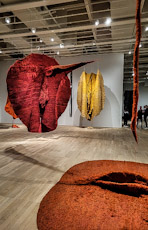
Cecilia has created two large sculptures which are hanging from the tall ceiling of the Tate Modern’s Turbine Hall until the 16th of April 2023. Each of these artworks consist of knotted strands of different materials, each of which is 27 metres long. They hang from circular metal structures looking to me rather like shredded laundry. Though they are undoubtedly deeply meaningful and attract the attention of many viewers, I felt the history underlying them was more interesting than their aesthetic qualities.

Abakanowicz

Elsewhere in the Tate Modern, we viewed an exhibition of the works of an artist, who knew how to write, but was creating during a time when the use of words had to chosen carefully to avoid being punished by the government. That artist Magdalena Abakanowicz (1930-2017), was born in Poland, where she created most of her art. After WW2, she studied painting and weaving the Academy of Plastic Arts in Warsaw. Her early works were created during a period when the Soviet-supported Stalinist regime in Poland imposed great restrictions on creative endeavours. During that harsh period, artists had to express any criticisms of the regime in a coded way in order to evade censorship. To some extent, this was necessary until Communist rule ended in Poland. In the mid-1950s, restrictions on art eased up a bit and experimentation became possible.

Magdalena moved from creating flattish conventional woven pieces to innovative three-dimensional artworks – woven sculptures of great originality. Photographs cannot do justice to these amazing creations. Videos can help the viewer appreciate the amazing way that these tapestries both fill and engulf space. However, the best way to see these works is to see them with your own eyes, which you can do at the Tate Modern until the 21st of May 2023. Included in the exhibitions are photographs of the lovely sculptures the artist created in later life and some videos of the artist talking about her work. There is also a film made in 1970 in which her tapestries are displayed on the sandy dunes of Poland’s Baltic coast. The artworks are suspended from poles and move gently in the sea breeze. It is clear from this film, which included scenes showing the fabric sculptures in galleries, that the artist seemed keen to have viewers explore them by touch as well as by vision. Sadly, and probably sensibly, the Tate forbids visitors from touching the lovely artworks.

Both the Vicuña and the Abakanowicz artworks use knotting and weaving to communicate ideas with the viewer. A window in one of the Abakanowicz exhibition rooms overlooks one of the quipu artworks. It intrigued me to see the juxtaposition of the works of the two fabric artists. Seeing these two exhibitions, one immediately after the other, made for a fascinating visit to the Tate Modern.

The stuff of dreams: an exhibition of Surrealist art

MOST NIGHTS I HAVE several dreams, all very vivid and in technicolour, often with a soundtrack. However, when I awake, I might only remember the outlines of one of them, if any at all. Much Surrealist art, often paintings, drawings, photographic images, or cinematographic sequences, depicts dreams. Whether these are the dreams that an artist has actually experienced, or they are creations that attempt to recreate the often weird ‘atmospheres’ that are produced in dreamers’ brains during slumber, it matters not because many of the Surrealist artists produce works that have the distorted realism typical of many dreams, which most viewers will recognise.

By Salvador Dali

Until the 29th of August 2022, there is an excellent exhibition of works created by Surrealist artists. Called “Beyond Borders”, it does not confine itself to well-known western artists such as Salvador Dali, De Chirico, Dorothea Tanning, Leonora Carrington, and so on, it introduces the viewer to Surrealists from as far afield as Japan, Latin America, and Africa, as well some pieces by artists who are new to me (and I suspect to many other visitors to the Tate). Most of the exhibits were paintings, graphic and cinematographic art; there were relatively few sculptures.   Well-known artists’ works are displayed alongside those of artists who are not widely recognised in this country, but deserve to be. Some might question the way that the curator (s) chose to group the artworks, but not being an art historian, this did not disturb me in the slightest. One new thing I learned from glancing at the informative notices amongst the exhibits is that Surrealist images were occasionally used by artists to convey politically subversive messaging. This reminds me of some strange (not necessarily Surreal) films that were made in parts of Europe when they were behind the so-called ‘Iron Curtain’: their oddity was supposed to disguise criticisms of the regime in power by baffling the strict but unimaginative censors.   

Overall, the exhibition provides a richly varied series of visual experiences. Wandering through the exhibition was a delight for my wife and me, and we shall try to visit the show again before it closes.

Tanning at the Tate Modern


One of the great features of possessing a Tate Card (an annual season ticket) is that one can enter (with or without a companion) the regular special exhibitions without paying extra for tickets, which tend to be quite costly. What I particularly like is that if an exhibition does not meet one’s expectations, one can spend a short time viewing without worrying about having wasted, maybe, as much as £18 per person.

Recently, I visited the much-hyped special exhibition of works by the French painter Pierre Bonnard (1867-1947) at the Tate Modern in London. Without the Tate Card, the two of us would have had to shell out £36 (about 30% of the cost of a Tate Card) to see what I thought was a tedious exhibition. 

I like Impressionist and Post-Impressionist art in general, but the Bonnard works left me cold (or at least lukewarm!). I cannot comment on the competence of their execution, but I found them short of visual excitement, almost boring compared with works of other artists painting during Bonnard’s lifetime. Consequently, we did not linger long in the exhibition. I may sound like a Philistine with my comments about the famous Bonnard, but it is only fair to write honestly about how the exhibition affected me. Incidentally, I noticed that many of the visitors at this show were more interested in chatting to each other than looking at Bonnard’s works. I saw one man sitting on a bench reading his newspaper rather than trying to enjoy Bonnard.

As we were still in the mood for looking at art, we decided to enter another special exhibition in the Tate Modern. Using our Tate Card, we saved up to £26 when we entered the exhibition of artworks by the American-born Dorothea Tanning (1910-2012). However, this is an exhibition that is well worth its entrance fee. Bonnard and Tanning’s working lives overlapped for a few years, but the American’s output made a far greater impression on me than the Frenchman’s. 

The exhibition at the Tate Modern commences with paintings from Tanning’s surrealist phase. Her execution and composition sets her amongst the best of the surrealist artists. Each painting has subtlety, excitement,  a sense of adventure, and creative freshness. As Tanning grew older, her works tended towards abstraction in an original way. In brief, Tanning was an artist whose visual language(s) really attract me. Her work has a freshness and impact that I found lacking in Bonnard.

In addition to paintings and designs for stage sets, the exhibition at the Tate includes some of rather weird soft fabric sculptures, which did not appeal to me quite as much as the framed works. However, they display another aspect of Tanning’s undoubted inventive talent.

I am glad we decided to visit the Bonnard, even though it disappointed me, because it got me to visit the Tate Modern after a long break (in India) and to discover the delights of Dorothea Tanning’s  artistic output.


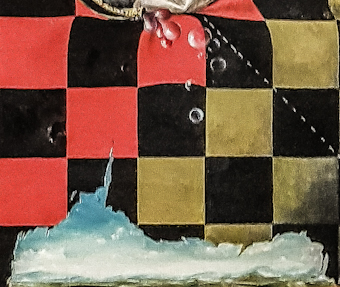
The photo is a detail of a work, “Endgame” , painted by Dorothea Tanning in 1944