Sunday morning stroll along the river from Hogarth’s grave to Hammersmith Bridge

EARLY ON SUNDAY mornings, we often drive to the riverside between Chiswick and Hammersmith. Usually, a parking place can be found on Chiswick’s picturesque Church Street close to the church of St Nicholas, in whose graveyard the artist William Hogarth is buried. This narrow lane leads from the Hogarth Roundabout to the riverside. Chiswick Mall follows the riverbank. On one side it is lined with elegant houses, some of which are several hundred years old. Between the Mall and the water’s edge, there is a chain of private gardens, across which you can catch glimpses of the river. All along this road, there are plenty of trees and flowers to be enjoyed.

Heading downstream, Chiswick Mall ends, and leads into the short Hammersmith Terrace, which is lined with houses where some famous printers and typographers once lived. Beyond Hammersmith Terrace, from which the river is hidden by houses, we regain views of the water as we walk along Upper Mall. This riverside promenade heads east and ends at a narrow passageway next to the Dove Pub, but before reaching it, we pass Kelmscott House, once a home of the artist and social reformer William Morris.

After passing the Dove pub, we enter Lower Mall. This riverside thoroughfare runs past Furnivall Gardens and then beneath Hammersmith Bridge, eventually reaching the Riverside Studious, where in addition to seeing one of the Daleks used in the “Dr Who” TV films, you can obtain refreshments in a pleasant café with a good view of the bridge. Sadly, this Victorian strucruer is in such a poor state of repair that only pedestrians and cyclists can cross it.

By walking between Hogarth’s grave and the Riverside Studios, you will have walked almost exactly one mile. We do this pleasant stroll quite often, and are never disappointed. Along the way, there are potential hazards including self-important joggers, who cannot understand that they are not the only people allowed to use the pathways, and cyclists, who seem to have the same arrogant approach as the joggers. That said, walking between St Nicholas and Hammersmith Bridge is a worthwhile and enjoyable experience, and along the way you will pass many places of historic interest, which are described in detail in my book “Beyond Marylebone and Mayfair: Exploring West London”.

Sailing on the pond on Sunday mornings

REGULARLY ON SUNDAY mornings, you will see a group of people standing at the northern edge of Kensington Gardens’ so-called Round Pond. It is not truly round, but squarish with rounded corners. This group of men and women will be seen standing close to trolleys on which there might be large model sailing boats. Often, the boats, which are radio-controlled, will be sailing in the pond’s water. These model boat enthusiasts are members of the London Model Yacht Club, which was founded in London in 1876.

Prior to 1876, there were other model boating clubs in London. In the 1820s, a group of model boat enthusiasts used to sail their craft in a pond in Green Park. This pond exists no more. In 1834, when the pond was made inaccessible by railings, the boaters moved to the Serpentine in Hyde Park. The first formal London Model Yacht Club was founded in 1846. Following disagreements, this club was disbanded in 1871. In 1876, the Model Yacht Sailing Association was established. It and another club, the London Model Yacht Club (Est. 1884) have been sailing on the Round Pond since the late 1880s. Before that, they had been using a pond in Hackney. For those interested in the detailed history of model boat sailing in London, please visit  www.lmyc.org.uk/history.

Next time you are in London at around 10.30 am on a Sunday morning, visit the Round Pond to watch the model boats ashore and on the water.

I have been gongoozling at London’s Little Venice today

I HAVE LEARNED a new word today. It can be used as both a noun and as a verb. The noun is ‘gongoozler’ and the verb is ‘to gongoozle’. I came across it used as a verb on an information panel by the south side of the water basin at Paddington’s Little Venice, where the Paddington Arm of the Grand Union Canal enlarges to become a pond, from which the Regents Canal commences.

The word gongoozle might possibly derive from two words of Lincolnshire dialect: ‘gawn’ and ‘gooze’. Both these words mean to stare or gape. A ‘gawn’ can also mean a small freight-carrying boat such as a canal narrowboat.

Gongoozling usually refers to watching boats. And this is what we did today as we ambled lazily along the Paddington Arm and the shore of Little Venice. With the sun shining and a pleasant air temperature (about 21 degrees Celsius), this was an enjoyable way of passing time on a Sunday morning.

On a very steep street

WE CAN EITHER travel into the centre of Funchal by bus or walk. From our guesthouse,  the steep Caminho do Monte drops steeply down to the city centre. Most of the way, this almost a mile long  thoroughfare has a gradient of 40 to 45 degrees. Walking down this slope does wonders for one’s lower leg muscles, especially the calves. The first time we descended it, my calf muscles began to go into tremor.

A Sacred Heart

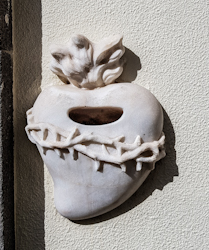
Our next attempt was altogether easier. On the way downhill, we passes a religious institution: a seminary called Colégio Missionário Sagrado Coração. Being Sunday, the gates were open for people who wanted to attend the Sunday mass. The institution is named in honour of the Sacred Heart. On either side of the door leading into the simply decorated chapel, there are car ings of hearts encircled by thorns.

There is a sculpture of a lion in the place’s large courtyard. Two busts of important religious figures stand near the chapel. One of them stsnds close to a terrace from which a wonderful view of part of Funchal can be enjoyed.

Although walking down the incredibly steep slope is slow, it is a wonderful way to observe deatails of life on the hills high above Funchal, and to meet locals standing on terraces over the road or in the entrances to their homes.

A Sunday afternoon in Hampstead and a bit of marketing

FROM CAMDEN TOWN, home of the busy Camden Lock and other popular markets, the 24-bus route more or less follows course of the now buried River Fleet, and ends at Hampstead’s South End Green. We disembarked at the Lawn Road bus stop on Fleet Road and walked the short distance to the Lawn Road Flats, also known as The Isokon. This building, inspired by the avant-garde housing projects in pre-WW2 Germany pioneered by the Bauhaus and similar institutions, was completed in 1934. A relatively bomb-proof structure, it was home to many people involved with cultural activities, including the author Agatha Christie (1890-1976), who wrote several of her novels whilst living there. The modernist block of flats still houses tenants. On Saturdays and Sundays, a small museum illustrating the history of this amazing edifice is open to the public. It contains photographs, information panels, and historical furniture items, all connected with the Isokon and its illustrious tenants. There is also a small, but well-stocked bookshop. It was here that I left several copies of my new book about Hampstead to be available for sale to visitors.

Bust of Agatha Christie at the Isokon Gallery in Hampstead

From the Isokon, we walked past South End Green and up Willow Road, which ascends ever more steeply as it approaches its northern end just near to Flask Walk and our next port of call, Burgh House. The house was constructed at the beginning of the 18th century. Here, we viewed the latest temporary exhibition, “John Cecil Stephenson: A Modernist in Hampstead”, which started at the beginning of April 2022. I will write more about this in a separate piece. Burgh House is home to a museum of the history of Hampstead and to a pleasant and popular café, which serves drinks and both hot and cold foods. The house also contains a small bookshop, well-stocked with a variety of books about Hampstead and artists associated with the place. I left several copies of my book about Hampstead to be sold there.

After spending a relaxing time in the Burgh House café, we wandered along Flask Walk, passing Keith Fawkes antiquarian bookshop, where copies of my book are on sale. Then, we walked onwards along the High Street and Perrins Court, where my father and I used to eat lunches at the Villa Bianca Italian restaurant. Reaching Heath Street, we passed the The Village Newsagent, which stocks my book (can you spot the theme emerging here?), and then entered Church Row. Halfway along it stands St John’s Parish Church.

The neo-classical church was completed in 1747. Twenty-three years before this, the “St Johns Passion” by Johann Sebastian Bach (1685-1750) was first performed in the Church of St Nicholas in Leipzig. At 5pm on Sunday the 3rd of April (2022), we listened to a good performance of this wonderful piece of religious music in the Church of St John in Church Row. With a small choir, a competent orchestra, and excellent soloists, the acoustics were excellent. Very thoughtfully, foam rubber cushions are provided for improving the comfort of the seating in the wooden pews. I was pleased to note that the current (April) issue of the parish newsletter includes a note about my new book.

After watching a colourful sunset, we took a bus to Paddington, where we enjoyed a tasty meal at the Malaysian Tuk Din restaurant not far from the station.

My book “Beneath a Wide Sky: Hampstead and its Environs” is available in Hampstead at the following locations:

THE CAMDEN ART CENTRE (Arkwright Road)

KEITH FAWKES (Flask Walk)

ISOKON GALLERY (Lawn Road)

THE VILLAGE NEWSAGENT (Heath Street)

BURGH HOUSE (New End Square, near Flask Walk)

The book (and Kindle) is also available from Amazon (https://www.amazon.co.uk/dp/B09R2WRK92)