DURING THE SECOND half of the nineteenth century, British tea planters cleared away great swathes of forest from the hills around Munnar in what is now Kerala. They used the cleared areas to grow tea bushes. To achieve this transformation and to maintain and harvest the tea gardens Indian workers, many of them Tamil, were brought into the area. Amongst them, there were some who had become Christians, most of them Catholics.
Outside Mount Carmel church in Munnar
Anticipating the Christian workers’ needs for practising their religion, Spanish missionaries from the Archdiocese of Verapoly climbed up the treacherous paths to Munnar, risking attacks by tigers, wild elephants, leeches, etc. They were of the Carmelite Order.
The first of these missionaries was Father Alfonso (1854-1916) who was born in the Spanish Basque country. He arrived in Verapoly (in Kochi on the Malabar Coast) in 1883. When he first went up to Munnar in 1897, there were no roads linking the place with the plains below it.
To cut a long story short, Father Alfonso managed to acquire a small plot of land in Munnar from the tea company that owned all of the land in the area. There, he built a church. It was a basic affair with a coconut leaf roof. Later, this was replaced by a more substantial edifice. Between 1934 and 1938, a new church replaced the second one, and that, with later modifications, is what can be seen standing proudly above Munnar town’s bazaar area. Father Alfonso died of malaria while visiting Munnar, and his grave is in the existing Mount Carmel church in Munnar.
Alfonso and his fellow missionaries did not come up to the hills merely to supply the Christian workers with their spiritual requirements. While visiting their ‘flock’, which was scattered amongst difficult to reach settlements, they managed to convert many of the other labourers to become god-fearing Roman Catholics.
I have distilled this information from a fascinating book I bought in Munnar: “Mother Church of the High Ranges. Munnar Church. First Missionary Accounts”, which contains extracts of letters written by the early Spanish missionaries to a Spanish Catholic journal.
What is notable amongst these accounts is the missionaries’ antagonism to the mainly British Protestants in the Munnar area. They also felt that the workers were being exploited, and that all of their readers should remember this while enjoying cups of tea.
THE BATTLE OF Portobello was fought between the British Navy and the Spanish in November 1739. It was an event during the War of the Austrian Succession. The battle’s aim was to capture the port of Portobello in Panama from the Spanish. The British were victorious.
I have been walking along Portobello Road frequently for over a quarter a century. Each time, I have passed a series of neighbouring shops collectively known as Admiral Vernon Antique Market. I thought it was an odd name until today when I noticed that it is close to an alley called Vernon Yard. Then, the penny dropped, and I began thinking about the choice of the shop’s name – an admiral on Portobello Road.
Admiral Edward Vernon (1684-1757) was born in London. He joined the Royal Navy in 1700, aged 12, and rose through the ranks. One of his many achievements was the creation of the name ‘grog’ for the commonly consumed drink consisting of rum diluted with water. Also, he made improvements to the methods of naval manoeuvres and the welfare of sailors. Another of his claims to fame was that along with Lieutenant-General Thomas Wentworth (c1693–1747) he led the British forces that captured Portobello.
Knowing this makes sense of the name of the antique shop and the name Vernon Yard. The shop and the dreary little alley are not the most magnificent of memorials to Edward Vernon. There is a more elegant one in Westminster Abbey. The most impressive item commemorating the admiral is the estate of Mount Vernon in Virginia (USA), which was once owned by George Washington’s family. It was named after Edward Vernon because one of Washington’s brothers, Lawrence (died 1752), had been under Vernon’s command during the capture of Portobello.
THE CHURCH OF St Mary’s in Cornwall’s western town of Penzance overlooks the harbour and much of the town. Its site has been a place of worship since at least 1321, when there was a chapel on the spot. Between the 2nd and 4th of August 1595, Penzance, along with Newlyn, Mousehole, and Paul, was sacked by Spanish forces under the command of Carlos de Amésquita. After causing much damage, Carlos celebrated mass in the chapel of St Mary at Penzance, an edifice he had spared from destruction.
The chapel was enlarged in 1662-1672 and then again in 1782. Until 1871, when a new parish was created, the enlarged chapel had been a ‘chapel of ease’ for the parish of nearby Madron. Reverend Thomas Vyvyan began replacing the old chapel with a new church in 1832. Its architect was Charles Hutchens (c1781-1834), of Torpoint near Plymouth. In August 1832, the old chapel was demolished, and worshippers used a temporary wooden building whilst the new church was being constructed (https://historicengland.org.uk/listing/the-list/list-entry/1220507). The new church, gothic revival in style, was ready for use in November 1835.
The church’s interior was damaged by fire caused by an arsonist in 1985 but was restored the following year. Being built of granite, the church looks older than it is at first sight. However, the design of its windows is typical of gothic revival. Inside the church, there are features that exemplify the very best of the gothic revival style, which reminded me of that masterpiece of the style, Strawberry Hill at Twickenham (near London). Having been restored after the fire, they are looking in superb condition.
I am glad that I climbed the several staircases that ascend the steep slope from the seashore near Penzance’s art-deco Jubilee Bathing Pool to the church. For those who prefer not to climb, the church can also be accessed by walking down Chapel Street from the central shopping area of Penzance. However, after seeing the church you will have to climb back up to where you started, but on the way, you might pause to look at the Chapel Street Methodist Church, with its odd but harmonious mixture of architectural styles, built in the mid-19th century. Or, if you have had enough of ecclesiastical architecture, you could drop into The Turks Head Inn for some refreshment spiritual or otherwise. The pub’s name reflects the fact that Cornwall used to be raided by Moorish pirates, who captured some of the locals and made them enter slavery, but do not let that put you off entering the place. Oh, and whilst you are on Chapel Street, do not miss seeing the unusual Egyptian House near the top of the thoroughfare.
THE BATTLE OF PORTOBELLO (or ‘Porto Bello’) was fought between the forces of Britain and Spain on the 20th of November 1739. The British were aiming to capture the settlement of Porto Bello in Panama during the early stages of the War of Austrian Succession (1740-1748). The victorious British naval force of only six heavily armed vessels was commanded by Admiral Edward Vernon (1684-1757). This gentleman has been accredited for coining the word ‘grog’, meaning rum diluted with water.
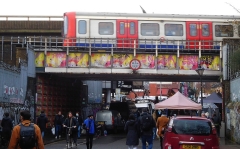
Rail bridge over Portobello Road
A map of Kensington drawn in about 1810 marks a ‘Portobello Farm’ next to what is now Portobello Road. The owner of the farm is said to have named his farm thus to honour Admiral Vernon’s capture of the Panamanian town of Porto Bello. The road or track running past the farm was called ‘Portobello Lane’. In the early 19th century, the farm stood alone amongst open fields where cows, pigs, and sheep grazed.
A detailed map surveyed in 1865 shows the farm located near a slight bend in Portobello Lane, about 270 yards north of a bridge carrying the railway across the lane, 280 yards east of ‘Notting Hill Station’ (now Ladbroke Grove Station). Almost across the road from the farm, there is marked ‘Notting Barn Lodge’. A lane led west from there to a larger building marked ‘Notting Barn’.
Notting Barn was the manor house of the Manor of Knotting Barns. Writing in 1820, Thomas Faulkner, author of “History and Antiquities of Kensington”, noted:
“In the midst of these meadows stands the Manor House of Knotting Barns, now occupied by William Smith esq. of Hammersmith, it is an ancient brick building, surrounded by spacious barns, and outhouses; the road to Kensal Green passes through the farmyard.”
The manor was part of the property of the De Veres, as is evidenced by a document dated 1476. In that year, it was seized by the Crown. In 1543, when the manor was owned by Robert Wright, it was sold to King Henry VIII. Then, through the centuries the manor changed hands frequently. The manor gave its name to the area now known as ‘Notting Hill’. The name of the manor and the present district might well have Saxon origins. Florence Gladstone, writing in 1924 (www.theundergroundmap.com/article.html?id=56157&annum=3000), suggested that a:
“…Saxon family, the Cnot-tingas, or ” sons of Cnotta,” may have made a clearing for themselves in the denser wood to the north. No less an authority than Dr. Walter W. Skeat suggests this Saxon solution for the name of Notting Hill. Other writers have thought that the encamp-ment was founded by followers of King Knut. Whether Saxon or Danish in its origin the little colony seems to have been entirely wiped out before the Norman Conquest; nothing but the name remaining to testify to its former existence. The popular belief that Notting Hill owes its name to the nut bushes which grew upon its slopes is a pleasant, but untenable, tradition. The name occurs in the Patent Rolls for A.D. 1361. There it is ‘Knottynghull’, proving that the ‘k’ is original as is also the double ‘t’ .”
By 1897, both Notting Barn and Portobello Farm no longer appeared on the map and Portobello Lane had been renamed ‘Portobello Road’. Notting Barn Manor House stood approximately where today St Marks Road and Bassett Road meet. Where the farm had once stood, there were residential streets that still exist, including Bevington, Blagrove and Raddington Roads. Across Portobello Road almost opposite the site of the farm there was a large building labelled ‘Franciscan Convent’ and opposite it just north of the former farm there was another large building, which is unlabelled on the map but was ‘St Joseph’s Home for the Elderly’.
St Josephs was founded by a Roman Catholic order, The Little Sisters of the Poor (https://ezitis.myzen.co.uk/stjosephshome.html). They bought Portobello Farm on the 7th of June 1865. They resided nearby whilst the farm buildings were demolished and their new convent and home for the elderly was being built. The home for the elderly opened in 1869. The home was finally closed in 1978. After being demolished in the early 1980s, a new housing estate, St Josephs Close, was built in 1986 with its entrance on Bevington Road. The old convent wall that runs along the east side of Portobello Road has become an open-air public art gallery.
Across the road and almost opposite the former farm and its successor, St Josephs, stands a formidable looking building that currently houses a Spanish school, the Vicente Cañada Blanch Spanish School. This was originally occupied by nuns of the Third Order of St. Francis, whose convent had been founded in 1857. The building was designed by Henry Clutton (1819-1893) and built in 1862, but it was modified and enlarged later.
Nothing remains of either the manor house or Portobello Farm. However, the slight bend in Portobello Road near the Spanish school is as it was when the farm existed as can be seen on detailed maps that marked the farm. The entrance to the farm was on a stretch of Portobello Road north of the elevated Westway (the M40 motorway). On Fridays and Saturdays, this section of the road becomes an open-air ‘flea market’, a scruffy extension of the main Portobello Road market south of the motorway and railway bridges that have been built close to each other where they traverse the busy market precinct.
I worked in Golborne Road for several years, near the streets that now cover the former Portobello Farm. Many of my patients lived in those streets. Most of them are probably unaware of the erstwhile existence of the farm, as was I until I researched this short essay.



 yamey
yamey 