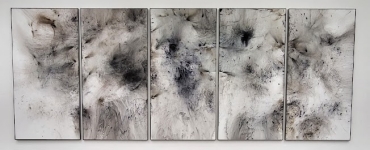
CAI GUO-QIANG IS an artist who was born in Quanzhou, Fujian Province, China, in 1957. Many of his artworks involve the extravagant and clever use of explosive materials, as can be seen in a documentary film being screened at the White Cube Gallery in Bermondsey (south London) until 9 September 2025. The film is accompanied by a collection of the artist’s images created on canvas, glass, and mirrors. Pleasing to the eye, these images have been created by an unusual method.
Guo-Qiang uses gunpowder, and ignites it, to assist him produce his pictures. The gallery’s website outlined his technique:
“… each composition is first mapped by sprinkling the powder, then covered and weighted before ignition, so that the blast disperses, recomposes and fuses matter into image.”
The unpredictability of the explosive material adds an interesting chance element to the finished product, but despite this, the composition was initially planned by the artist. In some of the works on display, not only was gunpowder placed on the base (i.e., paper, glass, etc) but also pigment powders. The explosions caused by igniting the gunpowder cause interesting spreading and scattering of the pigment.
The artist began experimenting with using explosives in his works on materials such as canvas and paper in the early 1980s in Quanzhou. Occasionally, the work in progress would ignite, and the fire had to be smothered to save the artwork. The works on display at White Cube were created after 2015, mainly in the 2020s. By now, he has refined his technique so that wholescale conflagration does not happen. However, as a gallery assistant told us, if you look carefully at some of the works, small burn marks can be found here and there.
Apart from being created in an intriguing way, I found the pictures being displayed in the gallery to be both attractive and beautiful.
GENERALLY, I AM NOT A FAN of food courts. Many of them in England are merely a collection of branches of well-known fast-food chains (such as KFC, McDonalds, Pizza Hut, Subway, and Burger King). A notable exception to this is a food court in Trinity Market in Hull, which visited in April 2025. On 9 May 2025, we visited Peckham in south London, having just viewed an exhibition in nearby Camberwell.
While strolling along Peckham’s busy Rye Lane, we came across the entrance to Rye Lane Market. After entering it and walking along an arcade lined with shops, we arrived in a large, covered area filled with food stalls: a food court. Unlike many other food courts, the food outlets were not branches of well-known chains. Instead, there were stalls catering to the multi-ethnic local population. We sat down at a table that was surrounded by stalls serving Mexican, Carribean, Colombian, and other many cuisines. We ordered the set lunch offered by a small Peruvian kitchen. As first courses, we ate cold boiled potatoes dressed in a red pepper flavoured mayonnaise and a delicately flavoured beef soup. These were followed by a fried rice dish containing chicken, pork, and smoked sausages, and another consisting of a whole fish beautifully fried, served with lentils, rice, and a salad containing onions, lime juice, coriander, and tomatoes. Freshly prepared and reasonably priced, everything was delicious.
There were more stalls serving food from other countries, mostly Latin American and African. One stall offered a range of vegetarian Indian dishes, including a snack, dabeli, that is popular in Kachchh (once an independent state, and now part of Gujarat). The lady working there told us that she is from Rajkot in Gujarat. When we mentioned to her that we have always thought that dabeli is a dish from Kachchh, she said it was Gujarati, but added that:
“It does not matter because the people of Kachchh are our brothers”.
Our first visit to Rye Lane Market’s food court has whet our appetites for further visits. There are so many enticing dishes on offer that I feel sure that we will venture across the Thames more often to sample the fare offered in that food court.
WORDS ARE INADEQUATE to describe the magnificent display of colours that can be seen in the Isabella Plantation at Richmond Park at the end of April and the start of May. I have written about this lovely garden many times before (e.g. https://adam-yamey-writes.com/2021/05/21/a-floral-fireworks-display/) and outlined its history, Do not take it from me that this display of flowering plants (including azaleas, rhododendrons, camelias, bluebells, and much more) is unbelievably beautiful, but hurry there and see it for yourself!
THE DAVID LEAN cinema, where we watched a superb film called “Coming to America” (made in 1988), is within a complex known as the Croydon Clocktower. In the heart of Croydon, this cultural centre is housed in what was originally constructed as the district’s Town Hall.
The Town Hall is a magnificent – exuberant – example of Victorian brickwork. It was constructed to the designs of a local architect, Charles Henman, and inaugurated by the Prince of Wales in 1896. There is a large statue of his mother, Queen Victoria, outside the façade on Katherine Street.
Until the 1980s, the enormous edifice was used for local government purposes. In the late 1980s, and early 1990s, the interior was renovated. Areas that were no longer needed for council business were repurposed as a public library, a café, a museum, and the David Lean cinema. A large room, which retains its original interior décor, the Braithwaite Hall, continues to be used for concerts, theatrical shows, and other public functions. It looked to me that the inside of the building had been hollowed out to create a spacious central atrium with a glass roof, which can be overlooked from galleries surrounding it on each floor. The result is pleasing to the eye. From the outside of the building, you would not expect to see this kind of atrium. The Town Hall complex is now known as the Croydon Clocktower, the name referring to the building’s high brick clock tower.
The film we watched in the small David Lean cinema was wacky but wonderful – a complete contrast to an incredibly slow-moving Taiwanese film, “Days”, which we watched a few days later.
FIRELEI BÁEZ WAS born in the Dominican Republic in 1981. She studied art in the USA, where she now lives and works. The South London Gallery (‘SLG’) in South London’s Peckham district is hosting her first solo exhibition in the UK. The show continues until the 8th of September 2024. The exhibition is distributed between the main gallery building and a converted fire station, which is a few yards away.
The large exhibition space in the main building is occupied by a wonderful immersive installation. The viewer walks beneath a huge blue canopy with multiple small oval holes suspended from the ceiling. Light filters through the material of the canopy producing the effect of sunlight dappled by leaves of trees, creating the feeling that one is walking in a forest. Recordings of bird sounds enhance this illusion. On the walls of the room there are large, boldly coloured aluminium cut outs, representing silhouettes of Ciguapas – figures from the folklore of the Dominican Republic.
In the converted former fire station, there are yet more works by Firelei Baez. On the ground floor, there are huge floor-to-ceiling, extremely colourful abstract paintings. The artist’s idea is to immerse the viewer in an excitingly vibrant sea of colours. The first floor has two galleries. In one, there are large, richly coloured silhouettes depicting Ciguapas. In the other, there are many pages from books, which the artist has transformed by overlaying parts of each of them with paint or ink. In doing this, she provides the viewer with alternative versions of what was originally on the page before she added her artwork. Although libraries and book-collectors might well object to extracting pages from books and then painting over them, the effects Firelei produced are both witty and attractive. In addition, they make you think twice about what was originally on the page.
For a north Londoner like me, Peckham seems to be a distant part of the world, but actually it is not to difficult to reach it by public transport. And many of the exhibitions we have viewed at SLG, including the one described above, makes the trip to Peckham well worth making.
ONE BRANCH OF London’s recently opened Elizabeth Line terminates at Abbey Wood, which is in the southeastern Borough of Bexley. A few minutes’ walk away from the station brings one to a large park called Abbey Wood, which I visited for the first time yesterday, the 24th of July 2024. The park contains the ruins of a 12th century Augustinian abbey – Lesnes Abbey.
The abbey was founded in 1178 by Richard de Luci (1089-1179), Lord of the Manor of Lesnes and Chief Justiciar of England (something analogous to a modern ‘Prime Minister’). It is believed that he founded the abbey as a repentance for his sins and also for those related to the murder of Thomas a Becket in Canterbury cathedral in 1174. Unfortunately, Lesnes never became established as one of Engand’s greater monastic institutions. This might have been due to the large amounts of money it had to expend on draining its pastures, which were regularly flooded by the waters of the nearby River Thames. In addition, the abbey developed a bad reputation because of its members disorderliness, which included many instances of immoral behaviour. Despite help from outside sources, the abbey continued to decline until it was dissolved (in 1525), along with many other religious establishments, by King Henry VIII.
After it was closed, the land and remains of the Abbey passed through various hands until it was bequeathed to Christ’s Hospital School in 1688. Between that date and 1933, the land was used as a farm by the school. From 1909 to 1913, the Woolwich and District Antiquarian Society carried out extensive archaeological investigations of the site of the abbey. One of their many discoveries was a stone effigy of a knight, who could be identified as being part of the de Luci family. It is now stored in the Victoria and Albert Museum in South Kensington. From 1939 to 1954, the new owners of the land, the London County Council, carried out further excavations. After that, in 1956, the ruins were made safe for visitors, and these can be viewed today. In 1986, the park and the ruins were transferred to the care of Bexley Borough Council, who have made the place very ‘user-friendly’ with excellent paths, helpful direction signs, information panels, and a lovely visitors’ centre with a small café.
The ruins are quite extensive and seen from a hillock above them, one can clearly see the ground plan of the abbey. Most of the ruins are low in stature, but a few walls of over 6 feet high are still standing. In what was once the abbey’s church, there are several carved pillar bases and other fragments of the original structure. Nothing apart from its ground plan remains of the cloisters, which were filled with picnickers and children when I visited. All in all, the ruins of Lesnes Abbey compare well with others I have seen during my travels in England and Wales. But they are not as spectacular as, say, Tintern Abbey in Wales and Fountains in Yorkshire. However, unlike the two mentioned, which take many hours to reach from London, Lesnes is a mere 26 minutes’ train ride from Bond Street.
I had not known of the existence of the ruins of Lesnes Abbey until a few days’ ago when I looked up mulberry trees on the Internet. One of the examples of mulberry trees that came up on the screen of my computer was that which is growing next to the ruins of Lesnes Abbey. According to the excellent guidebook to the abbey by Chris Hawkins, which I bought at the café, the mulberry at Lesnes was probably planted in around 1720. It was during this period that the monarch, hoping to establish an English silk industry, imported many mulberry trees to England. Unfortunately, the enterprise was doomed to failure because mulberry trees of the wrong variety were imported – the kind whose leaves were not suitable for feeding silkworms. The ancient mulberry tree at Lesnes is flourishing but has grown in such a way that its huge twisting trunk must be supported by steel struts.
I can strongly recommend a trip to Abbey Wood to view the ruined abbey. Having seen it, I am surprised that this fascinating site it is not better known outside the confines of southeast London.
WHENEVER WE VISIT the Newport Street Gallery in London’s Lambeth district, we pass the entrance to a small garden. Today (19th of June 2024), we decided to enter this little park – a peaceful haven only a few hundred yards south of Lambeth Bridge. It is called Old Paradise Gardens. Irregular in shape, it has one long main path leading from its northern entrance in a southeasterly direction towards its southern entrance, close to a busy railway line. Near the northern entrance, there is a small fenced off area, which is being developed as a community garden in collaboration with the nearby Garden Museum (next door to Lambeth Palace). Not being botanically knowledgeable, I cannot describe the wide variety of plants growing in the Gardens, but I can say that they make for an extremely pleasant green environment.
We saw a few worn, illegible tombstones propped up against one of the garden’s walls. These provide an important clue about the history of the Gardens. The place was:
“…previously a burial ground provided to the parish by the Archbishop of Canterbury in 1703. It was extended in 1816, but by 1853 was full and closed to burial. In 1880 it was decided to convert it into a public garden, which opened in 1884. Gravestones were moved to boundary walls … The recreation ground was extended in 1929 and by the 1970s was largely asphalted. Since re-landscaped, it has grassy mounds, a water feature, with shrubs and spring bulbs planted. In 2013 refurbishment was completed and the park was renamed Old Paradise Gardens. In 2023 a new community garden was introduced in the southeast corner designed by Dan Pearson Studios under the leadership of The Garden Museum nearby.” (https://londongardenstrust.org/conservation/inventory/site-record/?ID=LAM026&sitename=Old+Paradise+Gardens)
When we visited the Gardens at about 11 am today, we saw few other people. Probably, at weekends and after school is over, this delightful little open space becomes busier. It is always lovely to ‘discover’ yet another of London’s numerous green spaces – about 40% of London’s area is occupied by public green spaces.
If you happen to be in need of refreshment whilst visiting the Old Paradise Gardens, head for the elegant café attached to the nearby Garden Museum.
BERMONDSEY STREET IS only about 500 yards in length, and about 200 yards of it runs under the railway tracks and has no shops, eateries, or any other outlet open to the public. The remaining 300 yards of this thoroughfare is a delight to visit. It is lined with numerous cafés, restaurants, and a couple of pubs. In addition, there is a good picture framer, several art galleries, some fashionable shops, a church, and a museum of fashion and textiles. There are also a couple of open spaces – small parks. Apart from the magnificent Caphe House – a superb Vietnamese restaurant, one of my favourite places on this street is London Glassblowing (see: https://londonglassblowing.co.uk/).
London Glassblowing is a gallery dedicated to the display and sales of artistic glasswork creations. It was founded by Peter Layton, who was born in 1937 in Prague (then in Czechoslovakia). Fleeing the Nazis, his family moved to Britain in 1939. They settled in Bradford near his grandfather, a pathologist who was a colleague of Sigmund Freud. Initially specialising in ceramics, Peter went to teach at the University of Iowa in the USA. While he was there, Peter soon became fascinated with glass and studied in the institution’s glass blowing programme. After his return to the UK, where artistic glass blowing was not yet highly developed or even highly regarded, he opened the London Glassblowing Workshop in Rotherhithe in 1976. After moving to several different locations, it arrived at its present home on Bermondsey Street.
In addition to displaying fine works of art made with glass, visitors to the gallery can watch the glass blowers at work. This is fascinating to see. When we visited yesterday, the 16th of February 2024, there was a group of young children watching the glass blowers at work. A gentleman was patiently explaining what the glass blowers were doing and how they were achieving the exquisite multicoloured vase they were making. It was only when I got home that I realised that the person explaining was none other than Peter Layton.



 yamey
yamey 