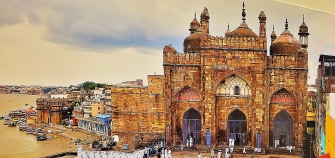
MOST PEOPLE ASSOCIATE Varanasi (Benares) with Hindu temples and practices. However, the city is important to other religions, notably Islam.
The largest mosque in Varanasi
Recently, we viewed an exhibition called “Mughal Banaras” at SOAS Gallery in London. It was a collection of excellent photographs taken by architect and photographer Jateen Lad who collaborated with historian Malavika Kasturi.
In a Hindu math (monastery) which existed during the time when the city was under Mughal rule, there is a collection of Mughal firmans (official documents) on display, including one written by Dara Shikoh, who was murdered by his brother Aurangzeb).
We were fortunate to have met Jateen at the exhibition, and he showed us around. His superb commentary brought the pictures to life, and discussed the historical importance of, and the current circumstances of the Muslims in the city.
FROM AFAR IT LOOKS like a small red and black oriental rug, but as you approach, it is not what it seemed at first sight. This artwork by Hadi Rahnaward, who was born in Afghanistan in 1986 and now resides in Belgium, is made with matches, glue, and other materials. The matches used are of two sorts. Some are tipped with black material, and the others with red.
The matches have been glued to a base so that each one of them is vertical and standing with its tip pointing upwards. They have been placed close to each other in such a way that their tips form a mosaic resembling a patterned oriental carpet or rug. The artist made this incredibly intricate creation in 2023. It is one of a collection of often intriguing artworks by young artists from south Asia and Afghanistan being exhibited at the SOAS Gallery (formerly known as the ‘Brunei Gallery’) in London’s Bloomsbury until 21 June 2025.
One of the other exhibits that intrigued me is an embroidery by Varunika Saraf (born 1981), who lives and works in Hyderabad (India). Called “The Longest Revolution” and made in 2024, this embroidery depicts many features of Indian women’s struggle for basic rights and parity with men. This busy looking artwork depicts many aspects of women’s political struggles, and in places reminds the viewer of some parts of the Indian Constitution that appear to have been considered less relevant than previously by some in India during the last few years. Even if the political content of this piece is ignored, it is an eye-catching work of art.
A FEW WEEKS AGO, we viewed a wonderful exhibition of contemporary quilt making at Swiss Cottage Library (see: https://adam-yamey-writes.com/2023/07/15/quilts-in-a-wonderfully-designed-library/ ). These quilts were made with both recycled bits of material and/or textiles specially bought for use in their manufacture. Although some of the works on display could be used as rugs or coverings, many of them were designed as non-functional artworks for display. Today (1st of August 2023), we visited the Brunei Gallery in London’s Bloomsbury. Our intention was to see an exhibition of paintings and drawings from the south of India. However, when we entered the place, we discovered that in addition to what we had come to see, there was another exhibition, which we did not know about. This is the rather intriguingly named “Japanese Aesthetics of Recycling”, which is on until the 23rd of September 2023. With a name like that, we could not resist taking a look at what was on show.
The exhibition has a fine collection of exhibits demonstrating the Japanese tradition of recycling old materials to create new objects. In a country where raw materials were highly valued, it made a lot of sense not to waste them, but to re-use them. We saw many examples of ‘Boro’ textiles. These are items made by fashioning worn clothing and waste fabrics to create another usable textile. Often, a large piece of used material with damage (e.g., holes) was made usable by patching it with scraps of waste material. Both quilting and Boro involve sewing pieces of material together. Unlike quilting, which uses scraps of material to create a brand-new entity, Boro uses scraps to restore worn textiles to make them usable again. There were also examples of ‘Washi’ on display. This is handmade paper concocted from already used sheets of paper (for example from discarded account books). The Washi was made waterproof by painting it with persimmon paste. Washi paper was used for many purposes including wrapping valuable clothing, floor coverings, room dividers, making bags, and more. For example, there was a conical hat made in leather and lined with waxed recycled Washi paper. In addition to these recycling techniques, there were several others. One which caught my attention was ‘Sakiori’, which in many ways resembles the North American and European rag weaving technique.
The exhibition was not only fascinating because of the range of recycling techniques exemplified, but also because many of the items made from the recycled materials were aesthetically pleasing. The exhibits are beautifully displayed, and the accompanying labels are interesting and informative. Whether you are interested in Japan or recycling or both, it is well worth visiting the Brunei Gallery to see this show.



 yamey
yamey 