
A statue iņ Ahmedabad and a friend in Bangalore

I FIRST CAME ACROSS the name Indulal Yagnik when I was researching my book (“Indian Freedom Fighters in London:1905-1910”) about the less well-known Indian Freedom Fighter, Shyamji Krishnavarma (1857-1930). Indulal Yagnik (1892-1972), who was a writer and political activist, published a biography of Krishnavarma in 1950. Yagnik wrote many other things, amongst which were the first 30 chapters of Gandhi’s autobiography that were dictated to him by the Mahatma whilst they were both imprisoned in Yeravada jail.


Between 1915 and 1947,  Yagnik was active in the Indian struggle for freedom. Amongst his many activities,  he carried the first tricolour Indian flag from Germany to India. This flag had been designed by Madam Cama, a leading proponent of Indian independence, and had been displayed to the world (for the first time) at a meeting of socialists in Stuttgart (Germany). Yagnik was imprisoned by the British at least twice on account of his anti-British activities and publications.


After Independence, in 1956, Yagnik led the Mahagujarat Movement for a separate Gujarat state, which led to the separation of Gujarat from Maharahtra that occurred in 1960.
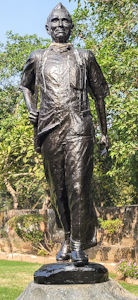
 

Close to the east end of the Nehru Bridge in Ahmedabad, the city in which Yagnik died, there is a small, well-maintained  park in  which there is a fine statue of Indulal Yagnik. It was created by the late Kantibai B Patel, who also made many other statues of well-known Gujarati people, including many of Mahatma Gandhi.  The statue of Yagnik depicts the man striding forward, his shirt pocket filled with a spectacles case and a pen.


I was keen to view the statue not only because I had read Yagnik’s biography of Krishnavarma  but also for another reason. His nephew,  who lives in Bangalore,  is a good friend, whom we got to know because his wife is related to members of my wife’s wider family.


Even if you do not have the sort of ‘connection’ we have with Indulal Yagnik’s nephew, the statue is worth seeing because it is a good piece of sculpture.
Exhibits in an exhibition at a famous landmark in Kolkata

FROM AFAR, THE VICTORIA Memorial in Kolkata looks almost magical. However, inside it is pompous and overbearing (and not particularly beautiful), just as the British must have seemed to many Indians before their country was freed from the British Empire.


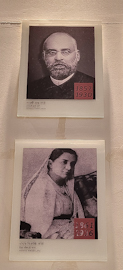
Visitors to the Memorial can explore the ground floor and the one above it. Much of the upper floor is dedicated to an exhibition of photographs and facsimiles of documents relating to the exploits of those who fought to make India independent.  Naturally, better known individuals such as Gandhi, the Nehrus, and Subhas Chandra Bose figure in this show. But they are outnumbered by lesser known freedom fighters. One of these is Shyamji Krishnavarma (1857-1930).  Many of you reading this might well be wondering why this man deserved to be includefacsimilesexhibition.


Like several other freedom fighters,  Krishnavarma went to London to become a barrister.  He returned to India and made a fortune working for the rulers of some of the Princely States.  Then, he returned to London. In 1905, when Bengal was partitioned  he conducted his own campaign against British rule in India.


Above: Krishnavarma,  below: Madame Cams

Amongst the many things he did in addition to starting an anti-British newspaper, Krishnavarma purchased a house in Highgate (northwest London), which he converted into a hostel and meeting place for Indians studying  in London. It was named India House. Soon, it became a meeting place for Indians who wanted to rid India of the British. I have read that amongst the revolutionary activities carried out in India House was experimentation in bomb making. Amongst those associated with India House was VD Savarkar (1883-1966). In 1910, he was arrested by the British and spent several terrible years in the Cellular Prison in Port Blair (Andaman Islands). Amongst Savarkar’s many achievements was the development of Hindutva.


In 1907, Krishnavarma migrated to Paris. Later, until his death  he resided in Geneva. Unlike Gandhi and his followers, Krishnavarma and his colleagues (including Madame Cama) did not believe that India could become free by relying only on non-violent protest.


I first became interested in Krishnavarma when visiting Mandvi in Kutch (part of Gujarat). Shyamji was born in Mandvi, and his ashes are kept at a memorial centre a few miles outside the town. The centre includes a full size replica of Highate’s former India House. Seeing this building standing on its own in a flat sandy semi-desert landscape intrigued me, and got me interested in Krishnavarma.  I became so fascinated that I wrote a book about Krishnavarma and what happened in and around his India House. The book is called “Indian Freedom Fighters in London (1905-1910)”, and is available from Amazon (e.g., https://www.amazon.co.uk/INDIAN-FREEDOM-FIGHTERS-LONDON-1905-1910/dp/0244270716/ ).


The exhibition at the Victoria Memorial includes several photographs and documents relating to Krishnavarma and his India House. I had seen some of these elsewhere, but a few were new to me.


Although the Victoria Memorial is not one if my favourite things in Kolkata,  I  am pleased we visited if only because there were exhibits related to Krishnavarma.  In addition,  I was pleased to see several paintings by Thomas Daniell (1749-1840) and one by an artist I like very much : John Zoffany (1733-1810). Both of these men spent several years living and working in India.

The house in the desert and a fighter for the independence of India

A NARROW ROAD LEADS away from the town of Mandvi (in Kachchh, a part of Gujarat) into an arid sandy area close to the seacoast. Scrubby bushes populate most of this flat terrain. After a few miles, a red building can be seen on the horizon. As you approach it, you can see that it resembles no other in the surrounding area, or, for that manner, in any other part of India. However, if you are a Londoner, it would seem familiar, although quite incongruous.

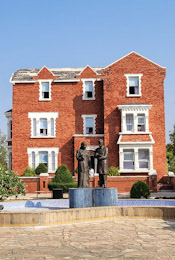
Replica of India House near Mandvi, Kachchh

The house in the desert is an accurate replica of a typical Victorian house, such as can be found in North London. In fact, it is a full-size copy of number 65 Cromwell Avenue in London’s Highgate area. The reproduction near Mandvi was built as part of a complex to commemorate Shyamji Krishnavarma (1857-1930), who was born in the centre of Mandvi.

Krishnavarma, who became a barrister and worked in various Princely States, moved to London, where he lived until about 1907. He moved to Paris, and then to Geneva, where he and his wife lived until they died.

In London, Krishnavarma lived opposite Highgate Woods. He invested wisely, and became interested in the works of English men, who had their doubts about Britain’s domination of India. He became an opponent of British rule in the Indian subcontinent. At first, his interest was mainly intellectual. However, in 1905, following the partition of Bengal, he became an activist.

One of his several activities was to purchase number 65 Cromwell Avenue. He had it adapted to become a ‘home away from home’ for Indians studying in London – they frequently had to endure the racist attitudes of English people. He named the building ‘India House’ (which should not be confused with the present Indian High Commission in London).

Apart from providing Indian food, some accommodation, and some leisure facilities, India House also hosted meetings that discussed the injustice of British rule in India. Soon, India House attracted the attention of the British police. This was because India House was becoming a nucleus or hotbed of anti-British activism. For example, some of the people who frequented the House experimented with bomb making and smuggling firearms to freedom fighters in India.

Krishnavarma left London in 1907, when he feared that he might be arrested. India House continued to be active until mid-1909 when one of its visitors assassinated an important colonial official.

Krishnavarma wrote in his will that after he was cremated, his ashes should be returned to India only after it had become independent of the British.

In the early part of this cemetery, the Chief Minister of Gujarat, then Narendra Modi, decided to bring Krishnavarma’s ashes to India – to Mandvi. Some years later, a complex to commemorate Krishnavarma was built outside Mandvi. Part if this is the replica of Highate’s former India House. The ashes of Krishnavarma and his wife are stored in urns on display in a building next to the replica.

If this story interests you and you want to know much more about India House, its replica, Krishnavarma and his fellow freedom fighters, including the currently influential VD Savarkar, you should read my, dare I say it, very informative book. I have produced two versions of it. One, the latest edition is “Indian Freedom Fighters in London 1905-1910), and is available here: https://www.amazon.co.uk/gp/aw/d/0244270716/ . The other “Ideas, Bombs, and Bullets”, which can only be delivered to addresses in India in available here: https://store.pothi.com/book/adam-yamey-ideas-bombs-and-bullets/.

A house in the desert

TWO YEARS AGO, we first visited Kranthi Teerth close to Mandvi in Kutch, once an independent kingdom and now a part of the Indian state of Gujarat. Kranthi Teerth is a memorial to Shyamji Krishnavarma (1857-1930) who was born in Mandvi. A brilliant Sanskrit scholar and a barrister, Shyamji became disillusioned with the British and by 1905 was advocating that India should become completely independent of the British Empire.

In 1905, Shyamji bought a large house in Highgate (North London). He converted this into a centre and hostel for Indians studying in London, a place where they could eat Indian food, meet fellow countrymen, and discuss affairs related to India. He called the place ‘India House’. The house still exists in Highgate but is now divided into flats.

Shyamji’s India House in Highate, not to be confused with the building with the same name in the Aldwych, rapidly became a centre for anti-British, anti-colonial activity until its demise by the end of 1909.

In 2009/10, a monument was created near Mandvi to commemorate the long forgotten pioneer of the Indian independence movement, Shyamji Krishnavarma. The monument includes a life size replica of the house in Highgate, which was once ‘India House’. The interior of the replica makes no attempt to copy whatever was inside India House back in the time of Shyamji. Instead, it contains portraits of numerous freedom fighters including some of those who either visited or lived in the house in Highgate when it existed as India House. There is also a collection of portraits of some of the heroes of the Great Rebellion, or First War of Indian Independence, that occurred between 1857 and ’58. One might question one or two omissions amongst the portraits (eg Jawaharlal Nehru and Gokhale), but there is a large selection of freedom fighters remembered here. Apart from the feisty Madame Bhikaiji Cama and Shyamji’s wife Bhanumati, there are no other ladies commemorated.

When I first saw the replica at Kranthi Teerth, which looks very incongruous standing tall in the flat sandy semi desert landscape, I became fascinated by its history. When we returned to London, I began researching the story of India House and its exciting contribution to the independence of India. Last year, I published a book about it: “Ideas, Bombs, and Bullets”. The title encapsulates what happened in India House: ideas were discussed; experiments in bomb making were undertaken; and guns were packed ready to be smuggled into British India.

It was interesting to revisit the portraits on display in the replica of India House after having researched my book. At our first visit, most of the persons portrayed meant nothing to me. However, seeing them again, having learnt about them while writing my book, felt rather like meeting old friends!

Yesterday, we revisited Kranthi Teerth and met Hriji Karali, whose ideas led to Narendra Modi’s encouragement of its construction. I presented the senior officials at Kranthi Teerth with a copy of my book. They appeared to be very pleased because until then they had not seen anything in English about Kranthi Teerth and the person it commemorates. My wife and I were given a warm welcome.

Apart from the replica of house in Highgate, there is a simple but spacious gallery where the irns carrying the ashes of Shyamji and his wife are reverentially displayed. These were brought to India from Geneva, where Mr and Mrs Krishnavarma died in the 1930s, by Narendra Modi in 2003 while he was Chief Minister of Gujarat.

I always enjoy visiting places more than once because each successive visit I discover more about them and thereby appreciate them with greater keenness. This was certainly true of our second visit to Kranthi Teerth.

“Ideas, Bombs, and Bullets” by Adam Yamey is available from:
Lulu.com
Pothi.com (best for purchasers in India)
Amazon
Bookdepository.com
Kindle

Picture shows setting of the replica of India House at Kranthi Teerth