SURROUNDED BY SOCIAL housing, the Frestonian Gallery is within a stone’s throw from the Westfield shopping mall in west London’s Shepherds Bush. This small but elegant commercial gallery hosts well-chosen artworks at temporary exhibitions. The artists whose works are displayed there are not as well-known as those shown in some of the larger and longer established galleries in Mayfair, but all of them deserve to be recognised as worthy exponents of their craft and creativity.
The current exhibition, which continues until 13 June 2025, is of paintings by Barry McGlashan, who was born in Aberdeen (Scotland) in 1974. Trained in painting at Gray’s School of Art in Aberdeen, he went on to teach in its painting department between 1998 and 2005. He now lives and works in Edinburgh.
At first glance, many of Barry’s paintings have a hazy or misty appearance. After a few moments, the mist seems to clear, and the viewer can enjoy beautifully painted scenes. The paintings have a dream-like quality, and as the gallery’s handout notes, some of his images are:
“… at once so vivid and yet close to slipping away entirely …”
Barry refers to a concept embraced by the Elizabethan John Dee (1527-1608). Namely, that the world around us is far more unseen than seen. Barry’s pictures do depict such an idea very well.
Rather than wasting time and money in the Westfield shopping mall, feed your eyes on the lovely paintings currently on show at the Frestonian. You will not regret visiting this gallery.
I FIRST CAME ACROSS the critic, writer, and poet Leigh Hunt (1784-1859) when I was collecting information for my book about Hampstead. For some years, Hunt lived in a house in Hampstead’s Vale of Health. Amongst the many noteworthy people who visited him there regularly were the poets Shelley and Keats. Later, when I was writing my book about west London, I found out that Hunt had resided in Edward’s Square, Kensington. He had also lived in Chelsea. Until today (the 7th of August 2023), I had never seen a memorial to Hunt. Today, I spotted one, a carved stone plaque, high up on the wall of the Bush Theatre that faces Pennard Road (in Shepherds Bush).
The theatre is housed in what was formerly one of several libraries established by the newspaper entrepreneur and philanthropist John Passmore-Edwards (1823-1911). The library building was built in 1895 and its external features are well-preserved. The theatre moved into it in 2011.
Hunt is not the only person commemorated on the plaque. Below his name is that of the artist Charles Keene (1823-1891). In his book “A Few Footprints”, Passmore-Edwards wrote (in 1906) that he placed memorials of illustrious people in places near where they died:
“I have placed medallions of Charles Lamb and John Keats in the Public Library, Edmonton; of Sir Henry Austin Layard and Sir William Molesworth in the Public Library, Borough Road ; and of Leigh Hunt in the Public Library, Shepherd’s Bush…
… Mr. A. E. Fletcher, who unveiled the memorial medallion of Leigh Hunt at the Shepherd’s Bush Public Library, said: ” Let us remember Shelley’s fine description of Leigh Hunt as one of the happy souls who are the salt of the earth.’ We have learnt enough to admire him for his genius and his marvellous industry, to honour him for his fearless outspokenness and courageous sacrifice for principle, and to love him for his splendid faith in humanity and his buoyant optimism””
However, Passmore-Edwards makes no mention of Keene.
The plaque was probably affixed to the library when it was built. But why the two names are on the same plaque is a bit of a mystery to me. The only possible connection, which makes sense in the light of what Passmore-Edwards wrote, is that both men died reasonably close to Shepherds Bush.
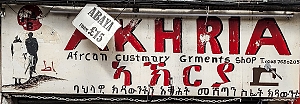
IN SHEPHERDS BUSH Market, I noticed a shop sign written in Arabic, Ethiopian and Latin scripts. The Latin script read as follows:
“Afrcan custmory grments shop”.
Was this bad spelling of English words or maybe something else? It might have been the latter as I will try to explain using two examples.
When I was a dental surgeon, I worked for a while with a wonderful assistant from Uganda. Her English was very good, but when she saw me eating potato crisps at lunch time, she used to ask me whether I was enjoying my “crisips”. The other example concerned a couple of Italian friends who had been living together since they were both 18 years old. Just after their 40th birthdays, they married suddenly. When we asked them why, the lady said in English:
“For physical regions.”
We were surprised. It turned out that what she was trying to say in her Italian accented English was that they had married for FISCAL reasons.
Both my Ugandan assistant and our Italian friend had inserted vowels between two consecutive consonants where they did not exist in the properly pronounced versions of ‘crisps’ and ‘fiscal’. Remembering this, I wonder whether whomever had written the shop sign in Shepherd Bush Market had thought it unnecessary to put in various vowels where they should have been because they believed that readers of their sign would automatically add vowel sounds between some pairs of consonants. This kind of reader would probably read the misspelt signs as follows:
“African customary garments shop”
If this is not the case, then the signwriter needs to improve his or her spelling of English words.
IT WAS FROM ETHIOPIA that historians believe coffee beans were first exported to Yemen, where they were roasted and processed into what we would now recognise as a coffee drink. The earliest recorded use of coffee beans for brewing the drink was in 15th century Yemen. However, soon the drink spread to other parts of the Middle East, North Africa, Turkey, and Persia. By 1600, it had reached Europe. Today, the 13th of April 2023, we were strolling along Shepherds Bush Market, which runs alongside the elevated railway tracks along which trains of the Hammersmith & City and Circle Lines run. The tracks run high above the market supported by brickwork arches. Some of these arches have been used to house shops and in one case an interesting café, which opened in 2020, just before the first of the covid19 lockdowns.
The café is called Delina and is run by Ethiopians. Beautifully decorated with Ethiopian textiles and other artworks, this place offers Ethiopian fare including coffee from Ethiopia. Customers can have their coffee prepared in various common ways such as, for example, Americano, espresso, and latte. I asked whether I could try coffee the way it is drunk in Ethiopia and was given the choice of coffee flavoured with cardamom or with ginger. I opted for the latter because once, many years ago, I had drunk coffee with ginger (and other spices) in a tiny coffee shop next to a mosque in Fort Kochi (Kerala, India), and liked it.
The lady working behind the bar first collected a ‘jebena’, which is ceramic container with a cylindrical base, a handle, and a long neck with a pouring spout. She washed it out and then placed it on a glowing charcoal to both dry it and heat it. Meanwhile, she prepared some coffee in the espresso machine, and filled a small jug with it. To this she added some ginger powder and stirred the mixture well. Carefully, she poured the ginger coffee into the heated ceramic container. Then, she loaded a small tray with the following: the ceramic container and a woven stand to support it upright; a tiny coffee cup with no handle; a bowl of sugar; and a small circular holder containing lumps of smoking incense. She explained that in Ethiopia it was believed that drinking coffee whilst being bathed in incense fumes enhanced the enjoyment of the beverage. There was enough coffee in the jug to refill the tiny cup or bowl about five times.
In Ethiopia, the coffee is usually first roasted in front of those who are about to enjoy it, ground with a pestle and mortar, and then brewed with water in the jebena being heated on charcoal. Then, it is poured into the tiny cups through a filter made with fine filaments. Although Delina has an electrically heated pan for roasting coffee beans, I imagine that roasting a fresh batch for one customer was considered too much work. I can imagine that when the place has a group of Ethiopian customers, shortcuts cannot be taken and the beans are freshly roasted for them.
As for the coffee laced with ginger, it was enjoyable. I could not taste the ginger, but I could feel it in my throat as I swallowed it. Years ago in Fort Kochi, we had been told that it was believed that ginger coffee was beneficial for the throat. Would I go to Delina again? Yes, I would. Despite the trains rumbling overhead every few minutes, the place has a delightful and visually satisfying ambience, and friendly staff. It also serves Ethiopian food, which we have yet to sample.
IT IS LESS THAN THREE and a half miles as the crow flies between Shepherds Bush Market in the west and Shepherds Market (in Mayfair) due east of it, but there is a world of difference between the two places.
Let us get one thing straight immediately, and that is the markets’ names and their relation to sheep. Shepherds Bush Market is named in connection with actual sheep. The place, Shepherds Bush, might either refer to a family name or to shepherding. A ‘shepherd’s bush’ is a bush from which a shepherd can shelter from the elements to watch his (or in the case of Little Bo Peep, her) flock. The place name might also refer to a place where shepherds rest their sheep on their way to Smithfield Market. However, today you are unlikely to spot a sheep anywhere in the area except in a butcher’s shop. In contrast Shepherds Market in Mayfair is named after an important London architect Mr Edward Shepherd (died 1747), who owned or developed some of the land on which fashionable Mayfair was built in the early 18th century.
“The core of the market consisting of butchers’ shops and the upper floors containing a theatre.”
There is a large building in the heart of Shepherds Market that bears the market’s name. It looks to me as if this was the building referred to in this quote.
Shepherds Market is a quaint village-like enclave surrounded by fashionable Mayfair, an extremely prosperous part of London. Although it bears the name ‘Market’, it is no longer a bustling market with stalls such as you would find in, say, Borough Market, Petticoat Lane, Ridley Road (Dalston), Portobello Road, and relevant to this essay, Shepherds Bush. The Mayfair enclave is a series of quiet streets with small boutiques, cafés, picturesque old pubs, hairdressers, a village-style newsagent-cum-postoffice, and upmarket eateries. This is not a place you should visit if you are planning to buy good value groceries or cheap clothing. It is now a part of London for meeting people and relaxing.
One restaurant, which closed in 1998, was a landmark in Shepherds Market. This was ‘Tiddy Dol’s’, which was named after a famous Georgian street-seller of gingerbread snacks (see: http://scrumpdillyicious.blogspot.co.uk/2013/10/mayfair-memories-tiddy-dols-welsh.html?m=0). I remember entering this rather gloomy eatery with my Italian brother-in-law, who wanted to try ‘real’ English food. We ordered him Welsh Rarebit, for which the restaurant was justifiably renowned. He looked at the dish in front of him, prodded its cheesy topping, and then made an involuntary expression that conveyed ‘disgust’ to me.
In the past (and maybe still today), Shepherds Market was a place where prostitution was not uncommon. Tiddy Dols was in the ‘epicentre’ of the prostitution ‘business’. So much so that:
“…in the late Seventies, commissionaires in the grand hotels of Park Lane would tell families of tourists not to go to Tiddy Dolls, such was the gauntlet of girls they would have to run.” (see: “The Independent” newspaper, 14th March 1996)
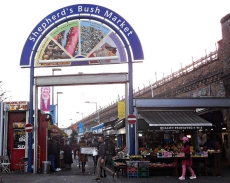
Shepherds Bush Market (‘Bush’ for short) is many things that Shepherds Market is not. The Bush market runs along a lane next to the railway arches above which trains run between Shepherds Bush Market and Goldhawk Road stations. Although it is an enjoyable place to visit. the Bush market is not at all ‘chic’ or ‘luxurious’; it is the opposite. However, it is a real street market with a few full-size shops that are housed in the arches under the railway tracks. The clientele of the market looks far less prosperous than the people you can see in Shepherd Market, and they come from a wealth of diverse ethnic backgrounds. On a recent visit, many of the vendors were Sikh men.
The Bush market offers a wide variety of fruit, vegetables, meat, fish, spices, pulses, plenty of other food products from all over the world, and many non-food items. If you are looking for, clothes, hats, shawls, shoes, suitcases, cooking utensils, ‘phone accessories, artificial flowers, tailoring, household goods, and you name it, you should head for the Bush market. Normally, this street market is crowded and busy. However, when we went there in early December 2020, there were few other shoppers to be seen. One stall holder explained that the decline in footfall was due the covid19 pandemic. This did not surprise us as much as what he said next. And that was the market had suffered because of lack of tourists due to the pandemic’s effects on tourism. According to him, the Bush market depends heavily on foreign visitors. That astonished me because I had always assumed that it was a market that catered mainly to locals.
Like Shepherds Market, the Market in Shepherds Bush contains a variety of eating places and nearby Shepherds Bush Green is surrounded by reasonably priced eateries.
Although I have not done it yet, a walk from Shepherds Market to Shepherds Bush Market would be most fascinating. It would be a stroll through the history of London’s westward spread that occurred between the early 18th century and the beginning of the 20th.
Both of the markets I have described are well-worth exploring. If I had to choose one over the other, that would be most difficult for me. I love the bustle and variety of markets such as that at shepherds Bush. However, that is not the only place you can enjoy such an atmosphere in London. Shepherds Market in Mayfair has a uniqueness that I have not found in other parts of London. It is a serene yet vibrant oasis in one of the busier parts of the city. So, let me drink a cortado or macchiato at Shepherds Market, and let me buy my halal lamb at Shepherds Bush Market. I will enjoy both experiences equally.
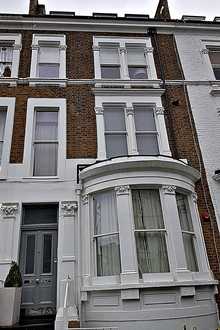
Number 140 Sinclair Road in west London, not far from Shepherds Bush Green, looks like an ordinary Victorian terraced house, which it is. However, in the first decade of the twentieth century it was home to a few Indian freedom fighters. When the seventeen year old David Garnett, the writer and a future member of the Bloomsbury Group, visited the house in 1909, he met Bipin Chandra Pal (1858-1932) the Bengali nationalist and a father of the Swadeshi movement, which promoted Indian economic independence. He shared the house with his son Niranjan Pal (1889-1959), a young Indian freedom fighter who was to become a founder of the Bombay Talkies film company. Sukhsagar Dutt (1890-1967), a young Indian revolutionary and brother of Ullaskar Dutt who was involved in the use of bombs in Bengal and Bihar and tried at Alipore (Calcutta), also lived at number 140.
In mid to late 1909, VD (‘Veer’) Savarkar (1883-1966) also lived at 140 Sinclair Road as a lodger of Bipin Chandra Pal. Savarkar, who was studying law at the time, was deeply involved in activities aimed at attempting to cause the British to leave India in order that the country became a sovereign nation. Savarkar is now best known for his contributions to the encouragement of Hindu nationalism. His book “Essentials of Hindutva”, published in 1923, is considered a seminal work by promoters of Hindu nationalism.
Savarkar moved from India House in Highgate, a centre of revolutionary Indian independence activists, to 140 Sinclair Road sometime in 1909 before the assassination in London’s Kensington of a senior Indian administrative figure, Sir WH Curzon Wyllie, in July 1909. The victim was shot at close range by Madan Lal Dhingra, a close associate of Savarkar. Savarkar was suspected of having some involvement in the plotting of Curzon Wyllie’s demise. Savarkar’s host in Sinclair Road, Bipin Chandra Pal, was firmly against what Dhingra had done, but accommodated Savarkar, who was pleased that the assassination had been successful until, as I wrote in my book “Ideas, Bombs, and Bullets”:
“… an angry crowd gathered outside, the house, Pal had to tell them that apart from being a paying guest, Veer had no other association with him. Another resident at this address, Pal’s son Niranjan, was a close friend of Veer’s and a regular visitor to India House. Niranjan’s association with India House worried Bipin greatly…”
Soon after this, Savarkar shifted his home in London to a flat above an Indian restaurant in a now non-existent alleyway in Holborn.
From what I have described, the seemingly ordinary terrace house at 140 Sinclair Road has played a small role in the history of India’s struggle for freedom from the British, which was eventually gained in August 1947.
For much more information about Indian patriots in Edwardian London, I invite you to read my recently published book, “Ideas, Bombs, and Bullets”, which focusses on the Indian patriots who congregated at India House in Highgate between 1905 and 1910.
During my wanderings through India, I have often noticed trees with thin threads tied around their trunks. These are peepal trees with heart-shaped leaves. They are held to be sacred by devout Hindus. Women wrap threads around the trunks in the hope that their prayers will be answered satisfactorily.
On at least one occasion, and this was in an Islamic mausoleum (dargah) in Baroda (Gujarat), I have seen threads tied around pillars within the dargah. Some of these threads had bangles attached to them. We were told by the guardian of the dargah, that Muslim women tie these threads, hoping that their wishes will be fulfilled.
Statues of Christ, the Madonna, and saints in churches in India are often draped with flower garlands. This is done more likely to honour the persons depicted in the statues than to have wishes granted. I have not yet seen any examples of threads tied in churches like I have seen in Hindu and Muslim shrines in India.
Yesterday, I visited St John the Baptist Church (Church of England) in Holland Road, Shepherds Bush, London. At the entrance to this magnificent Victorian Gothic building, there is a wooden crucifix. I was surprised to see that it had something that made me think of India. Two threads, each bearing a small metal medallion with some prayerful words on them, were wrapped around the heads of the nails penetrating Christ’s feet. I have never seen anything like this in a church in the UK. Is this a chance finding or the beginning of a new trend?







 yamey
yamey 