THE ARTIST PETER DOIG was born in Edinburgh in 1959. He grew up in Trinidad and Canada. He moved to England, where he studied art at Saint Martins School of Art and Chelsea School of Art, both in London. Until 8 February 2026, there is a superb exhibition of his paintings being held at the Serpentine South Gallery in Kensington Gardens. Many of the works on show reflect the years (2002-2021) that Doig lived in Trinidad.
The exhibition is called “House of Music” because that is exactly what has been created in the gallery. Not only can Doig’s pictures be viewed, but also there is music to be heard. The curators have created a “multi-sensory environment”. Along with the paintings, there are some beautifully restored loudspeakers originally designed for use in cinemas and large auditoriums during the first half of the twentieth century and the 1950s. The gallery’s website noted:
“Spanning the last 25 years, the exhibition brings together the artist’s paintings with sound for the first time. At the core of the exhibition are two sets of rare, restored analogue speakers, originally designed for cinemas and large auditoriums in the early and mid-twentieth century. Music selected by the artist – from his vast archive of vinyl records and cassette tapes accumulated over decades – plays daily through a pair of original ‘high fidelity’ 1950s wooden Klangfilm Euronor speakers. A rare Western Electric and Bell Labs sound system, produced in the late 1920s and early 1930s to meet the demands of the first ‘talking movies’, is installed in the central gallery.”
Doig’s beautifully executed, often colourful and quite delicate, paintings are the ‘stars’ of the show. Many of the 25 paintings depict life in Trinidad. Six of them include musicians and/or musical instruments. And Lions appear in many of the images. One of the paintings is Doig’s image of the large kind of loudspeaker that reminds one of the actual speakers on display in the exhibition.
Chairs are distributed randomly in two of the rooms of the gallery, and viewers are invited to sit down, contemplate the paintings, and enjoy the background music. On their own, the paintings would satisfy most people, but the careful use of background sound results in a show that should not be missed.
EVERY SUMMER, THE Serpentine South Gallery in London’s Kensington Gardens hosts a temporary pavilion in its grounds. Each year, a different architect is invited to design a pavilion. And the chosen architect must be someone who has never before had any of his or her buildings constructed in England. This year, the chosen architect is Marina Tabassum, who was born in Bangladesh in 1969.
A Capsule in Time
Along with her associates, her architectural practice (Marina Tabassum Architects (MTA)) has designed a capsule-shaped pavilion, appropriately named “A Capsule in Time”. The long axis of the capsule is aligned along a north/south axis. Most of this lovely, airy structure consists of series of parallel hoops between which there are sets of angled panels made of a tinted translucent material. The walls of the pavilion have benches along their inner edges. It is not a continuous construction because there are two wide gaps between sets of parallel hoops. One of these is aligned with the clock tower on top of the Serpentine South gallery. At each end of the capsule, the hoops decrease in diameter to form quarters of spheres. Within one of these, there is a counter where refreshments are available. One of the design criteria for the annual pavilions is that they can accommodate such a counter.
In the last few years, I have found some of the pavilions to be disappointing aesthetically and architecturally. This year’s most satisfying effort by Marina Tabassum is the best Serpentine pavilion I seen during the last five years.
WHEN WALKING IN Kensington Gardens March 2025, I spotted three trees planted in an open space outside the Serpentine South art gallery on the west side of Kensington Gardens. Taller than many of the trees around them, they had not been there when I visited the area in November 2024. Without foliage and with few branches, they seemed dead when compared with the trees growing near them. We revisited these unusual trees today (13 April 2025), and they looked wonderful in the morning sunshine.
It does not take long to see that these trees have unusual features. Two of them have unwieldy granite boulders lodged in their branches. The third tree looks as if it has been split open by, for example. a lightning strike. Parts of the wood of this tree have been painted gold. Though in some respects these three tall objects look like trees, one realises quickly that they are not trees but artworks.
Created by the Italian artist Giuseppe Penone (born 1947), they are part of an exhibition of his works, most of which are housed within the Serpentine South Gallery. Penone was a leading artist in an Italian artistic movement known as ‘Arte Povera’, which focussed on exploiting the simplicity of natural materials with artistic techniques. According to the Serpentine’s website, Penone said of his exhibition:
“All of my work is a trial to express my adherence and belonging to nature, and it is with this thought that I have chosen the works for the exhibition. The two paths that I have created—inside the gallery and outside of it, in the park—become two integrated gardens.”
The three tree-like sculptures both impressed and intrigued me. I have yet to see the works inside the gallery, but there is still plenty of time to view them as the exhibition continues until 7 September 2025.
THE SERPENTINE NORTH (Sackler) Gallery (in London’s Hyde Park) is hosting a wonderful exhibition until 27 July 2025. It is displaying paintings and drawings created by Arpita Singh (née Dutta), who was born in Baranagar (now in West Bengal, India) in 1937. Between 1954 and 1959, she studied for a Diploma in Fine Arts at the Delhi Polytechnic in New Delhi. In 1962, she married the artist Paramjit Singh, and they live in New Delhi.
The works on display at the Serpentine were created from 1971 onwards. All of them were both intriguing and enjoyable to see. Even without knowing what the artist intended, I got the feeling that, apart from some abstract works, the images Singh creates are full of messages, stories, symbolism, allusions to feminism, and social comment. Though full of meanings, Singh’s works are subtle – their messages, which are left for the viewer to interpret, are not ‘full on’, but add to the visual enjoyment of the images. Her colourful paintings often lack the conventional European way of depicting perspective. In many of the paintings and drawings, the elements of the composition seem to be floating on the canvas or paper. Some of the pictures look like collages, but on closer examination what appeared to have been stuck on was in fact painted on the artwork.
The colourful artworks on display at the Serpentine are well worth seeing. It is a special show not only because it is her first solo exhibition outside India but also because Singh’s work is so satisfying to see.
THE ARTIST YINKA SHONIBARE was awarded the prestigious CBE in 2019. In case you do not know what these three letters stand for, it is ‘Commander of the British Empire’ – not that Britain has much of, if any, empire left to boast of. For much of its long existence, places in the British Empire witnessed many injustices and inhumanities. This was especially true before the abolition of the slave trade in the early 19th century. Yinka Shonibare, who was born in London in 1962 and brought up between that city and Lagos in Nigeria, uses his artistic skills to explore Britain’s lengthy history of imperialism imaginatively and creatively. Even without knowing that he does this, his art works are in themselves visually exciting and fascinating to the viewer. The pieces on display until the 1st of September 2024 at the Serpentine South gallery in Kensington Gardens are well worth seeing both for their inherent beauty and for the way that Shonibare expresses his interpretation of Britain’s colonial past and its legacy.
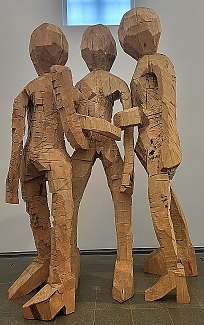
BORN IN WHAT BECAME EAST GERMANY in the town of Deutschbsaselitz, the artist christened as Hans-Georg Kern (b. 1938), is better known by the name of Georg Baselitz. His first education in art was at Hochschule für Bildende und Angewandte Kunst in East Berlin, commencing in 1955. After two semesters, he was expelled from this academy because of his lack of compliance with the socialist diktats of the German Democratic Republic. By 1957. he was a student at the Hochschule der Künste in West Berlin. In 1961, he changed his name to Georg Baselitz in honour of the town where he was born. In 1979, he began creating sculptural works, some of which are on display at London’s Serpentine South Gallery until the 7th of January 2024.
The works being shown at the Serpentine are all made of wood. They were created between 2011 and 2015 as models (maquettes) for finished works, and as such were not originally intended for public display. The wood has a rough finish and is pitted with many saw marks. After making preliminary drawings, some of which are displayed at the exhibition, Baselitz used axes, chisels, and chainsaws to fashion huge bits of timber into intriguing sculptural forms. These works are beautifully displayed in the various spaces of the gallery.
Although Baselitz’s timber sculptures are more figurative and much more complicated than those produced by my mother, seeing them reminded me of her. After leaving the sculpture workshops of St Martins School of Art, my mother hired a garage near Golders Hill Park, and used it as her studio. There, she worked on huge pieces of wood, creating abstract sculptures. Unlike Baselitz, she had no power saws, but only chisels and a power drill. I recall that when she wanted to create a ring-shaped piece of timber, she would first trace circles on the wood and then using a power drill she would drill holes around the circumference until the circle was complete. After that, she had to smooth the edges to produce a perfect circle. It was laborious, and lifting the heavy timber (without lifting gear) damaged her back.
The works on display in the Serpentine (and one outside it) appear to be crudely finished when looked at closely, but as semi-abstract sculptures they seem to mock the grandeur of classical Greek or Roman sculptures. Born a rebel, the artist has produced attractive works that comfortably go against the grain of traditional sculpture.
CONSTRUCTED IN 1974, it was 221 feet tall. It overshadowed the homes of many people including many of the wealthier inhabitants of West London’s Kensington. And I imagine that the wealthy inhabitants of the elegant crescents and other thoroughfares near it did not appreciate the views from their windows being spoiled by this Brutalist block of flats containing less well-off people, about whom they would rather not think. Between 2015 and 2016, the block was refurbished and made less of an eyesore by the addition of cladding – ostensibly to improve insulation – to its exterior.
On the afternoon of the 13th of June 2017, I was walking around North Kensington, taking photographs as usual. I stopped to take pictures of the recently built Kensington Leisure Centre and its near neighbour the Kensington Aldridge Academy – both are interesting examples of contemporary architecture. While I was taking these photos, I had my back to the tower block I have just described. Had I looked at it then, I would have thought that it would have been of little interest to me. How wrong I was.
Just after midnight on the following day, a fire broke out in that tall block – Grenfell Tower – that edifice which overlooked the homes of the wealthy residents of Kensington. The fire spread rapidly because of the highly inflammable nature of the cladding used to make the tower more attractive to its neighbours. Seventy-two people died in the conflagration; many were injured; and all the surviving residents were not only badly scarred psychologically, but also lost their homes and possessions.
From wherever you looked in a large area around Grenfell, including from the homes of the prosperous residents of Holland Park and Notting Hill, one could see the horrifically charred tower block – a fear-inspiring eyesore – the result of local government officialdom ignoring repeated warnings about the already known potential fire hazards that the cladding presented and inadequate planning for escape during a fire. I felt – and I am not alone in thinking this – that the local council hardly cared for a few impecunious residents in a tower block. What was more important was to save money so as not to impose high local taxes on people who could have easily afforded to pay them.
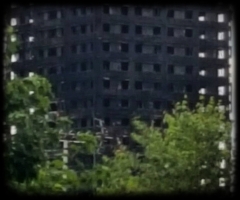
Soon after the fire, the charred tower was covered with protective wrapping to assist forensic investigations and to contain debris, which might otherwise have flown away and dropped in the neighbourhood. It also removed from sight the scarred, charred remains of the building – a 24 hour a day reminder of the avoidable, tragic loss of life, which was not altogether disconnected with civic and possibly criminal negligence. The remains of the tower are still covered up. Before the heart-rending remains of the conflagration were covered up, filmmaker Steve McQueen (born 1969 not far from Grenfell Tower) made a short film about the tower. It is currently on show at the Serpentine South Gallery in Hyde Park until the 10th of May.
The film is without words in its soundtrack and without any captions. It looks as if it might have been filmed with a drone or a camera held within a helicopter. It begins with a flight over beautiful countryside far beyond the edge of London. The camera moves above the scenes of rural serenity and slowly the city of London comes into view. We pass over London’s sprawling suburbs, and then the charred Grenfell Tower begins to be seen in the centre of the screen. The camera moves closer and closer to the blackened building, and then slowly circles around it many times. Each time the tower is slowly encircled, and the camera moves closer to it, more and more details of the destruction entered my consciousness, and my understanding of the horror of what had befallen Grenfell and its inhabitants gradually increased. As the camera moved around the wreck, you could catch glimpses of the parts of London surrounding it – the houses and flats of those who must have witnessed the fire, but were not affected by it, at least not physically. As the camera moved, one could see trains moving on nearby tracks and vehicles travelling along roads. I felt that I was witnessing life going on as usual at the same time as witnessing the horrors of a disaster. The absence of commentary added to the powerful impact that seeing these images of a lethal incineration simultaneously with scenes of normality made on me. There was a soundtrack, which consisted of recordings of everyday sounds – both natural and man-made. However, while the camera encircled the tower of death, there was no sound at all. I wondered whether this signified the fact that the victims, who had died, will no longer be able to enjoy the sounds of everyday life.
McQueen’s film is a sophisticated and solemn memorial to an event that could easily have been avoided. Without a soundtrack or explanations, the viewer is left to ponder the tragedy in his or her own way.
THE SERPENTINE NORTH art gallery is housed in what was once a gunpowder store, built in 1805. Next to it, there is an elegantly curvaceous café created by the Iraqi-British architect Zaha Hadid (1950-2016). Until the 3rd of September 2023, there is an interesting exhibit behind the north side of the café. It is an abstract mural of brightly coloured, differently sized rectangles and squares. When I showed a photograph of this to our daughter, she said it reminded her of African printed textiles. Maybe, this should not be surprising suggestions because the mural was painted by a Ghanaian artist, Atta Kwami (1956-2021), who was born in Accra.
The mural, painted on wood, is titled “Dzidzɔ kple amenuveve”, which means ‘Joy and Grace’.
The Serpentine’s website noted: “Its title is in Ewe, a West African language spoken by Kwami, and its composition characteristically plays with the colour and form improvisations distinctive to Ghanaian architecture and strip-woven textiles found across the African continent, especially kente cloth from the Ewe and Asante people of Ghana.”
Sadly, the mural is the last public work that Atta Kwami created. He died in the UK shortly after he completed it.




 yamey
yamey 