I entered one supermarket and purchased a bottle of gin. I paid for it, and as I left the store, the alarm rang. I ignored it. Nobody stopped me.
I took a bus to another area, where I entered a different supermarket. Once again, as I left the store, nobody, not even the store’s security guard, stopped me.
When I got home, I discovered that the anti-theft device had been left on my bottle. It should have been removed when I paid for the gin.
I tried removing the tag, which was tied to the neck of the bottle with tough metal cable. I realised that without breaking the glass bottle, I would not be able to reach the gin.
In the end, I retraced my steps and returned to the shop, which was a 10 minute bus ride away. I explained what had happened, showed the shop assistant the receipt, and demanded a fresh bottle, but with the security tag removed.
This episode made me wonder why so much effort is put into protecting goods when the security officials at the supermarkets take so little heed of their alarms when they are set off.
THINGS DID NOT BEGIN well for me when I arrived at Bangalore Airport’s recently opened Terminal 2 prior to boarding an Emirates airline flight to Dubai, where we were to catch another flight to London. We arrived at the airport in good time – before the check-in desks were open. After finding somewhere to sit, I walked to the Chaayos refreshment stall and asked for two cups of south Indian filter coffee. The server must have misheard me and only charged me for one. When this arrived instead of the two, I was expecting, I paid for another cup. While it was being made, I carried the first to my wife. I returned to the stall and picked up the second cup. It was filled to the brim, very hot, and the cup was poorly insulated. Just before I reached where we were sitting, my hand moved slightly, and the boiling hot coffee fell on my palm. This was extremely painful. I dropped the cup and the rest of its contents. I rushed to the washrooms, and after finding a tap that worked, I rinsed my palm in cold water. Meanwhile, my wife managed to get me some ice to put on the scalded part of my hand.
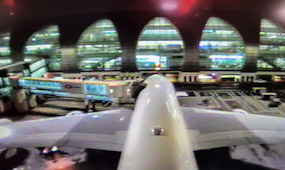
Dubai Airport
After dropping off our baggage and collecting boarding passes (printed on extremely thin paper), we headed for the security check. This involves divesting oneself of anything that contains metal before walking through a metal-detecting arch and then being frisked by a security official. Because the trousers I was wearing were too big, I had to keep one hand on them to stop them falling down. Meanwhile, I was somewhat shocked, and my hand was still smarting after the scalding.
After the frisking, I went over to the conveyor belt that carried our hand baggage and other items slowly through an x-ray machine. After rescuing both my wife’s and my own cabin baggage, telephones, wallets, coats, neck cushion, and my trouser belt, I secured my trousers with the latter. It was then that I realised that my boarding pass was nowhere to be seen. I was horrified – in so many decades of flying, I had never lost a boarding pass.
We reported the loss to the security supervisor – a female officer. She rang for an official from Emirates airline. While waiting for him to arrive, she said to my wife in Hindustani: “He should not worry. They won’t leave him behind.” After an agonising wait – actually, it was no longer than about 15 minutes – the official arrived. By then, I was feeling both anxious and extremely upset. The Emirates man explained that I would be issued a new boarding pass at the boarding gate. Not entirely happy with that, we left the security area, and headed for the departure lounges. On the way, we came across an empty baggage trolley, and began loading it with our carry-on bags and coats. As we were doing that, something fell to the ground – it was my missing boarding pass. In an instant my mood of melancholy and apprehension switched to one of immense happiness and relief. I rushed back to the security supervisor to tell her the good news. As the Emirates man was still around, I told him and shook his hand.
The flight to Dubai was pleasant. There was nothing to complain about. At Dubai, we had to pass through another security check. This time, I decided not to remove my belt before passing through the metal detector. Instead, I untucked my shirt and covered my belt with it. Despite there being a large metal buckle on the belt, the detector did not detect it. Nobody stopped me. Meanwhile, passengers’ hand baggage was passing through an x-ray machine so quickly that I doubt there was time to examine the series of x-ray images in any detail – if at all. After enjoying exorbitantly expensive hot drinks, which I did not manage to spill, we entered a departure lounge dedicated to our flight to London. Before entering the lounge’s seating area, an official examined each passenger’s passport and boarding pass. Most passengers, including my wife and I, had to head for a line of trestle tables. By each of them there was a male or female security official. A few passengers were sent straight into the seating area, bypassing the tables.
The officials standing at the tables first searched the contents of bags – rather cursorily. Then, using an electronic wand, they frisked the passenger. After that, each passenger was asked to present their hands, palms facing upwards. An explosives detector sponge was rubbed on each palm, on the clothing, within the footwear (which had to be removed), on the mobile ‘phones, and other carry-on items. After placing the (re-usable) sponges in a machine, we were allowed to sit down and await the flight. My wife told me that the security lady who examined her was both rude and rough.
This process took quite a while. I sat watching it and gradually, I and my wife became aware of something curious. About a third of the passengers on our flight were women wearing hijabs (Muslim head coverings). This was not surprising in an airport in a Gulf State. What was astonishing was that not one of them had to be searched at the tables. They were allowed to board the flight without having been checked as thoroughly as the other passengers had been. Given that very recently, soldiers wearing hijab were able to enter a hospital in Gaza and attack it with firearms, was it wise to assume that because they were wearing hijab, the passengers on our flight to London were beyond suspicion, whereas all the other passengers – both male and female – needed to be regarded as potential terrorists?
The flight to London could not be faulted. And in case you are wondering, by the time we landed at Heathrow, my scalded palm was neither painful nor inflamed.
OUR TAXI PULLED up outside the departure section of Calcutta’s huge airport terminal on the 20th of January 2024. We were dismayed to see the extremely long lines of people waiting with trolleys laden with assorted baggage. They were all waiting to pass through the police security check points to enter the terminal.
We soon realised that even if we were to have been at the head of one of these queues, we would not have been able to pass through the checkpoint without having first registered with DijiYatra.
If you have not flown from an Indian airport recently, you will be as puzzled as we were. DijiYatra is an electronic system depending on AI facial recognition to allow passengers to pass the various checkpoints on their way to the ‘plane without having to keep on showing paper documents at each point.
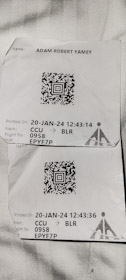
An app exists for DijiYatra, but we did not have this on our telephones. Looking perplexed, an airport official working for our airline, Indigo, led us to some electronic terminals. A man standing by it entered our PNR code, and took pictures of our faces. Following thus we were each handed small flimsy squares of paper bearing our names, flight details and a QR code. We were directed to a policeman standing nearby.
The policeman scanned our DijiYatra paper slips and checked our passports against the faces now recorded in the system. After this, we were sent to one of the checkpoints next to the entrance to the terminal. There was only one person in front of us. After having our small paper slips and our faces scanned, gates opened and we could proceed to the baggage drop-off counters.
At another checkpoint at the entrance to the security checking area, we scanned our DijiYatra slips once again. When the system matched the slip to a scan of our faces, we proceeded into the security control area.
The idea behind DijiYatra is to reduce the use of paper checking and to replace it by facial recognition systems. All well and good, but in our experience the system did rely on keeping two easy-to-lose tiny bits of paper. I guess that had we downloaded the app, the paper slips would not have been required.
What puzzled me were the long queues. Everyone in them had registered for DijiYatra.
HAVERHILL IS IN SUFFOLK, close to where this county’s border meets those of Cambridgeshire and Essex. It is not a place that is near the top of Suffolk’s list of attractions. It does not rival, for example, Lavenham, Bury St Edmunds, Long Melford, and Southwold, to name but a few. However, we chose to spend a couple of nights there. When exploring the town’s dining opportunities, one place caught my attention. It is a restaurant/bar named Baltic Amber.
On the establishment’s website (www.balticamberrestaurant.com/), there is a pair of sample menus. One is in English and the other in Lithuanian. The restaurant was established by a Lithuanian family in March 2020. Despite this, there are only a few Lithuanian dishes on the menu. When we visited, of the five Lithuanian dishes, one must be ordered a day in advance, and, sadly, another was unavailable.
On arrival at this modern place next door to a large Travelodge hotel, we were met at the entrance by two burly but extremely friendly uniformed security guards. One of them checked our names on a list which was attached to a clip board. We asked them if they were expecting trouble. They answered, half jokingly, that they were there to “… keep out the riff-raff to allow diners to enjoy their meals peacefully.” Then, we were led inside and met by a waitress, to whom the security guard said: “table 24”. We were greeted by the lady, who turned out to be Lithuanian and she showed us to our table. I practised the three words of Lithuanian, which I know, on her and later on the owner. Both seemed pleased with my efforts. The interior is modern and almost Scandinavian in design. The chairs at the tables were comfortable. Outside the restaurant, there are tables and chairs as well as a couple of fire-pits around which diners can be seated and kept warm.
Lithuanian potato pancakes with soured cream
We sampled Mead Vilnius, and aromatic spirit, rather like the Czech Becherovka. We also tried a Lithuanian beer. We ordered one of the Lithuanian dishes to share as a starter. Made of grated potatoes, which were fried and served with thick soured cream, they had a great resemblance to the Jewish dish, ‘latkes’. We followed that with Beef Stroganoff and Duck in an orange sauce. Both were above average both in quality and quantity.
The restaurant was full. The other diners, probably locals, were all having a good time, as did we. The place has good service and a pleasantly lively atmosphere. I am glad that I ‘discovered’ this place and would happily go again.
LARGE FIERCE LOOKING DOGS roam freely in the grounds of a huge mock Tudor house overlooking north London’s Hampstead Heath on the corner of West Heath Road and Platts Lane. Approach one of the metal gates designed to prevent an outsider from viewing the house properly and within seconds one of those dogs will meet you on the other side of the gates and bark menacingly. I did manage to peer through the railings and the shrubbery within them to catch a glimpse of a huge sculpture of a seated lion sitting close to the steps leading to the house’s front door. Several notices on the outer wall of the property read: “DO NOT ENTER. LARGE DOGS MAY BE RUNNING FREE”.
I have often passed this house and wondered about it.
A plaque posted by the Hampstead Plaque Fund reads as follows: “Francis Owen Salisbury (1874-1962) ‘Frank’. Artist. Mural and Portrait painter, recorder of scenes of magnificent pageantry and historic event. Stained glass artist. Lived here.”
Frank, born in Harpenden (Hertfordshire), was the son of a craftsman, who worked in plumbing, decorating, and was also an ironmonger. He was apprenticed to a stained-glass company when he was 15, and then entered Heatherley’s School of Art as a part-time student (www.19thcenturypaintings.com/artists/79-francis-%28%22frank%22%29-o.-salisbury/biography/). A skilled artist, Frank won a scholarship to the Royal Academy Schools, where he won two silver medals. Soon, he:
“…acquired a considerable reputation. He exhibited at the Royal Academy from 1899 to 1943 and his career as a portrait painter also flourished in the United States. His sitters include five presidents of the United States, five British prime ministers and many members of the British royal family, including the official coronation portraits of King George VI.” (https://www.npg.org.uk/collections/search/person/mp07514/francis-owen-frank-salisbury).
Frank painted more portraits of Winston Churchill than any other artist. His portrait of Franklin D Roosevelt is still the official portrait of this president hanging in the White House. He was the first person to paint a portrait of the young lady, who is now Queen Elizabeth II. He made portraits of many of the most famous and infamous personalities of the first half of the twentieth century. Frank’s skills were not confined to portraiture as the commemorative plaque reveals,
Frank was highly successful in the USA and by 1932, he was able to move into his impressive mock-Tudor mansion, Sarum Chase, overlooking Hampstead Heath. The house was designed by Frank’s nephew Vyvyan Salisbury (died c1982). Following Frank’s death, the property was bequeathed to the British Council of Churches, who soon sold the house and its contents. The house has since been used as a background for photo and film shoots. In Disney’s 1996 film of “The 101 Dalmations”, Sarum Chase was used as the exterior of Cruella de Vil’s home.
By 1974, the house was home to St Vedast’s School for Boys, part of the School of Economic Science, which has links with a branch of Hindu philosophy. In 2005, the building was sold and is now, or has been, the home of property developer and donor to Jewish charities.
I FIRST MET MY FRIENDS, the brothers, ‘A’ and ‘B’, at the birthday party of another friend ‘C’. This meeting would have been in March 1965. I know this because the celebrations included watching a matinee performance of the film “Goldfinger”, which had been released in the UK a few months before (in September 1964). We saw the film in the now long-since demolished Odeon Cinema in Temple Fortune, which is on the edge of Hampstead Garden Suburb (‘HGS’), where we all lived. Sadly, one of the brothers died a few years ago, but the other two friends are still thriving.
Mutton Brook
Since the major London ‘lockdown’ ended and we have become more mobile, having acquired a motor car, we have made several visits to HGS to see ‘old haunts’. One of these places is the series of public gardens (Northway Gardens and Littleton Playing Fields) that run along either side of a stream called Mutton Brook (it is a tributary of the River Brent that flows into the Thames at Brentford in Middlesex). The Brook runs parallel to Falloden Way, a stretch of the A1 road. Flanking the road that separates HGS into two sections, there is a shopping area appropriately and unimaginatively called the Market Place. During my childhood, the section of HGS north of Falloden Way was affectionately known as ‘Across the Jordan’ because many Jewish people live(d) there. I suspect that today, there is a fairly equal distribution of Jewish households in both sections of HGS separated by the A1.
My friends, A, B, and C, and I used to visit the gardens alongside Mutton Brook in our spare time. In those days, but not now, the water in Mutton Brook had a rather unpleasant smell (sewage or something rotting). One of the attractions in the gardens was a putting green open to the public. For a small fee it was possible to hire a putting implement (a putter) and a golf ball. The brothers, A and B, were very competitive, and C was less so. The three of them managed to complete the course in a respectably low number of well-aimed shots. By the time I had reached the second hole, the others had putted their balls into all 18 of the holes on the course. What I have never been able to understand is why when my ball was within inches of a hole, instead of falling into the hole, it spun around the circumference of the mouth of the hole without falling into the target area. Well, I was never skilled at any ball games, but I enjoyed the company of my friends.
Back in the 1960s, I believe that there were no refreshment areas in either Northway Gardens or Littleton Playing Fields. This has changed. There is a charming Café Toulous near one entrance to Northway Gardens and the Café Gaya in Littleton Playing Fields. Today, we sat at a table under trees near the latter and enjoyed drinking coffee in the shade. The ambient temperature was 31 degrees Celsius. In one direction, we could see the spire of Lutyen’s St Jude on The Hill Church in the heart of HGS and in the other, a nursery school that shares the same building as houses the Gaya.
There were about twenty children’s push chairs (buggies) parked in front of the two-storey nursery. This came as no surprise because the school was in use. What was remarkable was the presence of three hefty looking security men, two in uniform and one in ‘mufti’. Each of these fellows had walkie-talkies and the two in uniform seemed to be wearing protective (bullet-proof?) vests over their jackets. They were keeping a very close watch on the kindergarten and unlocked its front door when ever there was something to be delivered.
After enjoying our drinks, we asked the Eastern-European lady working in the café about the security guards. In not brilliant English with a marked accent, she replied:
“Security”.
Flippantly, I asked:
“Are the kids dangerous?”
Not seeing the joke, she explained:
“Private Jewish school”,
And then added:
“All private Jewish schools have security.”
How sad it is that nowadays, even kindergartens filled with tiny tots are considered to be at risk from attack. This was never the case when my friends and I knocked golf balls around the now non-existent putting green on the bank of Mutton Brook. What have we come to?




 yamey
yamey 