
Created by an arrow: Bombay’s longest occupied settlement

LEGEND HAS IT that when Rama was searching for Sita, who had been kidnapped,  he stopped at a spot in what is now Walkeshwar in Bombay. Thirsty, Rama asked his brother, Lakshmana, to get hom water. Thereupon, Lakshmana shot an arrow (‘baan’) into the ground, and where it landed, a stream began to flow. Although1000 miles away from the Ganges, it was considered to be a tributary of the holy river. This stream has been named the Bānganga, and its water is stored in a large rectangular stepped tank.
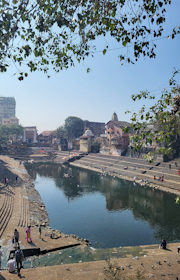
 

Bānganga Tank

The tank, the Bānganga Tank, was constructed in 1127 AD by by Lakshman Prabhu, a minister in the court of Silhara kings of Thane. It was restored in 1715. The area in which the tank is located, Bānganga,  is Bombay’s oldest inhabited district.


We have visited Bāngang often and it is always a treat. Located close to the Arabian Sea, the area around the tank is a complete contrast to the rest of Bombay. The tank is surrounded by small houses and, being a sacred spot, plenty of Hindu temples. The place is more like a quaint village than part of one of the world’s biggest cities.


Between the tank and the rocky sea shore, there is a large colony of ramshackle structures mostly made with sheets of corrugated iron. The inhabitants of this slum have an enviable view of the sea. One day, I  suppose, some developer will clear away these poor people’s dwellings, and replace them with swanky apartments or hotels. But developers should be wary because, so we were told, during the monsoon seasons, large areas of the slopes between the tank and the sea become inundated.


We made our most recent visit to Bāngang on the first day of 2026, and found it to be as delightful as ever. However,  we noticed that in addition to the pigeons and abundant waterfowl in the tank and on its steps, there was no lack of rubbish.


Since our last visit to Bānganga about two years ago,  the RPG Foundation has put up signs that identify various temples and provide some history of each place.  Despite these, there seemed ti be few tourists around the tank.

A palace by the sea

IN OCTOBER 2022, we visited the Isle of Wight and went around Osborne House, which Queen Victoria and her consort Prince Albert had constructed as a holiday home near the seaside on the north coast of the island. A largely unattractive Victorian pile, its saving grace is the Durbar Hall, which is a near perfect example of the Indo-Saracenic style of architecture that can be found in many places in India. Recently (in February 2023), we visited another royal summer palace located close to the sea. It is the Vijaya Vilas Palace close to Mandvi in the former Kingdom of Kutch, now a part of the Indian State of Gujarat.

The Vijaya Vilas was completed in 1927. It was built by Kutch’s ruler Maharao Kengarji III as a summer resort for his son and heir, the Yuvraj Shri Jayarajii.

Architecturally, it resembles older Rajput palaces, and is a fine example of the Indo-Saracenic style. It and its various oriental decorative and structural features were made by craftsmen from Bengal, Jaipur and other places in Rajasthan, Saurashtra, and Kutch. The predominant material used is sandstone , of which there is no shortage in Kutch. It seems that the palace suffered little damage during the 2001 earthquake, which badly affected the Maharao’s palaces in nearby Bhuj (the capital of Kutch).

Inside the palace there are rooms with furniture that would not look out of place in many English stately homes. There are many framed photographs of the royal family, their guests, and the many wild animals that were shot. One of these was a leopard that was shot by someone inside the palace. One of the window panes has a bullet hole that is said to have been made by the bullet that killed the creature. There are also photographs that record the many times that scenes in Bollywood movies were shot in the Palace.

One photograph shows the US General Dwight Eisenhower seated in a jeep. This picture was taken in Europe during WW2. I have yet to discover what, if any, connection existed between Eisenhower and the royal family of Kutch.

Visitors can visit the rooms on the ground floor, and can ascend to the roof from which there are superb views of the sea and the flat countryside around the palace. The first floor, which is private, is the residence of members of the former royal family.

Although not as old as it looks, Vijaya Vilas, is a superb example of the kind of palace typical of those older ones that can be seen in Rajasthan. To my taste, Vijaya Vilas is a much more lovely and harmonious edifice than Victoria and Albert’s seaside home on the Isle of Wight.