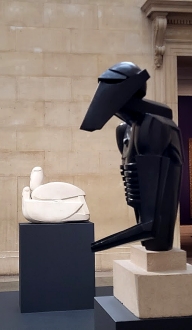
THE DUVEEN GALLERIES in London’s Tate Britain provide a wonderful space to display sculptures. The rooms are wide, long, and have high ceilings. Their walls are plain and do not distract the viewer. Until 30 March 2026, these magnificent spaces contain a selection of sculptures by Jacob Epstein (1880-1959), who was born in New York City. He joined the Art Students League in New York, before moving to Paris in 1902, where he studied sculpture at the École des Beaux Arts and Académie Julian. He settled in London in 1905. Both in Paris and London, he studied non-European sculpture, and what he learned from it often influenced his work. Some of the stone carvings in the Duveen Galleries are evidence of this. Soon after arriving in London, he began receiving important commissions to produce sculptures for significant institutions in London such as the British Medical Association (now Zimbabwe House). He became naturalised as a British citizen in 1910.
The collection of sculptures in the Duveen Galleries includes several stone carvings in different styles. The Tate’s website noted:
“In the 1910s, Epstein became a key figure in the ‘direct carving’ movement in Britain. This approach emphasised a ‘truth to materials’, in which sculptors worked directly with the stone, using its natural qualities rather than making wax or clay models first. He was influenced by the techniques and imagery used in ancient Egyptian, West African and Oceanic carvings, which he collected. At the time, his portrayal of sexuality as well as the simplified forms of his monumental figure carvings drew both admiration and intense criticism, limiting his opportunities for public commissions.”
Some of the sculptures on the former British Medical Association (now Zimbabwe House) building were criticised as being too explicit for Edwardian tastes, when they were completed in 1908. Sadly, these sculptures that can still be viewed from the Strand are badly damaged by being exposed to the weather and pollution.
The stone carvings in the Duveen, which vary from figurative to almost abstract, were all new to me. The bronze busts of famous and not-so-famous people include portraits of family members, artists, writers, entertainers and other public figures. These are the works that I tend to associate with Epstein. So, seeing his stone sculptures was a new and pleasant revelation for me. Each of the sculptures on display is accompanied by an informative panel. The works are well spaced so that each one can be admired in splendid isolation. This is an exhibition worth seeing.
HE WAS BORN in Chicago (Illinois) in 1935 and as a child was often taken by his mother to public galleries in the city. Maybe at least partly because of this Richard Hunt, who died in December 2023, became an artist. In 1953, he was awarded a scholarship to study at School of the Art Institute of Chicago. It was there that his interest in working with metal began and that he became acquainted with the work of the leading modernist artists of the 20th century. He taugh himself welding, and many of his fascinating sculptures that are on display at the White Cube Gallery in Bermondsey (until 29 June 2025) can be seen, beautifully displayed.
Many of the sculptures consist of bits of waste metal that Hunt salvaged, modified, polished, and welded together. Other sculptures are made of cast metal. Many of Hunt’s works are abstract, but suggest to the viewer that they might also depict transformations of organic forms. Each of the sculptures is intriguing and original. The influences of other artists might be subtly evident in some of them, but they are not at all obvious. The gallery’s website noted:
“Hunt developed a sculptural language that was both deeply personal and richly associative, drawing on a broad array of influences: the forms and rhythms of the natural world; the mythic narratives of Greek and Roman antiquity; his cultural heritage and global travels; the formal vocabulary of European modernism and the legacy of African American civil rights leaders who shaped his time.”
As one looks at the works on display, many of the things in the quote above become apparent.
Although some of the works at White Cube are quite small, Hunt has produced many huge works – too large to be within the White Cube – that are displayed in public places. I thought that Hunt’s sculptures were wonderful, and was surprided that until visiting this show I had not been aware of his work. The show at the White Cube was quite a wonderful eye-opener for me and I can strongly recommend seeing it.
THE BEN URI Gallery and Museum began its life in 1915 as a place where Jewish immigrant craftsmen and artists could exhibit their works. At that time, mainstream British artistic institutions were reluctant to include artists from recently arrived minority immigrant communities. Things have moved on a long way since then, and the organisation no longer confines itself to Jewish artists. Ben Uri’s remit:
“… has expanded to include relevant works by immigrant artists to the UK from all national, ethnic and religious origins, who have helped to enrich our cultural landscape.” (https://benuricollection.org.uk/)
My mother, the painter and sculptor Helen Yamey, was born in South Africa, and came to England in 1948. She was an immigrant artist.
When I was researching her life to write her biography, I discovered something about her which I had not known before. It was that during the first half of the 1960s, her sculptural work was chosen to be exhibited in several prestigious exhibitions. She exhibited alongside now famous artists such as Elisabeth Frink, Anthony Caro, David Annesley, Eduardo Paolozzi, Menashe Kadishman, William Tucker, Phillip King, David Hockney, Henry Moore, Barbara Hepworth, Paula Rego, Bridget Riley, Duncan Grant, and Jean Arp. As a youngster in the early 1960s, I was unaware that my mother’s work was rated as highly as those with whom she exhibited. It was only when writing her biography to accompany some photographs of her work, which had recently come into my possession, that I realised that although she was now forgotten by the art world, she had achieved something quite significant in the artistic world of the early 1960s. Having learned this about her artistic prowess, I discussed the matter with my daughter, who is a curator and a historian of art. In turn, she mentioned it to the current director of the Grosvenor Gallery in Mayfair. He suggested that I should contact the Ben Uri to find out whether they had any information about my mother.
The Ben Uri had no material about my mother, and were interested when I sent them information about her association with the Sculpture Department of St Martins School of Art and the exhibitions in which her work was shown. They decided to add her to their already extensive database listing immigrant artists from of 100 countries. After donating a copy of my book to the Ben Uri’s research library and having been interviewed by one of the organisation’s researchers, they added my mother, a long-forgotten sculptor, to their database. In addition, the researcher, Ms Milcic, has added an 800-word profile of my mother and her art to one of their websites. It can be read online here: https://www.buru.org.uk/contributor/helen-yamey- . This webpage also gives links to a site where some pictures of my mother’s sculptures can be viewed.
It gives me great satisfaction that my mother’s works, which had become largely forgotten, have at last been given some of the prominence they deserve. The reasons why she became forgotten and many other details about her life can be found in my recently published book “Remembering Helen: My Mother the Artist” (available from Amazon: www.amazon.co.uk/REMEMBERING-HELEN-MY-MOTHER-ARTIST/dp/B0DKCZ7J7X/)
My mother, HELEN YAMEY (1920-1980) was born in South Africa. In 1948, she came to the UK, and by 1952, she had become a sculptor. In the 1950s and ‘60s, she worked in the Sculpture Department of London’s St Martins School of Art alongside now famous sculptors including Elisabeth Frink, Anthony Caro, David Annesley, Eduardo Paolozzi, Menashe Kadishman, William Tucker, and Phillip King. Helen’s work was of a sufficiently high quality for it to be selected for showing in exhibitions that included the above-mentioned artists as well as others including David Hockney, Henry Moore, Barbara Hepworth, Paula Rego, Bridget Riley, Duncan Grant, and Jean Arp. Yet, unlike the artists listed, she and her work have become largely forgotten.
In my biography of Helen, “Remembering Helen: My Mother the Artist”, I describe her career as an artist, what she was like as a person, and explore why she did not make a reputation like those with whom she worked and exhibited. The book contains illustrations of many of Helen’s sculptures, and my daughter, Mala Yamey, an art historian and curator, has written notes about my mother’s sculptural works.
THERE IS AN EXHIBITION of sculptures by Lynda Benglis (born 1941) at the Turner Gallery in Margate (Kent). They are produced using a combination of traditional modelling and modern technology.
First, she makes small versions of these in clay. Then she scans them digitally. Using computer software, she magnifies the 3D (three-dimensional) scan. Next, she uses a 3D printer to create exact but greatly enlarged plastic replicas of the original clay models. These are then used to create the final metal casts – the sculptures seen at the exhibition.
EVERY TIME WE visit the town of St Ives in Cornwall, we come across something we have not seen before. On our most recent visit at the end of June 2024, we came across three sculptures by Barbara Hepworth (1903-1975), which were new to us. I will describe two of them in this essay, and leave the third for another time.
Hepworth migrated from Hampstead (in north London) with her second husband, the artist Ben Nicholson (1894-1982), and children, to St Ives in Cornwall at the outbreak of WW2. She lived there until the end of her life. From 1949 onwards, she lived and worked in Trewyn Studios, close to the busy heart of St Ives. This building is now a Barbara Hepworth Museum and Sculpture Garden maintained by the Tate Gallery. Visitors can see Hepworth’s studio and her garden next to it. The garden was laid out to designs created by Hepworth and her friend, the composer Priaulx Rainier (1903-1986). The garden contains works by the sculptor, which are arranged exactly as their creator had planned. We pay a visit to this lovely place every time we visit St Ives.
On our latest visit, we took a wrong turning, and headed down a narrow, sloping street. To our great delight we found a large outdoor sculpture by Barabara Hepworth, standing outside the front of the town’s Guildhall. Entitled “Dual Form”, this large abstract artwork made of cast bronze was created in 1965. It is part of an edition of 7 castings. The artist presented it to the town in 1968. It has blueish hues.
The other sculpture that we had not seen before is in a side chapel of St Ives’s gothic parish church of St Ia. Unlike “Dual Form”, it is figurative rather than abstract, and it is carved in shiny white stone. It depicts the Madonna and Child. Hepworth created this work following the death of her elder son, Paul Skeaping, who was an RAF air pilot. He was killed in an accident in Thailand in February 1953. The sculpture was unveiled in the church, where she found peace during her grieving, in 1954.
The two sculptures described above give a good idea of the breadth of Hepworth’s artistic talent. More evidence of her amazing creativity can be discovered in her former home, now a museum. In another piece, I will describe another sculpture and something I had not realised about Hepworth’s connection with St Ives.
WHEN I WAS A YOUNG child, I remember going with my parents to south London to visit a Spanish sculptor, who had escaped to Britain as a refugee during the Spanish Civil War. Although we only visited him once, I recall that his name was something like ‘Alberti’. That is all I can remember, and I do not believe that my parents ever spoke about him much since that visit made maybe more than 60 years ago.
Today, the 20th of May 2023, we spent a couple of hours in the Lincolnshire Town of Stamford. This attractive place has several lovely old churches, one of which is St Martins. This edifice contains a chapel filled with glorious funerary monuments of members of the Cecil family, which was of great importance during the reign of Queen Elizabeth I and other Tudors.
When we were about to leave the church, I spotted a modern wood carving of the head of a man with a beard and moustache. Although it was not nearly as attractive as the Cecil monuments, I decided to examine it. I do not know why I did, but I am glad that I did.
I was surprised to discover that the carved head was created by Jose Manuel de Alberdi Elorza (1922-2008). Beneath the head there is a notice with the following words written by Alberdi: “A kind of anti-war protest… The face at the moment just when Christ died on the cross … The deed is done. We have killed.”
The sculptor was two years younger than my mother, also a sculptor. All that I can discover about Alberdi on the Internet is that he was Basque and a refugee from the Spanish Civil War. Also, he taught sculpture at the St Martins School of Art in London from 1948 to 1958 , which is where my mother made sculptures during that time.
Although I cannot be certain, I am pretty sure that this head in Stamford was made by the Spanish sculptor we visited in South London so many years ago.
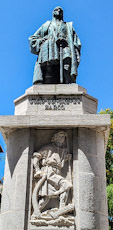
MOST VISITORS TO central Funchal in Madeira will pass, and probably notice, a bronze statue high up on a square based plinth outside the Bank of Portugal and the Golden Gate Grand Café. It depicts Joao Goncalves Zarco, who began the Portuguese settlement of Madeira in the 15th century. Very few people who pass this statue will know that it was created by a Madeiran sculptor, Francisco Franco (1885-1955). His older brother Henrique Franco (1883-1961) is one of Madeira’s most famous painters.
Both brothers studied at the Lisbon School of Fine Arts. They also spent time in Paris. Henrique returned to Madeira where he painted many of his pictures. Many of them are of Madeirans and scenes of the island. His paintings are beautifully executed and visually pleasing. Although the influence of Cezanne can be detected, Henrique did not seem to have affected by the innovative trends that were occurring in Western art during the 20th century.
Francisco visited Mussolini’s Italy in the 1920s and was impressed by the way that the state produced sculptures, which promoted the ethos and aims of the regime. He returned to Portugal, and began creating sculptural works that boosted the image of his country. Many of his important works were created for the Salazar government, which began in 1932.
Until our second visit to Funchal, I had never heard of the Franco brothers. Today, the 8th of May 2023, we visited a small museum in Funchal. It contains a fine collection of the works of both brothers. The museum contains many fine paintings by Henrique and sculptures by his brother, including a bust of Portugal’s former dictator Salazar. A video showing in the museum seems to suggest that far from being hostile to the Salazar dictatorship, Francisco was happy to create sculptures for it and its institutions.
Francisco attended an industrial school in Funchal. Its building is next to the museum. Over its main entrance is a carved stone sculptural frieze created by Francisco. The edifice now houses the Escola Secundaria de Francisco Franco, which opened in about 1976. Within its entrance lobby, we saw a bas-relief depicting the sculptor.
Although it is not one of Funchal’s main tourist attractions, the Museu Henrique e Francisco Franco deserves to be better-known.
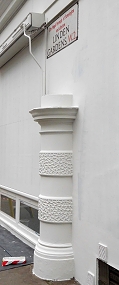
AT THE EASTERN END of Notting Hill Gate, there is a road called Linden Gardens. In the 1860s, only the eastern part of this existed and it was named Linden Grove. To the west of Linden Grove was Linden Lodge, set in extensive grounds with a large pond or lake. It was designed by the engraver, architect, and property developer Thomas Allason (1790-1852) and constructed in 1826. He lived there until about 1838. In the late 1860s, the Lodge was demolished, and houses were built around the edge of, and on, its grounds. This occurred because of the construction of the Metropolitan Railway in the mid-1860s. The gateposts of the lodge still stand, partially embedded in the buildings at the south end of Linden Gardens.
The website british-history.ac.uk noted that it was probably the peacefulness of the Grove:
“… which attracted two other artists, William Mulready, who lived in the southernmost of the eight paired houses (now demolished) from 1828 until his death in 1863, and Thomas Creswick, who lived at the still surviving No. 42 from 1838 until 1866. In the latter year this house was affected by the building of the Metropolitan Railway. Creswick therefore moved to Mulready’s now vacant house, and also, apparently, occupied the adjoining house to the north (with which it formed a pair) until his death in 1869.”
William Mulready (1786-1863) was the designer of the penny postage envelope depicting Britannia. Creswick (1811-1869) was a landscape painter and illustrator. Someone, who lived in Linden Gardens, told me that some of Queen Victoria’s children received art lessons in a studio in Linden Grove, but I have found no evidence to confirm this. However, it is certain that David Hockney painted Mr and Mrs Clark and Percy, a portrait of the dress-designer Ossie Clark (1942-1996) and his wife in their flat in Linden Gardens. The balustrades in the painting are typical of those on most of the first-floor balconies of the houses in the Gardens.
Another artist, Elsa Fraenkel (1892-1975), a German-Jewish born sculptor and Fellow of The Royal Society of Arts, who fled from the Nazis, also lived briefly in Linden Gardens, so I was informed by her daughter, who lives in Bangalore (India), where Elsa died.
AN UNUSUAL CRUCIFIX hands within the church of St Mary in Bruton, Somerset. It is a sculpture typical of early 20th century German Expressionism, yet it was created in 1969, long after the heyday of this artistic trend. The creator of this religious sculpture was Ernst Blensdorf (1896-1976). He was born Ernst Müller in North Germany, but after his marriage to his first wife, Ilse Blensdorf, in 1923, he changed his surname to ‘Müller-Blensdorf’, then later to ‘Blensdorf’.
At first, Blensdorf became a seaman. After having been interned as an enemy alien by the British during WW1, Ernst travelled to Johannesburg in South Africa with a fellow internee. It was here that he made a table-top wood carving of an African village. On his return to Germany, this fine carving persuaded Ernst’s father that his son had a future as an artist and was willing to support him towards this aim. While in Africa, Ernst had seen African art first-hand and exposure to this certainly helped influenced his future creations.
After a brief spell at an art school in Barmen, he left to become apprenticed to a master joiner. By 1922, he had become a journeyman for a furniture company, which specialised in manufacturing luxury items. During this period, he was influenced by the Bauhaus artist Paul Klee and the sculptor Alexander Archipenko. The skill that Ernest acquired and developed whilst manufacturing wooden objects for the furniture company became useful as he moved from applied craftsmanship to artistic endeavours. In addition to other activities, he taught at the art school in Barmen during the 1920s. By the 1930s, he had become an established sculptor and had exhibited his works at various exhibitions in Germany, where he received both private and public commissions.
When the Nazis took power in Germany, Blensdorf became one of the first artists whose works were categorised as ‘degenerate’ by Hitler and his regime. This led to him losing his teaching post at Barmen and his studio being wrecked by the Nazi’s loutish followers. Ernst, his wife, and children, moved to Norway, where he was planning a giant peace monument to honour the Norwegian statesman and Nobel Peace prize winner Fridjtof Nansen. In Norway, he worked on this project and made a living creating and selling artistic ceramic works, alongside the Norwegian ceramicist Eilif Whist.
When the Germans invaded Norway in spring 1940, Blensdorf and his children fled to Scotland. His wife, Ilse, remained behind, saying that she was a follower of Adolf Hitler. Following his arrival in the UK, Blensdorf was once again interned as an ‘enemy alien’. Along with many others, including a good number of men with artistic talent and German nationality, he was interned on the Isle of Man (from 1940 to 1941). His children were placed in a couple of orphanages. While interned, he, along with fellow artists, were allowed to satisfy their creative urges and even to sell their creations. Using whatever materials he could find during this period of scarcity, Blensdorf’s creative output was impressively large. For the first time in his life, he had plenty of time to undertake artistic work in the absence of anxieties such as he had experienced before arriving on the Isle of Man.
Blensdorf was released from internment in 1941. He went to live with an Austrian couple, the Schreiners, whom he had met in the internment camp. They lived in Charlton Musgrove in Somerset. With him, the Schreiners planned to set up an art school, but this failed for financial reasons. Ernst remained in Somerset. His first job was teaching pottery at a school in Bratton Seymour. It was here that he met his second wife, Jane Lawson. They married in 1942 and moved into a house near Wincanton, where they were joined by his children. Blensdorf taught in various schools in Somerset including the King’s School in Bruton.
In 1943, Blensdorf and his family bought a run-down 17th century house close to Bruton. Gradually, the house was restored and improved. It remained his home for the rest of his life. Although he exhibited often and in prestigious venues, Blensdorf never realised the great reputations that other artists, such as Henry Moore, Elizabeth Frink, Anthony Caro, and Barbara Hepworth, gained in the UK and beyond. For this reason, seeing his work for the first time during my first visit to the lovely Bruton Museum in July 2021, was a wonderful surprise and an exciting eye-opener. In one corner of this small museum, there is a large glass cabinet that contains examples of Blensdorf’s sketches, ceramics, and sculptures. When I told the lady, who was looking after the museum, how much I liked what I had seen of his works, she told me about the crucifix in the local church, which fortunately I was able to see. She also sold me a copy of a well-illustrated catalogue of an exhibition of his works that was held some time ago in the Bruton Museum. It is from this publication that I have extracted much of the information above. Bruton is a gem of a town. Visiting its museum is a ‘must’ because not only does it allow you to ‘discover’ the works of Blensdorf but also to see a display of artefacts relating to the author John Steinbeck, who lived close to Bruton between March and September 1959 … but that is another story.




 yamey
yamey 