
Armenian script in a church in Chennai

I HAVE VISITED ST THOMAS Mount in Chennai twice so far. The two visits were separated by at least a quarter of a century. Amongst the many interesting things to see and experience on this sacred hill are some examples of Armenian script. This characteristic lettering can be found both on several tombstones and on some framed paintings of saints. Also, there is some Armenian writing inscribed on an ornate pulpit.
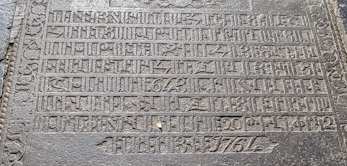
The church on the Mount is dedicated to Our Lady of Expectation. There are several sculptures of the pregnant Mary in or near the church, which was constructed close to the spot where St Thomas (the doubter) is supposed to have died. The church was constructed by Portuguese Franciscan missionaries in the 1520s. None of this information provides any clues to the presence of the Armenian lettering.

Armenians began setting in Madras in significant numbers in the mid-17th century. There is an Armenian Street in Chennai, where one can find an Armenian church. This was built in 1712. The two funerary monuments I saw on the Mount are dated after 1712: 1739 and 1764. The paintings with Armenian script are far newer. I am no expert on Armenia, so can say little if anything about their religious practices. Many Armenians are Christians, and a few of them are of the Catholic variety. I can only assume that the graves on the Mount are those of Catholic Armenians, and that some Catholic Armenian donor provided the paintings.

If anyone can give me more information about the presence of Armenian script in this church on the Mount, please share it with me.
The bank manager

I have always had difficulty reproducing my signature. Sometimes, this can create problems.

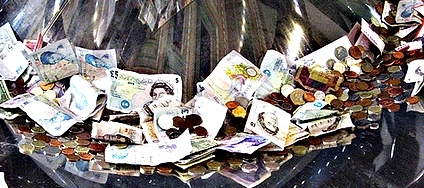
money

It was a warm day, lunchtime, in Spring 1982 when I walked to the local branch of my bank in the village, where I had just begun practising dentistry in north Kent. I needed some money. I wanted to cash a cheque to obtain ten Pounds.

I filled in one of my cheques, signed it, and handed it along with my bank card to the teller. She looked at the card and the cheque, and then said:

“I am sorry, sir, but your signatures do not match. Please re-sign your cheque.”

I did as was requested. But, the third signature differed significantly from the first two, which also looked unalike.

“Try again, Sir.”

My fourth attempt was yet another variation on a theme. The teller did not approve of it. By now, I was feeling both sweaty and slightly hypoglycaemic. I snatched my cheque and card and stormed out of the bank.

After returning to the dental practice, I calmed down. I still needed that £10. I rang the bank and asked to see the manager immediately. I was asked to return, which I did. On my arrival, the manager, dressed in a smart suit, was summoned to the counter. He said to me:

“How can I help you, sir?”

“I have just begun working as a dentist in the practice up the…”

Before I could finish, the manager invited me into his office. He offered me a chair, and then sat down. I explained what had happened earlier, and that I was concerned about having similar problems in the future as his branch was the most convenient bank to reach on my working days.

“Please give me the cheque, Mr Yamey.”

I handed him my cheque, which was covered with a selection of vaguely similar signatures.

“Please wait a moment,” the manager said, leaving the room.

A couple of minutes later, he returned and then handed me the cash.

I used that branch of the bank for the next eleven years and was never again asked to show my bank card when I wanted to cash a cheque. Such was the respect that the dental profession commanded several decades ago. Since then, I have simplified my signature so that I am able to reproduce it more or less reliably.