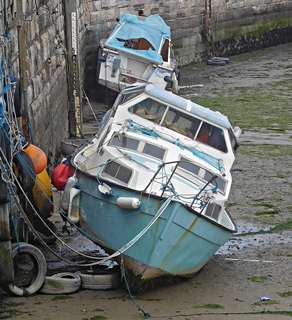
The Sunken Boat and the sea at the Turner in Margate (Kent)

I HAD NEVER HEARD of the artist Anna Boghiguian (born 1946) until we visited her exhibition at the Turner Contemporary Gallery in Margate (Kent). Anna was born in Cairo (Egypt), where she studied political and social sciences at The American University. She also studied fine arts and music at Concordia University in Montreal (Canada). The works on display at Margate until 26 October 2025 are a superb synthesis of both her interests in world affairs and artistic talents.

Anna’s show at the Turner is called “The Sunken Boat: A glimpse into past histories”. It consists of three installations, one in each of three spacious galleries. One gallery contains an installation comprising a set of sandy beaches littered with the remains of wrecked boats and sails along with other flotsam and jetsam. The walls of the room have frames containing images relating to historical and ecological events. Regarding this fascinating and beautifully composed exhibit, the gallery’s website noted that the installation:

“… the centrality of the sea in shaping histories of labour, trade, ecological collapse, and political conflict. It combines sculpture, painting, cut-out figures and sound, inviting reflection on rising sea levels and geopolitical tensions around undersea communication cables.”

Another room has a cluster of cut-outs depicting famous people of the past including Einstein, Gandhi, Queen Victoria, Napoleon, Pythagoras, and many others. Each of the cut-outs are colourfully painted and are suspended from the ceiling by fine threads, and hang above a large black and white chess board. They rotate gently in reaction to movements of the air caused by motions of the viewers.

The third gallery contained an installation that evoked being under the sea. Figures either swimming or drowning are suspended from the high ceiling. The room is lit with a blueish glow that gives the viewer the feeling of being below the sea’s surface. The floor of the gallery is a representation of the seabed, with undersea cables, marine creatures and plants, assorted debris, and other objects one might expect to find there. The lighting was chosen to evoke the reduced illumination that one can imagine exists deep below the sea’s surface. It reminded me a little of the church at Tudely (Kent) whose stained-glass windows by Chagall create the same impression. In this church, Chagall designed the windows to create the impression of being below the sea because the edifice is dedicated to the memory of someone who died by drowning. Unlike the church at Tudely, the installation at the Turner expresses a less specific, more global concern: that of the sea’s ecology at present and in the future.

Words can hardly do justice to the amazing show at Margate. Without doubt, it must be seen to be fully appreciated. The exhibition illustrates that  Anna Boghiguian is a competent and imaginative artist with a great grasp of past and contemporary political and present ecological challenges facing the waters in our seas and oceans. And she knows how to express these matters in imaginative and compelling ways,

A beach in the heart of London

The River Thames is tidal where it flows through the heart of London. At low tide, sandy beaches appear alongside the river’s banks. What is often beneath the water is revealed for a few hours. People, known as ‘mudlarks. wander along the sandy beaches looking for objects and fragments that have been thrown into, or lost in, the water over the many centuries that the city has been in existence. I have never attempted mudlarking, but many people enjoy searching for lost treasures.

A poet in Highgate and Cornwall

IN 1916, A FAMOUS poet, TS Eliot (1888-1965) taught at Highgate School in north London. I was a pupil at this establishment much later, between the year when Eliot died and 1970. One of Eliot’s pupils during his short spell at Highgate was to become one of Britain’s Poet Laureates: John Betjeman (1906-1984). Betjeman wrote (quoted in https://bradbirzer.com/2015/07/06/john-betjeman-remembers-t-s-eliot-as-teacher/):

“In 1914-15 I spent two unsuccessful terms at Highgate Junior School. Mr Eliot was a tall, quiet usher there whom we called ‘The American Master.’ Some of the cleverer boys from Muswell Hill (I was from Highgate) knew he was a poet. How? I have often wondered, for I cannot imagine him telling them or anyone that he was a poet, and I did not know that he had published any poems in England as early as that.”

Betjeman’s association with Highgate where he lived as a child briefly and was educated for less than one year was much shorter than his association with the county of Cornwall.

Betjeman’s family had a house in Trebetherick, near Polzeath in Cornwall, where many holidays were spent. In later life, the poet resided there. The small church of St Enodoc is about 930 yards south of Trebetherick. In the middle of a golf course overlooking the sea, the church dates from the 13th century. Much of it was built by the 16th century. Over the centuries, St Enodoc has often been submerged by drifting sands from the nearby beaches. Between the 16th century and the mid-19th century, the church was completely submerged. In 1863-64, the church was freed from the sand and restored under the supervision of James Piers St Aubyn (1815-1895).

When staying or living at Trebetherick, Betjeman visited St Enodoc regularly. In 1945, he published a poem “Sunday Afternoon Service in St Enodoc Court, Cornwall”, in which he describes his impressions of the church affectionately. Author of much poetry and several books about Cornwall, Betjeman died in his home at Trebetherick. He was buried in the small graveyard that surrounds St Enodoc, a building that still appears to be partially buried in the hillside. His grave is marked by simple stone with a beautifully carved inscription. Born in Lissenden Gardens, now in the Borough of Camden, Betjeman lived briefly in Highgate’s North Road in a house opposite Highgate School. However, it is with Cornwall rather than Highgate that most people connect with the former Poet Laureate. As a former pupil at Highgate School, I was pleased to pay my respects at Betjeman’s grave in Cornwall.