SURFERS AND INDUSTRIAL archaeologists will be familiar with the small village of Porthtowan on the north facing coast of Cornwall. It has a magnificent beach from which one can watch or immerse oneself in the glorious foam crested rollers. The name of the village derives from the Cornish ‘Porthtewyn’, which means ‘landing place at the sand dunes’. The road from the major A30 highway to Porthtowan passes through a wild landscape that resulted from intensive mining activity in the distant past.
An engine house
The terrain through which the road winds its way is dotted with the ruined remains of industrial buildings: engine houses for mines and chimneys of the former foundries and other processing plants. Most of these relics are recognisable but in a dilapidated state. However, we passed on of them, which has been beautifully restored, and converted into guest accommodation.
Tin mining in Cornwall ‘took off’ in earnest in the 16th century. During the 18th and 19th centuries, deep mining for tin and copper was a major activity in the county. Mining of arsenic was added to this, and for a while in the late 19th century, Cornwall was a major supplier of this for the world. The engine houses that dotted the landscape housed steam operated pumping engines that allowed mines to be dug deeper than before.
Today, mining in Cornwall has declined. However, it might pick up now that valuable deposits of lithium containing ore are beginning to be found. The landscape through which we drove to Porthtowan is now protected from development by having become part of a UNESCO World Heritage Site since 2006.
NOT FAR FROM Henley-on-Thames, lies the village of Bix. Its name might derive from either the Anglo-Saxon word for box, an evergreen shrub, or from a word, ‘behaeson’ meaning ‘to vow’. By 1085, when the Domesday Book was compiled, Bix was divided into two nearby settlements, each of which had its own church. One of these has disappeared, and the other, St James, is now in ruins.
Still consecrated but in a dilapidated state, St James is now known as Bix Old Church. Very little is known about the early history of this ruined church. It was in existence by 1274, when it and the other church were so poor that they had to share a vicar. In the late 1700s, the walls of St James began to collapse. So, brick buttresses were constructed to prevent further damage. These buttresses are still standing, but they failed to halt the collapse of the church. In 1874, the church was deemed unusable, and a new church, the present St James, was built.
We visited the new church, arriving just in time to meet someone who was about to unlock it. Constructed in 1874, it is a Victorian gothic edifice. Inside, the church is built with bricks of differing colours arranged in layers to produce an eye-catching appearance. What makes this church fascinating is that it contains various things that were rescued from Bix Old Church: the font; two fragments of Flemish stained glass dating from 1530; and the carved stone bowl of the piscina. These valuable remains were moved from the old church to the newer one in 1875.
Bix Old Church is reached by a long country lane that is only wide enough for one car. It and the church are in surprisingly a rural environment, considering how close it is to places like Henley, Reading and High Wycombe. We visited the church mainly because when I passed a sign for Bix, which I thought was a strange name, I looked it up on the Internet later while enjoying a picnic, and found out about the existence of the ruined church. Once again, a short visit into the English countryside has resulted in an unexpected, fascinating discovery.
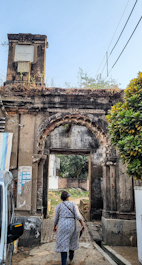
ALL THAT REMAINS OF A MAHARAJAH’S PALACE … IS ONLY A FEW ARCHES.
Not marked on Google maps, but mentioned in a guidebook to Murshidabad (in West Bengal), this remnant of a palace is extremely difficult to find. Our toh-toh (electric autorickshaw) driver asked many locals for directions. To my surprise, all knew about the small remains of a former palace, once a home of Maharaja Nanda Kumar (1705-1775), a tax collector for the British East India Company [see: https://en.m.wikipedia.org/wiki/Maharaja_Nandakumar ], who fell foul of the Company’s law. The guidebook did not mention this or the fact that he, a friend of Warren Hastings, was hanged by the Company for alleged fraud.
ONE BRANCH OF London’s recently opened Elizabeth Line terminates at Abbey Wood, which is in the southeastern Borough of Bexley. A few minutes’ walk away from the station brings one to a large park called Abbey Wood, which I visited for the first time yesterday, the 24th of July 2024. The park contains the ruins of a 12th century Augustinian abbey – Lesnes Abbey.
The abbey was founded in 1178 by Richard de Luci (1089-1179), Lord of the Manor of Lesnes and Chief Justiciar of England (something analogous to a modern ‘Prime Minister’). It is believed that he founded the abbey as a repentance for his sins and also for those related to the murder of Thomas a Becket in Canterbury cathedral in 1174. Unfortunately, Lesnes never became established as one of Engand’s greater monastic institutions. This might have been due to the large amounts of money it had to expend on draining its pastures, which were regularly flooded by the waters of the nearby River Thames. In addition, the abbey developed a bad reputation because of its members disorderliness, which included many instances of immoral behaviour. Despite help from outside sources, the abbey continued to decline until it was dissolved (in 1525), along with many other religious establishments, by King Henry VIII.
After it was closed, the land and remains of the Abbey passed through various hands until it was bequeathed to Christ’s Hospital School in 1688. Between that date and 1933, the land was used as a farm by the school. From 1909 to 1913, the Woolwich and District Antiquarian Society carried out extensive archaeological investigations of the site of the abbey. One of their many discoveries was a stone effigy of a knight, who could be identified as being part of the de Luci family. It is now stored in the Victoria and Albert Museum in South Kensington. From 1939 to 1954, the new owners of the land, the London County Council, carried out further excavations. After that, in 1956, the ruins were made safe for visitors, and these can be viewed today. In 1986, the park and the ruins were transferred to the care of Bexley Borough Council, who have made the place very ‘user-friendly’ with excellent paths, helpful direction signs, information panels, and a lovely visitors’ centre with a small café.
The ruins are quite extensive and seen from a hillock above them, one can clearly see the ground plan of the abbey. Most of the ruins are low in stature, but a few walls of over 6 feet high are still standing. In what was once the abbey’s church, there are several carved pillar bases and other fragments of the original structure. Nothing apart from its ground plan remains of the cloisters, which were filled with picnickers and children when I visited. All in all, the ruins of Lesnes Abbey compare well with others I have seen during my travels in England and Wales. But they are not as spectacular as, say, Tintern Abbey in Wales and Fountains in Yorkshire. However, unlike the two mentioned, which take many hours to reach from London, Lesnes is a mere 26 minutes’ train ride from Bond Street.
I had not known of the existence of the ruins of Lesnes Abbey until a few days’ ago when I looked up mulberry trees on the Internet. One of the examples of mulberry trees that came up on the screen of my computer was that which is growing next to the ruins of Lesnes Abbey. According to the excellent guidebook to the abbey by Chris Hawkins, which I bought at the café, the mulberry at Lesnes was probably planted in around 1720. It was during this period that the monarch, hoping to establish an English silk industry, imported many mulberry trees to England. Unfortunately, the enterprise was doomed to failure because mulberry trees of the wrong variety were imported – the kind whose leaves were not suitable for feeding silkworms. The ancient mulberry tree at Lesnes is flourishing but has grown in such a way that its huge twisting trunk must be supported by steel struts.
I can strongly recommend a trip to Abbey Wood to view the ruined abbey. Having seen it, I am surprised that this fascinating site it is not better known outside the confines of southeast London.
WE USED TO make long trips by car in France. Amongst the many sights we visited were various Cistercian abbeys, such as those at Citeaux and Clairvaux. Later, during trips to Wales, we often visited the ruins of the Cistercian Abbeys at Strata Florida and at Tintern on the River Wye. I do not know what drew us to these Cistercian places, but we went out of our way to see them. So, when we were staying near Warrington in Lancashire and I noticed that we were not far from yet another Cistercian site, we made a bee line for it. Overlooking the River Dee, the ruins of Basingwerk Abbey are located near the town of Flint in the county of Flint.
Though not as extensive as the ruins at Tintern, there is plenty to see at Basingwerk. Dedicated to the Virgin Mary, the abbey was founded in 1132 by Ranulf de Gernon, 4th Earl of Chester. Being on the border between England and Wales:
“Basingwerk was patronised by both the Welsh and Anglo-Norman nobility. Royal benefactors included Henry II, Prince Llywelyn ab Iorwerth (d. 1240), Prince Dafydd ap Llywelyn (d. 1246) and Edward I.” (https://www.monasticwales.org/browsedb.php?func=showsite&siteID=24).
Originally founded as part of the Order of Savigny, it joined the Cistercian Order in 1147. In about 1355, it was reported that the abbey was in a devastated condition. During the early 15th century, Basingwerk tried to encourage pilgrims to visit its shrine, hoping that this would raise funds to repair the place. Between 1481 and 1522, Abbot Thomas Pennant restored the abbey and improved its fortunes. Sadly, by 1537, the institution had been suppressed by order of King Henry VIII. In 1540, the site of the former monastery was sold. After changing hands a couple of times, it became the property of the Mostyns of Talacre.
In 1923, the ruins of the abbey were taken over by the government, and now they are well-maintained by CADW – the historic environment service of the Welsh Government. Despite the appallingly bad weather prevailing when we visited the remains of the Cistercian abbey, we were able to enjoy wandering around the ruins. To recover from the inclement conditions, we took refreshments in the nearby café/restaurant in Basingwerk House.
AFTER THE CITY of Ahmedabad was established in about 1420, Mahmud Begada, a Sultan of Gujarat, captured the city of Champaner (near Pavagadh) in 1482. He spent more than 20 years developing it and creating glorious buildings – some fabulous mosques, fortifications, city wall and gates, etc. He renamed the city Muhammabad.
The name ‘Champaner’ was given to the place in the 8th century AD to honour a general serving the Chavda dynasty that founded the city. I have not yet found out how long it was called Muhammabad, but it is no longer known by that name. Now, it is known as Champaner.
In 1535, the then Sultan of Gujarat, Bahadur Shah, fled the city just before it was defeated by the Mughals led by their emperor Humayun. Today, the city is in ruins, and has become a UNESCO World Heritage Site.
We had visited the site twice before, and revisited it a third time in November 2023. Prior to making this trip, we had been advised by a friend to see a ruined mosque located a short distance away from the rest of the ruins. To reach this, the Kamani Masjid, we hired an autorickshaw.
Ek Minar ki Masjid
The Kamani mosque is situated in a jungle away from the main road. We left the latter and drove along a dirt track through the dense vegetation. The sound of our vehicle’s engine disturbed a flock of grazing peacocks, who rushed away from us.
The Kamani Masjid stands in a clearing. It has lost its roof but the rows of pillars and arches that once supported it remain standing and are a beautiful sight. The decorative base of a minaret stands at one corner of this magnificent array of arches. This relatively unvisited ruined mosque is well worth visiting not only because of its beauty but also its peaceful location.
Our autorickshaw driver, realising our interest in historical buildings, suggested that we visit another mosque, which we had not seen before. Called the Ek Minar ki Masjid (ie ‘One Minaret Mosque’), it lives up to its name. Built in the 16th century, at the same time as other mediaeval mosque in Champaner, all that remains today is the large plinth on which it stood, a small fragment of wall, and a single intact minaret. The base of the minaret, like that at Kamani and other mosques built in that era, is decorated with geometric patterns. Standing alone, it is a splendid example of a 16th century minaret.
After seeing the two isolated Masjid, we visited the famous helical stepwell, which we had seen before. On previous visits, the water level had been low and we could see the full extent of the long staircase that spirals down the sides of the circular well. This latest visit we saw only the first few steps because the well was almost full.
Champaner and its archaeological ruins are one of many good reasons to visit Gujarat – a state in India, which does not attract its fair share of foreign visitors, unlike, for example Rajasthan, Goa, and Kerala.
IN ABOUT 1380, Roger Ashburnam (died 1392) commenced building a castle surrounded by a moat about 6.7 miles southeast of what is now Royal Tunbridge Wells in Kent. During the centuries after the commencement of its construction, this edifice, Scotney Castle, was modified in various ways in different architectural styles.
In 1778, the cricketer and landowner Edward Hussey (1749-1816), who killed himself with a blunderbuss, purchased the estate in which the castle stands. In 1830s, Hussey’s grandson, also called Edward Hussey III, built a new and larger house on a hill overlooking the old castle. It was designed by the architect Anthony Salvin (1799-1881), who was an expert on mediaeval buildings. At the same time, the gardens surrounding the new house were landscaped. As part of the landscaping process, carefully selected parts of the old castle were demolished to create a picturesque ruin – an attractive garden feature.
In the 18th and 19th centuries, it was not uncommon for garden designers to build follies to add interest to gardens. Often, the follies look like classical or mediaeval structures – either constructed to look intact or ruined. At first sight, the old Scotney Castle looks like a grand and elaborate garden folly, but it cannot be so-described – it was not built as a folly. Although its degree of ruination was enhanced in the 19th century, it had been a real castle for several centuries, and had been built to be used as a fortification as well as a residence. Thus, what had once served to counter a possible invasion by the French ended up being an elaborate garden ornament. Maintained by the National Trust, Scotney Castle is well worth a visit. The ruined castle and its surrounding gardens make a magnificent sight. Salvin’s newer edifice, which is open to the public, does not deserve much of a visitor’s attention.
WILTON IN WILTSHIRE was capital of Wessex between the 9th and 11th centuries (AD). Today, it is famous for its carpet manufacturing and the wonderful Wilton House, which has been home to the Earls of Pembroke since 1544, when King Henry VIII gave it to them after the Dissolution of the Monasteries. The House, which contains a fabulous collection of paintings by the great masters, was built on the site of Wilton Abbey (established in 871 AD).
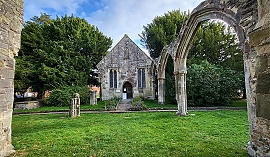
St Mary’s church in the centre of Wilton was originally the first Anglo-Saxon church in the town. It was first built in the 9th century, and then rebuilt in the 12th century. The newer church was further modified in the 15th century. However, by the 18th century it was becoming dilapidated. In 1751, the surving part of the church became used as a mortuary chapel for the Earls of Pembroke. This situation remained unchanged until 1848, when the construction of the large Italianate church of St Mary and St Nicholas was completed in nearby West Street. Then, the old St Mary’s was demolished except for the chancel and the first bay of the nave (than next to the chancel). This survivor is rarely used for services and is now cared for by the Churches Conservation Trust, which looks after historic churches of interest that have become redundant. Outside the preserved part of St Mary’s there are a few gothic arches, remains of the previously much larger church.
We have visited Wilton several times, to see both Wilton House and the Italianate church, as well as to partake of refreshments in the town’s cafés, but it was only today (7th of October 2022) that I first noticed the remains of St Mary’s. This only goes to show that revisiting a place often can be rewarding.
THERE IS A SUPERB Vietnamese eatery on London’s Bermondsey Street, called Caphe House. After eating a tasty banh mi, a baguette filled with meat and fresh vegetable, a dish no doubt inspired by the French occupation of Vietnam, and a pho, a clear broth with meat, vegetables, and noodles, we crossed the road to examine a sculpture. This eye-catching artwork had not been present when last visited Caphe House, sometime before the pandemic and well before October 2019. It consists of a row of seven piles of stone carvings of differing heights, resembling short totem poles. Made of Portland stone, Bath stone, marble and other materials found in the River Thames, this was created in 2020 by Austin Emery and members of the local community. Over 100 members of the community made carvings in a workshop, and these have been assembled by Emery to create what we saw, an artwork named “Cornerstone”. Cornerstone also incorporates fragments from Southwark Cathedral, Westminster Abbey, London Bridge Station, and bones from the Thames.
Cornerstone, a sculpture in London’s Bermondsey
After admiring this unusual and intriguing sculpture, I spotted a notice nearby. It relates to the history of Tanner Park, where the sculpture stands, and includes the following:
“… Originally part of the grounds of Bermondsey Abbey the site of the Park was later in use as a Tannery …”
Reading this notice, I realised that this was the first time I had seen mention of an abbey at Bermondsey.
There had been an abbey in Bermondsey since the early 9th century (https://en.wikipedia.org/wiki/Bermondsey_Abbey). This was centred on the site of the present-day Bermondsey Square, about 390 yards south of the Cornerstone sculpture. The abbey to which the notice at Tanner Park refers was a Benedictine abbey, which was dedicated to St Saviour and was founded in the early 11th century. A wealthy religious establishment, it was, like so many other similar institutions, dissolved by King Henry VIII in the 16th century, in 1537. But where was it?
By 1822, only tiny fragments of the abbey were still standing. Today, nothing remains, although occasional archaeological digs have exposed parts of it, albeit temporarily. Fathome’s map of Southwark compiled in 1643-48 shows that then the abbey was still standing intact in its grounds (https://www.british-history.ac.uk/old-new-london/vol6/pp117-133). According to one writer (https://knowyourlondon.wordpress.com/2018/07/06/bermondsey-abbey/), who does not give the source(s) of his information, the site of the abbey was:
“The abbey lands extended from the present church of St Mary Magdalene, across today’s Tower Bridge Road.”
A map included by this writer marks the abbey church as lying along Abbey Street with the nave to the west of Tower Bridge Road and the chancel east of it. A wall plaque (www.londonremembers.com/memorials/bermondsey-abbey) which I have not yet seen informs that the abbey:
“… occupied ground between Bermondsey Street, Abbey Street, and Grange Walk…”
The church of St Mary Magdalen stands on Bermondsey Street just before its crossing with Abbey Street. This stands on the site of a church that existed in 1290 and which served lay workers of the abbey. This was demolished in 1680, but the late mediaeval tower was kept. It was rebuilt ten years later. During the 19th century, the exterior was covered with rendering and various other architectural modifications were made both internally and externally (https://en.wikipedia.org/wiki/St_Mary_Magdalen_Bermondsey). Apparently, the church’s mediaeval arches are visible inside the tower behind the organ and the church also contains some mediaeval stone capitals that might well have been parts of Bermondsey Abbey. St Mary Magdalen is the oldest surviving building in the area. It is open occasionally. I have entered it once, but that was long before I knew about the mediaeval remnants it contains.
Despite the fact that Bermondsey Abbey is now merely a historical memory, Bermondsey Street is an interesting place to visit. Amongst its attractions are Peter Layton’s glass studio, where you can watch glassblowers creating fantastic artworks in glass; Rachel Eames Gallery, which often has good exhibitions of contemporary artists’ works; The Fashion and Textile Museum; The White Cube (Bermondsey), which hosts spectacular shows of contemporary art; and the Cornerstone sculpture, described already. I suggest starting your visit with an early lunch at Caphe House, rounding it off with Vietnamese filter coffee, and ending it with another good coffee at the cheekily named, quirkily decorated Fuckoffee café.
YORKSHIRE IS RICH in the ruins of abbeys and other religious institutions, which were all dissolved (closed down) by Henry VIII in the 16th century and left to decay. The better known of Yorkshire’s ruined abbeys include those at Fountains, Rievaulx, and Whitby. In the North Yorkshire district of Ryedale, there are the extensive ruins of a former Cistercian abbey, founded in 1137 and called Byland Abbey. Having visited ancient but still intact and well-preserved Cistercian monasteries in various places in France, I have a reasonable idea of what these places look like. What I particularly liked about the ruins at Byland was that although much of the old stonework has been taken away and incorporated in other buildings, sufficient remains not only of the abbey church but also of the many buildings (e.g., the refectory, the cloisters, the chapter house, and the abbot’s house) that made up the monastic settlement. Having seen the monasteries in France I was able in my mind’s eye to create an image of how Byland might have looked in its heyday.
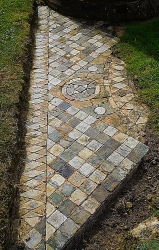
Apart from its great beauty as a ruined church, the abbey’s vast former church has something that I cannot recall ever having seen at other ruined abbeys I have visited. Exposed to the open air and risking being trod upon by visitors are many quite large expanses of mediaeval floor tiling. Many of the fired clay tiles still bear their coloured glazes. There are patches of tiling where they are laid out in circular geometric patterns. It was surprising to see such a great number of these tiles because even in many of the still intact British churches and cathedrals, such ancient flooring is quite rarely preserved to such an extent as in the ruined Byland Abbey.
I was told that when the abbeys were dissolved by Henry VIII, their roofs were removed, and this ensured that the buildings became unusable and fell into decay. The west end of Byland’s huge church contains the remains of a masonry circle that was once the frame for an enormous rose window, believed to be a prototype for the rose window that still can be seen at York Minster. While the Minster is a sight not to be missed, so is Byland Abbey. The latter might not have such a spectacular location as the ruins at Whitby and Rievaulx, it is, in my opinion, a far more interesting place to explore.






 yamey
yamey 