In most churches, one can light candles when saying prayers.
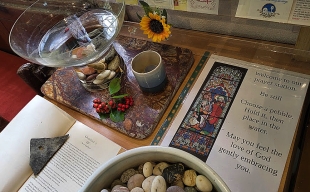
At St Winnow in Cornwall, we noticed something quite different. A bowl filled with water was standing on a table next to a bowl filled with pebbles. Those wishing to make a prayer, are invited to take one of the stones and place it into the water, instead of lighting a candle. We were told by someone working in the church that the stone dropping is a Celtic Christian tradition. I have since read that it might also have been a pagan tradition.
DURING THE REIGN of King Henry VIII, many English churches were vandalised because of the monarch’s divorcing the country from the Roman Catholic Church. Many artefacts were destroyed in churches to erase their connection with the Church in Rome. These included carvings and stained-glass windows. Holy Trinity Church in the wool town of Long Melford in Suffolk was no exception. Above the south entrance to the church, you can see empty stone frames that once contained stone effigies of saints. Much of the 15th century church’s mediaeval stained-glass was also destroyed.
Luckily for us, some of the stained-glass survived. This is because it used to be located in the windows of the clerestory high above the long nave – out of reach of the people sent to destroy it. In recent times, the surviving windows have been restored and placed in the windows lining the north wall of the church. These windows are much lower than those in the clerestory, and are easily viewed from the ground. The windows depict both dignitaries and religious subjects, which were the main targets of the vandals who were destroying religious images.
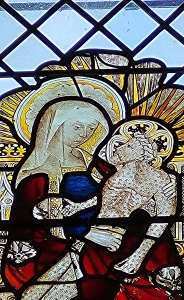
One of the windows is particularly interesting because it shows the Virgin Mary holding the dead body of Christ soon after it had been removed from the Cross. In other words, it is what is known as a Pietà. This subject matter was, and still is, extremely important in Roman Catholic imagery, and had they been able to reach it, those who attacked the church would have certainly wanted to destroy this. A knowledgeable gentleman, who was helping in the church, told us that the pre-Reformation Pietà in the church was an extremely rare survival from the time before Henry decided to break with Rome. What is more is that unlike many images of the Pietà, the dead Christ is shown with his eyes wide open.
The Pietà image in the surviving mediaeval stained-glass is just one of many interesting things that can be seen in the magnificent, large parish church at Long Melford. As the Michelin Guidebooks often say, the place is “worth a detour”.
THE HAZIRA MAQBARA is an impressive octagonal structure in Baroda (Gujarat). It was built in about 1586 in the Mughal style of architecture, such as can be found in Delhi. This beautiful mausoleum houses the graves of Qutb-ud-din Muhammad Khan who was the tutor of Salim, son and successor of Akbar, and also that of his son Naurang Khan who held important posts in Gujarat under Akbar. There are other graves within the building and also nearby on land near it.
The various graves are covered with colourful cloths upon which red rose heads are placed. The roses are replaced daily, and the cloths every Thursday. This we were told by an elderly man who had been praying loudly within the main central chamber of the mausoleum.
Apart from the beauty of the building and its wonderful jaalis (latticework window screens), I was impressed by some things that I have noticed in many other Muslim mausoleums in India.
Incense stick near some gravestones
Within the mausoleum and close to the graves outside it, there were incense sticks (agarbatti) burning, releasing small clouds of fragrant smelling smoke. Within the mausoleum, I spotted at least two oil lamps (diyas), each with small flickering flames.
Agarbatti and diyas are commonly found in Hindu temples, and often at the beginning of the day in shops, restaurants, etc. I first noticed them being used in Islamic settings in India in Sufi dargahs (shrines containing graves) in Bangalore when going on excellent guided walks led by my friend Mansour Ali. Later I begun noticing these things, which I had initially assumed were only associated with Hinduism, in places associated with Islam. I have discussed this commonality of Hindu and Muslim practices in one chapter of my new book about travels in India, which is available from Amazon (eg https://www.amazon.co.uk/HITLER-LOCK-OTHER-TALES-INDIA/dp/B0CFM5JNX5/ ) AND if you live in India, from https://store.pothi.com/book/adam-yamey-hitler-lock-and-other-tales-india/ .
Other chapters in my book about my experiences of visiting India cover a wide variety of subjects. The book, which is aimed both at those who ‘know’ India and those who do not, is both informative and entertaining.
YOU NEVER KNOW WHAT you might discover when you stop in a small English town or village. And wherever you halt, you are highly likely to find something intriguing. Camelford in Cornwall is no exception to this. We stopped there to buy meat from Steve Heard Quality Butchers, and their meat is so excellent that we have shopped there twice in the last few days. After our second visit to the shop, we strolled around Camelford and soon came across the Methodist Free Church, which is housed in a rather plain grey stone edifice. A small sign near its entrance advertised that there was an exhibition inside its entrance lobby. Luckily, the church was open, and we were able to discover something about Camelford’s missionary in China.
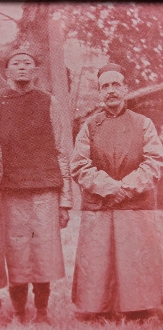
Samuel Pollard (1864-1915), the son of a Bible Christian Church preacher, was born in Camelford. After commencing a career in the British Civil Service, working in the Post Office Savings Bank in London’s Clapham, he was appointed a missionary to China in 1886. His change of career was prompted by his having attended a conference (The Southsea Methodist conference). In 1887, he set off for southwest China, where he became a Christian missionary amongst the Miao people. In 1891, he was posted to a newly opened Bible Christian mission station in Zhaotong. It was there that he began establishing a Christian movement amongst the Big Flowery Miao (aka ‘A-Hmao’) people, who live in the cold, rugged, mountainous areas of southwest China. In Zhaotong, Samuel married Emma Hainge, and they had four sons.
During the last 10 years of his life, Samuel converted 80% of the 400,000 Big Flowery Miao to Christianity. According to a Methodist website (www.myunitedmethodists.org.uk/content/people/ministers/sam-pollard):
“Sam Pollard worked from a missionary base in Zhaotong but travelled extensively around the province of Yunnan sometimes alone but usually with other missionaries or with Christian converts. From 1897 to 1904 Sam’s missionary efforts was focused on anyone who would listen. He and his colleagues held services which were often in the open air in a town centre or village market place. To gain attention he started off either banging a gong or attempting to play a concertina. Then, in order to have more effect, he blew a trumpet but he always maintained that he had little or no musical ability. As his reputation spread there was less need for this noisy introduction and simply standing up in a crowded place or advertising a meeting by word of mouth was enough. Sometimes many hundreds of people would attend and occasionally up to 3000!”
Apart from many adventures whilst living in, and travelling around, China, Pollard, who learned Mandarin at China Inland Mission training school at Ganking, is best known for a linguistic achievement. Along with several colleagues, he developed a script for the language spoken by the Big Flowery Miao. It has become known as ‘Pollard Script’. The Methodist website explained:
“‘Pollard Script’ was developed by Sam and several of his colleagues to help the A-Hmao to read in their own language. This proved a difficult task because many of the words use different tones rather than phonetics. He took inspiration from a script that had been developed by a Methodist Missionary working with North American Indians and also adapted Pitmans shorthand to indicate the level of the voice tones. Sam managed to translate much of the New Testament into this script before he died and there have been some improvements since, but it is still known as ‘Pollard Script’ and is also used by several other ethnic groups such as those that speak Tibeto-Burman languages.”
Samuel died of typhoid whilst trying to help a Chinese child suffering from that illness. Returning to the website already mentioned:
“The A-Hmao, Big Flowery Miaos still venerate Samuel Pollard as their spiritual leader. Their deep respect has survived Communism and the extremes of the Cultural Revolution right through to today. And it all started with Sam’s birth in the Bible Christian Manse in Victoria Road 150 years ago in Camelford in Cornwall!”
A recent President of China (‘reigned’ from 2003 to 2013), Hu Jintao, restored Pollard’s grave (at Weining Yi in Miao Autonomous County). He is said to have asked his officials to be like Pollard and support the poor.
Had it not been for the excellence of the butcher in Camelford, we would not have returned to the town. Because the town centre is quite picturesque, we spent some time looking around, and, as luck would have it, we stumbled across an exhibition about a remarkable man, of whom I had never heard.
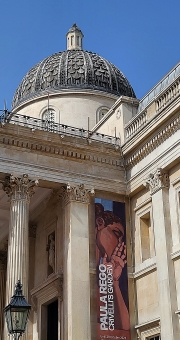
THE WORD ‘INSPIRATION’ has at least two meanings. One of them is ‘to breathe in (i.e., inhale air). When air is inhaled, many of the oxygen molecules it contains are converted to become other substances, some of which is carbon dioxide that is exhaled. Another meaning of the word is to be mentally stimulated, often by something one has perceived in the world around us. What results from this form of inspiration might not much resemble whatever it was that caused it. Today (the 6th of August 2023), we visited a small exhibition in one room of London’s National Gallery. Showing until the 29th of October 2023, the exhibition is called “Paula Rego: Crivelli’s Garden”.
The exhibition contains two major works: “La Madonna della Rondine (The Madonna of the Swallow)” painted in about 1490 by Carlo Crivelli (c1435-1495); and “Crivelli’s Garden” painted in the early 1990s by Paola Rego (1935-2022) when she was the National Gallery’s first Associate Artist between 1990 and 1992. There are also some sketches that Rego made for her enormous painting, originally designed to be a mural.
Both the Crivelli and the Rego paintings are excellent, but quite different in style. However, Rego was inspired to create her mural after seeing Crivelli’s altarpiece. Although both paintings are of religious subjects, there is no obvious similarity between the two of them. As Paola Rego said in 1992:
“If the story is ‘given’ I take liberties with it to make it conform to my own experiences and to be outrageous.”
And that is what she has done after having been inspired by Crivelli’s masterpiece.
The paintings at the base of Crivelli’s altarpiece (the ‘predella’) include scenes set in gardens. According to the National Gallery’s website, what Rego did was to reimagine:
“…Crivelli’s house and garden to explore the narratives of women in biblical history and folklore based on paintings across the collection and stories from the medieval Golden Legend. Her figures inspired by the Virgin Mary, Saint Catherine, Mary Magdalene and Delilah, share the stage with other women from biblical and mythological histories.”
She has populated her picture with portraits of people she knew including (to quote the website again):
“…friends, members of her family and staff at the National Gallery whom she asked to sit for her, including Erika Langmuir, Lizzie Perrotte and Ailsa Bhattacharya who were members of the Education Department at the time.”
The resulting work is both beautiful and fascinating, but quite different from the 15th century work which had inspired her.
Whether your artistic preferences are for art created during the Italian Renaissance or in the late 20th century, this small exhibition will not disappoint you. If you enjoy both, as I do, then this inspiring show of artistic inspiration is a ‘must see’ event.
WE HAD INTENDED to drive along the A1 directly from London to Stamford in Lincolnshire. The A1 follows the route of the old Great North Road, but tends to bypass the small towns through which the older road ran. After driving northwards for about 1 hour and 40 minutes, I spotted a brown and white direction sign pointing towards a tourist attraction, the historic town of Buckden. We left the A1 and soon found ourselves in the village of Buckden. With its three old coaching inns, it was once a stopping place for travellers on the old Great North Road. As soon as we entered the place, we spotted some impressive, mainly brick, Tudor buildings behind crenelated boundary walls. A sign by an entrance to the grounds bore the words “Claret Centre”. We entered to discover that a sale of garden plants was being set up. We were invited to wanderin around the remains of a Tudor Palace and the knot garden next to it.
The Claret Centre is housed in the extensive remains of Buckden Palace – once a property owned by the Bishops of Lincoln. In the Domesday Book of 1086, the manor of Buckden belonged to the Bishop of Lincoln. By the time that St Hugh was Bishop of Lincoln (he had that position from 1186 to 1200), there was already a Bishop’s house in Buckden. St Hugh was by all accounts a remarkable man. Amongst his many virtues, he protected some of the Jewish people of the city of Lincoln from massacre in the 1190s. Albert Hyamson wrote in his “A History of the Jews in England”: “At Lincoln, the Jews saved themselves by taking refuge in the castle. They were befriended by the Bishop Saint Hugh, whose death ten years later was very sincerely mourned by the local community.”
The bishop’s residence at Buckden was rebuilt several times before that which can seen today was constructed in the late 15th century. With two brief interludes, the bishop’s home and grounds remained as church property until 1870, when the property was bought by James Marshall of the firm Marshall and Snelgrove. In 1919, Dr Robert Holmes Edleston bought the by then dilapidated Buckden Palace. Keenly interested in history, Edleston extensively restored the Tudor buildings. He was an admirer of Napoleon III, and wrote two books about him. He planned to open a museum of the Frenchman’s relics at Buckden Palace and in anticipation of this project, which was never realised, inserted a commemorative plaque to Napoleon III in a wall facing the palace’s courtyard. Thanks to Edleston, there are substantial remains of the Tudor structures including an impressive square tower. This overlooks a beautifully restored knot garden, now named Queen Katherine’s Garden.
After the marriage of Katherine of Aragon (1485-1536) and King Henry VIII was annulled in May 1533, Katherine was housed in various places around England. One of these was Buckden Palace, where she was held/housed between July 1533 until 1534, when she was transferred to nearby Kimbolton Castle, where she spent the rest of her life. In December 1533, when Henry VIII sent the Duke of Suffolk to move Katherine to a more secure place, the men of Buckden resisted this and the duke had to abandon the attempt. Katherine was not the only noteworthy person to have stayed at Buckden. After her death, Henry VIII stayed there with his fifth wife, Catherine Howard in 1541. Other celebrities who visited included Thomas Wolsely, James I, Samuel Pepys, and the Prince Regent (later King George IV).
During WW2, Buckden Palace was home to refugees from the London Blitz. In 1956, Bishop Leo Parker (1887-1975), Roman Catholic Bishop of Northampton, arranged for Buckden Palace to come into possession of the Claretian Missionaries. Hence, its current name – The Claret Centre. The Claretians were founded by St Anthony Mary Claret (1807-1870) in Vich (Spain) in 1849. His followers grew widely in the Spanish-speaking world, and the movement came to Britain in 1912. After founding the first Claretian community in Hayes (Middlesex), others were established at Gorseinon (Wales), Langley Park (Durham), and Buckden.
Had it not been for the sign on the A1, I am not sure that we would have ever visited, or even known about, Buckden Palace. We were lucky to find the grounds accessible because of the flower market that was being arranged when we turned up. I am not sure that it is always possible to wander about the place as freely as we did on other days. Buckden has an attractive parish church as well as the three inns already mentioned. There is a high-end boutique hotel in the George Inn. Nearby, there is also an excellent hairdresser. Even if the palace is not open, Buckden is a charming place to rest a while on a journey along the frequently busy A1.
WHILE TRAVELLING AROUND India, I have seen many trees that serve some kind of Hindu religious purpose. Often they are peepul trees, whose leaves are heart-shaped. Frequently, there is some kind of shrine next to the trunk, and often there are fine threads wrapped around the circumference of the trunk.
Near the middle of the market place in 8the Goan town of Mapusa, there is an old tree next to which there are two shrines. The tree’s leaves did not look like those of a peepul tree. What interested me was that at first sight both of the shrines, which resemble small huts, looked similar.
On closer examination, it could be seen that one of the shrines was, as I expected, Hindu, and the other was, to my surprise, Christian.
Whether this close proximity of the two shrines was pure coincidence or related to the fact that the tree provides good shade, I cannot say. Another possible explanation of the closeness might possibly be a symptom of inter-religious tolerance in this small Goan town. Who can say? Whatever the explanation for the closeness of the two shrines, it was heartening to see.
DURING SEVERAL TRIPS within the ex-Portuguese colony of Goa on the west coast of India, we have visited churches and other Christian religious establishments built under Portuguese rule. The Portuguese arrived in India several centuries ago, and finally left their colonies in 1961 when they became incorporated (or annexed) into India. One of the aims of the Portuguese was conversion of their Indian subjects to Christianity. Many of the conquered people became Christian, and many churches and seminaries sprung up in the occupied territories. We have visited quite a few of these.
In most of the churches we have seen in Goa as well as in the recently opened Museum of Christian Art in Old Goa, we have noticed that depictions of angels saints, and Christ himself have facial (and other) features that are typical of Indian physiognomy. This is not too surprising as many artefacts in the churches of Goa were created by Indian artists.
When we visited the Museum of Christian Art in Old Goa, we saw two depictions of Baby Jesus lying on what looked just like typical Indian ‘charpoys’ (traditional Indian beds). The Holy Child in each case is a tiny doll. What fascinated me is that the dolls were wearing the sort of tiny bangles that are often worn by small Indian babies. One of the tiny models of Jesus was also wearing earrings.
Moving away from Christian sculptures and paintings, which have incorporated Indian characteristics, day to day Christian worship in India often incorporates features with origins in Hindu ritual practice. One example is the use of flower garlands (‘malas’), which is just as common in Christian settings as it is in Hindu settings.
Christianity was introduced to India not only by the Portuguese, but by others including St Thomas (apocryphally), and various European invaders. However, despite its foreign origins, India was not only affected by the Christian religion but has also made its mark on it.





 yamey
yamey 