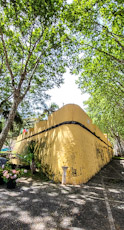
The oldest existing European building in India was built by the Portuguese

VASCO DA GAMA and his Portuguese crew set foot on Indian soil near Calicut in Kerala in 1498. The Portuguese were not the first Europeans to arrive in India: Romans had traded with India long before the fifteenth century,  but there are no known remains of any structures they might have built. Despite the lack of any structures known to have been built by the Ancient Romans, many Roman coins have been found in India.


In 1503, five years after Vasco arrived, some Portuguese sailors erected a wooden fortress at Pallipuram, about 18 miles north of the present Fort Kochi and 100 miles south of Calicut. Two years later  this fort was replaced by a hexagonal stone structure. This two-storey edifice is believed to be India’s oldest existing building built by  Europeans.
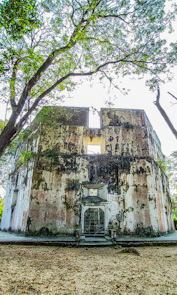
 

The upper storey of the fort, on which would have been placed canons, no longer exists. Each of the fort’s six walls are about 6 feet thick, 32 feet wide, and 34 feet tall. They contain 18 former embrasures for cannon.


A staircase leads from the ground to the ground floor of the fort. Next to this, there is a circular plaque with the words: “Pallipuram Fort. The most ancient European building in India.  About 1503. Conserved as a historic relic by the Government of Travancore. AD 1909”.


The fort remained in Portuguese hands until 1661, when it was captured by the Dutch. Then the Dutch sold it to the Kingdom of Travancore in 1789. It remained under the control of Travancore until India became independent in 1947.


Today, although little remains to be seen apart from the hexagonal walls, it is fascinatingly evocative to visit a place with such an interesting history. Located within its peaceful grounds there is a square pond (tank) filled with water. I have no idea how long that water feature has been in existence. 


Standing looking it in the hot humid heat on a January afternoon, I wondered how the sixteenth century Portuguese managed to bear the uncomfortable climate and survive in this fort that was once surrounded by steamy jungle.

An Albanian who fought the Portuguese in India during the 16th century

MY NEW BOOK IS ABOUT THE LIFE AND ADVENTURES OF AN ALBANIAN HERO WHO FOUGHT THE PORTUGUESE IN INDIA DURING THE 16TH CENTURY

AN ALBANIAN IN INDIA” is available

as a paperback and a Kindle eBook from Amazon:

ABOUT THE BOOK

The Albanian, known as ‘Khwaja Safar’, was born in southern Italy. Just as the Albanian national hero Skanderbeg fought the invaders of Albania, Khwaja Safar valiantly opposed the invaders of his adopted country – Gujarat.

After serving as a soldier in Italy, he went to sea as a trader, and was successful. While sailing in the Red Sea, he was captured by an Egyptian admiral, and taken to Cairo. He was presented to the Sultan. Khwaja rose rapidly to become the treasurer and trusted advisor ruler of Egypt’s ruler. From Egypt, he travelled to Yemen, and then to Gujarat in western India, where he became a formidable opponent of the Portuguese, who were aggressively attempting to monopolise trade in the Indian Ocean. With his knowledge and experience of the tactics of European armies, he became Portugal’s most formidable opponent in 16th century western India.

My book (also available as a Kindle eBook), “AN ALBANIAN IN INDIA”, is illustrated with pictures and maps. It describes Khwaja Safar’s extraordinarily exciting life and my visits to places where he made his mark in India.

CLICK BELOW TO REACH THE AMAZON PAGE FOR MY NEW BOOK:

Apologising for the weather

I praised Ryanair after our flight from Stansted to Funchal in late April 2023. The return flight to Stansted (in May 2023) was delayed because of weather conditions at Funchal’s airport. This was not the airline’s fault. However, I regret to say that the Portuguese airport staff at Funchal handled this delay badly and rudely.

The flight back to London was as good as can be expected on a budget airline. Despite not being responsible for meteorological conditions, the pilot could not stop apologising for the delay.

Where the Portuguese landed

A GUIDE BOOK to Madeira suggested that before the Portuguese set foot on Madeira, there had been others from different places. Some of these earlier settlers are said to have been travelling on an English ship from England to Portugal. However, the boat was blown off course and ran aground on the shore of Madeira, near where the town of Machico stands today. Two of the passengers on the ship were the English lovers Robert Machim and Anne d’Arfet, who were fleeing England where their relationship was not approved of. They are supposed to have died on the island. Later, their (?) graves were discovered. Fascinating as this is, the veracity of the story is questionable.

18th century fort in Machico

What is most certain is that the Portuguese Joao Goncalves Zarco and Tristao vaz Teixeira landed on the beach at what is now Machico in July 1419, and in so doing helped initiate the erstwhile worldwide Portuguese empire.

In 1440, Teixiera and his descendants were awarded the Captaincy of Machico – the first on the island of Madeira. In the middle of the 15th century, the settlers on Madeira began growing sugar cane. In those days, sugar was a valuable commodity, much desired in Europe. The prosperity of Machico increased.

Today, Machico is a pleasant town with a promenade running along the seafront. Three churches survive from earlier times. We visited the Igreja de Nossa Senhora da Conceição, whose construction was completed by the end of the 15th century. Between it and the sea front, there is a small fortress – Forte de Nossa Senhora do Amparo, which was constructed in about 1706. We saw a few market stalls next it. One if them, a florist, was selling gorgeous pink proteas.

Machico is a 50 minute bus ride from Central Funchal, the city that replaced it as Madeira’s capital by the early 16th century . The journey is spectacular with great views of the sea and the mountains, but because of the incredible windiness of the roads, it is not ideal for those prone to motion sickness.

An amazing bookshop in Madeira

I AM ADDICTED to visiting bookshops. In the heart of Madeira’s capital, Funchal, not far from the cathedral in a steep narrow street stands the Livraria Esperança. Founded in 1886, this bookshop is the largest in Portugal, and maybe one of the largest in Europe. It is housed on three storeys of an 18th century Palace. On each floor, there is a veritable warren of rooms, each filled with books and magazines.

The unique feature of this well stocked bookshop is that each book is displayed so that its whole front cover can be seen. This differs from many other bookshops in which most books are shelved so that only their spines can be seen. Many of the books in the Livraria are held between the jaws of clips hanging from pegs on the bookshelves.

Although books are arranged according to subject matter in different rooms, within each of these rooms the books seem to be randomly arranged. For example, a book about Salazar might be hanging between one about Roman archaeology and another about East Timor. I am not sure how the salespeople lay their hands on a particular volume that a customer requires.

More than 99% of the books are in Portuguese. There is a small collection of books in other languages. I do not understand Portuguese sufficiently well to read a serious text in that language. So, sadly I left the wonderful shop without having made a purchase.

Roosters on the roof

ALL BUT THE MOST unobservant visitors to Goa will notice that some houses are decorated with models of roosters or saluting soldiers. These models often adorn roofs, but can also be found attached to other external parts of a house.

The roosters/cockerels were commonly added to houses, which were built in the Portuguese era (before 1960), and indicated that either their inhabitants were Catholic and/or pro-Portuguese.

The saluting soldiers (‘soldados’ in Portuguese) might indicate that someone in the house had been in the military. Alternatively, some people, who had been in favour of Goa becoming independent of Portugal, added these after India had ‘liberated’ Goa from Portugal.

In addition to poultry and soldiers,so.e houses are decorated with lions. I have seen it suggested that these are in remembrance of the Kadambas, who ruled Goa during the 3rd to 5th centuries AD.

Despite many modern buildings sprouting up in Goa, there are still plenty of picturesque old edifices to enjoy. And some of these display the decorative features described above

Baby Jesus with bangles

DURING SEVERAL TRIPS within the ex-Portuguese colony of Goa on the west coast of India, we have visited churches and other Christian religious establishments built under Portuguese rule. The Portuguese arrived in India several centuries ago, and finally left their colonies in 1961 when they became incorporated (or annexed) into India. One of the aims of the Portuguese was conversion of their Indian subjects to Christianity. Many of the conquered people became Christian, and many churches and seminaries sprung up in the occupied territories. We have visited quite a few of these.

In most of the churches we have seen in Goa as well as in the recently opened Museum of Christian Art in Old Goa, we have noticed that depictions of angels saints, and Christ himself have facial (and other) features that are typical of Indian physiognomy. This is not too surprising as many artefacts in the churches of Goa were created by Indian artists.

When we visited the Museum of Christian Art in Old Goa, we saw two depictions of Baby Jesus lying on what looked just like typical Indian ‘charpoys’ (traditional Indian beds). The Holy Child in each case is a tiny doll. What fascinated me is that the dolls were wearing the sort of tiny bangles that are often worn by small Indian babies. One of the tiny models of Jesus was also wearing earrings.

Moving away from Christian sculptures and paintings, which have incorporated Indian characteristics, day to day Christian worship in India often incorporates features with origins in Hindu ritual practice. One example is the use of flower garlands (‘malas’), which is just as common in Christian settings as it is in Hindu settings.

Christianity was introduced to India not only by the Portuguese, but by others including St Thomas (apocryphally), and various European invaders. However, despite its foreign origins, India was not only affected by the Christian religion but has also made its mark on it.

The Old year in flames

The ending of the old year and beginning of the new one is celebrated all over the world in a variety of ways and at different times of the modern calendar. For example, the Chinese, the Gujaratis, the Parsis, the Jewish people, and the Russian Orthodox all celebrate the start of a new year on different dates. People, whatever their personal beliefs, also celebrate the end of the year on the 31st of December.

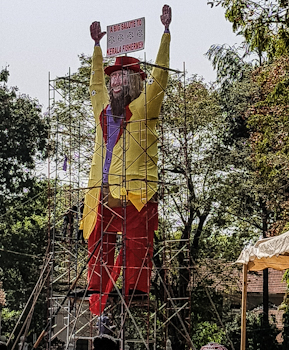
Cochin, which is a historic port in the southern Indian state of Kerala, was a Portuguese colony for a while in the 16th and 17th centuries. The Papaanji (spelling varies!) is named after a Portuguese word meaning ‘old man’.

Every year, a giant Papaanji is erected in a centrally located open space in historic Fort Cochin. During the afternoon of New Year’s Eve, the Papaanji is stuffed full of dry straw and fireworks. The roads around the open space are closed to motorised traffic. Despite this, a few youths on motor bikes manage to enter illegally.

After sunset and during the evening of the 31st of December, the area around the Papaanji fills with vendors and ever increasing numbers of people. Some of these merrymakers wear masks and others wear glowing red devil’s horns.

During the few minutes before midnight on the 31st, unbelievable numbers of people gather. The strong tide of people resembles a powerful surge of water such as you might expect if a large dam has just been breached. The crowd adds much noise to the cacophony of sound being relayed over various loudspeakers. Several times, I was almost knocked over by this human tsunami.

At midnight, the crowd became even noisier when flames began leaping from the ignited Papaanji. First, I could only see billowing clouds of smoke. Soon, frightening flames became visible. Then, bursts of stars appeared as the fireworks exploded.

Within minutes, the conflagration and fireworks ended. The old year, represented by the Papaanji, had been burnt out to make way for the new one. The crowds began to thin out a little, but despite that, it was quite hazardous trying to leave the area.

For an hour or two after midnight, boisterous revellers created much noise in the streets. The whole affair seemed to be generally good natured.

I am glad that I have seen the Papaanji aflame, but once in a lifetime is enough for me.