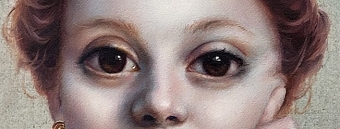
GINNY ON FREDERICK is a tiny art gallery at 99 Charterhouse Street, next to Smithfield meat market. We had never heard of it before, and after seeing it mentioned in the Financial Times newspaper, we went there today (11 March 2026) to view a collection of portrait paintings by British-born Hanna Murray (b. 1994). She received her MFA from New York Academy of Art in 2021, and now lives and works in Brooklyn, New York (USA). Like the gallery, the artist was new to us.
The six paintings on display were all portraits, beautifully executed. What makes each of them special is the artist’s depictions of her subjects’ eyes. They are literally eye-catching, and especially alluring. Along with her choice of colouring, the eves give the portraits an almost dreamlike quality, slightly weird but in a positive way. The gallery’s excellently written handout mentions the eyes, suggesting (quite correctly) that the subjects depicted:
“ … appear to observe themselves being observed.”
Difficult to find because it is so small and without a noticeable sign outside it, Ginny on Frederick was well worth the visit, and seeing the works by Hannah Murray was a delightful experience.
WHEN A FRIEND invited us to join him at London’s Kenwood House to view an exhibition of portraits by the artist John Singer Sargent (1856-1925), I had some misgivings. In the not-too-distant past I saw an exhibition of his portraits at the Tate Britain, and I left it unimpressed. In that show, the portraits were displayed alongside the dresses that the sitters had worn for their pictures. In contrast, the show, which is on at Kenwood until 5 October 2025, was very satisfying.
Between 1870 and 1914, 102 American women married men in the British peerage, and more than this married into the British upper class. Put bluntly, the men were enriched by their American brides’ money, and the ladies acquired social positions that were highly regarded in British society. Regarding these marriages, Theodore Rooseveldt said:
“I thoroughly dislike … these international marriages … which are not even matches of esteem and liking, but which are based upon the sale of the girl for her money and the purchase of the man for his title.”
Sargent, the artist, made portraits of more than thirty of these brides, and it is a selection of these that are on display at Kenwood in an exhibition appropriately named “Heiress. Sargent’s American Portraits”. Each picture is accompanied by an information panel that gives interesting biographical details about the ladies.
Undoubtedly, Sargent’s grand portraits made with oil paints on canvas are superb. However, even better than these, and there are several on display at Kenwood, are his charcoal sketches. Unlike the paintings that required the subject to attend 6 or more sittings, the charcoal portraits were completed in one sitting. Despite or maybe because of the rapidity of completing the charcoal images, these portraits seem to be even more expressive than the oil paintings upon which he had spent far more time. During a period of 20 years, he completed almost 700 charcoal portraits. Although there might have been one or two of his charcoal portraits at the Tate exhibition, a great proportion of the exhibits at Kenwood were examples of Sargent’s superb charcoal technique. For me, the highlights of this small exhibition were the works executed in charcoal.
I left the show at Kenwood feeling pleased that I had been, and with a greater appreciation of Sargent’s talent than I had before.
AMOAKO BOAFO WAS born in Accra (Ghana) in 1984, where he works and lives. After teaching himself to draw and paint in his childhood, he was engaged in various professions before he studied art at Ghanatta College of Art and Design in Accra. There, he was awarded a prize for being the best portrait painter in his year. In 2013. Boafo moved to Vienna (Austria) where he was the co-founder of a centre for artists of colour and LGBTQ+ voices.
Because of the marginalisation of Black people he noticed in Austria, Boafo began to specialise in portraying Black people. As the gallery’s website noted, he is:
“Inspired by the expressionistic portraiture of Vienna Secession artists Gustav Klimt and Egon Schiele, he counts among his contemporary influences Jordan Casteel, Maria Lassnig, Kerry James Marshall, and Kehinde Wiley.”
Looking at the faces in Boafo’s paintings on display at the Gagosian Gallery in London’s Mayfair until 24 May 2025, I could see the influences of Klimt and Schiele in them. Many of the paintings include depictions of patterned fabrics and wallpaper. What makes his paintings fascinating is that instead of using brushes, Boafo paints the faces and bodies of his subjects with his fingertips. The effect produced is curiously mosaic-like.
Part of the exhibition in Gagosian is hung conventionally in a large room. In another part, in a separate room, Boafa’s paintings have been hung in a life-size reconstruction of the courtyard of his childhood home in Ghana. In addition to the paintings, there is a display of playing cards designed by the artist. In brief, I am pleased that we visited this exhibition of works by a refreshingly original artist.
THE BEN URI gallery in was established in 1915 in London’s East End. Named in honour of Bezalel Ben Uri, the craftsman who designed and built the Ark of the Covenant, it moved to Boundary Road in St Johns Wood in 2002. Originally, it was a place where Jewish immigrant artists and craftsmen could display their work. More recently, it has widened its remit to feature artists of all religions, who have migrated to Britain from other countries.
Until the 29th of November 2024, the gallery is holding an exhibition of works by an artist born in Goa (part of India since 1961): Lancelot Ribeiro (1933-2010). He came to England to study accountancy in 1950. He disliked the subject. At first, he lived with his half-brother, the artist FN Souza. Later, he resided in Hampstead. In 1951, he began studying art at St Martins School of Art, where my mother created sculpture between 1950 and the mid-1960s. The exhibition at the Ben Uri focusses on Ribeiro’s work in the field of portraiture, and displays his innovative and imaginative approach to this form of art. The exhibition is small but well displayed. I felt it was a more satisfactory showing of Ribeiro’s art than the exhibition that was held recently at Hampstead’s Burgh House.
UNTIL AUGUST 2024 when I visited Salford, I believed that there was little that excited me about the work of the artist Laurence Stephen Lowry (1887-1976). My first impression of this artist was back in the 1970s and ‘80s, when reproductions (posters) of his paintings of industrial landscapes crowded with stick-like depictions of people were popular items in print shops of the Athena chain. I liked the pictures, but there seemed to be little variety amongst the paintings that were reproduced for sale.
My appreciation of Lowry’s art was not improved after seeing a special exhibition of his paintings held at Tate Britain in 2013. The paintings were badly displayed. There were too many of them crowded on to the walls of the galleries. They were so densely packed into the gallery that they were difficult to examine carefully. As far as I can remember, there was little difference between the subject matter depicted in the paintings. Most of them were of the kind that I had seen reproduced in the Athena shops. I came away from the exhibition neither being impressed by it nor having gained more admiration for Lowry.
So, in August 2024 when we headed for The Lowry, a modernistic cultural centre at Salford Quays in Greater Manchester, which contains a collection of artworks by Lowry, my enthusiasm was somewhat dampened. The Lowry itself is a successfully adventurous example of modern architecture, which is well worth seeing. It contains a gallery devoted to the works of LS Lowry. Our visit to this gallery, which contains about 400 of his artworks, was, as the saying goes, ‘mind-blowing’. First of all, in comparison with the 2013 exhibition at the Tate, the works of art are extremely well displayed. Secondly, and more importantly, what we saw completely changed my mind about Lowry’s works.
Although there were several of Lowry’s works in the style favoured by customers of Athena’s outlets, these wonderful pictures were outnumbered by other images which demonstrate Lowry’s versatility as an artist. Lowry painted many faces and portraits, all of which convey the personalities of the people portrayed and the artist’s sometimes quirky or humorous perceptions. There are numerous images – both sketches and paintings – of ships. There are evocative landscapes devoid of people. Most surprising to me, are his paintings of seascapes, which are so brilliant that they put Lowry alongside Turner in his ability to capture the sea on canvas. Apart from paintings, there are numerous sketches and ‘doodles’ on display, each one of which demonstrates Lowry’s skill as a draughtsman.
The immense variety of what is on display in the gallery in The Lowry demonstrates the amazing diversity of LS Lowry’s depictions of life in Lancashire and elsewhere. The exhibition at Salford Quays opened my eyes to his brilliance, and now I realise how wrong I was when I came to a judgement of his talents before having discovered how wide a range of art he created so skilfully.
PETWORTH HOUSE IN West Sussex is a huge palace maintained by the National Trust. It contains an unbelievably remarkable collection of old master paintings, including many by Joshua Reynolds, JMW Turner, and Anthony Van Dyck (1599-1641). The paintings and many sculptures were collected by the 3rd Earl of Egremont, George O’Brien Wyndham (1751–1837), who was a patron of JMW Turner and John Constable, both of whom were regular visitors at Petworth House. When we visited the house in August (2024), we saw the paintings by Turner, but did not notice any by Constable. A full list of the paintings in Petworth is listed at: www.wikidata.org/wiki/Wikidata:WikiProject_sum_of_all_paintings/Collection/Petworth_House .
While viewing the overwhelmingly splendid artworks at Petworth, a pair of paintings by Van Dyck intrigued me. Painted in 1622, one depicts Sir Robert Shirley (1581-1628), and the other his wife Lady Theresia Shirley (1589-1668). They are fine portraits, but what interested me was the lives of these two people.
The Safavid dynasty ruled Persia from 1501 until 1736. In 1598, Robert Shirley travelled to Safavid Persia with his brother Anthony to train the Shah’s army in the military techniques used by the English army. It is not clear who put the idea of visiting Persia into the minds of the Shirleys. One suggestion is that it was mooted by the Venetians. The modernisation of the military supervised by the Shirley brothers improved the fighting ability of the Persian army to such an extent that they were able to score a great victory in a war between the Safavids and their Ottoman neighbours in 1612. After Anthony left Persia (in about 1600), Robert stayed behind with 14 other Englishmen. In 1607, he married Sampsonia, whose portrait by Van Dyck hangs in Petworth. She was a Christian lady born into the Circassian nobility of Safavid Persia. After being baptised, she added the name Teresia to her own name, and became known as Lady Teresia Sampsonia Shirley.
The Safavid Shah Abbas (ruled 1587-1629) sent Robert to England in 1608 to encourage King James I to join a confederacy against the Ottoman Empire. While in Europe, Robert visited other rulers for the same reason. Between 1609 and 1613, he lived in Spain. His wife travelled from Persia to join him there. Between 1613 and 1615, Robert was back in Persia. Then, he returned to Europe, and resided in Spain.
It was in Rome in 1622 that Van Dyck painted the portraits of Sir Robert and Lady Teresia now hanging in Petworth. They were dressed in lavish Persian clothes. It has been suggested that these ‘exotic’ outfits attracted Van Dyck, but by 1622 this couple were already sufficiently celebrated to be worthy of the artist’s attention regardless of how they were attired.
Shirley’s final visit to Persia was in 1627, when he accompanied Sir Dodmore Cotton – England’s first ambassador to Persia. However, soon after arriving there, he died in Qazvin (now in northwest Iran). His wife took his remains to Rome in 1658. She retired to a convent in that city, and lived there until her death.
I have discussed only two of the multitude of paintings at Petworth. Most of the others we saw there were not only by great masters, but also worthy of study. Although the design of the rooms in Petworth is not as spectacular as in many other stately homes, the collection within it deserves a leisurely visit. And as there is so much to see in the way of artworks, the visitor should plan to spend several hours there. We were there for three hours and that was hardly long enough.
ONE OF MY FAVOURITE National Trust properties in England is Trerice, which is about 2.3 miles south of the Cornish town of Newquay – not one of my favourite places in Cornwall. We visit the house and gardens at Trerice every time we spend time in Cornwall, and always discover soothing there that we had not noticed before.
This tine (June 2024), one of the volunteers working in the house pointed out a painting by John Opie (1761-1807). I had not come across his name before. Our informant told us that he had been born in Cornwall, and thought that he had been involved with the establishment of the Royal Academy. He was born at Trevallas between St Agnes and Perranporth, both of which are not far from Trerice. At an early age, his artistic talents became evident, but his father, a carpenter, wanted John to become a carpenter. A physician, Dr Wolcot, met him at the place where he was an apprentice, and reecognising John’s artistic skills, paid for him to be released from his apprenticeship. Wolcot encouraged Opie, and by the start of the 1790s, he was a successful portraitist in Cornwall.
In 1781, Wolcot took Opie to London, where his works were admired by great artists of the time including Sir Joshua Reynolds, who compared John’s work to that of Caravaggio and Velasquez. A year later, Opie began working independently of Wolcot, who had been supporting him up until then. An acquaintance of Dr Wolcot introduced Opie to the court of King George III. This led to Opie being commissioned to paint portraits of people of high rank in English society and royalty. In 1886, he was elected a full member of the Royal Academy, and in 1805 he was appointed a professor in that esteemed institution.
There are three paintings by Opie hanging on the walls of Trerice house. One is a portrait, and another a self-portrait. The third, which depicts three people playing cards, is a copy of the same picture that can be seen at Petworth house. The version at Trerice is believed to have been painted by Opie and others in his studio. Each of the three people in it have smiles. It is thought that in this painting, Opie was experimenting with the depiction of smiling. Although attractive, this picture is not as attractive as his other two paintings in Trerice.
It is always pleasant to re-visit places, and always exciting to discover something one had missed on earlier trips to that same location. As well as the lovely interiors at Trerice, the gardens surrounding it are always a joy to behold.
RECENTLY I PUBLISHED a book about the highly innovative Victorian photographer Julia Margaret Cameron (‘JMC’; 1815-1879). She married a British colonial administrator and lived during the heyday of the British Empire. In my book, I tried to portray her sympathetically, but I do hint briefly that she was a ‘child of her times’ as far as he attitudes towards the colonised was concerned. Today, the 11th of July 2023, I paid a visit to London’s National Portrait Gallery (‘NPG’) to see how JMC and her works are currently presented.
JMC was a friend of the painter George Frederic Watts. His portrait of her hangs in the NPG. Another portrait by Watts hanging in the gallery depicts the historian and social commentator Thomas Carlyle (1795-1881). Nearby in another room, you can see Carlyle as portrayed in a photograph taken by JMC. This photograph is close to JMC’s photograph (see photo above) of Edward John Eyre (1815-1901). As British Governor of Jamaica, this gentleman was responsible for the brutal suppression of a revolt against British rule on the island. Under his command, 1000 homes were burned and 439 people were killed. Although this outraged many in Britain, it was defended by people such as Carlyle. Eyre’s portrait, made whilst he was awaiting trial, was, according to the NPG’s label, crafted by JMC to make him seem as if he was vulnerable and not:
“… a ruthless murderer but a sensitive man of duty.”
Another caption, next to a photograph of JMC by an unknown photographer suggests that her:
“… photographs are admired for their beauty and artistry. They also reflect the values of the Victorian era. Her portrait of Governor Eyre indicates her support for him following his violent suppression of the Morant Bay uprising.”
From what I have just written, you might get the impression that someone who composes the labels in the NPG is disapproving of JMC. Much as I feel that JMC’s apparent support for Eyre (and Carlyle) is not to my 21st century taste, one must remember that Cameron was living in a time when any uprising in the colonies would have been regarded as a dangerous – even apocalyptic – threat to the privileged life that she and her contemporaries enjoyed.
In all fairness to the NPG, they also have on public display one of JMC’s photographs of a less controversial sitter – the scientist Sir John Herschel (1792-1871). JMC met him in South Africa whilst she was convalescing from an illness she caught in India where she was living in 1837. It was Herschel who sparked off JMC’s enduring fascination with photography, which really ‘took off’ when she received her first camera in late 1863. She was then living on the Isle of Wight next door to her friend the poet Alfred Lord Tennyson.
JMC did not confine herself to taking photographs of defenders of colonialism. She made wonderful photographs of anyone she could find – both famous and completely unknown. What distinguished her work from that of her contemporaries is that, by experimenting with techniques in the studio and also in the darkroom, she created photographs that were works of art rather than slavish attempts to record real life accurately. Like great portrait painters, her photographic portraits give the viewer a sense of the sitter’s inner personality as well as his or her physical appearance.
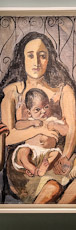
DESCRIBED AS THE FIRST living artist to have had a retrospective exhibition in the Soviet Union, the American painter Alice Neel (1900-1984), there is a superb exhibition of her art at the Barbican Centre in the City of London until the 21st of May 2023. Alice, who was born in a small town in Pennsylvania, led a colourful life – and by this, I am not referring only to her paintings. Politically, she was leftward leaning. In 1935, she joined the US Communist Party and remained a member throughout the McCarthy era and after it. She participated actively in anti-fascist activity before WW2. Some of the portraits she painted were of Marxists and members of the US Communist Party. Maybe, it was this political activity that got her, her family, and her paintings invited to Moscow in 1981. She was a Communist but objected to the bureaucracy associated with the Party. In late life, when she was asked about her political views, she replied that she was “an anarchic humanist.”
During the Great Depression that hit the USA in 1929, President Franklin Delaney Roosevelt initiated the New Deal programme to deal with the unemployment crisis. In 1933, as part of this the Public Works Art Project was set up, and Alice joined it immediately. She was paid US $26.88 per week to produce a painting every six weeks. Her works done for this organisation and its successor, the Federal Art Project of the Works Progress Association, depicted urban scenes of adversity and social injustices. These paintings were her own brand of Socialist realism. I liked what was on display.
Alice remained a figurative artist throughout her life and throughout the period when most of her fellow American artists were moving away from the figurative and increasingly towards the abstract. The highlights of the exhibition are her portraits, some of them of subjects who have removed their clothing. In all of her portraits, she gets beneath her subjects’ clothing or external appearance and portrays not what a conventional portraitist depicts, but the personalities of her subjects as she understood them. The results were not always liked by her subjects, but the viewer can get much more of an idea of what the people would have been like had we been lucky enough to meet them. Like the Victorian photographer Julia Margaret Cameron (1815-1879), Alice’s portraits are not a slavish reproductions of nature but a wonderful attempt to portray what lies beneath the surface – the subject’s soul and character. She once said:
“As for people who want flattering pictures of themselves, even if I wanted to do them, I wouldn’t know what flattery is. To me, as Keats said, beauty is truth, truth beauty … I paint to reveal the struggle, tragedy, and joy of life.”
Included at the Barbican’s exhibition, there is a documentary film about Alice made by Nancy Baer. Alice was filmed in various situations, and comes across as a delightful person. Some of the scenes in the documentary show her at work on a portrait. What impressed me when watching these scenes in her studio was her ability to create straight from life unwaveringly. She looked at her subject and without faltering painted elements of the portrait that did not need adjusting. Her eye-brain-hand coordination looked to be superb.
“…a wall text incorrectly refers to Neel’s 1981 Moscow exhibition as being by the “first living artist to have a retrospective in the Soviet Union,” whereas many artists including Yuri Petrov-Vodkin, Alexander Deyneka, Pablo Picasso and Fernand Leger had exhibited there from the 1930s onwards.”
They may well be right, but whether the artists mentioned were showing a few of their works rather than a retrospective covering their whole output until the date of the exhibition, is a question I cannot answer. In any case, it was no mean achievement to have been both invited to exhibit in Moscow during the Cold War and to have been elected to the American Academy and Institute of Arts and Letters (in 1976).
Once again, I must admit my ignorance: Alice Neel was an artist who was new to me. However, I am pleased that she is now on my radar. I can strongly recommend visiting the exhibition at the Barbican for an exciting visual feast.



 yamey
yamey 