Raise your eyes in this church in central London

THE STRAND IS a street in the heart of London, which runs close to the River Thames. It used to be close to the water. Hence, its name. Two churches stand like islands in this busy thoroughfare. One of them is St Clement Danes, and to the west of that is St Mary Le Strand, which we entered today (the 17th of May 2024) after visiting the Photo London exhibition at nearby Somerset House.

St Mary Le Strand was designed by James Gibbs (1682-1754) and constructed between 1714 and 1717. It was built on the site of a great maypole, which was the centre of May Day celebrations in the 16th and 17th centuries. The church’s interior is in an exuberant baroque style, reflecting its architect’s earlier travels and training in Italy.
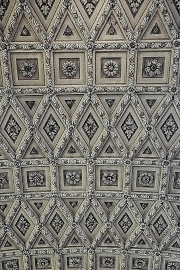
The walls of the nave are bare. It had been intended to have been painted, but this never happened. What really attracts the eye is the amazing geometric ceiling above the nave (see photograph). The ceiling is an expanse of triangles, squares, and lozenges that cover its barrel vaulting. In the centre of each of these many shapes, there is a sculpted flower. This ceiling was designed by Chrysostom Wilkins, who worked on other churches in London. It was created in plasterwork, shaped by hand, without using moulds.

St Mary Le Strand has been open less regularly than its neighbour St Clement Danes. Although I have visited the latter often, I believe that today was either the first or one of a very few visits to St Mary Le Strand. If you happen to be passing this church, and it is open, do take a few minutes to admire its wonderful ceiling.
Bringing India to Queen Victoria in England

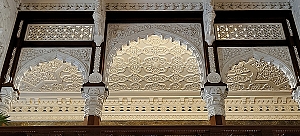
OSBORNE HOUSE ON the Isle of Wight was one of Queen Victoria’s favourite residences. Apart from one room within it, I was not overly impressed by the place. That room, which alone is a very good reason to visit Osborne, is the ornate Durbar Room. Entering this vast hall is like stepping inside an exuberantly decorated Maharajah’s palace somewhere in India. It is a superb example of the Indo-Saracenic style, which is according to one definition (on Wikipedia) was:

“… a revivalist architectural style mostly used by British architects in India in the later 19th century, especially in public and government buildings in the British Raj, and the palaces of rulers of the princely states. It drew stylistic and decorative elements from native Indo-Islamic architecture, especially Mughal architecture, which the British regarded as the classic Indian style, and, less often, from Hindu temple architecture.”

The Durbar Room was built not in India but in the country that ruled it at the time. It was designed not by a British architect but by a man from British India – Ram Singh (1858-1916), who was born in Rasulpur in the Punjab (now a village in Pakistan). His skills were recognised at a young age when he was seen working in a woodcarver’s shop in Amritsar. The man who spotted his talent was Rudyard Kipling’s father, the art teacher Lockwood Kipling (1837-1911). At the time, Lockwood was the first principal of the Mayo School of Industrial Arts, Lahore (established in 1875). He enrolled Ram as a student. Ram Singh was a successful student and soon became assistant drawing master at the school and Lockwood’s protégé. The two men collaborated in many important projects including designing Aitchison College in Lahore, the Mayo School in Lahore, and both the Indian Passage and ballroom at Bagshot Park (near Windsor). The work he had done in England led to him and Lockwood Kipling being given the commission to design the Durbar Room at Osborne.

The Durbar Room was designed to accommodate large ceremonial occasions and to reflect Queen Victoria’s exalted position as Empress of India, a role created by the British Parliament in 1876. This room, completed in 1891 as an extension of Osborne House, with its riotous array of mainly Mughal-style plasterwork decorations might have served yet another purpose. By the time it was completed, Victoria had never visited India, and at the age of over 70 years was unlikely to do so (and never did). In a way, the Durbar Room brought India to Victoria, and judging by its appearance, did so very well.

A numerical oddity in Cornwall

TRERICE HOUSE IN Cornwall was built mainly between 1570 and 1573. It is one of the loveliest National Trust (‘NT’) properties in the county and one of my top ten. In one of the upper rooms there is an ornate bas-relief above the fireplace. The top of this bears the following:

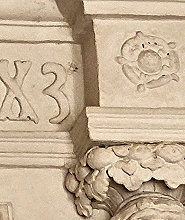
“ANNO: DOMINI: M : CCCCC : LXX3”

It is clearly a date in mostly Roman numerals, (i.e., 1573). However, this date has several odd features.

‘CCCCC’ is 500, but usually abbreviated to ‘D’ in Roman numerals. There is a surplus of colons (‘:’) and instead of ending in a Roman numeral, there is the Arabic numeral ‘3’.  Or is it the symbol for a serpent, rather than a ‘3’? It is a curiously shaped 3: it is widest at the top and tapers towards its lower end.

The NT volunteer offering information in the room with this curious date suggested three possible explanations for this peculiar form of the date above the fireplace. One is that the creator of this date miscalculated the amount of space, and instead of ending the date in ‘: III’, used the Arabic ‘3’ to fit in the last part of the date. Had he used ‘D’ instead of the unusual ‘CCCCC’, there would have been plenty of space to fit in the entire date using only Roman numerals. Another explanation offered is that the ‘3’ is really a stylised serpent, a symbol of wisdom often associated with Queen Elizabeth I, during whose reign the house was built.

3 or a serpent?

The last explanation was provided by a builder, who had visited Trerice some weeks before us. He suggested that the ‘3’ was added to indicate that the building works were supposed to have been completed in 1570, but had finished 3 years later than expected; the builders were running behind schedule.

Whatever the explanation of the curiously written date, and you might have another theory, Trerice is well worth a visit.