IT IS ALWAYS WORTH ‘popping’ into Christie’s auction house in London’s Mayfair because there is usually a display of interesting objects being displayed prior to being auctioned. When we visited the place on 16 May 2025, there was a collection of ceramics created by Pablo Picasso (1881-1973). They included plates, jugs, and decorative objects.
Picasso began producing ceramic objects in 1947. The Madoura pottery studio in Vallauris, France produced blank ceramic items, which Picasso then decorated. A website dedicated to Picasso’s ceramics (https://picasso-ceramics.org/) gives much information about the artist’s involvement in this form of art, and I have quoted from it below. The website explained that Picasso began producing ceramics because:
“… the high prices and relative rarity of Picasso’s paintings meant that most people would never be able to own one, the artist liked the idea of working in a medium that would be more accessible to the average person. He realized that pottery could be produced on a scale that his paintings could not. With prices of around $100 in the 1950s and 1960s, Picasso’s ceramic series were far more financially accessible than his previous artworks. The utilitarian nature of his pottery also made the art form more appealing to the general public, who may not understand the appeal of an abstract painting, but who could appreciate the value of a beautiful plate or pitcher.”
As he had never worked with ceramics before this, he had to develop his techniques and learn how materials behaved when they were incorporated with ceramics. However, his experience with lithography assisted him, as the following explained:
“Since Picasso had no prior training in ceramics, professional potters at Madoura would create blank ceramic objects for him to work with. He would then reshape, paint, and engrave the pottery to create his original designs. Picasso had previous experience engraving lithographs, which informed the methods he used to engrave his pottery, as well as his choice to release the pottery in numbered editions. While this numbering practice was common for lithographs at the time, it was relatively unheard of for pottery.”
The designs on Picasso’s attractive ceramics were largely inspired by Spanish folk art. The auction house beautifully displayed the objects that will come up for sale on 22 May 2025. If you are interested in owning a piece, it is an online auction: https://onlineonly.christies.com/s/picasso-ceramics/lots/3722
JUST IN CASE you are tempted to see them, here are two events in London, which I found disappointing. One of them is the Silk Roads exhibition at the British Museum. It was crowded, insubstantial, and resembled a badly lit antiques fair.
The other is the film “The Brutalist”. It is over three hours long, but that is not what irritated me. It was a gratuitous, self-indulgent, uninteresting ‘mish-mash’ of irrelevant story-telling. The only mitigating aspect of this film was the actor Adrien Brody, but I felt sorry that his talents were expended on such a pointless film.
On a positive note, I can strongly recommend viewing the excellent exhibition of Picasso’s prints at the British Museum.
SOME MIGHT DISAGREE with me, but I was extremely unimpressed by the “Silk Roads” exhibition that is being shown at London’s British Museum (‘BM’) until 23 February 2025. It seemed to be like an overcrowded, poorly lit antiques fair. Additionally, it appeared to be a rather sketchy overview of what is a highly interesting period in the history of international trade. In contrast to the over-hyped Silk Roads show, another exhibition, “Picasso Printmaker”, showing at the BM until 30 March 2025 is magnificent.
Just as Rembrandt (1606-1669) was one of the best European painters of the seventeenth century, Picasso (1881-1973) was one of the best European painters of the twentieth century. Like Rembrandt, Picasso not only painted but also created prints. During his life, Picasso created at least 2400 prints. The BM has by far the UK’s largest and most representative collection of his prints. Some of these are on display in the beautifully curated show at the museum. The exhibition displays a series of Picasso’s prints ranging from some of the earliest (created around 1905) to those he made during the very last days of his life.
The prints on display were made using several techniques including: aquatint, drypoint (engraving), etching, linocut, lithograph, sugar aquatint, and transfer lithography. He learned these techniques from some of the best printers in France, and experimented with methods of his own. Many of the exhibits are prints made with black ink on white paper, but a few contain other colours. Although the black on white images are of the highest artistic quality, the coloured prints are particularly spectacular
The prints on display at the BM illustrate that throughout his long creative life, Picasso was a highly skilled artist who was not lacking in imagination. Each print in the exhibition increased my appreciation and admiration of Picasso’s artistic output. This exhibition should not be missed if you are keen on twentieth century art and are spending time in London.
WHILE I WAS STUDYING to become a dentist (in the late 1970s), I used to attend an etching and engraving class in a studio in West Hampstead’s Sumatra Road. The class was supervised by the owner of the studio, my mother’s cousin Dolf Rieser (1898-1983). Like my mother, he was born in South Africa. They were both born in King Williams Town, but he was 23 years older than her.
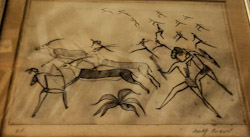
An engraving by Dolf Rieser
Dolf ‘s childhood memories evoke South Africa as it was at the turn of the century (19th/20th) and are recorded in his unfinished autobiography (dolfrieser.com). Here is an extract that gives a flavour of them:
“The climate of King William’s Town was particularly difficult to bear and my mother suffered greatly especially where her nerves were concerned. I vividly remember her awful attacks of migraine when she had to stay in a darkened room. In the end we decided to leave South Africa, as I shall relate later on . My uncle, my mother’s brother, was at that time living on the border of Basutoland. He was running a small trading post and also kept some horses and sheep. This place was right up on the high plateau and was called Moshes-Ford after the famous Basuto chief, Moshes. My uncle invited us up to him for a holiday and I think we first took a train and then had to continue by horse and carriage, which presumably was also the postal service at the time. I remember well an “ooutspan” for lunch near an immense field full of dried bones and skeletons. These were the remains of the “Rinderpest” which shortly before had nearly wiped out the cattle of South Africa. I played football with a cow or ox skull, very much to the annoyance of the grown-ups. The following night we had to spend at the German Pastor’s home and I remember how impressed I was with the enormous bed and unknown eiderdowns.”
The ’Rinderpest’ was a disease that afflicted cattle.
During his classes at Sumatra Road, he would regale us with stories of Paris in the 1920’s and 1930s, when he was there learning etching an engraving in the studios of both Stanley Hayter and Joseph Hecht. One story that sticks in my mind is how he used to attend the same Parisian café as Pablo Picasso. The great master sat at one table alongside the the other leading artists in Paris, and junior artists like Dolf sat close by at another table.
Dolf was an excellent teacher. He showed us how to etch and engrave. However, what impressed me most is that he had the ability to look at his students’ works in progress, understand what we were trying to achieve, and then provide constructive (rather than prescriptive) advice.
I really miss Dolf, even though it is so many years since he died. He had a wonderful sense of humour, was a wonderful raconteur, and, having once trained as a biologist (before becoming an artist), a wonderfully adventurous approach to his métier.
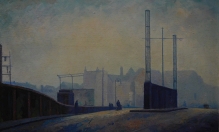
RECENTLY, WE DROVE to Southend-on-Sea in Essex to see an exhibition, “Brothers in Art”, at the town’s superb Beecroft Art Gallery. There, we enjoyed visiting a temporary exhibition of the paintings of two artists, about whom we knew nothing: the brothers Walter (1908-1997) and Harold (1911-1971) Steggles. They were members of the East London Group of artists, East End workers who created and exhibited together between 1928 and 1936. Influenced by the artists John Albert Cooper (1894-43) and Walter Sickert (1860-1942), the group produced pictures that often-depicted everyday scenes and mundane sites in a joyful way.
The Steggles were born in Ilford (east London), sons of the manager of a high-class footwear store in London’s Strand. They were not born into a family that had any history of artistic talents. At an early age, the brothers began visiting art exhibitions, including, in 1925, one at the Bethnal Green Men’s Institute Art Club at the Bethnal Green Museum. This led them to join the art classes there. Walter was 17 and Harold was 14. Unhappy with the classes at Bethnal Green, they joined the art classes conducted by John Cooper at the Bromley & Bow Institute. He encouraged the brothers to paint scenes near the institute. Soon they became members of the East London Group.
In 1928, the Group held an exhibition at the Whitechapel Art Gallery. The brothers exhibited several of their paintings at this prestigious public art venue. Many influential members of the art scene attended the show, one of them being the then director of the Tate Gallery. Several of the brothers’ paintings at the exhibition were acquired by the Tate.
The East End Group also held regular exhibitions at the Lefevre Gallery in London’s West End. The gallery, which existed from 1926 until 2002, represented leading artists including, to mention only a few, Seurat, Matisse, Degas, Picasso, Dali and Kandinski. The two brothers:
“… found themselves part of a cosmopolitan artistic milieu that included Ben Nicholson, Charles Ginner, Philip Wilson Steer, George Braque and Raoul Dufy … Before long they found themselves sought after by other galleries and Harold became a protégé of the flamboyant aesthete Eddie Marsh who lived near his office in Gray’s Inn as well as accepting a prestigious commission from Villiers David to paint the gentlemen’s clubs of St James.” (https://spitalfieldslife.com/2017/07/26/harold-walter-steggles-artists/).
Harold recalled that the first picture he sold was bought by the highly influential art dealer Sir Joseph Duveen (1869-1939) and was hung at the Tate Gallery in 1929. In 1936, Walter had one of his paintings exhibited in the Venice Biennale.
Walter and Harold sold their paintings and became prosperous enough to buy a car. This allowed them to make forays into East Anglia where they painted things they saw. Some of these East Anglian scenes were on display at the exhibition in Southend alongside their paintings of sights in London; many of these places have disappeared since WW2. Both Walter and Harold were commissioned by the Shell petrol company to create posters. These display places in England, beautifully depicted. Several of these were also on display.
Even though the brothers were successful as artists, they had to continue working in non-artistic jobs to gain a sufficient income. When Walter retired, he was able to concentrate fully on painting.
With the death of John Cooper in 1943, the East End Group declined and the works it had created faded from the artistic world’s limelight. What the group created was not as excitingly innovative as the art produced by the now better-known artists, some of which I mentioned above. However, the work of the Group and, in particular, of the Steggle brothers is of high quality and very pleasing aesthetically. It was well worth trekking out to Southend to see their paintings.
I VISITED BARCELONA in the late 1960s. One of the sights I saw was a museum dedicated to Pablo Picasso. Before entering that place, the artist’s works somewhat puzzled me. In the museum, there were some of Picasso’s earliest paintings. They were straightforward rather than abstract, and extremely well executed. The artist’s talents were immediately obvious. As I moved from room to room, the works on display became increasingly abstract. By seeing his progression from figurative to abstract, I began to appreciate his greatness as an artist, and I began to understand why he is regarded as a brilliant creator by many people. By the time I had finished looking around the museum, I had been converted from being sceptical about Picasso to becoming yet one more of his fans. More recently, I saw an exhibition showing the artistic development of Roy Lichtenstein from his earliest to his latest creations. No longer was he just a creator of entertaining pictures based on American comic strips, but I could see that he was an artist of great competence. Like the foregoing examples, a visit to the Cartwright Hall Museum in Bradford and seeing some of David Hockney’s earliest works also enhanced my appreciation of this highly prolific visual artist.
Bradford in Yorkshire is not far from the city of Wakefield, where Barbara Hepworth (1903-1975) was born. She was baptised in the city’s fine cathedral. Until today, I had mixed feelings about Hepworth’s works. There are some that I like very much, including a Mondrian-like crucifix at Salisbury Cathedral and a Naum Gabo inspired work attached to the eastern side of the John Lewis shop on London’s Oxford Street. Also, I have enjoyed visits to Hepworth’s studio and garden in Cornwall’s St Ives. However, as beautifully executed as her works are, I did not become terribly keen on her artistic output until today, the 18th of September 2021.
What converted me and increased my appreciation of Hepworth as an artist was today’s visit to the Hepworth Wakefield Museum. We arrived to discover that for the time being the whole museum is filled with works by Hepworth, beginning with her earliest and ending with her latest. The temporary exhibition, “Barbara Hepworth: Art & Life”, continues until the 27th of February 2022, and should not be missed.
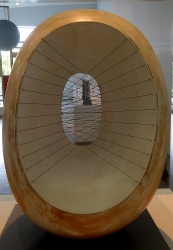
As with other abstract artists, such as Picasso, Hepworth began learning the basics of figurative representation. Her earliest carvings and drawings were created superbly competently but give no hint of which directions her creative output was soon to follow. Had she not developed any further, she would have been regarded as a skilled, if not too exciting, sculptor. However, Hepworth soon became involved artistically, and in one case maritally, with leading artists of the twentieth century. Contact with them and their ideas can be detected in some of the works she created as she moved from purely representational to highly abstract. It was particularly interesting to see a small carving with a hole in it, the first of her many works to have holes in them. The idea of the holes is to allow light to flow through her sculptures. It was not only other artists who inspired Hepworth’s creation but also the forces of nature, which unconsciously sculpt rocks, trees, and other natural features in the landscape.
It was interesting to see the life-size prototypes of some of Hepworth’s works I have admired in the past. It was wonderful, for example, to be able to get close to the full-size model sculpture which is now high up on the wall of John Lewis in Oxford Street.
Once again, seeing a collection of works illustrating the progression of an artist’s output from student days until the achievement of fame and beyond has helped me to increase my appreciation of an artist about whom I had some reservations. Today’s visit to the Hepworth Wakefield has moved Barbara Hepworth a long way up my ladder of great artists and removed any doubts I had about her works.
Finally, here is something that intrigues me. Hepworth, like Picasso and also my late mother, had what might be described as traditional basic artistic training, just like the European and western artists who created during the many centuries before the 20th, yet all three of them (and many others) moved from expressing themselves with figurative works to abstract creations. However, unlike the artists who flourished before the latter parts of the 19th century and never strayed into the world of artistic abstraction, those who created during after the late 19th century (including the Impressionists) strayed away from the purely figurative/representational. Why this happened is no doubt the subject matter of much art historical literature, which I have yet to read. As I wrote the previous sentence, it occurred to me that the move towards abstraction (and other forms of art that do not appear to give the viewer a straightforward recreation of nature) coincided with the advent of photography. The photograph can give the illusion of being a true image of the world, leaving the artist to explore other more imaginative representations of what he or she has seen.




 yamey
yamey 