ONCE A PALACE IN CONSTANTINOPLE, NOW A MUSEUM IN ISTANBUL

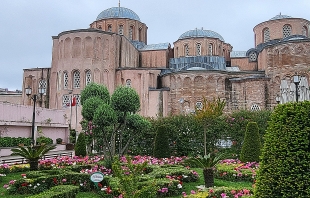
MUCH HAS CHANGED IN Istanbul since we last visited it in October 2008. Many places we saw then have either been restored or are closed for restoration. One place that was not open to visitors in 2008 is the Tekfur Sarayi, a palace built next to the ancient city walls of Istanbul. We came across it in April 2024 after having made an abortive visit to the nearby Kariye Mosque (once a Byzantine church), which was closed for restoration.

The Tekfur Sarayi, which used to be known as ‘Palace of the Porphyrogenitus’, is one of three Byzantine palaces still surviving in Istanbul. This edifice was constructed either in the late 13th century or early in the 14th. According to Wikipedia, the palace was:

“… named after Constantine Palaiologos, a son of the Emperor Michael VIII Palaiologos. “Porphyrogenitus”, meaning literally “born to the purple”, indicated a child born to a reigning emperor. The emperor would show off the newborn heir from the balcony and have them proclaimed “Caesar Orbi”, or “ruler of the world””.

The palace was badly damaged during the Ottoman conquest of Constantinople in 1453, and was later used to house part of the Sultans’ menagerie. By the end of the 17th century, the animals were moved, and the building housed a brothel. In 1719, the building was repurposed to house a factory for making decorative tiles, and this is how it remained before going out of business during the first half of the 19th century. Next, it became a poorhouse for some of the Jewish people in Istanbul. Following this, it became a bottle factory for a few years before being abandoned. What makes the building of special interest is that it is a rare surviving example of secular Byzantine architecture.

In 2010, the building was extensively restored and 5 years later a new roof and glazed windows were added. After that, new wooden floors and ceilings and staircases were added. In addition, a stylish lift was installed close to the palace. This allows visitors to reach the high second floor with ease. From a terrace on the second floor, there is a superb panoramic view of the city. In 2021, the place became a museum, whose exhibits include displays of the kind of tiling that used to be made in the palace and informative explorations of the stages in the traditional methods of manufacturing tiling. On the ground floor, there are a couple of archaeological remains of the kilns in which the tiles were fired. Apart from the exhibits, the elegantly contemporary design of the museum and what can be seen of the palace itself add much to the enjoyment of a visit to the Tekfur Sarayi.

The ground floor opens out into a courtyard where more archaeological finds can be viewed. A short staircase from the yard leads to a small garden from which one gets a good view of both the palace and the city walls stretching away from it. Although we were hoping to see the Kariye Mosque, but were unable to do so, visiting the Tekfur Sarayi more than adequately compensated us.

A MOSQUE IN ISTANBUL AND RECYCLING BY THE OTTOMANS

THE MOLLA ZEYREK mosque stands high on one of Istanbul’s seven hills. From its garden, which has a pleasant café, you can enjoy a wide panorama that includes views of the Bosphorus, the Golden Horn and bridges crossing it, the Galata Tower, the great Suleymaniya Mosque, and many other historic buildings around it. Turn your back on the view, and look across the well-kept flower garden, then you will see what looks like a large Byzantine church with three apses and several domes. However, as you stroll around this building, you will soon notice that it has its own minaret. This mosque was a church before 1453 when the Ottomans captured Constantinople/Istanbul.

As is the case with many other places of historic interest in Istanbul, there is an informative notice outside the mosque, written in three languages (Turkish, Arabic, and English). It outlines the history of the mosque. The building, designed by the architect Nikeforos, was built in the 12th century by Eirene (died 1134), the wife of Emperor Ioannis II Komnenos (ruled 1118-1143). Her father was King Laszlo I of Hungary. The edifice which is, in fact three churches joined in one building were the churches of the large Pantokrator Monastery. This institution included a 50-bed hospital, a library, an old-age home, a sanctuary for lepers, a medical school, a pharmacy, and a holy spring. The triple church was exceptional because:

“Except for the Church of the Holy Apostles, no other Byzantine building received as many imperial burials. John II (1118-43) and Eirene (Piroska of Hungary), their son Manuel I (1143–1180), and his wife Bertha of Sulzbach, were buried there, as were the Palaiologan emperors Manuel II and John VIII in the 15th century. In front of Manuel’s black marble sarcophagus was the Stone of Unction (a marble slab on which Christ’s body laid after his crucifixion), which Manuel brought from Ephesus around 1170. The large funerary chapel of the Archangel Michael is described by the typikon as a heroon – the shrine of a hero later used for the imperial mausoleum of Constantine and his imperial successors at the Church of the Holy Apostles.” (www.thebyzantinelegacy.com/pantokrator-monastery)

These monuments can no longer be found in the building.

Soon after Mehmet the Conqueror captured Istanbul, the monastery was converted into a madrassa. It became the first educational establishment created by the Ottomans in Istanbul. The monastery’s monk cells became cells for the madrassa and the triple church, suitably modified with a minaret, a mimbar, a mihrab, and other Islamic features, became a mosque with two classrooms for religious instruction. One of the new establishment’s professors was Molla Mehmed Efendi, nicknamed ‘Zeyrek’ – now, part of the mosque’s name. This learned man not only offered education to those who were already Muslim, but also to those who converted to Islam. In addition, he was instrumental in persuading many local people to convert to his religion.

Apart from the former church complex, now mosque, the other monastery/madrassa buildings have disappeared. This century, what had become an unusable, badly dilapidated structure was restored, and is now back in use as a mosque. The mosque occupies the southernmost of the three chapels. The other two chapels, although attractively painted, were empty spaces. One of these once served as the Byzantine Imperial mortuary chapel.

The Molla Zeyrek Mosque was formerly a Byzantine church. When the Ottomans took Istanbul, rather than destroying the places of worship of their Christian enemies, they recycled or repurposed them – they modified the churches and converted them to become mosques. Probably, the best-known example of this is Istanbul’s enormous Ayasofya-i Kebir Cami-i Şerifi (i.e., the ‘Hagia Sophia Grand Mosque’), constructed in the 6th century.  Apart from Ayasofya, which we walked past almost every day during our recent 16-day visit to Istanbul, The Molla Zeyrek mosque was one of the most impressive and largest former Byzantine churches that we saw in the city. However, my favourite of these recycled churches was near where we were staying: the Kucuk Ayasofya Mosque, in whose charming walled garden we enjoyed numerous glasses of tea, met many friendly Turks, and watched the antics of the garden’s large feline population.

I have visited many cities in America, Asian and Europe. Many of them are fascinating, but now I can safely say that amongst these wonderful places, Istanbul has become my favourite because here the past, present, and future blend together with an exciting vibrance.

An artist in Turkey with a famous Albanian ancestor

ALI PASHA OF TEPELENE (1740-1822) was born an Albanian in what is now Albania. He ruled the Ottoman pashalik of Yanina (Ioannina in Greek) with a large degree of autonomy. One of his descendants was Naciye Hanim. She married Lieutenant Colonel Abdurrahman Ziya Bey,

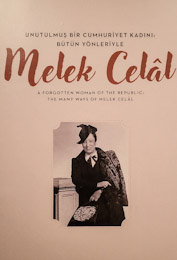
Naciye and her husband had only one child, a daughter called Melek, who was born in 1896 (in Istanbul) and died in 1976 ( in Munich, Germany). She became a renowned painter, sculptor, and writer (books and articles). I would not have heard of her had we not visited the magnificent Sakip Sabanci museum of art at the village of Emirgan on the European shore of the Bosphorus. At this place there was an excellent exhibition of Melek’s life and works. With information both in Turkish and English, it was an enlightening experience.

From an early age, Melek showed signs of artistic ability. She was brought up in an intellectual atmosphere. The Turkish poet Niğar Hanim encouraged her to take up painting. Her first lessons were with her uncle the soldier and painter Kâzim Bey. Later, she attended the Académie Julian in Paris. She also attended the School of Fine Arts for Women in Istanbul. While in Paris, Melek worked with various well-known French artists in their studios. Soon, she was recognised as an accomplished artist. This is evident from the many portraits and still-life’s on display in the exhibition.

In addition to painting and sculpting, Melek was a prolific writer of articles and books. She was also involved ed with Turkish politics during the period when the Ottoman Empire was dying and Ataturk’s modern Turkey was in its infancy. Her first book was published in 1938. In 1959, she published a book in French to introduce western readers to the delights of the Topkapi Palace complex in Istanbul. Many of her publications are on display alongside her paintings and one sculpture.

Melek married twice. First with Mr Celal in 1917. They had a son, and Celal died soon after that. In 1956, she married Dr Lampé, a physician. He died before she did. Melek died whilst being treated in a hospital in Munich.

Melek was one noteworthy descendant of Ali Paşa of Tepelene. There were others, who became famous Turkish intellectuals, including the writer Ebüzziya Tevfik(1849-1913), another writer Abdülhak Şinasi Hisar (1887-1963) and the author and poet Nâmik Kemal (1840-1888). These people of Albanian descent were not alone in shaping Turkey – both Ottoman and modern – in various ways, both peaceful and otherwise. I had heard about some of them, but Melek and her art are a wonderful discovery.

Made in India and sold in Istanbul

KARAKÖY IS A DISTRICT of Istanbul close to the Golden Horn (Haliç). When walking along Tersane Cadesi, a busy avenue lined with shops selling technical goods for mechanical operations (from nails to power tools), we passed an old building topped with domes. Its walls are alternating layers of stones and brick work.

A plaque on the wall of this place reads “ISBU FATIH BEDESTENI AYASOFYA VAKFI KEBIRI OLARAK INSA EDEL MIŞTIR”, which means ‘This Fatih Bazaar was built as a part of the Hagia Sophia Foundation’. So, the building was constructed as a bazaar, and is still used as such. Like the rest of the street, only machine tools and spare parts are sold in the edifice.

Made in India

The above-mentioned foundation was founded soon after the Ottoman conquest of Istanbul. Its function, along with other foundations, was to restore and restructure Istanbul, which had deteriorated badly during the last years of Byzantine rule. I have not yet been able to find out when the bazaar was constructed.

On one of the external walls of the building, a selection of rubber car tyres was on display. An elderly man, who was running the stall, greeted us, and began trying to guess where we were from. My wife told him that she is Indian. Hearing that, the old fellow rushed back to his collection of tyres, and we started to walk away. A few seconds later, he rushed towards us. He was holding a tyre in his hand, and pointing to it, and he kept saying “India”. We stopped, and then he rotated the tyre until he found the words “Made in India” embossed on it, and showed then to us.

A CAFE, A PUBLIC TOILET, A CHURCH, AND A MOSQUE IN ISTANBUL

I NEEDED NEW shoes today (20th April 2024). After buying a pair in the superbly stocked Fast Step shoe shop, we felt the need for coffee. Near the shop, we found a café called Gutta. Having enjoyed good coffees – both Turkish style and Italian style, we needed to answer the call of nature.

We asked if the café had a toilet. It did not, but, as has happened frequently in Istanbul, we were directed to the nearest mosque. This mosque, like others in Istanbul, has public toilets, for which in this case a modest charge was levied. As with most WCs in Istanbul, this one was well-maintained.

Kalenderhane Mosque

The mosque in this case is called the Kalenderhane Mosque. Its name derives from the Kalender dervishes, who once used it as a ‘tekke’. From the outside it looks remarkably like a very old Greek Orthodox church. It was converted for the use of the dervishes by Sultan Mehmet (the Conqueror) in 1453. In the 18th century, it was converted into a mosque.

Built in about the 9th to 10th century next to the Aqueduct of Valens , it is now thought to have been dedicated to Theotikos Kyriotissa. Sadly, as it was locked up, we were unable to enter the edifice.

Had it not been for nature’s call, we might not have come across this interesting mosque. As is the case for many old mosques in Istanbul, it is a fine example of Ottoman repurposing existing Christian buildings in the 15th century.

At rest by the waters of the Bosphorus in a beautiful mosque

BY THE LATE SIXTEENTH century, Istanbul had become an extremely important crossroads between Asia and Europe. It was the capital of the Ottoman Empire, which by then extended over large parts of Europe, the Middle East, Egypt, and the north coast of Africa.

Part of the military force that the Sultan of the Ottomans used to maintain the empire was a group of soldiers called janissaries. These were (usually) Christian men who had been captured by the Turks, converted to Islam, and trained in military skills. They were often most effective soldiers.

Today (16th of April 2024), we visited an elegant complex of Islamic buildings close to the waterfront at Üsküdar on the Asian shore of the Bosphorus Straits. Designed by the famous Ottoman architect Mimar Sinan (c1489-1588) in 1580, it houses a former madrasa (now used to house a library), cloisters, a mosque to which is attached the turbe (edifice housing a grave, like a dargah, as can be found in India), and a small mosque.

This complex was commissioned by Ṣemṣi Ahmed Paṣa (1516 – 1580). Amongst his numerous achievements he was, for a time, head of the janissaries. He also served as the beglerbeg (governor) of several provinces including Rumelia (which included much of the Balkans and Romania) and Anatolia.

This lovely architectural ensemble is visited by some of the many tourists who stream past it, and by many pious locals.

An automobile in Albania

KRUJA small

This is an extract from my book “REDISCOVERING ALBANIA” (ISBN: 978-1326807108). The extract describes a visit to a historic town and problems with a rented car.

“When we have hired cars in the past, we have been presented with a car which is almost new and totally flawless. This was not the case with Enterprise at Tirana’s airport. We had ordered a Tata Indica car – I had chosen it because of the price and also because I had not driven an Indian car since 1994, the first and only time that I ever drove in India. Our Tata was distinctly tatty in appearance. It was covered in scratches and dents, all of which were carefully noted and photographed by the Enterprise representative and me. The upholstery was clean but looked well worn. He told us that the car was “quite new”; it had “…only done about 32,000 kilometres”. Dubious at first, I realised later that this unprepossessing vehicle was just the job for the terrain that we were going to traverse.

I had not driven for two years, the last time being when we hired a car in Palermo (Sicily) in 2014. However, I soon got into the swing of driving. I was pleased that we had not hired the car from an office in Tirana, where traffic is heavy, but from the airport where traffic is light. Soon, we left the main Tirana to Shkodër ‘highway’, and then began winding our way uphill to the small town of Krujë, which is where Albania’s hero Skanderbeg had his headquarters while he was combatting the invasion of the Ottomans.

Skanderbeg, the son of a noble-man called Kastrioti, was taken forcibly by the Turks to Turkey as a young boy (as many Christian youths were in that time). He was converted to Islam, educated as a soldier, and became a good fighter in the Ottoman Army. In 1443, aged 38, Skanderbeg along with several other Albanian soldiers abandoned the Turks. Soon, he took command of the Castle at Krujë, which became his headquarters from where he harassed the Ottomans, who were trying to invade what is now Albania. After many military exploits both in Italy and in Albania, Skanderbeg finally succumbed to malaria in 1468. This is a very brief account of the career of a man who saved Western Europe from becoming part of the Ottoman Empire. Albania did become part of the Empire, but in the words of a guidebook published in 1969 by Albturist, the state tourist agency of Albania:

Although their heroic efforts were not crowned with final victory, the Albanian people did not kneel down. Throughout the centuries that followed, our people continued their resistance against the Ottoman feudal regime.”  

The road became steeper and steeper until we entered the town in which level ground is a rarity. We parked the car on a steeply sloping street and made our way to a café, whose terrace provided a great view of the town’s castle, which overlooked us, and the old bazaar, which was several metres below us. From where we were sitting we saw one or two elderly people wearing what looked to us like traditional costumes, but most people were dressed in modern clothing.

We made our way along the shiny cobbled street that runs between the two lines of shops that make up the old bazaar. This has been extended since I saw it in 1984, but the extension has been made to look as if it were original. As in 1984, all of the shops in the bazaar are selling goods aimed at tourists: everything from tasteless ‘tat’ to some very lovely antiques. One particular shop contained superb examples of traditional Albanian handicrafts, some pieces including some wooden cradles for babies were quite old. Some weeks later in Tirana, we met, quite by chance, the shop owner’s cousin, the daughter-in-law of one of Albania’s foremost artists. Although the bazaar resembles what I remembered from my first visit in 1984, the town is filled with new buildings, including mosques and churches, which might have existed before Enver Hoxha destroyed them, but are now reconstructed or entirely new. Many but not all of the old Ottoman era buildings that made Krujë so attractive to me in 1984 have been demolished to make way for newer mostly less-attractive constructions. Nevertheless, Krujë, nestling in the wooded hills that surround it, is still a lovely place to visit.

After stumbling through the cobbled market, we began climbing the path that leads to the castle complex. On our way we passed an old (Ottoman?) structure that housed what must have once been the outlet for a spring. It was filled with fragments of old carvings including an eight-pointed star, and just above the outlet for the water two animals (lions?) facing each other.  Nearby, two young boys selling small round green plums asked where we were from, and then tried to sell us some of their fruit. Just before we reached the entrance to the castle, we came across a man sitting on a wall selling books. He was the author of the various volumes that he had set out for sale. We said hello to him, and told him that we would have a look at his books after we had visited the castle.

Parts of the vast area of the interior of the castle walls are still inhabited. Much of the space is covered with ruins of what had originally been Skanderbeg’s castle and then later the Ottomans’. These ruins include a solitary watchtower and the base of a large minaret. We had read that there was a Bektashi mosque, the Tekke (‘teqe’ in Albanian) of Dollma, in the grounds. A young man offered to guide us to it. Because the way to it was extremely rough and Lopa had a bad ankle, she decided to wait for me while I went to see the mosque. The young man explained to me (in good English) that he is a Bektashi, a member of a ‘sect’ of Muslims (although many Muslims disclaim them) that is halfway between Shia and Sufi. It is particularly popular in Albania, Bulgaria, and Anatolia. Unemployed as so many Albanian graduates are, he spends his time looking after the tekke and its surroundings. On our way along the path to the tekke, we met a woman, aged about 30, with her small child. She spoke some English, but mainly gossiped in Albanian with my new acquaintance. We stood next to what looked to me like an Ottoman hammam or bathhouse. It was, but it has been heavily restored with bright new roof tiles that detract from its character and beauty. After the woman left, he explained that when she had been orphaned, his family had informally adopted her and brought her up as a daughter.

The 18th century tekke is in good state of preservation. By the way, a tekke is a gathering place for Sufi and Bektashi believers. Its interior walls and ceilings are covered with delicately painted frescos and lines of Arabic or Turkish calligraphy. There are several tombs of dervishes within the mosque, and also some outside it in its grounds. Near the tekke, I saw some old stone fragments that looked as if once they had been part of an earlier structure, maybe a church. My guide introduced me to an elder man who lives in a recently built circular meeting place next to the mosque. The old man, I was told, had spent 12 years in prison during the Communist era simply because he was a Bektashi adherent. Some years ago I showed my friend Bejtulla Destani, an academic from Kosovo, pictures in a book by Albert Mahuzier who visited Albania in the early 1960s, in the years before Enver Hoxha outlawed religion. The book included a photograph of the imam or priest of the tekke in Gjirokastër. Without hesitating, Bejtulla said that it was most likely that that man would have been killed by Hoxha’s people soon after 1967.

The visit to the tekke took rather longer than I had anticipated. As we were making our way back to where I had left Lopa, a security man came rushing towards me shouting: “Mister Adam?” I nodded, and he led me not to where I had left my wife, but instead to the Ethnographic Museum, where Lopa was passing the time and also becoming concerned that I might have been kidnapped or worse. After being reunited, I took a look around the museum which was not only interesting on account of its exhibits, but also because it was housed in a very old Ottoman era building.

Our way back to the castle entrance took us past the impressive but incongruous fortress-like building, built in 1982 by the Communists to house a museum or mausoleum to honour Skanderbeg. I did not enter it in 1984, and not on this visit (because it is closed on Mondays). When we emerged from the castle, we stopped by the man selling books. He introduced himself as Professor Baki Dollma (he was related to the Dollma family after whom the tekke is named), a professor of history. Most of his books are in Albanian. We bought a couple that contained some English and were related to the history of Krujë. When he learnt that I also write books, the professor became very friendly, and kept addressing me as ‘Professor’.

We left the amiable professor, and returned to our car. I turned the ignition key, and nothing happened. I tried several times, and then assumed that we had been given a dud hire car. I rang Enterprise, and explained the situation, and was told that someone would ring me back in a few minutes. When this happened, I was asked if I had used the remote control. I told the person on the ‘phone that I had not the remotest idea of what she was talking about. I was told to look under the driver’s seat where I would find a little box on a cable, and that I should always press a blue button on it before starting the car. It worked. However, it would have been helpful to have known about this security feature when we took possession of the vehicle.”


Enjoyed the extract? Then read more!  Buy a copy ofREDISCOVERING ALBANIAby Adam Yamey. It is available from on-line bookstores such as Amazon, bookdepository.com, lulu.com, and as an e-book on Kindle