GODDEN GREEN IS a tiny hamlet next to Knole Park, close to Sevenoaks in Kent. There is not much to the place, but it has a special place in my heart, and seeing the place, or even thinking about it, makes me nostalgic. You can discover why by reading my book “AN ALPHABETICAL TOUR OF ENGLAND”. The book and Kindle are available from Amazon https://www.amazon.co.uk/gp/aw/d/B0FVV6JLZ7/
Tag Archives: nostalgia
In the pie, or the core of the matter
RECENTLY WHEN WALKING in an an orchard in Hampshire, we found that the trees were literally groaning beneath the weight of apples growing upon them. Seeing all of these ripe fruits brought back memories of visiting family friends, who lived in Kent, during my early childhood.
Whenever we went to their home, we were given a lavish lunch. The dessert was always apple pie. The apples were covered with a topping of pastry. What fascinated me was that the centre of this topping was always raised above the rest of it. Beneath this centrally located curved mound, – and this is what used to fascinate me – there would be a ceramic cup buried amongst the cooked apples. Discovering a cup buried in an apple pie tickled my imagination, and always puzzled me. I believe that it is normal practice to insert something to support the pastry topping, but when I was less than 10 years old, I did not know this. Our friend who used to cook this apple pie for us is, sadly, no more,
Incidentally, in recent years, some of the best apple pie I have tasted is that served at The Only Place in Museum Road, Bangalore (south India). Its recipe was introduced to the restaurant by the American wife of Haroon, who founded the restaurant many years ago.
A coffee house in the Indian city of Bangalore (Bengaluru)
GOING THROUGH SOME old photographs today, I came across a few taken in the India Coffee House that used to be on Bangalore’s MG Road. Here is what I wrote about the place in my book “Coracles and Crocodiles: 101 Tales of India”:
“When I first visited Bangalore in 1994, there was a coffee house on Mahatma Gandhi (‘MG’) Road close to the now derelict Srungar Shopping Complex. This venerable, popular ‘hole in the wall’ was a branch of the Indian Coffee House (‘ICH’) chain. In both appearance and atmosphere, it reminded me of some of the older coffee houses I had seen Belgrade and Sarajevo in Yugoslavia (when it still existed).
At the ICH, customers sat at old wooden tables on wooden benches with hard, upright backrests. Old Coffee Board (‘ICB’) posters hung on the walls. The waiters were dressed in white jackets and trousers held up by extremely wide red and gold belts – like cummerbunds – with huge metal buckles that bore the logo of the ICB. These gentlemen wore white turbans with red and gold ribbons on their heads. In addition to (in my humble opinion) rather average quality, but low-priced South Indian filter coffee, a variety of snacks and cold drinks were also on the menu.
During the British occupation of India, admission to most coffee houses was restricted to European clients. In the late 1890s, the idea of establishing an ICH chain of coffee houses for Indian customers began to be considered. In 1936, the ICB opened the first ICH in Bombay’s Churchgate area. By the 1940s, there were at least 50 branches all over what was then British India. In the mid-1950s, the ICHs were closed by the Coffee Board. The Communist leader AK Gopalan (1904-1977) and the Coffee Board workers managed to get the Board to hand over the ICH outlets to them, and they formed a series of Indian Coffee Workers’ Co-operatives. The cooperative in Bangalore was formed in August 1957. There are now several branches in the city. The MG Road branch, which opened in 1959, closed in 2009 … “
DISCOVER more about this and many other things I have experienced in India by reading my book, which is available from Amazon:
Some things never seem to change
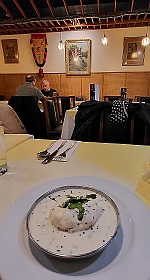
DURING THE 1970s and 1980s, we used to make visits to a restaurant in north London’s Willesden Lane. Founded in 1964 and specialising in South Indian cuisine, it was called Vijay. It still exists at the same address. Out of curiosity and ‘for old times’ sake’, we paid it a visit last night (the 29th of February 2024).
Entering Vijay was like stepping back in time. It was uncanny; nothing seemed to have changed. The walls are still lined with raffia work panelling, the wooden Kerala-style ceiling, and the pictures on the wall (mostly colourful depictions of Hindu deities) looked exactly as we remembered. Naturally, none of the staff were recognizable.
Back in the ‘70s and ‘80s, we used to eat at Vijay to enjoy South Indian dishes that were not easy to find elsewhere in London. If I remember correctly, in those days Vijay only had this kind of food on its menu. Today, the menu still has South Indian dishes, but also many offerings of food that is definitely not typical of South India. It offers a wide selection of North Indian dishes – such as most British people would hope to find in an ‘Indian restaurant’. One of the hors d’oeuvres, which you would never find on India, but is common in British Indian restaurants is fried pappads (poppadums) served with a tray of chutneys and pickles to accompany them, Vijay now offers this. Probably, Vijay has added North Indian dishes to their menu because, for many potential customers, South Indian dishes are far less familiar.
Yesterday, we ordered a few dishes. They were enjoyable enough but not outstanding, However, it was great fun sitting in a place that had hardly changed since we last visited it at least 30 years ago.
Trains, buses, and Bar Linda in London’s Golders Green
MUCH HAS CHANGED IN Golders Green since I was a small child in the 1950s. However, a few things have remained more or less the same. My earliest memories of Golders Green Underground station and its neighbouring open-air bus terminus date back to about 1960, when I began travelling by bus to school in Swiss Cottage.
The Underground station used to have two entrances. One, which faces the bus yard, is still in use. The other, which was approached by a long, covered walkway from beneath the bridge crossing Finchley Road, was closed to the public many years ago, but the passageway still exists. It was this entrance that my family used when using the train to travel into central London. There was also a covered staircase situated between these two entrances – this, now disused, was opened during rush hours. It led to the small parking area where the H2 bus, which serves Hampstead Garden Suburb, begins its journey. During my childhood, there was no public transport in the Suburb. Every day, I used to make the 10-minute walk to Golders Green station, passing the crematorium and the Jewish cemetery on my way.
Overlooking the eastern edge of the bus yard, is what was once the Hippodrome Theatre. When I was a lad, this was a flourishing theatre showing plays and pantomimes. Later, it was taken over by the BBC. After they left it, various religious organisations have used it for their meetings. Built in 1913, six years after the Underground was extended from Hampstead to Golders Green, this building’s exterior looks much as it did when I first remember seeing it.
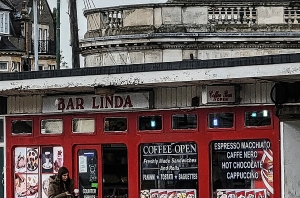
The western edge of the bus yard has always been lined with a row of single storey sheds. Most of these have been used as shops and offices for London Transport. One of them houses a small café called Bar Linda. This was not in existence when I first used to visit the station, but I believe that it opened in the 1960s. Although this friendly little place has been serving customers for many decades, the first time I ventured inside it was in about 2017 when I was about to walk around Golders Green to take photographs for a blog article I was planning to write. I have re-visited it several times since then.
Although Golders Green might not be as aesthetically pleasing as its neighbours, Hampstead and Hampstead Garden Suburb, it is an area full of interest. Much has happened there since 1907 when it began growing from a rural hamlet into a leafy suburb. You can discover much more about Golders Green – its past, my memories of it, and its vibrant present – by reading my book “GOLDERS GREEN & HAMPSTEAD GARDEN SUBURB: VISIONS OF ARCADIA”, which is available (paperback and/or Kindle, from Amazon websites, such as:
Having lunch with my father at the White House
AFTER MY MOTHER DIED in 1980, I began practising dentistry in Kent. Almost every weekend, I used to spend Saturday nights at my father’s house in Hampstead Garden Suburb. We used to have Sunday lunch together in one of his several favourite restaurants in Golders Green and Hampstead. Many of these restaurants no longer exist.
There were a few Chinese restaurants, which my father liked, in the Golders Green area. One of them was in Temple Fortune near the branch of Waitrose, which has been in existence since I was a child in the 1960s. The Chinese restaurant, which served a wonderful hors d’oeuvre that included a scallop in its shell, has long since closed.
In Golders Green Road, there were two more Chinese restaurants, both now gone. In one of them, my father was always greeted by the friendly manager (or, maybe he was the owner) with the words:
“Hallo Professor. How are you, professor?”
The food was well-prepared and tasty in both of them, just as it was in the Temple Fortune eatery.
Almost opposite the Hippodrome theatre, on the corner of North End Road and West Heath Drive, there was an Italian restaurant. Here, my father and I always received a warm welcome and enjoyed reasonably good Italian food. Currently, the site is occupied by a Turkish restaurant, which I have not yet tried.
Some weekends, we travelled up to Hampstead village. One of the two restaurants we visited occasionally was La Cage imaginaire, which still exists at its original location at the lower end of Back Lane, where it meets Flask Walk. Back in the 1980s, this place served classic French cuisine prepared to a high standard. I remember the cheese trolly which was richly supplied with ripe French cheeses. We revisited the place in about 2021 for ‘old times sake’. The management had changed and the food was nothing to write home about.
Today, the 3rd of November 2023, we ate at Mani’s in Hampstead’s Perrins Court. It was our third visit there, and the quality of the food in this busy eatery is highly satisfactory. Near the corner of Perrins Court and Hampstead High Street, there stands the Villa Bianca (‘white house’). This Italian restaurant must have first opened its doors to customers sometime in the 1980s. Never cheap, this restaurant was one of my father’s favourites in northwest London. Being a regular diner there, he was always welcomed like an old friend. Unlike many of the places where my father and I ate Sunday lunches in the 1980s and early 1990s, The Villa Bianca still exists, and is popular. Today, I looked at the menu. Although not suitable for those on a tight budget, many of the dishes did not seem much more costly than those served in far less fancy looking establishments.
DISCOVER MUCH MORE ABOUT HAMPSTEAD BY READING MY BOOK AVAILABLE FROM AMAZON, e.g., :https://www.amazon.co.uk/BENEATH-WIDE-SKY-HAMPSTEAD-ENVIRONS/dp/B09R2WRK92/

Where I watched my first ever movie
THE LAST TIME I watched a film at the Everyman cinema in London’s Hampstead was in the 1960s. In my book “Beneath a Wide Sky: Hampstead and its Environs”, which I published in 2022, I described the cinema and my recollections of it as follows:
“It was at the Everyman that I went to the cinema for the first time in my life. My parents, who were not regular cinemagoers, decided that the rather sad French film, “The Red Balloon” (first released in the UK in late 1956), was a suitable production to introduce me, a four-and-a-half-year-old, to the joys of cinema. My parents, who tended to avoid popular culture, probably selected the “Red Balloon”, an arty French film, because it was a little more recherché than the much more popular Disney films that appeared in the late 1950s. The cinema, which still exists, was, according to Christopher Wade, built in 1888 as a drill hall for The Hampstead Rifle Volunteers. Then, in 1919 its windows were bricked-in, and it became MacDermott’s Everyman Theatre. In 1933, it became a cinema. I saw many more films there in my childhood and adolescence. Every year, there used to be a festival of Marx Brothers films in the summer months. I loved these films and used to visit the Everyman on hot sunny afternoons when I was often the only person in the auditorium. In those days, the cinema’s auditorium had a strange smell that strongly resembled household gas. Indeed, there were gas lamps attached to the walls of the auditorium, but I am certain that I never saw them working. They might have there for use as emergency lighting in case there was an electricity supply failure. These were quite frequent during my childhood but never happened when I was at the Everyman.
The cinema is, I have been told, now a very luxurious place. The seats are comfortable and have tables beside them, at which waiting staff serve food and drinks. This is a far cry from what I can remember of the rather basic cinema in the 1960s. Back in those days, the Everyman, like the now long-gone Academy cinemas in Oxford Street, favoured screenings of ‘arty’ films rather than the more popular films that most cinemas showed. Now, the Everyman, formerly an art-house cinema, thrives by screening films that are most likely to attract full houses. That this is the case is yet more evidence to support the idea that Hampstead is not what it was. Many of the sort of people who might enjoy arty films that attract often small niche audiences, who used to live in Hampstead, can no longer afford to reside in the area.”
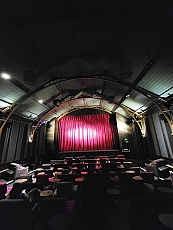
Today, the 16th of May 2023, my daughter took me to see a film at the Everyman (see picture). As already mentioned, the cinema is now quite ‘swish’. It had been re-designed late last year. Whereas once it had only one screen, now it has two. We saw our film, “The Unlikely Pilgrimage of Harold Fry”, screened in what was the original auditorium – Screen 1. The ceiling supported by tapering metal struts is how I remember it from at least 50 years ago. Otherwise, all has been changed. The smell of gas has gone. The seating is curious to say the least. It consists of well-upholstered armchairs and couches, all well separated from each other. In between them, there are tables, and metal wine cooler buckets are attached beside each of them. The upholstery materials are colourful and differ from seat to seat. For my taste, the aesthetics are not too successful. The screen is placed high enough so that it does not matter how tall a person sits in the seat in front of you. The acoustics were good. All in all, it was a pleasure revisiting the cinema in which I saw my first ‘movie’ sixty-six years ago.
My book about Hampstead is available from Amazon:
https://www.amazon.co.uk/BENEATH-WIDE-SKY-HAMPSTEAD-ENVIRONS/dp/B09R2WRK92/
Transported back to childhood on the Isle of Wight
IN THE EARLY 1970s, I used to travel on the London Underground’s line from Golders Green to Euston or Warren Street, both stations being near University College London, where I was a student. Back in those days, smoking was permitted on the Underground. Each Northern line tube train had two carriages for smokers. I have never smoked, but I used to travel in the smokers’ carriages because they were usually emptier than the other ones in which smoking was forbidden. Thinking back on this, I suppose that I must have been passively smoking on the Underground. On the other hand, because there were fewer people in the smoking carriages, my chances of catching other people’s airborne germs must have been reduced.
From an early age, before I became a daily commuter, I liked travelling in the rear carriages of the Northern Line tubes. These carriages contained control panels, which the train’s guards operated to open and close the doors and to inform the driver when the train was ready to leave. As a child, I was fascinated by watching the guard at work. Actually, there was little else to watch after the tube entered the tunnel after leaving Golders Green. Incidentally, what was the rear carriage, was also the front carriage when the train changed direction on reaching the end of a line.
The Northern Line trains I have been describing were built by Metro-Cammell in 1938. By the end of the 1980s, the trains were taken out of service and newer units began operating on the Northern Line. The 1938 trains were shipped out to the Isle of Wight, where they carried passengers on the Island Line. After many years of service on the island, the sea air caused these venerable trains to corrode and deteriorate. In the early years of the 21st century, they were taken out of service.
In late October 2022, we visited the train museum at Havenstreet on the Isle of Wight. One of the exhibits is a collection of old train carriages and engines in a large shed. Amongst these exhibits is one of the former Northern Line carriages built in 1938. Visitors are permitted to enter it. I was delighted to find that the example on display was one of the rear carriages containing the guard’s control panels. Seeing these again after so many years was a curiously moving experience. I felt for a moment that I had been transported back to my childhood days, when travelling in these trains used to fill me with wonder.
Eating there again at least 50 years later in Venice
EARLY IN SEPTEMBER (2022), I was eating spaghetti alle vongole (spaghetti with clams) in a restaurant in Venice (Italy). The place where I was eating this delicious dish has many memories for me.
During the late 1950s and throughout the 1960s, my parents took my sister and me for annual holidays in Venice. My parents were discerning eaters. Unfortunately, back in those now far-off times, there were very few restaurants in Venice which served food that met my parents’ approval. Eventually, they homed in on one place that they liked enough to return there for every evening meal (our accommodation provided lunch as part of our demi-pension deal). That restaurant is called the Antica Locanda Montin (‘the Montin’). According to its website, it has hosted celebrities including Modigliani, Ezra Pound, Robert de Niro, Luigi Nono, and David Bowie. Well, I did not know that when I used to dine there with my family.
During our recent trip to Venice, we found out that the Montin is still in business, and we booked a table for lunch. To my delight and amazement, the restaurant looks exactly as it did when I last visited it over 50 years ago. It does not seem to have changed one little bit. The front of the Montin faces a small canal. The dining room is long and rectangular. At the far end opposite the front door, a rear door gives access to a pleasant garden, where people can eat in good weather. The walls of the dining room are covered with framed paintings, many of them of great artistic quality. Apparently, they have been donated over the years by artists, who have dined in the restaurant.
I cannot remember what I used to eat at the Montin over 50 years ago. However, my spaghetti alle vongole was tasty and enjoyable. My wife and our daughter were also happy with what they ate. Our lunch was one of the better meals we ate during our four days in Venice. What I enjoyed even more than the food was discovering that the Montin looks as it did when I was much younger. I am glad that the place has survived the trying times we have been through recently and Italy’s various economic crises.
To Venice by crossing the water
THE LAST TIME I flew into Venice’s Marco Polo airport was in the late 1960s with my parents. In those days, the airport was tiny in comparison with what it is now. Back then, there were two ways of reaching the city of Venice from Marco Polo: by bus to Piazzale Roma, or far more expensively, in a private water taxi, in effect a speed boat. Despite my mother’s tendency to become seasick easily, we always took the speedy water taxi from the airport to our pensione on the Fondamente Zattere. In those now distant times, the airport arrival hall was much closer to the shore of the lagoon than it is today.

Times have changed. The airport has grown and is far from the waterfront. Although there are still plenty of speedy water taxis carrying passengers, there is now a regular, moderately priced water bus service, which links Marco Polo to many points in Venice. We used this service.
As we crossed the lagoon, many water taxis sped past us. We passed Murano and the cemetery island of St Michele. Then, as we approached the Fondamente Nuova on Venice proper, I spotted the curious domed Bell Tower of the church of Madonna dell’Orto. I looked at it and felt a lump in my throat as I remembered the numerous times I visited that church with my parents to see the frescos within it. It was one of my favourite Venetian excursions, being taken to see that edifice.
After getting off at the wrong stop (mea culpa) and boarding another vessel, we reached our destination near the Gardens where much of the Venice Biennale happens. There is no doubt that arriving in Venice by traversing the water in a boat is far more dramatic and pleasant than arriving across the bridge by train or bus.