THE CHURCH OF St Peter Mancroft stands above the marketplace in the centre of Norwich. Built between 1430 and 1455, it is an elegant example of the Perpendicular style. It was constructed to show off the wealth of the 15th century citizens of Norwich. It is filled with interesting features. I will discuss two of them.
The church contains a Resurrection tapestry, which is in fine condition. It was woven by Flemish weavers in 1573, and might have once been used as an Easter Day covering for the front of the high altar. The tapestry depicts the Easter story in three episodes. The central panel shows Christ emerging from his tomb. In another panel of the tapestry, Jesus is depicted as a gardener, which is how he appeared to Mary after he had left his tomb (John, chapter 20).
The tapestry is kept at the west end of the church close to the font. The other feature that I will describe is in the chancel in the eastern half of the church. It is a memorial to the polymath and writer Sir Thomas Browne (1605-1682), who was a parishioner of St Peter Mancroft. He was buried in the church and lay undisturbed until 1840, when workmen accidentally broke open his coffin. Then, his skull was removed from the rest of his skeleton for phrenologists to study it. It was only in 1922 when the detached skull was reburied in St Peter Mancroft, but not in the same place as the rest of Browne’s body. The burial register for 1922 recorded the skull as being aged 317 years,
Browne, who was interested in everything in a scholarly way, would most likely have approved of having his skull investigated by phrenologists.
Although visiting the Anglican cathedral is one of the highlights of a trip to Norwich, St Peter Mancroft should not be missed.
DURING OUR LAST HOUR in central Norwich, we explored an alley, which we had not noticed before. It led downhill to a churchyard. This surrounded two sides of a mediaeval (late 15th century) church: St Peter Parmentergate. A ‘parmenter’ was a tailor or someone who made facings and trimmings for clothes. The doorway at the southeast corner of the church was open, and two men were standing outside it. We asked them whether we could look inside the church. They said that we could do so, but did not tell us what to expect inside.
The interior of the church maintains many of its original church-related features, but in all other respects it is quite unusual. The nave of the church has no pews, but instead there is a new wooden floor that curves up at both its east and west ends. The chancel is filled with skateboards, magazines about skateboarding, and a variety of toys. Where there were once kneelers in the choir stalls, there are now skateboards. Elsewhere in the church, there were skateboards galore and helmets for skateboarders. The church is a mecca for skateboarders.
Since 2021, the church has become a skateboarding rink and a shop for skateboards. The owner of this extraordinary establishment told us that he knows of only four churches that have become converted for the use of skateboarders, and one of them is currently out of use.
The church ceased being used as a place of worship in 1980. Since then, it has been maintained by the Norwich Historic Churches Trust (‘NHCT’). Before it became used as a skateboarding centre, it served various purposes. From 2007 until 2017, it housed a centre for martial arts. Next, it was let out to the NHCT. After that, it was used by a counselling specialist.
A few hours before seeing St Peters Parmentergate, we had visited St Gregory’s, a church converted to an antiques shop. That surprised us, but not as much as St Peters Parmentergate, which must be seen to be believed. It is good to see those churches in Norwich, which have ceased serving the purpose for which they were built, are being both looked after and being kept alive as part of the city’s life.
THE CITY OF NORWICH used to have about 100 churches. Today, there are about 73 churches in use as places of worship. That is approximately one church for every 1900 people. Many of Norwich’s churches are no longer used for worship, but being of historic and architectural value, they are kept standing. One of these redundant churches is St Gregory’s in the heart of the city. It was constructed in the 14th century, and has been designated a Grade 1 Listed Building. Closed in 1971, it is looked after by the Norwich Historic Churches Trust.
On entering St Gregory’s, you are confronted by models of deer with antlers standing in the porch alongside all manner of ‘junk’. Beyond this, there is a glass fronted refrigerator containing cans of carbonated drinks. On entering the body of the church, the visitor is confronted by all manner of used goods (including antiques) arranged picturesquely in the aisles, the chancel, and other parts of the church. When the initial surprising impact of the church is over, one notices features of the original church that still remain: the stone font; the royal coat of arms; stained glass windows; funerary sculptures; the organ; and a fine wall painting of St George and the dragon. Towering above the sea of goods, there is beautiful gothic vaulting.
Since 2011, the church has been used as an antiques centre (actually, it is more like an indoor flea market). The variety of goods on sale is huge. Beneath the organ, where the choir stalls must have been, there is a second-hand book seller. Despite the somewhat Bohemian look about this stall, the books are not moderately priced.
Whether or not one has any interest in purchasing antiques, St Gregory’s is well worth a visit because what has been created within it is much better than many immersive installations created by professional artists.
DURING THE 1970s, Philip and Jeannie Millward began collecting folk art and other artefacts in the Swat Valley of Pakistan. Over the years, these intrepid travellers have been collecting folkloric and other objects from all over south Asia: from Pakistan, India, Indonesia, and so on. At first, they stored their growing collection in a warehouse in Norwich. The Millwards’ collection grew and grew and included things bought from auctions and dealers in the UK. Today, a part of what they have amassed is beautifully displayed in a building with an interesting history.
The Millwards’ South Asia Collection is housed in a huge building, which opened in 1876. It was designed to be an indoor roller-skating rink. However, by 1877, this enterprise failed, and the building became used for Vaudeville theatre. Five years later, it became a Salvation Army ‘citadel’, and then in 1898, it became a builders’ merchant’s storehouse. In 1993, the edifice was purchased by the Millwards, who converted it to become a museum to display items from their collection.
The museum’s exhibits are beautifully laid out, and clearly labelled. Many of the objects on display are very fine examples of their type. I have seen only few museums in India that come up to the high standard of this museum in Norwich. Many of the fine pieces that the Millwards have brought from the Indian subcontinent and elsewhere in the past might not now be allowed to leave their countries of origin. But luckily, they have come to Norwich where they are being expertly cared for. The museum is not simply a display place. It works with academic institutions such as CEPT University in Ahmedabad (Gujarat) to carry out research projects that help put objects in the collection into their true context.
Although the museum is the main attraction of the place, the former roller-skating rink also houses a shop where finely crafted, high quality folkloric goods, sourced in India and other places, can be bought. What is on sale has been purchased directly from the craftspeople who made them, rather than from middlemen. And the prices attached to them are very reasonable – not much greater than one would expect to pay in good handicraft shops in India.
Norwich is filled with attractions for the visitor. Less well-known than the castle, the cathedral, and the Sainsbury Centre for Visual Arts, the Millward’s South Asia Collection in Bethel Street should become one of the first places a visitor heads for.
This is the tower of the 15th century St Peter Mancroft in Norwich, Norfolk. Situated next to the market place, this is the city’s parish church. It is the centre of civic worship, whereas the magnificent cathedral is the ecclesiastical centre of the city’s worship. Both this church and the cathedral make a visit to Norwich worthwhile. The city has other magnificent attractions, which I will write about soon.
A LABYRINTH DIFFERS from a maze in that the former contains a continuous path without the confusing branching and blind endings found in the latter. Often the pathways of a maze are lined by walls or hedges so that the person within them cannot have an overview of the layout of the maze. In the case of labyrinths, these are frequently absent and someone entering a labyrinth can easily observe the layout of its pathway. Labyrinths have been constructed since time immemorial, but the one laid out on the lawn in the cloisters of Norwich Cathedral was only constructed in 2002, to celebrate the Golden Jubilee of Queen Elizabeth II’s reign.
The cathedral’s website (www.cathedral.org.uk/visit/things-to-see-and-do/the-labyrinth) notes:
“The Labyrinth forms a continuous path and represents a spiritual journey. Although there are many twists and turns, and at times we may be uncertain where the path will take us next, we are never lost … a labyrinth affirms the gentle guiding hand of God, who even when we may feel lost or confused, is leading us ever onward … Quietly walking the labyrinth can be a way of seeking to resolve a problem, seek guidance, grieve a loss, release a fear or just to be with God. Labyrinths are familiar feature in all cultures. The seemingly simple act of following a pattern is a surprisingly profound means of soul-searching, engaging body, mind and soul.”
I like the sentiments expressed in this extract but wonder how effective this labyrinth is really in helping to resolve difficult personal problems. I suppose when navigating a labyrinth, one’s mind briefly concentrates on this task rather than continuing to mull over whatever is bothering it. This short distraction from one’s inner musings can be therapeutic just as is the case with doing sport or concentrating on a hobby or artistic activity or craftwork.
LIKE FLORENCE NIGHTINGALE, Edith Cavell (1865-1915) was a heroine of the nursing profession. In fact, Edith, who was born in the county of Norfolk, was martyred because of her compassion and goodwill.
Recently, we spent four nights at an excellent bed and breakfast place in Norfolk. It is located in the village of Swardeston, which is only 4.7 miles southeast of Norwich Cathedral. After leaving our accommodation in Swardeston, we spent several hours in central Norwich. At least one hour of our visit to the city was taken up by exploring the interior and exterior of the cathedral. We attended part of a Sunday service, which was held in the part of the church east of the nave. The cathedral’s choir sounded magnificent. The reason the congregation was not in the nave is that part of the cathedral is currently being used to display ‘Dippy the Dinosaur’ from London’s Natural History Museum. On Sundays, Dippy is allowed a day’s rest from being gawped at by crowds of visitors, so we did not get to see this prehistoric skeletal attraction, apart from a short section of its backbone, which could be glimpsed through the window of a locked door leading from the magnificent cloisters to the nave. You might be beginning to wonder why I began this piece by telling you a little about Edith Cavell. Well, now I will tell you more.
Grave of Edith Cavell next to Norwich Cathedral
After the service and a wander around the cloisters and the east half of the cathedral, we walked around to the outside of the southeast corner of the building, where we were told that we would find the burial place of Edith Cavell. The original gravestone surmounted by a cross stands close to a newer monument, which does not bear a cross, but resembles the kind of gravestones often found in Commonwealth war cemeteries but has a circular inscription that reads: “ECOLE BELGE D’INFIRMIERES DIPLOMEES”. While we were looking at these two memorials, we chatted with a lady who was passing by. When we asked her why Edith Cavell was buried in Norwich, she told us that the nurse had been born in the village where we had been staying, Swardeston. When she was born, her father was the vicar of the village’s church, which we would have visited had we known about its connection to the famous nurse.
Close to the cathedral, next to the western wall of the Cathedral Close, there is yet another monument to Cavell. A bronze bust of Cavell tops a rectangular based column with a bas-relief showing a soldier attaching a wreath to the monument. Erected in 1918, the bust’s sculptor was Henry Pegram (www.racns.co.uk/sculptures.asp?action=getsurvey&id=289), who lived from 1862 to 1937. The monument was commissioned by the physician John Gordon Gordon-Munn (1863-1949), who was Mayor of Norwich between 1914 and 1915.
After finishing school, Edith Cavell first became a governess, including for a family in Brussels. Then, after caring for her ailing father, she trained to become a nurse. She worked in various English hospitals until 1907 when she was recruited by Antoine Depage to become the matron of a recently opened nursing school in Brussels, L’École Belge d’Infirmières Diplômées. This helps explain the inscription on the newer of the two memorials next to the cathedral.
When WW1 broke out, Edith was visiting her widowed mother in Norfolk. The Red Cross took over her clinic and the nursing school, to which she returned after seeing her mother. It was in Brussels, after it had been occupied by the Germans, that she began helping British soldiers to escape from German-occupied Belgium to then neutral Holland. Harbouring and helping soldiers who were in armies fighting the Germans was against German military law. In August 1915, after being betrayed by a collaborator, she was arrested by the Germans, tried at a court-marshal, and found guilty of aiding a hostile power. She was executed by firing squad at Schaerbeek, a district of Brussels.
Cavell was first buried next to St Gilles prison in Brussels. Then in 1919, her body was shipped to England. At first, it lay in state on Dover pier for one night before it was transferred by train to London, where there was a state funeral in Westminster Abbey. On the 19th of May 1919, Edith was buried at the spot next to Norwich Cathedral, where she ‘rests’ now.
Next time that we are in Norfolk, we will try to visit the church in Swardeston, where Edith’s father officiated. As the bed and breakfast accommodation was so excellent in Swardeston and we fell in love with Norwich, I hope it will not be long before we return to Norwich and its environs.
PS: there is a large memorial to Edith Cavell in London, near the south end of St Martins Lane and just north of St Martin-in-the-Fields church.
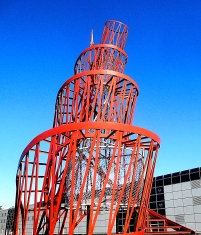
THE MARXIST SOCIETY of the University of East Anglia had just held a meeting around it, so we were told by someone working in the Sainsbury Centre for Visual Arts on the university campus in Norwich. The object around which the political gathering was held is a 35 feet high model of a structure that was never built full size. The Russian architect Vladimir Tatlin (1885-1953) had planned to build a futuristic tower in Petrograd (aka ‘Leningrad’ and ‘St Petersburgh’), an example of Constructivism. The tower, which was to have been 1300 feet high, was planned to celebrate and house The Comintern (3rd International). Hoping to rival Paris’s Eiffel Tower and to symbolise the modernity of Soviet Russia, the tower was never built.
Model of Tatlin’s tower with the Sainsbury Centre behind it
Sometime, back in the early 1970s, it was decided to construct a model of the Tatlin Tower near the Hayward Gallery on London’s South Bank. This was not a simple task because the structure is complex, and proper detailed blueprints were unavailable. To make a model of the Tatlin Tower that was faithful to the designer’s original idea, and which would not topple over, the services of a structural engineer were required. My uncle Sven, who worked for the firm of Felix Samuely and Partners, proved to be the man for the job. Working with the project’s director, Jeremy Dixon, my uncle had to unravel the plans of the structure using photographs of a 17-foot model of the tower that Tatlin had created in 1920 and a few existing images of plans that Tatlin had prepared. There were inconsistencies between Tatlin’s plans and the model produced in 1920. In 1971, Dixon:
“…built small models in balsawood to get it right, and he worked with Sven Rindl of consulting engineer Felix J Samuely & Partners, who generated detailed freehand drawings as they talked” (quoted from “Blueprint”, December 2011)
Dixon wrote about this in Sven’s obituary as follows:
“I particularly remember working with him on the reconstruction of the remarkable tower that Vladimir Tatlin produced as a monument to the Third International, the communist organisation founded in 1919, for the Art in Revolution exhibition at the Hayward Gallery in 1971. The project required us to go back to first principles to reinvent its extraordinary geometry and structure.
Sven would sit listening and commenting during our complex voyage of discovery, and at the same time he would be drawing. These drawings would be remarkable, elegant, three-dimensional sketches straight off the sketch pad, finished and complete. They were graphic works of art as well as documentation of engineering ideas.”
The model was built with timber inside the Hayward Gallery before being exhibited outside it in 1971 as part of an exhibition called “Art in Revolution: Soviet Art and Design since 1917”.
Forty years later in 2011, another model of the Tatlin Tower was produced, this time made of a more durable material, steel. Once again, the project was overseen by Jeremy Dixon. The completed model was first displayed in the courtyard of London’s Royal Academy. In an advance notice of the project (www.architectsjournal.co.uk/archive/ra-unveils-tatlins-tower), my uncle, who had died in 2007, was given a prominent mention:
“The 10.5m high steel structure in the Annenberg Courtyard was designed by architects Jeremy Dixon of Dixon Jones Architects, Christopher Cross, Christopher Woodward and engineer Sven Rindl. The tower will form part of the Royal Academy’s forthcoming exhibition, Building the Revolution: Soviet Art and Architecture 1915-1935 which opens on 29 October 2011.”
I remember going to view the model and then seeing a small exhibition about it and its construction. The exhibition, which was held inside the Royal Academy, included images of some of the beautifully drawn plans and diagrams created by my uncle.
The steel model of the Tatlin Tower, which was exhibited at the Royal Academy in 2011, has been lent to the Sainsbury Centre by the academy. Painted in red, this model of an experiment in futuristic architecture stands outside and close to the magnificent building that houses the Centre. The edifice, which is now over 40 years old, but looks like new, was designed by the architects Norman Foster and Wendy Cheesman.
We had no idea that there was a model of Tatlin’s tower next to the Sainsbury Centre when we visited it in September 2021. My wife and I were pleased to see this reminder of a much-missed relative whom we both loved dearly.
Standing on the central stone at noon, the person’s shadow is cast on the stone marked ‘XII’
AN INTERESTING SUNDIAL in the gardens of Blickling Hall, Norfolk consists of numbered stones laid out around a larger central stone. When someone stands on the central stone, his or her shadow will fall on the stone bearing the hour of the day.. This is an example of an ‘anellematic’ sundial.




 yamey
yamey 