Art Deco in a north London Suburb

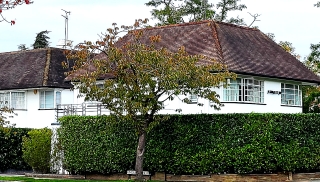
EXAMPLES OF THE ART DECO style that was popular during the era between the two World Wars can be found all over London. In the newer part of Hampstead Garden Suburb (north London), there are a few examples of this style.

Kingsley Close, which leads west from Kingsley Way, contains only houses built in the Art Deco style.

You can read more about these and other examples of this style in Hampstead Garden Suburb in my book about the Suburb, which is available from Amazon: https://www.amazon.co.uk/GOLDERS-GREEN-HAMPSTEAD-GARDEN-SUBURB/dp/B0BHG873FB/

When German bombs rained down on Hampstead and a pub that no longer exists

DURING MY CHILDHOOD in the 1960s, there was a concrete platform on Hampstead Heath Extension. It was close to Hampstead Way. Today, where it used to be visible, there is a mound of impenetrable bushes and weeds surrounded by a fence. The concrete structure was a base for anti-aircraft guns during WW2.  Although, many German aircraft were knocked out of the sky by guns such as these, many of them caused a great deal of damage all over London. Recently, while sorting through some books, I came across a slender volume called “Hampstead At War”. It was first published by Hampstead Borough Council in 1946, republished by the Camden Historical Society in 1979, and then again in 1995.  The book contains many photographs of the terrible destruction caused by bombs dropped by the Luftwaffe over Hampstead.

One of the photographs in the book struck a particular chord with me. It shows the badly damaged Hare and Hounds pub after it had been bombed in 1940. The pub, which was almost next door to the famous Old Bull & Bush pub, was established in about 1751. However, the building that was destroyed was built a long time after that.

Between 1965 and 1970, I used to travel From Golders Green station to Highgate School on the bus (route 210). Every school day, the bus would pass the Old Bull & Bush and its neighbour, the Hare and Hounds. When passing the latter in those days, I always wondered why the pub looked so recently built. When leafing through the “Hampstead at War” book today, more than 50 years after leaving the school, I found the answer. The book contains a photograph showing the extensively damaged pub.

The Hare and Hounds was rebuilt during the years I studied at Highgate. Although I can only faintly recall its appearance and can find only one photograph of it after its rebuilding, its presence remains firmly fixed in my memory. Finding the book certainly jogged my memory, and seeing the photographs of war damaged Hampstead makes a great impression. One wonders why the Germans chose to waste their ammunition on an area that has always been mainly residential.

PS: The Hare and Hounds closed forever in 2000.

A library that is far from mundane in north London

VISITORS TO LONDON (and residents of the city) should not miss visiting Kenwood House, which is in north London between Hampstead and Highgate. Not only does it contain a magnificent collection of Old Master paintings that can be compared favourably with what can be seen in Britain’s finest public art galleries, but it also has a beautiful library.

In my book about Hampstead, “Beneath a Wide Sky: Hampstead and its Environs”, I wrote:

“The first house to stand on the site of the present one was built in brick by John Bill (1576-1630), printer to King James I. He bought the Kenwood Estate (which was known as ‘Caen Wood’) in 1616. After several changes in ownership, the Estate was bought in about 1747 by a former Prime Minister and King George III’s close associate, John Stuart, third Earl of Bute (1713-1792). In 1754, Bute sold the property to the lawyer and law-reformer William Murray (1705-1793), who became the First Earl of Mansfield, and was Lord Chief Justice of the King’s Bench from 1756 to 1788. In 1778, he was a supporter of the Roman Catholic Relief Bill that led to the violent protests described above. During the First Earl’s stay in the House, he employed the architect Robert Adam (1728-1792) to make improvements.”

The library was one of the improvements that Robert Adam created at Kenwood. The library or Great Room was constructed between 1764 and 1774. It was intended both as a reception room and a library, which might explain why so little of this large room’s wall space is occupied by bookshelves. Most of the wall space is occupied by mirrors and windows. Lord Mansfield would have been used to host guests, hold dinners, and for music performances.

The library’s architecture is based on that of Roman public bath houses.  John Summerson (1904-1992), the architectural historian, wrote of its design in his “The Iveagh Bequest, Kenwood : a short account of its history and architecture” (published 1988):

“This is one of the finest Adam rooms in existence … The shape of the room, with its curved ceiling leading into two apsidal ends, on the chords of which are pairs of columns, is one which Adam used for several of his most stately interiors. Apart from the plan, a great innovation for England was the flat arched ceiling which Adam frankly describes as ‘extremely beautiful …”

Although the library is the finest of Adam’s creations at Kenwood, there are others that deserve to be admired. These include the orangery, the entrance hall with its magnificent stucco ceiling, and the library’s anteroom. In this piece I have concentrated on the interior of Kenwood House, but a visit to this wonderful place should be accompanied by a stroll in the place’s superb, landscaped gardens.

My first visit to a famous pub near Hampstead (in north London)

I HAVE BEEN PAST the Old Bull and Bush pub near Hampstead inummerable times during the past 70 years, but until today (1 June 2025), I had never entered it. Here is a little about the pub from my book “Beneath a Wide Sky: Hampstead and its Environs”:

Made famous in an old music hall song Down at the Old Bull and Bush (by Andrew B Sterling and Henry von Tilzer), the Old Bull and Bush began life as a farmhouse that was built around 1645. The pub began in the early 18th century. The artist William Hogarth (1697-1754) visited it regularly. The artists Gainsborough and Reynolds frequented the pub with the actor/director Garrick. The present pub was built in the 1920s and is uninteresting architecturally. When I was a child, there was another pub next door to the Old Bull and Bush. This was the ‘Hare and Hounds’. I used to pass it and the two pubs on my way to school in Highgate (between 1965 and 1970). It was already present in the early 19th century. In 1940, during WW2 it was twice destroyed by aerial bombardment. And, according to Christopher Wade, it: “… existed for a time in five linked caravans…” before being rebuilt in 1968. The pub ceased operating in 2000 and has since been demolished. A modern brick apartment block now stands where people used to enjoy a casual pint.”

Well, today, we ate lunch at the pub. The dining room was comfortable, the service was good, but the food was unexceptional. Would I visit that establishment again? Maybe, but I still prefer other pubs in Hampstead.

PS My book is available from Amazon, e.g.:

https://www.amazon.co.uk/BENEATH-WIDE-SKY…/dp/B09R2WRK92

A disused passageway in north London’s Golders Green

DURING MY CHILDHOOD and teenage years, there used to be two entrances to Golders Green’s tube (Underground) station, which is on the Edgware Branch of the Northern Line. One of these entrances, which is the only one in use today, is from the bus station (bus yard) next to the old Hippodrome Theatre and opposite the clock tower.

The other entrance, which has been closed for several decades, was beneath the bridge that carries the railway tracks over Finchley Road. The canopy at this entrance is still standing. Passengers used to walk beneath this canopy and then along a long walkway covered by a wooden canopy supported by timber pillars with simply ornamented capitals. . This passageway , which still exists, led to a ticket hall. Neither the ticket hall nor the passageway are accessible to the public.

You can discover much more about Golders Green, its past and present, in my book, which is available from Amazon, e.g.:

From West Bengal (India) to a floor in north London

KENWOOD IN NORTH London (next to Hampstead Heath) is a delightful place to visit at all times of the year. Amongst its attractions are a collection of fine paintings within Kenwood House; architectural features designed by Robert Adam; beautiful grounds with a lake; some modern sculptures; and a refreshment complex housed in the former servants’ quarters and stables. Close to the cafeteria, there are some toilets for use by visitors.

After visiting the ‘gents’ toilet, I looked down at the floor of the passageway leading to it, and saw a square, metal manhole cover. It had some lettering on it. Amongst the lettering, I noticed the following “KIC-INDIA”. Seeing this made me wonder if this manhole cover in north London had been made in India.

When I returned home, I looked at the Internet to see whether I could find out anything about the connection of this manhole cover with India. KIC-INDIA refers to an ironworks in India called KIC Metaliks Ltd (www.kicmetaliks.com), whose office is in Calcutta (Kolkata) in West Bengal. The company website revealed:

“K I C Metaliks Limited, founded in 1986 and headed by entrepreneur Radhey Shyam Jalan, is a leading pig iron manufacturer in West Bengal headquartered in Kolkata. Publicly listed on the BSE, the company has over 35 years of experience catering to hundreds of satisfied customers using cutting-edge technology. Its factory in Durgapur produces pig iron with a current capacity of 2,35,000 MTPA. The company takes a prudent yet ambitious approach to capacity expansion to become a dependable pig iron supplier.”

The company was formerly known as ‘Kajaria Iron Casting Limited’, and its plant is at Durgapur, 100 miles northwest of Calcutta. While searching the Internet, I came across other examples of KIC manhole covers in the British Isles, including at Bangor (County Down), South Shields (Tyne and Wear), and Plymouth (Devon).

Often when I am out walking, I look down at manhole covers. Sometimes they have interesting designs on them. When I spotted the KIC manhole cover at Kenwood today (6th of November 2024), it was the first time I had seen one made in India set into a floor in England.

A walk in the sunshine on a Saturday morning in north London

AFTER DAYS OF GREY skies, the sun shone without pauses today (the 30th of March 2024). This was lucky because come rain or shine, we had decided to walk south from Primrose Hill through Regents Park to Marylebone Road. Much of the way we passed places with fond memories for us. The first of these was Chalk Farm Underground station. It was near here that my wife used to live in a flat on Fellowes Road long before we married.

From the station, we walked across a graffiti-covered iron bridge that crosses the mainline railway tracks from Euston. This brought us to the eastern end of Regents Park Road (‘RPR’). Lined with shops and eateries, this curving road is where we met with our friends frequently. One of our favourite places was Lemonia – a Greek restaurant. When it first opened, it was on the south side of the road. Now, it occupies larger premises on the north side of RPR. After having coffee at Roni’s, an Israeli café that did not exist in the 1980s when we often visited the area, we walked towards the base of Primrose Hill. Today, being the Easter weekend, the road was far less busy than it is on other weekends.

Looking down from Primrose Hill

Fortified with coffee and a croissant, we ascended the steep path leading from opposite the house where Friedrich Engels once lived to the summit of Primrose Hill, which had attracted a crowd of people who had come out to enjoy the sun and the magnificent view of London to the south of the hill. While we were descending the hill towards Regents Park, a young lady, who was ascending the hill with her husband and two children, greeted us. I did not recognise her as I had not seen her for 21 years, and (then only briefly) when she was a young teenager. She is the daughter of one of my cousins, and the great-great granddaughter of my ancestor Franz Ginsberg, who was a Senator in the parliament of South Africa between the two world wars.

After reaching the bottom of Primrose Hill, we crossed Prince Albert Road, and then walked over a bridge that traverses the Regents Canal. At the south end of the bridge, we passed some enclosures (containing what looked like large wild boars or warthogs) of the London Zoo.  Then, we walked along a straight path between grassy playing fields – not particularly scenic. In the distance we could see the minaret of the Regents Park Mosque and the domes on the roof of the London Business School, where my wife studied. Eventually we reached a more attractive area close to the eastern edge of the Boating Lake, over which we crossed on a bridge. Soon, we arrived at the circular road, appropriately named the Inner Circle. It seemed to being used as an unofficial racetrack for cyclists on expensive looking bicycles. Having safely crossing the road without being hit by a cyclist, we entered the round heart of Regents Park, which contains the famous Queen Marys Rose Garden.

We took refreshments at the strange-looking Regent’s Bar & Kitchen. In plan, it is a collection of identical adjacent hexagons. The roofs of some of these have sharp conical pinnacles. From there we passed beds of rose plants. All of the roses were without flowers, A small wooden bridge crosses a stretch of water – part of a larger pond – to reach the attractive Japanese Garden Island from which you can see a man-made rocky waterfall designed as it would be in gardens in Japan.

After wandering around the Japanese garden, we headed towards the Inner Circle, which we crossed before walking south along a road called York Bridge because it crosses a body of water by means of of a similarly named Bridge. Before reaching the bridge, we passed the buildings of Regent’s University. These used to house a part of the University of London – Bedford College. Founded in 1849, it was for the higher education of women. From 1878 onwards, women studying there were awarded degrees by the University of London. In 1984, after Bedford College had merged with Royal Holloway College, its premises in Regents Park became the home of Regent’s University, which is not affiliated to the University of London. Interestingly, the wrought iron gates to Regent’s University’s grounds still bear the crests of its predecessor – Bedford College. In the 1920s, my wife’s maternal grandmother, Benabai Bhatia, who had come from India with her husband Haridas, who was studying for an FRCS, studied at Bedford College. On her return to India and after she was widowed at a young age, she became a superintendent of schools in Bombay.

After crossing York Bridge, we soon reached Marylebone Road, having had a thoroughly enjoyable walk.

Memories of Gujarat (India) at a park in north London’s Golders Green

GOLDERS HILL PARK lies halfway between Golders Green and Hampstead – both in north London. It occupies what used to be the extensive grounds of a former country house that was built in the 18th century and destroyed during WW2 (in 1940). Its fine landscaping was influenced by the great garden designer Humphry Repton (1752-1818). I have been visiting the park since my early childhood in the 1950s, when, if I remember correctly, my parents used to play tennis on the still existing tennis courts. The park has many attractions including a pond with an attractive stone bridge; a walled garden; many fine old trees; plenty of shrubs and flowers; a bandstand, which was certainly in use during my childhood; a good café-cum-restaurant; a wooded area; a stumpery; a deer enclosure; and a small zoo. The deer enclosure and the zoo were in existence when I was a young child. Today’s visitors can watch the deer and view animals such as wallabies; ring tailed lemurs; at least one kookaburra; donkeys; and a variety of exotic birds. The pond mentioned above is often visited by ducks.

Today (the 3rd of March 2024), we visited the park on a crisp, cold, sunny morning. The dew-covered lawns were full of blooming crocuses, and some of the bushes had burst into flower. Most of the trees, being deciduous, were devoid of leaves. By chance, I looked up at one of these leafless trees and saw a children’s kite caught up in its branches. Seeing this, my thoughts shifted 5000 miles from Golders Hill to Gujarat (in western India).

Wherever you go in Gujarat, you are likely to see kites caught up in the branches of trees. Unlike the kite I saw today, those in Gujarat are not the toys of small children, but part of a festival celebrated once a year, The Hindu festival, which celebrates the increase of day length a month after the winter solstice is known as ‘Uttarayan’ in Gujarat. The occasion is celebrated by kite flying. During this period of kite flying, riders of bicycles, motorcycles, and other two-wheelers face a real but, to the outsider, unusual hazard that could result in serious injury, if not death. I have described this festival and its hazards in some detail in my anthology of 101 vignettes of life and travel in India –“The Hitler Lock and Other Tales of India”.

Seeing the kite in Golders Hill Park reminded me of what I have seen in Gujarat during my several visits to that Indian state. However, although this year Uttarayan began on the 15th of January – not so long ago – I find it hard to believe that the kite I saw in the park was stranded in the tree during celebration of that festival.

[The book (& Kindle) is available from Amazon:

WHERE ONCE THERE WAS A PUB IN HAMPSTEAD THERE IS NOW A SUPERMARKET

HAMPSTEAD IS RICH in historical curiosities. One of them is an unexceptional little road that has an interesting story.

Just south of Tesco’s supermarket (the former Express Dairy) on Hampstead’s Heath Street there is a narrow cul-de-sac called Yorkshire Grey Place. It enters Heath Street across the road from The Horseshoe pub and Oriel Place. I have often wondered about this short, uninviting blind-ended lane and its history. Just under 50 yards in length, it runs west from Heath Street.

At long last, I began looking on the Internet for some history (if any) of this bleak little roadway lined on both sides with high buildings. It gets its name from a pub that used to exist near it – The Yorkshire Grey. The pub was already in existence by 1723, but was demolished in the 1880s (https://londonwiki.co.uk/Middlesex/Hampstead/YorkshireGrey.shtml) – in 1886, according to FE Baines in his “Records of Hampstead” (publ. 1890). An online history of Hampstead (www.british-history.ac.uk/vch/middx/vol9/pp15-33) provided the following information about the pub and its surroundings:

“North of Church Row the Yorkshire Grey had been built by 1723 and cottages called Evans Row probably faced it c. 1730. In 1757 the inn and 14 houses occupied by a brickmaker, clockmaker, carpenter, apothecary, and others were ‘late freehold’ but in 1762 they were described as copyhold (one alehouse, two houses, and 11 cottages).”

This area was one of the slums of Hampstead – it was devoid of water supply and drainage.

During the planning and construction of Fitzjohns Avenue, which began in 1875 and was only completed by about 1887, there was some discussion about whether it should end on the High Street or give direct access to the road up to Hampstead Heath. Prior to the late 1880s, the recently built Avenue stopped south of Hampstead village. Its route from there into the centre of Hampstead village was subject to some controversy. This was described in “Hampstead, Building a Borough 1650-1964” by FML Thomson, as follows:

“… The shopkeepers in the High Street feared loss of trade if any traffic was diverted to a new route, and held out for a scheme which would debouch Fitzjohn’s Avenue into High Street at the King William IV ; while the gentry wanted the direct route to Heath Street and the Heath, arguing that this gave a bit of slum clearance of Bradley’s Buildings, Yorkshire Grey Yard, and Bakers’ Row as a bonus. The dissension continued when the scheme was revived with a number of public meetings in 1881, dominated by the gentry element which was increasingly exasperated at having its carriages bottled up in Fitzjohn’s Avenue without any proper exit.”

As it turned out, the “gentry element” had their way, and the slum clearance that affected Yorkshire Grey Yard was carried out – the pub disappeared as a result. In relation to this, the online history of Hampstead, already quoted revealed:

“In 1883 the Metropolitan Street Improvement Act authorized redevelopment of the whole area at the joint expense of the local authority and M.B.W. In 1888 High Street was widened, Fitzjohn’s Avenue (then Greenhill Road) was extended to meet Heath Street, and soon afterwards Crockett’s Court, Bradley’s Buildings, and other slums, including Oriel House and other tenemented houses, were replaced by Oriel Place, shops, and tenement blocks.”

The pub has long gone, but I managed to find two pictures depicting it. One is a painting showing the place in about 1863 (https://artuk.org/discover/artists/lester-harry). It was the work of Harry Lester. The other is a black and white photograph in the book by FE Baines, which was published a year after the pub was demolished. A detailed map surveyed in 1868 showed that the pub was quite a large building with a substantial yard next to its east facing façade. To its west, the yard opened on Little Church Row (now part of Heath Street). This and a blind-ending road called Yorkshire Grey Yard are shown on the map. Immediately south of the pub, there was another cul-de-sac running from east to west – it was unnamed. I believe that this is what is now called Yorkshire Grey Place.

The map drawn in 1868 shows the layout of the area around today’s branch of Tescos before Fitzjohn’s Avenue was conceived. Another map drawn in 1915 shows how the topography of the area changed following the completion of the Avenue. The Yorkshire Grey pub existed before the nearby, still existing, Horseshoe pub was established – it appears on the 1915 map. Originally named ‘The Three Horseshoes’, it moved from Hampstead High Street to its present address in 1890. Had the Yorkshire Grey pub survived, it would have been about 110 feet away from the Horseshoe.

Once again, wondering what is in a name – in this case Yorkshire Grey Place – has opened my eyes to an interesting bit of the history of Hampstead. Finally, it is interesting to note that the Victorian building that houses Tesco’s was built in 1889 – three years after the Yorkshire Grey pub was demolished to make way for buildings along the northern continuation of Fitzjohns Avenue. So, next time you are queuing to pay in Hampstead’s Tesco, remember that you are standing on land where once the patrons of the Yorkshire Grey once trod.

You can read much more about Hampstead and its surroundings in my book, which is available from Amazon:

https://www.amazon.com/BENEATH-WIDE-SKY-HAMPSTEAD-ENVIRONS/dp/B09R2WRK92/

Trains, buses, and Bar Linda in London’s Golders Green

MUCH HAS CHANGED IN Golders Green since I was a small child in the 1950s. However, a few things have remained more or less the same. My earliest memories of Golders Green Underground station and its neighbouring open-air bus terminus date back to about 1960, when I began travelling by bus to school in Swiss Cottage.

The Underground station used to have two entrances. One, which faces the bus yard, is still in use. The other, which was approached by a long, covered walkway from beneath the bridge crossing Finchley Road, was closed to the public many years ago, but the passageway still exists. It was this entrance that my family used when using the train to travel into central London. There was also a covered staircase situated between these two entrances – this, now disused, was opened during rush hours. It led to the small parking area where the H2 bus, which serves Hampstead Garden Suburb, begins its journey. During my childhood, there was no public transport in the Suburb. Every day, I used to make the 10-minute walk to Golders Green station, passing the crematorium and the Jewish cemetery on my way.

Overlooking the eastern edge of the bus yard, is what was once the Hippodrome Theatre. When I was a lad, this was a flourishing theatre showing plays and pantomimes. Later, it was taken over by the BBC. After they left it, various religious organisations have used it for their meetings. Built in 1913, six years after the Underground was extended from Hampstead to Golders Green, this building’s exterior looks much as it did when I first remember seeing it.

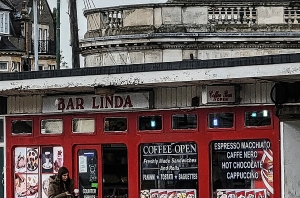
The western edge of the bus yard has always been lined with a row of single storey sheds. Most of these have been used as shops and offices for London Transport. One of them houses a small café called Bar Linda. This was not in existence when I first used to visit the station, but I believe that it opened in the 1960s. Although this friendly little place has been serving customers for many decades, the first time I ventured inside it was in about 2017 when I was about to walk around Golders Green to take photographs for a blog article I was planning to write. I have re-visited it several times since then.

Although Golders Green might not be as aesthetically pleasing as its neighbours, Hampstead and Hampstead Garden Suburb, it is an area full of interest. Much has happened there since 1907 when it began growing from a rural hamlet into a leafy suburb. You can discover much more about Golders Green – its past, my memories of it, and its vibrant present – by reading my book “GOLDERS GREEN & HAMPSTEAD GARDEN SUBURB: VISIONS OF ARCADIA”, which is available (paperback and/or Kindle, from Amazon websites, such as: