A chance discovery in a shop in Covent Garden

I ALWAYS ENJOY looking through the books on sale in charity shops (thrift shops). First of all, one often sees books that are either out of print or that you did not know existed. Secondly, occasionally, one finds real treasures.

Today, I was in an Oxfam shop near Covent  Garden when I found a book called “Muslims in India.” Edited by Ratna Sahai, it was published in the mid to late 1990s. What made it interesting is that this illustrated and quite learned book was produced for the Indian Ministry of External Affairs. In other words, it was commissioned by the Government of India. I wonder whether the present Indian Government will produce a new version of this volume.

I paid very little for the book – about 10% of what booksellers on the Internet are charging.

An interesting outdoor bazaar in Bangalore

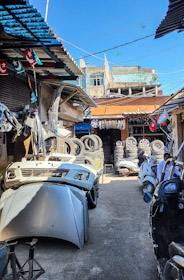
AT FIRST SIGHT, you might well think that you are looking at a crowded carpark which has been blown to pieces by a powerful bomb. There are parts of cars – bodywork, tyres, engine parts, etc., – all over the place.

After a moment or two, you begin to realise that there is a semblance of order in this ocean of car parts, many of which have been salvaged from cars at the end of their useful lives. For this area in the Shivajinagar district of Bangalore is a car parts bazaar. There are many different dealers, each specialising in particular parts of a vehicle. For example, there are merchants selling radiator grilles, others purveying axles (both front and rear), there are sellers of tyres, there are shops selling car doors and body panels … and so on.

Near both Russell Market and St Mary’s basilica, the car parts bazaar is almost hidden from sight by the buildings surrounding it. It is approached by short gullies – narrow lanes. I first stumbled across it in late December 2007. Then, on subsequent trips to Bangalore, I tried to find it again, but in vain. Today, the 26th of December 2023, I managed to locate it, and spent a few minutes wandering around it, stopping to take photographs.

It seemed that most of the dealers were Muslims. Some of them stopped me, greeted me, and asked where I came from and my name. When I replied ‘Adam’, they asked me whether I am Muslim. This reminded me of my first visit to Kosovo in 1975. As soon as I stepped of the bus that had carried me from Skopje (Macedonia) to Prizren (Kosovo), a group of youngsters surrounded me. They wanted to know my name, and when I told them, they were very happy because they thought that, like them, I was a Muslim.

Most of the dealers in the car part bazaar were happy with my taking photographs, but a few in one section of the market asked me not to use my camera.

As far as I could see, no repair work was being undertaken in the bazaar. Nearby, next to Russell Market, there were plenty of cars being repaired. Often those involved in repairing a vehicle were engaged in noisy discussions.

It is seeing places like the seemingly shambolic car parts bazaar that help to endear India and its people to me.

Long live the revolution!

NAGPADA JUNCTION IS one kilometre east of Mumbai Central Station. There are several interesting memorials located around this place where six busy roads meet. Each of them commemorates someone of the Islamic faith.

One memorial, a large rectangular bas-relief, is dedicated to the great poet Mirza Ghalib (1797-1869).

Dominating the junction is a tall flagpole from which India’s flag flutters. The base of this includes a large curved bas-relief in grey stone. The base has carvings of several important Indian freedom fighters including Mahatma Gandhi. There are also scenes of these leaders behind bars and other Indians being attacked by Britishers. The words “Quit India” can also be seen in several languages. The Quit India movement was one of many attempts to get the British to leave the huge country they ruled until 1947.

This monument and its flagpole are mainly dedicated to the memory of Maulana Abul Kalam Azad (1888-1958). In brief, he was all of the following and much more: an Indian independence activist, Islamic theologian, writer and a senior member of the Indian National Congress. Between 1947 and 1958, he was independent India’s first Minister of Education.

Lesser known than Ghalib and the Maulana, but also commemorated at Nagpada Junction is the freedom fighter Maulana Fazlul Hasan Hazrat Mohani (1875-1951). This celebrated writer of poetry in the Urdu language is best known for a slogan he created in 1921: “Inquilab zindabad”, which means “Long live the revolution”. He is also credited as being one of the first Indians to demand complete independence for India, rather than increases in the degree of the country’s autonomy whilst remaining part of the British Empire.

At first a member of The Indian National Congress, Hasan Hazrat later joined the Communist Party. He was against the Partition of India and would have preferred that India had become a confederation of states such as was the case in the USSR.

Nagpada Junction is both rich in traffic and memorials to notable Muslim men. One more memorial and a street name commemorate another Muslim, Sofia Zuber (Zubair), at this meeting place of busy. thoroughfares. She was an education superintendent for Urdu affiliated to a civic body and later a corporator from Nagpada. The short road named after her used to be a meeting place for Urdu authors and journalists.

I would not have written about this interesting traffic junction had I not noticed the Maulana Abul Kalam monument as we sped past it in a yellow and black taxi. Curious about it, we returned later and had a look around, and then ate good kebabs in the Sagar restaurant beside the junction.

Triumph of the ego

jinnah

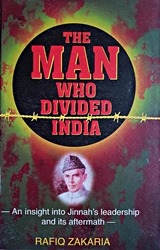
Mohammed Ali Jinnah (1876-1948) saw the realisation of his ambition, the formation  of a sovereign nation for Indian Muslims: Pakistan, a year before he died as its supreme leader. Jinnah was a brilliant barrister and orator. His brilliance is described by Rafiq Zakaria in his book “The Man who divided India“. The author, clearly recognising his subject’s skills, does not rate him highly as an individual. His lucid, well-reasoned text makes this very clear.

At first, Jinnah, who was always attracted to politics, strove for Hindu-Muslim unity/harmony in pre-independence India. Various factors, including his disapproval of the anti-British Khilafat uprisings of India’s Muslims following WW1, led to him being sidelined by both the Indian National Congress and the main Indian Muslim political groupings. This led to him leaving India and establishing a legal practice in London and also attempting (in vain) to become involved in British parliamentary politics. 

Returning to India after a few years in London, Jinnah recommenced his struggle to become prominent in the Indian polical scene. To do this, he abandoned the idea of working for Hindu-Muslim unity for the opposite – the alienation of India’s Muslims. This proved successful. Under his leadership of the Muslim League, he promoted the idea of a separate sovereign state for India’s Muslims by indoctrinating his followers to believe that as the Congress became more powerful and when the British left India, Muslims would be at the very least dominated by the Hindus. By 1947, when the British gave up their hold on India, the formation of Pakistan, a sovereign state for Indian Muslims, was guaranteed.

The formation of Pakistan was associated with mass movements of people: Muslims into Pakistan, Hindus and Sikhs out of the newly created country. During this ‘Partition’, there was massive loss of life and much irreversible misery both in Pakistan and India. Furthermore, Pakistan was not one contiguous territory, but two widely separated portions: West Pakistan and East Pakistan (now Bangladesh).

Zakaria describes how Jinnah, the great leader of the  Muslims, was really a very unobservant Muslim. Throughout his life, Jinnah ate pork, enjoyed alcohol, hardly knew the Koran, and never learnt Urdu, the language of the Muslims of the Indian subcontinent. According to Zakaria, Jinnah did not hold his fellow Muslims in high regard, to put it mildly. It appeared to me while reading the book that Jinnah took advantage of Muslim fears of possible domination by the Hindus to further his ambitions of achieving political prominence, which were indeed successful.

Zakaria uses the last few chapters of his fascinating book to discuss the legacy of Jinnah’s creation, Pakistan. He paints a gloomy picture. Having espoused the idea of the separateness of the Muslims, and promoted the idea that the Indian Muslims were a ‘race’ or ‘nation’ separate from their non-Muslim Indian neighbours, Jinnah, like his hero the Turkish leader Kemal Ataturk in Turkey, decided that Pakistan should become a ‘modern’ secular state rather than some kind of Islamic entity. He wanted to govern Pakistan using the model of British imperialism, which the Indian subcontinent had just freed itself. This has not happened in Pakistan; it is now an Islamic state.

Zakaria emphasises that far from unifying India’s Muslims, Jinnah’s creation of Pakistan has achieved the very opposite. The Muslims of the subcontinent are now divided between Pakistan, India, and Bangladesh. Many families have members now separated by international borders. Many Muslims in India continue to live with the fear that they are somehow threatened by the Hindu majority in the country.  In addition, within Pakistan itself, different factions of Muslims (Sunnis, Shias, and others) are in permanent conflict with each other. In Bangladesh, there are also problems. And, if that were not bad enough, the political situation in modern Pakistan is extremely unstable and life there is far from peaceful. From what I have read in Zakaria’s interesting and highly readable book, Jinnah’s dream of unifying India’s Muslims has turned into a nightmare.

To conclude, it should be mentioned that Zakaria, an Indian Muslim, has served the Indian Congress Party, which opposed Jinnah in the years before independence,  as a high-ranking official. Despite that, I felt that his book attempts quite successfully to give a balanced view of Jinnah and his politics without concealing his own views.