Painting scenes of daily life on sheets of mica in colonial India

ONE CAN PAINT ON paper, canvas, glass, textiles, ceramics, and walls. Until yesterday (9 February 2025) when we visited an exhibition at Bangalore’s Museum of Art and Photography (‘MAP’), I did not know that paintings have been made on sheets of the translucent mineral mica. Mica has been, and still is, mined in great quantities in India.


Because of its translucency,  lanterns made with mica, on which images have been painted, have been used in both Hindu and Muslim ceremonies.  Since the eighteenth century artists have been creating paintings on mica, usually using watercolours or gouache mixed with an adhesive to ensure that the colours stick to the mica. Because the colours are on a translucent material that does not absorb any of the pigments, rather than opaque paper that inevitably absorbs some pigment, they appear much more vibrant on mica than on paper.


Murshidabad,  now in West Bengal,  was an important centre of mica painting. Initially, artists concentrated on paintings and portraits commissioned by local nawabs and other members of the Indian aristocracy.  With the arrival of Europeans in Murshidabad and other parts of Bengal in the late eighteenth century, the artists began depicting subjects designed to appeal to European customers. Europeans were particularly attracted to the paintings on mica. The subjects included illustrations of daily life and customs. They are therefore an interesting record of life in Bengal (and other parts of India) during the late eighteenth century.


The exhibition at MAP consists of a collection of paintings both on mica and on paper. These images were designed to appeal to European visitors (both short- and long-term) to India and are examples of Company Paintings  (East India Company).


Many of the paintings on mica depict people who appear to have no faces. Originally, these paintings had faces painted in gouache. However, the faces were painted on a layer of mica placed above that on which the rest of the subject was painted. This was done to give the images a three dimensional quality. Sadly, many of these upper layers have been lost, resulting in literally a loss of face.


The exhibition at MAP was well displayed. An extremely informative booklet about the exhibits and mica painting was available free of charge.  I am pleased we visited the show not only because it was both beautiful and fascinating,  but also because we had visited Murshidabad a few weeks earlier.

PS mica painting was done in parts of India where mica was plentiful,  such as Andhra Pradesh,  Madhya Pradesh, Tamil Nadu, Rajasthan,  Bihar, and Jharkhand.

Beware of upsetting wealthy benefactors: a word of warning to Donald Trump

A JAIN BANIA (BUSINESS MAN) called Hiranand Shah travelled from Rajasthan to Patna in 1652. In 1707, he financed Prince Farrukhsiyar sufficiently for him to become the Mughal Emperor (he ruled from 1713 to 1719). Manik Chand, a later head of this Jain family was then rewarded with the title ‘Jagat Seth’, which means ‘banker or merchant of the world’. By the eighteenth century, the family or house of of Jagat Seth was the largest banking house in the Mughal Empire.


The Nawabs of Bengal used the banking services of the house of Jagat Seth to pay tribute to the Mughal emperors in Delhi. William Dalrymple wrote that the Jagat Seth family were able to:

“… make or break anyone in Bengal, including the ruler, and their political instincts were sharp as their financial ones.” (quote from Wikipedia)


When the young Siraj-ud-Daulah became Nawab of Bengal in 1756, he alienated many people including Jagat Seth Mehtab Chand. Siraj demanded 30 million rupees as a tribute from the banker. When the banker refused, Siraj-ud-Daulah  slapped him. As a result, Jagat Seth took part in the conspiracy to defeat Siraj-ud-Daulah.  He and others, including Mir Jafar, helped the British, led by Robert Clive,  to defeat Siraj-ud-Daulah at the Battle of Palashi (Plassey) in 1757.  Jagat Seth’s money funded the British to help them defeat Siraj-ud-Daulah.


The Jagat Seth family was at least as influential as tycoons such as the Rothschilds in Europe and figures such as Jeff Bezos and Donald Trump’s current ‘chum’ Elon Musk. Taking the story of Siraj-ud-Daulah as an example, one could say it is best not to upset your wealthy supporters.  So, Donald, it would be best not to upset Elon!


Soon after the Battle of Palashi,  the fortunes of the house of Jagat Seth began to decline. Today, this remarkable family is commemorated by an opulent mansion, which they built in Murshidabad, sometime after it became the capital of Bengal (for 70 years during the eighteenth century). In 1980, the house was opened up as a museum, which is privately owned and run. We visited this place before we knew about the family’s involvement with the downfall of Siraj-ud-Daulah and the following capture of Bengal by the British. Like many other places in Murshidabad,  it is a fascinating reminder of Murshidabad‘s history during the era when Europeans, especially the British,  were beginning to make their mark on Bengal.

A palace that was in Pakistan for less than two days

IN 1904 THE WASIF Manzil, a palace in Murshidabad (West Bengal,  India) was restored after an earthquake had badly damaged it in 1897. The palace was built for Sir Sayyid Wasif Ali Mirza Khan Bahadur (1875-1959), who became Nawab of Murshidabad in 1906. It was designed by a Britisher, Mr Vivian, and  a Bengali engineer, Surendra Barat.  This pleasant building is a mixture of architectural styles and includes some turrets with crenellations.


Visitors can explore the interior of Wasif Manzil, which now contains a museum. The exhibits include several wooden framed mirrors, which were imported from Belgium. There are also some glass topped display cases containing dust covered documents, several of which have obsequious addresses to Queen Victoria and some of her royal successors. By the time that Wasif Ali Mirza was living, Indian royalty was very much at the beck and call of the British rulers of India. It was in their interest to appear to be loyal supporters of the Imperial rulers of India.


On the fifteenth of August 1947, when land was divided between the newly formed Pakistan and independent India (by Cyril Radcliffe who only visited  India for the first tine in 1947), Murshidabad was allotted to Pakistan: it became part of East Pakistan (https://en.m.wikipedia.org/wiki/Murshidabad_district).

Thus, the Wasif Manzil stood on Pakistani territory.  However, less than two days later, there was a territorial land swap: Murshidabad, then in Pakistan, was exchanged for Khulna, then in India. Thus Murshidabad became part of India  and Khulna became part of East Pakistan  (now Bangladesh).


Because of a brief period in the second half of August 1947, the Wasif Manzil was in Pakistan for less than two days.

Almost nothing remains, but this palace and its owner have not been forgotten

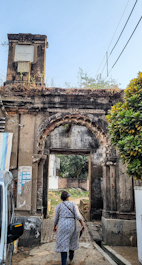
ALL THAT REMAINS OF A MAHARAJAH’S PALACE … IS ONLY A FEW ARCHES.

Not marked on Google maps, but mentioned in a guidebook to Murshidabad (in West Bengal), this remnant of a palace is extremely difficult to find. Our toh-toh (electric autorickshaw) driver asked many locals for directions. To my surprise, all knew about the small remains of a former palace, once a home of Maharaja Nanda Kumar (1705-1775), a tax collector for the British East India Company [see: https://en.m.wikipedia.org/wiki/Maharaja_Nandakumar ], who fell foul of the Company’s law. The guidebook did not mention this or the fact that he, a friend of Warren Hastings, was hanged by the Company for alleged fraud.

Mrs Warren Hastings and a diamond dealer in Bengal

AS EARLY AS THE SEVENTEENTH century, the French,  Dutch,  and English set up factories (trading stations) at Cossimbazar, which is beside the Hooghly River in the north part of West Bengal.  It existed before what is now Murshidabad became capital of Bengal. Today, what was once an important trading centre, where European merchants acquired goods to bring from India to Europe, is now no more than a rustic village.


Cossimbazar is home to a small cemetery, the Old English Cemetery, which contains the graves of  about 30 Brits who died between 1730 and  about 1800.  Within this small graveyard, which is maintained by the Archaeological Survey of India,  there is one above the burial place of Mary Hastings and her young daughter Elizabeth. The gravestone has been restored and is legible.


Mary, who died in 1759  (as did her daughter), was the first wife of Warren Hastings (1732-1818). He was a senior British East India Company administrator: the first governor of the Presidency of Fort William (Bengal), the head of the Supreme Council of Bengal, and so the first governor-general of Bengal in 1772–1785. He lived in Cossimbazar for a short time.


While reading about the Old English Cemetery,  I discovered that it contains the grave of a successful Jewish merchant from London: Lyon Prager  (died at Cossimbazar). Born in 1746, he died suddenly in May 1793. In brief, as an article (www.telegraphindia.com/culture/diamonds-and-dust-the-backstory-of-a-forgotten-grave-in-murshidabad/cid/1889965) revealed:

“Prager had come to Calcutta in 1786 on behalf of a London firm of Israel Levin Salomons, an Ashkenazi Jew. Diamonds were just one of the things Salomons traded in his India business; pearls and drugs were others.”

Stones cut in Benares by experts from Gujarat  were sent down the Ganges to merchants and traders at Cossimbazar and other places further down the Hooghly. Most probably when Lyon Prager took ill at Cossimbazar  he was there for undertaking business dealings.


Unlike Mary Hastings’s gravestone, the writing on Prager’s is now illegible. I have seen a photograph of his monument that is surmounted by an obelisk,  which was taken when the grave was still identifiable.  Without knowing that it was Prager’s grave, I  photographed it when we visited the cemetery in January 2025.


When I was researching my book about Jewish migration to South Africa, I learned that the Dutch East India Company did not permit Jewish people to travel to their trading stations in the Cape of Good Hope and elsewhere unless they had converted to Christianity. The presence in India of a Jewish trader, such as Lyon Prager   suggests that in the eighteenth century, Jews were not barred from joining trading expeditions by the British East India Company.

Bankers living on the banks of the Hooghly River in West Bengal

BANKERS ON THE BANKS OF THE HOOGHLY RIVER

JAINISM IS AN ANCIENT Indian religion still practised today. The Jains, members of this religion, believe, amongst many other things, in non-violence towards all members of the animal kingdom, from microbes to elephants. For this reason they are vegetarian and will not eat anything that grows beneath the surface of the soil for fear of killing creatures that might be attached to them. Thus, Jains will avoid eating, for example, onions, carrots, and potatoes.

Recently, I read that Jains do not go in for farming because by tilling the soil there is a risk that creatures living in it might be harmed. For reasons that include this, the Jains tend to be a business and banking community.

In the eighteenth century, some Jain families migrated from arid Rajasthan to fertile Bengal and settled around Murshidabad. It is said that these people helped persuade the rulers of Bengal to move their capital from Dhaka to what is now Murshidabad. Some of these Jains, known as the Sherherwalis, became bankers to the Nawab, and consequently became extremely wealthy.

One of these Sherherwali bankers, Rai Bahadur Budh Sing Dudhoria, constructed a huge mansion, now known as ‘Bari Kothi’, close to the river Hooghly in what is now the small city of Azimganj (near Murshidabad). The huge edifice, which was restored a few years ago, is built around seven courtyards. It is lavishly decorated in a style that would have been familiar to the family when it was enjoying its heyday. Today, it is used as a luxurious ‘heritage’ hotel, which is famed for its Jain food.

When the banker, who lived at Bari Kothi, told the Nawab that he wanted to move away from Murshidabad because he lacked the company of fellow Jains, the ruler allotted land on both sides of the river to the Jain community, and told the banker to invite other Jains to make their homes there. 97 families arrived.

The combined wealth of the 30 or so Sherherwali families who settled in the Azimganj area was so great that it exceeded that of the entire English aristocracy. This was sometime before 1757, when the Nawab Siraj-ud-Daulah was defeated by the British at the Battle of Palashi (Plassey). After that, Bengal’s capital shifted to Kolkata, as did most of the Sherherwalis.

Bari Kothi was badly damaged during the Naxalite disturbances in the 1970s. It was beautifully restored under the supervision of the architect Dr Samar Chandra. We visited the place today (15 January 2025) and were shown around the maze of corridors, rooms, and courtyards. Our guide showed us parts of the building that are still undergoing careful restoration. What has already been restored and is used by hotel guests is superbly done. For those seeking a glorious ‘heritage’ experience, a few days at Bari Kothi will not be disappointing. However, for those hoping for a fried egg at breakfast time, this is most certainly not available.

Baked earth and building Islamic places of worship

THE COUNTRYSIDE AROUND Murshidabad is dotted with brick factories. Their tall, often smoking, chimneys are surrounded by vast expanses of new bricks, usually stacked neatly. The clay that can be found in the area is particularly good for brick making.  So, it is unsurprising that many local buildings make substantial use of brickwork.


One of the towers of the Katra mosque

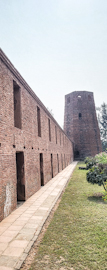
Near Murshidabad,  there are two famous mosques constructed not with stone or concrete, but with bricks. One of these, the Katra mosque, was constructed entirely with bricks between 1723 and 1724. This huge edifice was built not only as a mosque but also as a caravanserai. It is one of the largest caravanserais in the Indian Subcontinent.  The rooms of the caravanserai are arranged in a square that surrounds the mosque rather like cloisters in a monastery. These small rooms also served as workplaces and bedrooms for students studying the Koran and other Islamic texts. Thus, the Katra was a complex consisting of a mosque, a caravanserai, and a madrasa. At each of its four corners,  there were tall brick towers. Only two of these remain.   The tomb of Nawab Murshid Quli Khan(1660-1727) is located under the staircase leading to the main entrance of the building. Protected by the Archaeological Survey of India, the remains of the Katra complex are well conserved. This is not the case for another brick mosque nearby: the Fauti Masjid.


The Fauti was constructed in 1740 by Nawab Safaraz Khan (c1700 – 1740). However,  it was never completed. It is a large mosque, 137 feet long and 38 feet wide. If you manage to chamber within it, which I did with great difficulty despite helping hands, the remains of its five huge incomplete domes can be seen.


The Fauti is a protected building, but in a bad condition. It is possibly perilously unstable. However, because of the vegetation around it and within it, it is a picturesque ruin of the sort that eighteenth and nineteenth century European Romantic artists enjoyed portraying.


In addition to these mosques, which were built using baked clay (I.e., bricks), we have also seen some Hindu temples near Murshidabad that include terracotta in their construction.  But more about these at a later date.

A white horse, which only works for a few days each year, grazes in Bengal

This white horse, grazing outside the Nizamat Imambara, which faces the Hazarduari Palace in Murshidabad, is only required to work during the few days of the Shia Muslim festival of Muharram.

The Imambara is a Shia congregation hall, which was constructed in 1847. Only open during Muharram, it contains a shrine that houses soil brought from Mecca.

Defeated by the British who were helped by a traitor

THE MOTIJHEEL PARK in Murshidabad is a popular amusement park with a boating lake, a roller coaster, a restaurant, a miniature railway that carries passengers, and, surprisingly, a small museum.

Siraj-ud-Daulah

The museum is dedicated to Siraj-ud-Daulah (1733-1757), who was the last independent Nawab of Bengal before the territory was conquered by the British East India Company’s army. There is also a statue of Siraj-ud-Daulah in the park.

His forces were defeated at the Battle of Palashi (Plassey) in 1757 by armies led by Robert Clive. Siraj-ud-Daulah lost the battle not least because Clive bribed Mir Jafar, who was Siraj-ud-Daulah’s Commander-in-Chief, to defect to the British. The defeat at Palashi was an important factor in allowing the British to conquer Bengal.

The dimly lit museum at Motijheel Park contains a series of information panels that give the viewer a simplified history of Siraj-ud-Daulah and the Battle of Palashi. Apart from these, there are a few other exhibits of no great significance.