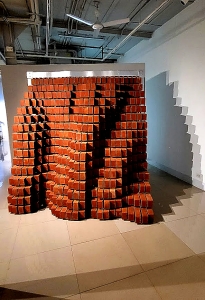
OUR FRIEND GEETHA Mehra has her art gallery on 2nd Pasta Lane, near Colaba Causeway in Bombay. On one of our visits in November 2025, she had organised an exhibition, “Behind the Façade”, which consisted of works by the contemporary artist Teja Gavankar. The artefacts on display were almost architectural, some using brickwork and others containing other materials, As the gallery’s website explained:
“Gavankar is interested in dual states, in forms that appear rigid, where solidity gives way to softness and movement. A dialogue between natural and built environments unfolds, stemming from the artist’s experience of living in Mumbai’s suburbs. Gavankar observes the contours of the city during her commute, seeing organic forms emerge in its industrial undertones.”
Whereas architects make structures which are functional, Gavanka created architectural structures that were artworks designed to challenge the viewers perceptions of space. Seeing the brickwork sculptures and the patterned brick façade she designed for the gallery reminded me of the brick workshop we saw in progress at the Chitrakala Parishad in Bangalore a few days earlier (see: https://adam-yamey-writes.com/2025/11/20/bricks-and-design-at-an-art-school-in-bangalore-bengaluru/).
FOUR MAJOR ROADS meet at Bombay’s Hutatma Chowk. In the middle of this extensive piazza, there is one of the city’s much-loved landmarks: the Flora Fountain. This fountain was constructed in 1864 and is surmounted by a statue depicting the Roman goddess Flora. Originally intended for the Victoria Gardens, it was placed in its present position instead. It stands where the Church Gate, one of the gates of Bombay’s Fort, which was demolished in 1860, was located.
Within a few feet of Flora, there are several places where books can be purchased. For new books and the latest releases, head for Kitab Khana, which is about 73 yards southeast of Flora. This is a well-stocked, pleasantly arranged bookshop with its own (rather pricey) café. Books are sold at their marked prices less ten percent. It is a fine bookshop but not a patch on The Bookworm and Blossom Book House in Bangalore. Both of these Bangalorian booksellers offer a far more extensive stock (both new and second-hand) than Kitab Khana.
Just over 70 yards north of Flora Fountain, there is a corner where Dadabhai Naoroji Road meets Mahatma Gandhi Road. Several pavement booksellers display their vast stocks of books around this corner. Each seller has a bewildering number of books, mostly arranged as tall columns from which removing a book can be quite difficult to achieve without causing all the books to topple over. Some of the books are new, some are pirated editions of recent books, and the rest are used books. I do not know how they do it, but the booksellers have a good knowledge of what they have in their stock, and where to find a particular title if they have it.
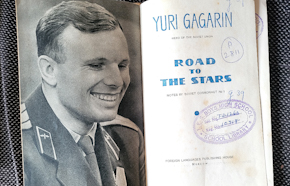
Whenever we visit Bombay, we spend time at the pavement booksellers. Over the years, I have managed to find several rare, out of print books here. Prices are reasonable and the vendors are prepared to discuss the price (i.e., ‘haggle’). At the end of 2025 and the start of 2026, we were in Bombay, and as usual, haunted the pavement booksellers. Whereas on previous visits, I have found what I was looking for as well as some interesting surprises, on our most recent trip, most of the well-stocked stalls were devoid of the kind of books I was hoping to find. Only one of the several stores had a good selection of out-of-print books. It was here that I acquired a copy of “Road to the Stars” by the Soviet astronaut Yuri Gagarin: the first man in space. Although newer softcover versions of this book are available, I bought a slightly battered copy of the original hardback edition published in the USSR in 1960 by The Foreign Languages Publishing House (Moscow). I paid considerably less than I would have for one of the newer (often facsimile) editions.
My other find, which I obtained in late 2025, is extremely rare. It is not listed on the very comprehensive bookfinder.com website. The book in question is “The Bohras” by Asghar Ali Engineer. Several of his other books are listed for sale on the website but not this one. Although I have yet to read the book, I can tell you that the Bohras are members of a denomination within the Ismaili sect of Shia Islam. The bookseller told me that the book is rare and refused to drop his (not unreasonable) starting price. While buying the book, neither the seller nor I knew how truly difficult it is to find a copy of this volume.
Whereas Flora Fountain is a sight that tourists feel they must see, the bookshops around it are, for me, the greater attraction when in Hutatma Chowk.
THE HANGING GARDENS, located on the top of Bombay’s Malabar Hill, is a pleasant park in which to pass time in a relaxing way. We spent an enjoyable hour and a half sitting on a bench in the shade one Sunday morning.
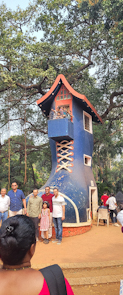
After leaving our seat, my wife wanted to see if something that she remembered from her childhood in the 1950s still existed. After leaving the Gardens and crossing a road, we entered another park, the Kamala Nehru Park, which contains a children’s play area. And it was here that we found the thing my wife recalled: a giant boot. Children can enter the boot through a door in it, and then climb up an internal staircase to reach a viewing platform at the top of the boot. The boot reminds one of the story of the old woman who lived in a shoe.
My wife used to be taken to play in the shoe by her grandmother who lived nearby in Walkeshwar Road. My wife remembered the boot as having been painted pink, but since then it has been repainted and is no longer that colour.
ONE OF INDIA’S greatest modern painters was Maqbool Fida Husain (1915-2011), who was born in what is now Maharahtra. He studied art at the Sir JJ School of Art in Bombay.
While visiting Bombay’s branch of the National Gallery of Modern Art (NGMA) on 2 January 2026, we saw two of Husain’s drawings and two of his paintings. They had been hinges next to a portrait of the artist by Anil Naik (born 1959), a graduate of Sir JJ School School of Art.
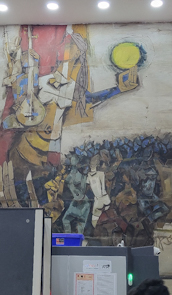
Husain’s painting at LIC
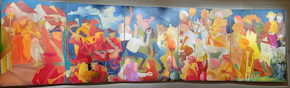
From the NGMA, we made our way to the huge Bombay headquarters of the LIC insurance company. My wife had read that this place is home to a painting by MF Husain. Nobody in the building knew about it despite the fact that the painting occupies most of one wall of the foyer of one wing of the building.
Husain’s painting at LIC is in need of some conservation work. The lower part of it is hidden from view because an x-ray machine used to check bags etc has been placed against it. It was painted in 1963 and depicts Indian life and culture.
It is to be hoped that thus fine mural will neither be allowe to fade away nor destroyed.
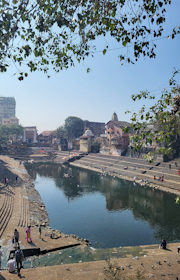
LEGEND HAS IT that when Rama was searching for Sita, who had been kidnapped, he stopped at a spot in what is now Walkeshwar in Bombay. Thirsty, Rama asked his brother, Lakshmana, to get hom water. Thereupon, Lakshmana shot an arrow (‘baan’) into the ground, and where it landed, a stream began to flow. Although1000 miles away from the Ganges, it was considered to be a tributary of the holy river. This stream has been named the Bānganga, and its water is stored in a large rectangular stepped tank.
Bānganga Tank
The tank, the Bānganga Tank, was constructed in 1127 AD by by Lakshman Prabhu, a minister in the court of Silhara kings of Thane. It was restored in 1715. The area in which the tank is located, Bānganga, is Bombay’s oldest inhabited district.
We have visited Bāngang often and it is always a treat. Located close to the Arabian Sea, the area around the tank is a complete contrast to the rest of Bombay. The tank is surrounded by small houses and, being a sacred spot, plenty of Hindu temples. The place is more like a quaint village than part of one of the world’s biggest cities.
Between the tank and the rocky sea shore, there is a large colony of ramshackle structures mostly made with sheets of corrugated iron. The inhabitants of this slum have an enviable view of the sea. One day, I suppose, some developer will clear away these poor people’s dwellings, and replace them with swanky apartments or hotels. But developers should be wary because, so we were told, during the monsoon seasons, large areas of the slopes between the tank and the sea become inundated.
We made our most recent visit to Bāngang on the first day of 2026, and found it to be as delightful as ever. However, we noticed that in addition to the pigeons and abundant waterfowl in the tank and on its steps, there was no lack of rubbish.
Since our last visit to Bānganga about two years ago, the RPG Foundation has put up signs that identify various temples and provide some history of each place. Despite these, there seemed ti be few tourists around the tank.
THE PARSIS WHOSE religion is Zoroastrianism were prominent in Persia until it was invaded by Arabs. In response to this invasion, they began migrating from Persia. The first wave of migration between the eighth and tenth centuries AD. They arrived by sea on the coast of what is now Gujarat. They were given permission to settle in India, where they have prospered. Many of their descendants became prominent businessmen and politicians. Many of them were generously philanthropic. Over the centuries, the Parsis have zealously adhered to their ancient religious traditions and rituals. During the nineteenth century, a second wave of Zoroastrians arrived in India from Persia. This group are known as Irani Zoroastrians.
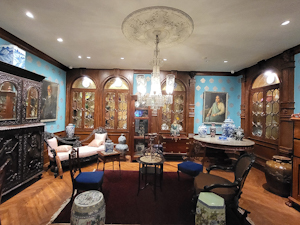
A room in the museum
In December 2025, we visited a wonderful museum dedicated to Zoroastrian archaeology, history, and customs. Near the Babulnath Mandur in Bombay, it is The Framji Dadabhoy Alpaiwalla Museum.
The museum was established in 1954. Between 2018 and 2025, it was renovated. The result is superb. The fascinating exhibits are well displayed alongside interesting information panels.
Sadly, the number of Parsis in the world is declining. When we discussed this with an official in the museum, his view was that the decline is due to the education of Parsi women. He believed that because many Parsi women are getting good educational qualifications, they are too busy developing their careers to give up time to have children. His view might be one reason for the fall in the Parsi population, but there may well be others. Another thing is that traditionally unless the father is a Parsi, a couple’s children cannot be Parsi. So, if a Parsi woman marries a non-Parsi, her children will not be considered Parsis.
In view of the gradual fall in numbers of Parsis (and Iranis), it is fortunate that the fine museum in Bombay exists to remind us of wonderful history and achievements of these people who fled their native land and enriched the land which offered them sanctuary.
WE OFTEN VISIT Wadebridge in Cornwall. It contains an establishment called Churchill Bars. Actually, it is also the headquarters of the local Conservative Club. Until 2025, this place had a restaurant that served well-prepared meals, which included very tasty roast pork belly. Sadly, since early 2025, the Churchill Bars have ceased serving meals.
Fortunately, far away from Cornwall in South Bombay, Churchill Cafe is still in business. Located in Colaba and owned by Parsis, this tiny restaurant serves superb European-style dishes, as well as a few Parsi gastronomic offerings. Decorated with photographs of London landmarks and a portrait of Winston Churchill, this bustling restaurant is well worth visiting.
KRISHEN KHANNA CELEBRATED his one hundredth birthday in July 2025. The NGMA (National Gallery of Modern Art) in Bombay is currently holding a superb exhibition showcasing his paintings. The show is beautifully displayed and the artworks are skilfully illuminated.
Khanna was born in Lyallpur, now in Pakistan. After the Partition of India in 1947, he worked as an official in Grindlays Bank in Bombay. However, before Partition, he had already begun painting. The bank job was just to help keep him and his family going after they had left/fled what became the Pakistani part of Punjab.
Soon after arriving in India, Khanna began associating with members of Bombay’s Progressive Art Group that included notable creators such as FN Souza and MF Hussain. Thereafter, his painting career took off, and his reputation soared.
The exhibition at the NGMA surveys Khanna’s extraordinary range of paintings. Their subject matter ranges from political to historical to religious … and much more. The show, which demonstrates the artist’s amazing versatility and great artistic skill, continues until 12 December 2025, and should not be missed if you are in Bombay.
THE DR BHAU Daji Lad Museum in Bombay’s Byculla district is housed in a building with a neo-classical (Palladian) facade. However, within it there architecture is gloriously Victorian. Recently restored its interior competes with the exhibits for the viewer’s attention.
Prince Albert
The museum was opened in 1872 as ‘The Victoria and Albert Museum’. Like its namesake in London, its exhibits are form a display of applied arts, technology, and design. Some of them are replicas of objects that were sent from India to London as exhibits in the Great Exhibition of 1851.
In 1975, the museum was given its present name, which honours Dr Bhau Daji Lad (1822-1874). He was an eminent physician and surgeon, who researched cures for leprosy. With a keen interest in archaeology, he did much to raise funds to pay for the establishment of the museum.
One of the men who donated money towards the founding of the museum was the Jewish businessman David Sasoon. The museum contains a tall statue of Victoria’s Consort Prince Albert. The base of this includes the words “dedicated by David Sassoon”, and beneath them, there are some words in Hebrew. The base of the statue also has words in Hindi, Gujarati, and Urdu scripts. In front of the statue, there is a bust of Sassoon.
Like the much larger Victoria and Albert Museum in London, the Dr Bhau Daji Lad Museum contains a wide variety of beautifully crafted objects: too many to describe here. Some rooms of the museum are dedicated to housing temporary exhibitions. Behind the museum, there is a courtyard, lined by another exhibition space, a café, a small Hindu shrine, and a museum shop.
Of the many wonderful places that can be seen in Bombay, the Bhau Daji Lad Museum is one of my favourites.
WE ATTENDED AN exhibition of paintings on cloth textiles by Anju Dodiya, who was born in Bombay in 1964. She studied at the Sir JJ School of Art. We were fortunate to have met her at Chemould Galleryin Bombay’s Prescott Street, where her paintings are being exhibited.
The exhibition is called “The Geometry of Ash”. The fabrics on which she has painted beautiful, slightly mysterious images come from all over the world. Some from West Africa, and one from London (it is a slightly stained British Museum tea towel).
According to the gallery’s handout: “Anju speaks of stillness not as passivity, but as resistance. In an age of urgency, of constant outrage and digital noise, her paintings compel us to pause. They demand attention, not compulsion …”
Whetether or not you feel this when you view the exhibition is irrelevant because the paintings are beautifully executed and visually compelling. I am pleased that we were braved Bombay’s high air temperature one afternoon to walk to the show.




 yamey
yamey 