Bacon, the Bard, and Butler’s Retreat in Epping Forest

VISITORS TO QUEEN Elizabeth’s Hunting Lodge in Epping Forest can obtain food and drink at the nearby Butler’s Retreat. I will describe the Hunting Lodge in another essay, and will now concentrate on the small weatherboard clad building called Butler’s Retreat, and something that stands close to it. The Retreat is housed in an edifice that was originally built as a barn in about 1859. The Conservators of Epping Forest converted it into a retreat – a refreshment place – in about 1878.

The Retreats in Epping Forest were originally refreshment stalls set up by the Temperance movement to serve non-alcoholic drinks to the many trippers who came to enjoy the forest. Butler’s Retreat is one of the last surviving Victorian retreats in the forest. Its name derives from that of:

“John Butler who took over the lease of the barn on 1st January 1891 having previously operated a kiosk in the forest.” (www.chingfordhistory.org.uk/butlers-retreat-and-drinking-fountain)

His wife, Hannah, took over the refreshment business in 1903, and the Butler family ran it until 1971. After closing in 2009, the building was refurbished by the City of London Corporation (which maintains the forest) and re-opened as a cafe in 2012. The café no longer confines itself to non-alcoholic beverages. In addition to drinks, it serves a range of snacks and light meals. These can be eaten at tables outside the building or within its attractive dining areas in which supporting timber beams can be seen. They support the roof above the first-floor dining room.

Forty-five feet away from the northeast corner of Butler’s Retreat, there is an intact, but disused, pink granite drinking fountain, which was restored in 2011. Constructed in 1899, it was donated by Sir Edwin Durning-Lawrence, Bart, MP (1837-1914). After studying law at London’s University College, he qualified as a barrister at Middle Temple in 1867. During his working life he was both a Justice of the Peace and served as a Member of Parliament for Truro (from 1895 to 1906). Two of his brothers served as Lord Mayors of London.

Sir Edwin was a prolific author. He is best known for his writing in support of the idea that the plays attributed to William Shakespeare (1564-1616) – the Bard – were not written by him but by Francis Bacon (1561-1626). I am in no position to assess Sir Edwin’s arguments, but I believe that most modern scholars tend to believe that it was not Bacon but Shakespeare who wrote the plays.

Apart from providing the fountain near Butler’s Retreat, Sir Edwin donated his extensive library to the University of London. Also, some of the money he left to the university was used to endow a professorial chair in the History of Art department at his alma mater – University College London.

The drinking fountain at Butler’s Retreat is nothing too out of the ordinary to look at, but I am pleased that I did examine it closely to see what was inscribed on it, and noticed the name of Sir Edwin. It is interesting that this drinking fountain, which was donated by someone who doubted Shakespeare’s authorship, should be situated only a few yards away from a building that was standing during the Bard’s (and Bacon’s) lifetime – Queen Elizabeth’s Hunting Lodge.
A beneficient ruler of a kingdom now part of Gujarat

THE AINA MAHAL (‘Palace of Mirrors) in Bhuj (Kutch, Gujarat) was constructed in about 1750, and badly damaged during the terrible earthquake of 2001. Luckily, some of the palace survived, and several rooms containing an intriguing variety of objects can be visited by the public. Above these, there is another floor, which is not accessible to the public. A prominent member of the royal family of Kutch, with whom we have become friendly, kindly showed us around these rooms, which include the old Durbar Hall where the ruler, the Maharao, used to hold audiences. After 1868, when a new palace, the gothic revival style Pragmahal, was built, the rulers of Kutch used its larger durbar.

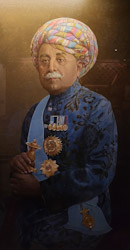
The old durbar Hall in the Aina Mahal contains fine painted portraits of some of the previous Maharaos. One of these depicts Maharao Desarji II, who ruled from 1819 to 1860. Amongst his many achievements he encouraged the study of mathematics, geography, and astronomy. He developed schools and hospitals. And he also put an end to slave trading in Kutch. In addition, he put an end to the practice of sati (‘self’-immolation of widows during their husbands’ cremations).

His son Pragmalji II, who ruled from 1860 to 1875, not only had the Pragmahal place built but also encouraged education. It was during his reign that the Alfred School was built. It was named in honour of Queen Victoria’s son Prince Alfred, who visited India in 1869/70.

My wife’ great great grandfather, Laxmidas Ravji Sapat, was the 11th headmaster of the Alfred High School between 1888 and 1892. This was during the reign of Maharao Khengarji III, who ruled Kutch from 1876 to 1942. He loved wildlife and took an interest in education. Amongst the many things he did was establishing the Museum of Kutch and the Jubilee Hospital – both in Bhuj. He also helped Laxmidas Ravji Sapat.

After being headmaster of the Alfred School, Laxmidas and his son-in-law went to London to study law, Mr Thacker, at Middle Temple. Going to London to study was expensive. As both Laxmidas and his son-in-law, Mr Thacker (my wife’s great grandfather) were bright, their community, the Kutchi Bhatias, clubbed together to help finance the education of these two promising men. Additional money was donated by the Maharao (Khengarji III), who, as already mentioned, was keen on promoting education.

I am grateful that we were privileged to have been shown around a part of the Aina Mahal not open to the public. Apart from seeing something new and having a member of the royal family to explain things, we managed to see portraits of his ancestors, each of which was accompanied by labels that summarised their achievements.

An illustrious ancestor

QUEEN VICTORIA’S SON Prince Alfred (1844-1900) visited India in December 1869. In his honour several schools in India were founded in his name. In the present State of Gujarat, there are at least 3 still in existence. One is in Rajkot, another in Bhavnagar, and one in Bhuj (formerly the capital of the Princely State of Kutch).

Alfred High School in Bhuj

In Bhuj, we have a friend, Pramod Jethi, who is a historian of Kutch. Some of what I am about to relate is based on information kindly provided by him. Much of the rest is gleaned from what my wife’s family have told me.

My wife’s mother’s great grandfather was one Laxmidas Ravji Sapat (aka Sampat), who was born in the mid-19th century, or a bit earlier. Along with Gokaldas Parekh, Laxmidas was one of the first teachers in the Alfred High School in Bhuj (founded by Rao of Cutch, Pragmalji II in 1870). It is likely that he was its headmaster for a time. I have yet to see it, but his portrait hangs in the school. One of my wife’s relatives, also a descendant of Laxmidas, arranged to have it restored a few years ago.

In 1890, Laxmidas left the school. Later, along with his son-in-law, Cullyanji Murarji Thacker, he went to London (UK) to become a barrister. He studied for the Bar at Middle Temple and was called to the Bar on the 27th of June 1900, along with his son-in-law. Mr Thacker, who was my wife’s mother’s grandfather. The two men received financial help for their studies from the Kutch Royal family.
Both men were members of the Bhatia community in Kutch. Back at the end of the 19th and the early 20th it would have been unusual for a man and his son-in-law to travel out of India together to study.

Laxmidas, after leaving the Alfred School, became appointed as police chief of Bhuj, then diwan (Prime Minister) of Jaisalmer, and after that Chief Justice of Jodhpur. Apparently, he was very successful in reducing dacoitry in the Kingdom of Kutch and also Jaisalmer.

Recognising that the dacoits robbed because they were impoverished and starving, he helped make arrangements that reduced these poor peoples’ need to steal. It was this success that attracted other rulers of Princely States to offer him employment.

Regarding Jaisalmer, I discovered this quote:
“On his retirement, one Laxmi Das Raoji Sapat, who had lately served as Police Commissioner in the Kutch State, was appointed as Dewan of Jaisalmer”
This was in 1903.

As for Mr Thacker, he was successful enough to have owned a large house with two separate kitchens (one veg, the other for meat), and to have employed an English governess for my wife’s maternal grandmother, Benabhai, who married the surgeon Haridas Bhatia FRCS (died of septicaemia whilst on duty in 1926).

Incidentally, Benabhai was sent to London to study at the former Bedford College at the same time as her husband was studying for his FRCS. This contrasts with Mahatma Gandhi, who went to study in London, leaving his wife behind in India.

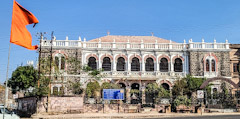
In January 2023, whilst spending a short time in Bhuj, we took a look at the elegant exterior of the city’s Alfred High School, which adjoins the Bhuj Museum. Badly damaged in the earthquake of 2001, the school building has been well restored. A less attractive, newer building was built to enlarge the school. On a future and lengthier visit to Bhuj, we hope to be able to view the portrait of Laxmidas that hangs inside the school.

Where Mahatma Gandhi met Vallabhai Patel in Ahmedabad

THE GUJARAT CLUB, the oldest club in Ahmedabad, stands opposite the Ahmed Shah Masjid, the oldest mosque in the city. The club was founded in 1888 by Rao Bahadur Nagarji Desai. With over 1000 members, the much used clubhouse is in an unmodernised condition. Located next to the recently constructed (2020) City Civil and Session’s Court, the Club is a ‘hang-out” and informal meeting place for many senior advocates. In former times, the place was frequented by Ahmedabad’s wealthy Mill owners and high ranking Britishers. It was the first Indian club that admitted Indians as well as Europeans from the moment it was established.

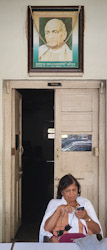
Vallabhai Patel above a doorway at the Gujarat Club

The Club is located close to a house where Sardar Vallabhai Patel (1875-1950) lived. Patel frequented the Club regularly and played bridge there. It was where he first met Mahatma Gandhi in 1916. A tree marks the spot where they chatted.

After having passed the Bar Examination at London’s Middle Temple, where my wife achieved the same thing many years later, Patel came to live in Ahmedabad. The first meeting with Gandhi at the Club marked the start of Patel’s attachment to the Mahatma’s cause. Years later, Patel played a key role in uniting the former Princely States with what had been British India to form the India of today. An important freedom fighter for Indian independence, he became a senior member of the country’s government after 1947. A close associate of Gandhi, the two men chose to differ on how to deal with certain issues, for example the creation of Pakistan.

We sat under the verandah of the Gujarat Club and enjoyed cups of tea. From where we sat we could see a large rectangular open space, which was being used as a car park. The ground was marked out with tennis court lines and a couple of nets were stretched between rows of parked cars.

We began conversing with an advocate at the next table. When he learned that my wife was a barrister, he kindly offered to show us around the neighbouring court building.

We spent well over an hour sitting in various court rooms. Most of these had two layers of glass screens, separating the judges and the court officials from the rest of the room: a covid precaution.

Several things impressed my wife as being different from what happens in British courtrooms. First, the plaintiffs are permitted to speak directly with the judges, rather than via intermediaries such as barristers. Secondly, the judges seemed to be handed the papers of a case at the moment it was about to be heard, rather than in advance. Thirdly, each judge was able to switch seamlessly between fluent Gujarati, Hindustani, and English. Also, they made decisions far more rapidly than their counterparts in the UK.

After our fascinating visit to the court house, our host and a charming advocate from his firm invited us to return to the court and the Club to celebrate Republic Day on the following morning, the 26th of January 2023. We accepted, and I will describe the events in another essay.

Our visit to the vibrant Gujarat Club proved far more exciting than we had anticipated. What was once a place where mill owners rubbed shoulders with British officers and officials, where Patel first met Gandhi, is now a congenial place where advocates meet, converse, read, and relax.