THERE IS A MEMORIAL that was recently erected in a tiny, picturesque seaport in Cornwall: Mousehole.
It commemorates the 7th anniversary of the disastrous fire that occurred at Grenfell Tower in west London, during which 72 people, including 18 children, perished. Since that tragedy, Cornwall has been hosting survivors of the tragedy as is explained in a newspaper article in The Packet (dated 12 June 2024):
“The plaque was the work of Cornwall Hugs, a Cornish charity that hosted hundreds of Grenfell Tower fire survivors, bereaved family members, and firefighters in the years following the disaster in London … The charity welcomed its 500th Grenfell guest in October 2023. Since then, many families have made their temporary homes in Mousehole. This village also saw Grenfell families unveiling a special street sign featuring a green Grenfell heart in 2019.”
The thoroughfare on which this memorial has been placed is called Grenfell Street. Incidentally, the name Grenfell is associated with several families in Cornwall.
QUETHIOCK IS A tiny village in Cornwall. It has a church, St Hugh, that contains many interesting features.
One small thing that fascinated me was a small brass plate attached to a wooden table. It commemorates Dr Erich Schneider of Aussig (Usti na Labem) in Bohemia, who was born in 1889, and perished in the Auschwitz concentration camp in 1944. His wife, Marketa, was interned in the Terezin concentration camp, but survived. She moved to England after WW2. The Schneiders had a son, Johann, who was born in 1921. He was educated in England. At school or college, he became friendly with Reverend Lintell’s children, and spent holidays with them in Quethiock. Later, Johann became an economist at the Treasury, and between 1987 and 2005, he was an assistant pastor at St Anne’s Lutheran Church in London.
It was a great surprise finding this memorial to a victim of the Holocaust in sucharemotepart of Cornwall.
WHENEVER WE VISIT the picturesque port of St Ives in Cornwall, we come across things we had not noticed on previous visits. On our latest visit, made in early July 2024, we discovered a monument that we had not noticed before and entered a chapel, which we had seen often, but never entered.
The monument is a bas-relief plaque mounted on one of the walls of the Roman Catholic Sacred Heart and St Ia Church. It is dedicated to the memory of John Payne, the portreeve (harbour master) of St Ives. He was executed in 1549 because he was a Roman Catholic. His demise occurred during the 1549 Prayerbook Rebellion. In case you had never heard of this – and it was news to me – the Prayerbook Rebellion (aka the ‘Western Rising’) happened because of something that happened during the reign of King Edward VI. Edward’s uncle, Edward Seymour, encouraged iconoclasm and the use of English (instead of Latin) during church services. This was unpopular in large parts of England, and when in 1549 the “Book of Common Prayer” was introduced, revolt against it broke out in Devon and Cornwall.
John Payne was hung in the marketplace of St Ives. His death was ordered by Sir Anthony Kingston, the Provost Marshal (c1508-1556). Payne was not the only Cornishman who was executed for his Catholic beliefs. The monument in St Ives is not only dedicated to him but also to:
“… all the men of St Ives who died to defend the Catholic faith in the Western Rising – 1549”
I am not sure when the memorial plaque was placed on the church, but it does bear the dates “1549” and “1949”.
Further into the town than the monument just described, one reaches the Smeaton Pier, where fishing boats unload the seafood, which they have caught. Wedged between a public toilet (for ‘gents’) and the small St Ives Harbour Master’s Office, there is a tiny chapel dedicated to St Leonard. This small building built with stones is entered via a few granite steps. Consisting of a small room (about 10 feet long and 6 feet wide. No one knows when it was constructed, but records indicate that it underwent some repairs in1577. The chapel was probably used by seamen setting out for sea and also provided shelter in bad weather. In 1971, the chapel was renovated and opened as a museum and a memorial to the fishermen of St Ives.
On the outside of the chapel, there is a plaque commemorating the record breaking 600-mile passage made by the St Ives lugger Lloyd from Scarborough to St Ives in 1902. The journey took 50 hours. Within the chapel, there are glass cabinets containing historical maritime items as well as old photographs and some models of sailing ships.
Although small, both the chapel and the memorial add to the fascination of the wonderful town of St Ives. In a future essay, I will tell you about some more of the things we ‘discovered’ during our latest visit to the place.
THE FIRST BLACKFRIARS railway station was opened in 1886. This station has been replaced by a 21st century station that now serves trains of the Thameslink network, which connects places north of London with places south of the city – no further north than Peterborough, and no further south than Brighton. Originally, when it first began serving passengers in the 19th century, trains carried people to overseas destinations including Leipzig, Naples, St Petersburg, and Marseilles.
The ticket hall of the current Blackfriars Thameslink station contains a reminder of the days when passengers departed for places much further afield than Brighton and Peterborough. It is a section of the original station’s facade, on which a list of destinations once reachable from the station is inscribed . The list includes many places on the European mainland as well as places in southeast London and Kent, through which travellers heading towards foreign lands had to pass.
I do not recall the old Blackfriars station, but the current one is an elegant example of modern architecture. What is particularly nice is that the platforms are on a bridge spanning the Thames. While waiting for a train, passengers can enjoy splendid views up and down the river.
FURNIVALL GARDENS IS a pleasant grassy open space that lies between the busy Great West Road (part of the A4) and Hammersmith’s riverside at Lower Mall. The park was created as part of the Festival of Britain (1951). Prior to WW2, the area upon which the garden now stands was mostly occupied by industrial premises and slums. Part of this area was occupied by the Quakers (of Hammersmith) Friends’ Meeting House and its adjoining Friends’ burial ground. A little bit of the land owned by the Quakers is now covered by the carriageways of the A4. The Quakers gave up their land to Hammersmith Borough Council when they were planning Furnivall Gardens.
There have been Quakers living and worshipping in Hammersmith since 1658 (see: https://hammersmithquakers.org.uk/history/). In 1677, they built their first Meeting House at number 28 Lower Mall near Hammersmith Creek (now covered up), which used to run along the western edge of what is now Furnivall Gardens. This tributary of the Thames ran through a very poor area of Hammersmith. In 1765, the meeting House was rebuilt and remained in use until a few years after the Creek was covered over in 1936. On the 24th of July 1944, this venerable Meeting House was destroyed by a flying bomb.
I have walked through Furnivall Gardens many times, but it was only today (the 18th of February 2024) that we took time to look at a noticeboard with its history. My wife noticed that the former Quaker Meeting House and burial ground are mentioned on this informative board. It indicated an area of the Gardens, where a memorial stone can be found. The simple monument in an area walled off from the rest of the park is surmounted by a circular metal plate on which the following words are inscribed:
“This garden is on the site of the Friends’ Meeting House and burial ground 1765-1944”.
It is an unassuming little memorial, which you might not notice if you did not know it existed. It has taken me several decades to become aware of it. I have driven along the stretch of the A4 that runs alongside Furnivall Gardens many times. And until today, I had no idea that my car’s tyres were racing over land where once Quakers were buried.
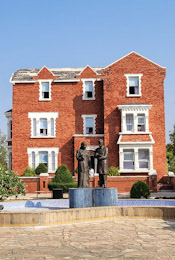
A NARROW ROAD LEADS away from the town of Mandvi (in Kachchh, a part of Gujarat) into an arid sandy area close to the seacoast. Scrubby bushes populate most of this flat terrain. After a few miles, a red building can be seen on the horizon. As you approach it, you can see that it resembles no other in the surrounding area, or, for that manner, in any other part of India. However, if you are a Londoner, it would seem familiar, although quite incongruous.
Replica of India House near Mandvi, Kachchh
The house in the desert is an accurate replica of a typical Victorian house, such as can be found in North London. In fact, it is a full-size copy of number 65 Cromwell Avenue in London’s Highgate area. The reproduction near Mandvi was built as part of a complex to commemorate Shyamji Krishnavarma (1857-1930), who was born in the centre of Mandvi.
Krishnavarma, who became a barrister and worked in various Princely States, moved to London, where he lived until about 1907. He moved to Paris, and then to Geneva, where he and his wife lived until they died.
In London, Krishnavarma lived opposite Highgate Woods. He invested wisely, and became interested in the works of English men, who had their doubts about Britain’s domination of India. He became an opponent of British rule in the Indian subcontinent. At first, his interest was mainly intellectual. However, in 1905, following the partition of Bengal, he became an activist.
One of his several activities was to purchase number 65 Cromwell Avenue. He had it adapted to become a ‘home away from home’ for Indians studying in London – they frequently had to endure the racist attitudes of English people. He named the building ‘India House’ (which should not be confused with the present Indian High Commission in London).
Apart from providing Indian food, some accommodation, and some leisure facilities, India House also hosted meetings that discussed the injustice of British rule in India. Soon, India House attracted the attention of the British police. This was because India House was becoming a nucleus or hotbed of anti-British activism. For example, some of the people who frequented the House experimented with bomb making and smuggling firearms to freedom fighters in India.
Krishnavarma left London in 1907, when he feared that he might be arrested. India House continued to be active until mid-1909 when one of its visitors assassinated an important colonial official.
Krishnavarma wrote in his will that after he was cremated, his ashes should be returned to India only after it had become independent of the British.
In the early part of this cemetery, the Chief Minister of Gujarat, then Narendra Modi, decided to bring Krishnavarma’s ashes to India – to Mandvi. Some years later, a complex to commemorate Krishnavarma was built outside Mandvi. Part if this is the replica of Highate’s former India House. The ashes of Krishnavarma and his wife are stored in urns on display in a building next to the replica.
If this story interests you and you want to know much more about India House, its replica, Krishnavarma and his fellow freedom fighters, including the currently influential VD Savarkar, you should read my, dare I say it, very informative book. I have produced two versions of it. One, the latest edition is “Indian Freedom Fighters in London 1905-1910), and is available here: https://www.amazon.co.uk/gp/aw/d/0244270716/ . The other “Ideas, Bombs, and Bullets”, which can only be delivered to addresses in India in available here: https://store.pothi.com/book/adam-yamey-ideas-bombs-and-bullets/.
ALFRED LORD TENNYSON (1809-1892), the famous Victorian poet, had his home, Farringford House, at Freshwater Bay on the Isle of Wight. First, he rented the house in 1853, and then bought it in 1856. Because he was pestered by so many tourists, he moved to Aldworth in West Sussex in 1869. However, he kept Farringford, and spent most winters there. In 1860, his friend, the creative photographer Julia Margaret Cameron (1815-1879), bought a house, Dimbola, which was very close to Farringford.
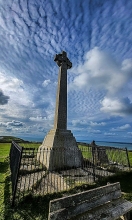
In 1897, a memorial to the poet was erected on Tennyson Down, a clifftop high above Farringford and Dimbola. Designed by JL Pearson, it is a tall stone Celtic cross mounted on a stepped base. A gently sloped footpath leads from Dimbola to the memorial, but we did not use this. Instead, my friend Martin and I laboriously climbed a steeper path closer to it. The cross is impressive and dramatic against the wide-open sky – almost Wagnerian. The views from the clifftop were magnificent on the clear day we visited it.
Our descent from the clifftop was somewhat adventurous. This was not intentional. Because we could not remember the place the path (and staircase), which we ascended, began, we had to create our own route down the steep, almost vertiginous, wooded slopes. We had to be careful not to trip over the numerous tree roots and fallen branches that were hidden under fallen leaves that lay all over the place. I was quite relieved when we reached the car park without having fallen or strained our ankles. Next time I visit the poet’s memorial, I will use the lengthier but safer footpath.
You can read more about Tennyson and Julia Margaret Cameron, “Between Two Islands. Julia Margaret Cameron and her Circle”, available from Amazon sites such as:
IN THE 1980s when Yugoslavia existed, I used to visit the Bosnian city of Sarajevo regularly. In the centre of the town there was (and might still be) a museum about the assassination of Archduke Franz Ferdinand in 1914. Near this, there were impressions of two footprints in the pavement. These mark the supposed spot from which Gavrilo Princip fired the shots that killed the Archduke. You could stand in that very spot if you wished. I have no idea whether this curious memorial still exists but I was reminded of it when walking along the waterfront in Cornwall’s Falmouth.
On the 14th of June 1968, Sir Robin Knox-Johnson (born in 1939) set sail from Falmouth as a competitor in the Sunday Times Golden Globe race. In his small boat, the 32-foot Suhaili (a Bermudan ketch), he circumnavigated the World non-stop. Having won the race, he disembarked at Falmouth on the 22nd of April 1969.
Just as Princip’s exploit was commemorated by imprints of footprints, so was Sir Robin’s. However, at Falmouth there are two sets of footprints embedded in brass plates. One set has its toes pointing towards the sea, and the other, commemorating Sir Robin’s return, has its toes pointing towards the land (away from the sea).
Whereas the impressions of Princip’s footsteps make us remember the terrible consequences of his actions, those of Sir Robin celebrate a great achievement.
ON OUR WAY TO LOOE (in Cornwall), where we hoped to buy fresh fish – and we did – we passed through an extraordinarily picturesque village called Lerryn, which lies on the banks of the River Lerryn (a tributary of the River Fowey). The shopkeeper in the village store recommended that we took a look at the church in nearby St Winnow (aka ‘St Winnoc’). On our way to this place, which is at the very end of a narrow country lane, we were first slowed down by a flock of pheasants which refused to get off the road, and then by some workers felling a tree.
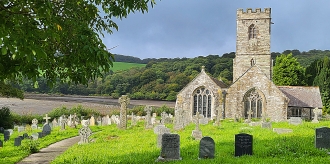
The parish church of St Winnow was built mainly in the 15th century and is positioned on a slope overlooking a stretch of the River Fowey. It is named after a saint, who is new to me. According to a website (www.anglozuluwar.com/images/Journal_10/St_Winnow_Church.pdf):
“St Winnow was one of the tireless band of Celtic priests and evangelists who consolidated and extended the Christian Church in Wales, Ireland, Cornwall and Brittany after the withdrawal of the Roman legions in the 5th Century. St Winnoc probably grew up in Wales and came here in about 670 AD to begin his missionary work, forming a small religious community and establishing a Lan or sacred enclosure. Eventually he moved to Northern France and founded a monastery at Wormhout, not far from Dunkirk.”
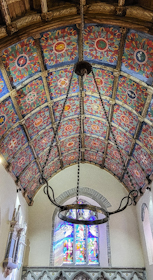
The church contains pews with beautifully carved endings. Two of its east windows have stained glass that dates from 1500. One of these windows contains a good display of the types of clothing worn at that time. The carved granite font, created in the 15th century, has bas-reliefs depicting angels with outstretched arms. All these features and others including the gothic architectural style make the church worth seeing. However, one thing struck me as being particularly unusual. It is an inscribed slate memorial on the north wall of the Lady Chapel.
The slate commemorated the death of William Sawle, who was buried on the 16th of February 1651. Beneath his name there is an anagram of it, which reads:
“I was ill: am wel”
‘Wel’ being a variation of the spelling of ‘well’.
Below this, there is the following verse:
“When I WAS sick, most men did deeme me ILL
If I had liv’d, I should have beene soe still.
Prais’d be the Lord, that in the Heav’ns doth dwell
Who hath received my Soule. Now I AM WEL.”
And beneath this, there is information, carved on the slate, that informs the viewer that Sir JSG Sawle Penrice repaired it “… out of respect to his Maternal Ancestors …” in 1838.
The Sawle family have lived in Cornwall since the time of William the Conqueror. By 1620, they were living at Penrice House near St Austell (see: http://www.sole.org.uk/sole2/penrice.htm). As for William Sawle, whose memorial bears an anagram, I cannot tell you anything yet because I have not found any information about him. However, his memorial in St Winnow is a great example of grave humour.
THERE IS A LOVELY walled garden, open to the public, in Sunbury-on-Thames. We were introduced to it today (20th August 2023) by our friends, Sue and Imtiaz, who live in Richmond. The large garden is well-tended and awash with flowers including a wonderful crop of late flowering roses. In the centre of the square garden, there is a carved stone lion on a plinth.
The lion commemorates the deaths of Captain Charles Frederick Lendy on the 15th of January 1894, aged 30. And his brother Edward August William Lendy on the 23rd of December 1893, aged 25. Charles died in Bulawayo (now in Zimbabwe) during the Matabele Campaign. And Edward, who was a captain in the Sherwood Foresters and Inspector General of the Sierra Leone Frontier Police, died in Warina (in Sierra Leone). According to a website (https://victorianweb.org/sculpture/warmonuments/9.html), he died as a result of ‘friendly fire’, and Charles died “from the effect of the Matabele campaign”, whatever that might mean. According to another website (www.photosunbury.com/lendymemorial4.htm), Charles
“… collapsed and died of peritonitis on 15th January 1894. Elsewhere, another interpretation places him at the Tati Hotel (in Botswana) where his illness was attributed to a heavy bout of drinking and eating.”
The brothers were the only sons of French born Major Auguste Frederic Lendy (1826-1889), a Royalist, who came from France as an exile, and settled in Sunbury-on-Thames. He ran his Practical Military College in nearby Twickenham, which prepared young men for entry into the major British military academies. He also wrote some books about warfare, and encouraged the British to be well prepared for military encounters. His sons’ military careers, though prematurely ended, were a credit to his teaching and philosophy.
Both brothers were in Africa to assist in the preservation and growth of Queen Victoria’s British Empire. One of them died because of friendly fire, and it seems that the other died of illness rather than during fighting. I doubt that their father would have been too pleased to know that neither of them had died whilst attempting something demanding bravery.
Apart from the Lendy memorial, there is a café in the walled garden, and next to that there is a small gallery. The gallery contains a fascinating embroidery on which most of the old houses in Sunbury-on-Thames are depicted beautifully and in great detail.
In addition to the walled garden and its contents, Sunbury-on-Thames has many old houses and a magnificent church (St Marys), which was designed by the Victorian architect Samuel Sanders Teulon (1812-1873), son of a French Huguenot, and built in 1857. I am very grateful that our friends introduced us to this charming place on the Thames.






 yamey
yamey 