ONE GREY SEPTEMBER afternoon, we stepped into the Almine Rech gallery in London’s Mayfair a few days before its wonderful exhibition of paintings, “Summer of Dragons”, by Hiba Shahbaz was due to end (on the 28th of September 2024). Each of the works on display depict dragons, and some of them also include human figures, often scantily dressed.
Hiba was born in Karachi, Pakistan. She studied Indo-Persian miniature painting in Lahore’s National College of Art. Then, she studied in the USA at the Pratt Institute in Brooklyn (New York City), where she was awarded her Master of Fine Arts degree. She now lives and works in the USA.
The skills she gained while training to paint Indo-Persian miniatures can be seen in the much larger paintings, which are on display at Almine Rech. Some of the paintings evoked memories of Chinese or Japanese art. Others depict dragons in the company of naked women. All the paintings, including some wooden boxes decorated with paintings, were completed in 2024. I suspect that had she remained in Pakistan and produced the same images, those containing the nudes might have been severely frowned upon.
We left the gallery, feeling very satisfied with what we had seen. Although the clouds above us had become more threatening, the visual experience of the exhibition brightened our moods.
WE VISIT DOVER Street in London’s Mayfair frequently to view exhibitions at the commercial art galleries along it. Laid out in the late 17th century, the street is named after Henry Jermyn (c1636-1708), 1st Baron Dover, who was a member of the syndicate that developed the area in which it is located.
Despite having walked along this street countless numbers of times, it was only this September (2024) that we spotted the entrance to a narrow alley way on the west side of the street between numbers 41 and 43. The alley is called Dover Yard. The first 12 yards of this passageway are covered by a high barrel vaulted, brick-lined ceiling. Then, after a short stretch open to the sky, one enters a wide yard made attractive with plenty of plants.
The yard itself is surrounded by modern buildings. In the 1970s, the yard, which has existed since the 18th century, was bought by developers and used as service area and parking lot (www.ianvisits.co.uk/articles/londons-alleys-dover-yard-w1-64590/). It was redeveloped recently, and is now flanked by the elegantly designed Nightingale coffee bar and restaurant (part of 1 Hotel Mayfair) on the north side, and Dovetail, a Michelin-starred restaurant, faces it. West of the wide yard, there is another narrow alleyway leading to Berkely Street. It has become a peaceful, almost hidden oasis in the heart of a busy part of Mayfair not far from Piccadilly.
As is often the case when revisiting places we thought we knew well in London, we come across places like Dover Yard, which we have passed often but never noticed. Although we did not try it, the Nightingale looks like it would be a very pleasant place to stop for refreshment.
MICHAËL BORREMANS WAS born in Geraardsbegen in Belgium in 1963. He studied art in Ghent. This city and others nearby are rich in fine paintings by great Flemish artists such as Jan van Eyck, the Brueghels, Rubens, and Hugo van der Goes. These famous painters worked in the 14th, 15th, and 16th centuries. Their work often has a particular kind of clarity, which is especially evident in the portraits they painted.
Two paintings by Borremans
The works of Borremans, which are on display at the David Zwirner gallery in London’s Mayfair until the 26th of July 2024, include portraits painted recently. Although they depict modern subjects, their visual quality and fine execution reminded me of the Flemish artists, who worked many centuries ago. Borremans paintings are not imitations of the works of the earlier Flemish artists but the effect his paintings have on me does not differ markedly from what I experience when viewing the Flemish art of many centuries ago.
Some of the paintings by Borremans depict the faces of monkeys dressed up in human clothes – 18th century painter’s garb. These paintings were inspired by a work created by Jean Siméon Chardin, who worked in the 18th century. The monkey depicted was not a real one, but a glazed porcelain model. I am not sure what message is being portrayed in these intriguing works.
The exhibition at Zwirner was well worth seeing. The pictures were well hung and beautifully lit, and a breath of fresh air, artistically speaking. Sadly, by the time you read this, it will be over.
I HAVE NO IDEA how many commercial art galleries there are in Central London. Today (the 14th of May 2024), we visited an art gallery, whose existence was previously unknown to us, and there we saw an exhibition of works by an artist, who was also new to us. The gallery is Carl Kostyal in Savile Row. Its discreet entrance is sandwiched between two fashionable tailors’ stores. Half Hungarian and half Swedish, Carl Kostyál opened his gallery in Savile Row in 2010. Three years later, he opened another gallery in Stockholm.
The artist, whose work is being exhibited, is Leo Park, who was born in Sweden in 1980. His exhibition in Savile Row is called “Beyond Pleasure”. It consists mostly of large paintings, but also a wall covered with a mosaic of small sketches, The beautifully executed artworks are eye-catching, and reminded me a little of the works of some of the pre-WW2 Surrealists. The paintings and sketches are of imagined forms that immediately made me think of human bodies. The images are clearly meant to evoke such thoughts, but looked at objectively, they are all shapes that do not exist in nature. The paintings and drawings are all displayed in the beautifully restored rooms of the 18th century building that houses the gallery.
The show ends on the 2nd of June 2024, and is well worth visiting.
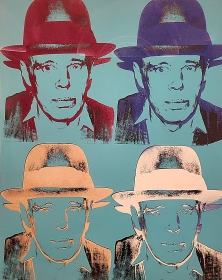
IF I WERE to tell you that I have just seen an exhibition of well over fifty photographic portraits of one person, all reproduced from the same original print, and enjoyed it, you might begin to wonder about me and my sense of aesthetics. Well, I really did enjoy this exhibition at the Thaddeus Ropac gallery in London’s Mayfair. If you wish to share the experience, you will have to hurry, because the show ends on the 9th of February 2024.
On or soon after the 30th of October 1979, the German artist and political activist (e.g., a co-founder of the German Green Party) Joseph Beuys (1921-1986), who was in New York City for the installation of a retrospective exhibition of his works at the Guggenheim Museum, was taken to meet the American Pop artist Andy Warhol (1928-1987). During that encounter, Warhol used his Polaroid camera to make a portrait of Beuys wearing his characteristic felt hat. It was not the first time that Warhol had photographed Beuys. He had also used his Polaroid when he first met Beuys earlier in 1979 at the Hans Mayer gallery in Düsseldorf (Germany). This meeting has been recorded on film (see https://youtu.be/PRrC8EJ3KxI?si=DM4RoR9nDrX_cJbX).
Between 1980 and 1986, Warhol used his Polaroid photograph of Beuys as the source image for a series of screen-printed portraits. As the Press Release on the website of the Thaddeus Ropac Gallery explained:
“Repeating Beuys’s arresting gaze on different scales and in different formats, Warhol exercised his characteristically experimental approach to materials in the portraits. Amongst the paintings, unique Trial Proofs, line drawings, and unique and editioned works on paper, are examples of some of the artist’s earliest uses of diamond dust in portraits. These sit alongside images that have had their tonal values inverted to give the effect of photographic negatives. Belonging to the Reversal Series in which Warhol reproduced key subjects from across his wide-reaching body of work – including his iconic portraits of Marilyn Monroe, the Mona Lisa and Mao …”
In the 1940s, Warhol began his working life in commercial and advertising art. By the 1950s, he had discovered the secret of repeating images making small changes to produce variations on a theme. In 1952, he had his first solo exhibition in an art gallery (in NYC). Although it was not well received, it was not long before he became recognised as an artist of note. In 1962, he learned screen-printing techniques, and became one of the first artists to use this process for creating artworks. These include most of the images on display at Thaddeus Ropac.
The results, which we were able to see at the gallery were far from monotonous, despite being repetitions of the same photograph. By modifying the sizes, colouration, and many other aspects of the photographic portrait, Warhol managed to bring a considerable degree of liveliness to this image. As I saw the various diverse presentations of the single image of Beuys, the German artist began to feel oddly familiar. It was almost as if I was meeting an old friend.
Before seeing the exhibition, I had my doubts about viewing what I had heard were multiple reproductions of the same photograph. My worries were dispelled within a few seconds of looking at the exhibition. I was fascinated how one image could be altered in so many different ways and the effect that seeing the results had on me, There are now less than 24 hours left before the show ends. So, if you can, hurry up and view it.
WHEN WE ARE IN LONDON, we make regular visits to the commercial art galleries, many of which are to be found in and around Mayfair. Not only can one get to see some of the most recent works of contemporary artists, but also those that will eventually end up in private collections that are usually inaccessible to the general public. Today, the 12th of October 2023, we were walking along Cork Street, heading towards the Waddington Custot Gallery when we passed a gallery, the Stephen Friedman, which we had never entered before. Through its window, we saw works by an artist, whose oeuvre we enjoy, and entered.
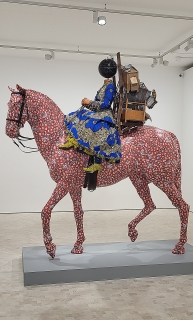
Much of the exhibition at Stephen Friedman is dedicated to creations of the British Nigerian artist Yinka Shonibare. He was born in London in 1962. His Nigerian parents took him to Lagos in Nigeria when he was 3 years old, and he lived there until he was 17. A year later, he developed transverse myelitis, which left him paralysed on one side of his body. Despite this, he went on to study fine art at the Byam Shaw art school, and then later at Goldsmith College (part of the University of London). Because of his disability, Yinka directs a team of assistants to create his artworks (sculptures, photographs, fabrics, and much more). He has become a widely exhibited and highly acclaimed artist.
Yinka’s works are visually engaging and highly imaginative. They are also full of meaning. He uses his creations to:
“… question the validity of contemporary cultural and national identities within the context of globalisation. Through examining race, class and the construction of cultural identity, his works comment on the tangled interrelationship between Africa and Europe, and their respective economic and political histories.” (see https://yinkashonibare.com/biography/)
Although one can easily enjoy the aesthetics of his creations without understanding the artist’s messages contained within them, a good knowledge of colonial and post-colonial history will enhance the viewer’s experiences of them.
The exhibition is on until the 11th of November 2023. In addition to Yinka’s works, he has curated a small, but fascinating, collection of artworks by several artists from the African diaspora.
I LIKE SEEING SCULPTURE in open air locations. For example, I have enjoyed the Yorkshire Sculpture Park, the garden containing works by Henry Moore (near Much Hadham), Barbara Hepworth’s Garden in St Ives (Cornwall), and the annual Frieze sculpture shows in Regents Park. Until the end of August 2023, the Waddington Custot Gallery is exhibiting several large metal sculptures by Bernar Venet (born 1941 in France). Yesterday, the 8th of July 2023, we visited Grosvenor Square where these artworks are on display alfresco. Although they are not the most exciting sculptures I have ever seen, they looked good amongst the trees and lawns of the square.
The west side of Grosvenor Square is occupied by a large building that was until recently (2018) the Embassy of the USA. Constructed in 1960, it was designed by the Finnish architect Eero Saarinen (1910-1961). The structural engineering firm responsible for the edifice was FJ Samuely, which was founded by the Austrian-born Felix James Samuely (1902-1959), who fled to Britain in 1933 to escape the Nazi persecution. When he died, Frank Newby (1926-2001) became the firm’s senior partner. It was he who supervised the structural aspects of the realisation of Saarinen’s project in Grosvenor Square. One of Frank’s colleagues was my uncle Sven Rindl (1921-2007), who joined Samuely in 1954 and later became a director. It was my uncle who played an important role in creating the former embassy’s distinctive appearance when viewed from Grosvenor Square.
Just beneath the top of the centre of the façade of the embassy that faces Grosvenor Square, there is an enormous sculpture of an eagle. Gold coloured, this huge (35 feet wingspan) symbolic creature was created by the Polish-born sculptor Theodore Roszac (1907-1981). What few people know about this very visible open-air sculpture is that it has remained firmly attached to Saarinen’s building for well over 60 years thanks to my uncle Sven. For, it was my uncle who designed the eagle’s tethering to the building.
When we went to Grosvenor Square yesterday, the first thing I did was to see if the eagle was still in place. It was, and as I have just discovered, it is likely to remain there because the building is subject to a statutory conservation order. In contrast, the sculptures by Vernet, part of the Mayfair Sculpture Trail (www.bondstreet.co.uk/articles/art-in-mayfair-sculpture-trail-2023), will be removed by the 29th of August 2023.
PS: Did you know that the Duke of Westminster leased the land on which the Embassy stands to the Americans for one golden peppercorn per year in gratitude for what the USA did to help Britain in WW2?
ONE OF THE MANY JOYS of visiting London’s commercial art galleries is, apart from seeing the works of art on display, viewing the architecture of the galleries. Today, the 1st of Aoril 2023, we made a brief visit to the Bernard Jacobson Gallery in Mayfair’s Duke Street St James. Most of the exhibition space is in the basement. However, who ever designed the place has done something both spectacular and intelligent. Part of the ceiling of the basement has been removed to reveal above it a two or three storey high lightwell,which admits ample daylight to augment the artificial illumination in the rest of the basement.
The exhibition we viewed, which continues until the 28th of April 2023, is of paintings by the German artist Bernd Koberling (born 1938). His large works, executed in a variety of materials, are colorful abstracts. Even though they are abstracts, they bring to mind plants and other natural phenomena including reflections in watery surfaces.
I liked the pictures, but could not help being distracted by the gallery’s eye-catching design.
THE LONDON-BASED ARTISTS Gilbert Prousch (born 1943) and George Passmore (born 1942) first met whilst they were studying sculpture at the St Martins School of Art, where, incidentally, my mother created sculptures in the 1950s and early 1960s. From the late 1960s onwards, most of their creations have portrayed themselves, usually together, in an incredible variety of poses and situations. One might say that they were pioneers of selfie-making.
On the 1st of April, Gilbert and George (‘G+G’) opened their new establishment, The Gilbert & George Centre, in London’s Heneage Street near Spitalfields and Brick Lane (see https://gilbertandgeorgecentre.org/). I have yet to visit this new gallery, and look forward to doings so soon. To coincide with this new venture, the White Cube Gallery in Mayfair’s Masons Yard is holding an exhibition of works by G+G until the 20th of May 2023.
Called “The Corpsing Pictures”, this exhibition at White Cube consists of G+G posing as corpses in a range of different settings. In each picture, the two artists are portrayed lying as if dead but fully dressed in their characteristic smart suits. In many pictures, images of bones have been included in the compositions. At first sight, these pictures, which look like stained glass windows, appear somewhat macabre, but soon the viewer becomes aware of the playful and often punning nature of the images. Each composition is compelling visually and together the collection is a stunningly beautiful sight.
I suspect that the crowds at the Heneage Street Centre will be great for the first few weeks after its opening. So, if you want to see some good examples of the works of G+G without being bothered by too many other viewers, I recommend that you head for the White Cube in Masons Yard.
MY MOTHER SETTLED in London in about 1951, a year before I was born. The UK was still recovering from WW2, and life was not too easy. There were shortages of food. I remember my mother telling me that during the early 1950s, relatives in South Africa used to send parcels of food, including, as I can still recall, tinned guavas. The postman used to lug these heavy packages to our home in Hampstead Garden Suburb. My mother used to feel guilty that she was lucky enough to be receiving food that few others could not obtain, and used to open the parcels and give the postman a couple of tins from them. Soon after I was born, my mother, already a painter, began making sculptures. Somehow or other, she managed to get permission to work in the sculpture studios at the St Martin School of Art, which was then located on Tottenham Court Road. She was not enrolled as a student, but worked alongside, and received help from, several sculptors who have now become famous. Amongst these were Antony Caro, Phillip King, William Turnbull, and Elisabeth Frink, who became a family friend.
Most of my mother’s sculpting was done during the 1950s and 1960s. This was a period when many people, including British sculptors, were simultaneously recovering from the horrors of war; fearful of the Cold War and the possibility that it might develop into a war with atomic weapons; and looking towards the future. Sculptors reacted to this situation in various ways as can be seen at an exhibition being held in the Marlborough Gallery in London’s Mayfair until the 22nd of April 2023. Called “Towards a New World: Sculpture in Post-War Britain”, this show to quote the gallery’s press release:
“… emphasises the international impact of a group of young sculptors and artists who merged past trauma, present anxieties, and future hopes into a new visual language.”
Lyn Chadwick
The artists whose works are on display include, amongst others, Elisabeth Frink, William Turnbull, Reg Butler, Bernard Meadows, Kenneth Armitage, Lyn Chadwick, Graham Sutherland, and Francis Bacon.
Apart from some of the works by Reg Butler and Bernard Meadows, the artworks on display exhibit what the art historian Herbert Read described as: “…the iconography of despair, or of defiance; and the more innocent the artist, the more effectively he transmits the collective guilt. Here are images of flight, or ragged claws ‘scuttling across the floors of silent seas’, of excoriated flesh, frustrated sex, the geometry of fear.”
The Geometry of Fear was the name of a group of British artists who exhibited at the 1952 Venice Biennale.
Bernard Meadows (1915-2005) was a name that was new to me. He was Henry Moore’s first assistant. Later, he taught Elisabeth Frink at the Royal College of Art. He was a member of the The Geometry of Fear group but as the press release explained he differed from most of its members: “While the distorted human figure became a prominent motif for many of the artists associated with the ‘geometry of fear’ group, for others, like Bernard Meadows, it was animal imagery that resonated most with the collective societal trauma of the war. Visceral depictions of birds and crabs acted as vehicles to express human emotion.”
I enjoyed seeing this exhibition. The works are well-displayed in the spacious, well-lit rooms of the Marlborough. After viewing the exhibition, I wondered about my mother’s sculptures, most of which now only exist in photographs. Her first sculpture, a terracotta mother and child, was figurative but veering towards the abstract. As time passed, her work became increasingly abstract, and tended to be closer to being brutalist rather than naturalist. Although I never heard her mention The Geometry of Fear, I wonder whether her artistic sympathies lay with them rather than with any other ‘school’ of artistic activity.





 yamey
yamey 