
An ingenious use of simple matchsticks in a work of art

FROM AFAR IT LOOKS like a small red and black oriental rug, but as you approach, it is not what it seemed at first sight. This artwork by Hadi Rahnaward, who was born in Afghanistan in 1986 and now resides in Belgium, is made with matches, glue, and other materials. The matches used are of two sorts. Some are tipped with black material, and the others with red.

The matches have been glued to a base so that each one of them is vertical and standing with its tip pointing upwards. They have been placed close to each other in such a way that their tips form a mosaic resembling a patterned oriental carpet or rug. The artist made this incredibly intricate creation in 2023. It is one of a collection of often intriguing artworks by young artists from south Asia and Afghanistan being exhibited at the SOAS Gallery (formerly known as the ‘Brunei Gallery’) in London’s Bloomsbury until 21 June 2025.

One of the other exhibits that intrigued me is an embroidery by Varunika Saraf (born 1981), who lives and works in Hyderabad (India). Called “The Longest Revolution” and made in 2024, this embroidery depicts many features of Indian women’s struggle for basic rights and parity with men. This busy looking artwork depicts many aspects of women’s political struggles, and in places reminds the viewer of some parts of the Indian Constitution that appear to have been considered less relevant than previously by some in India during the last few years. Even if the political content of this piece is ignored, it is an eye-catching work of art.
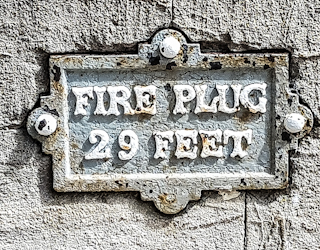
Fire plug


The first time I encountered the term ‘fire plug’ was when I was researching the life of my great grandfather Franz Ginsberg, who died in 1936. As an 18 year old, he went from his home in the German Empire to the South African town of King Williams Town in 1880.  By 1885, he had established a factory for making matches. Such factories are full of raw materials that are prone to catching fire. As his business grew, so did his need for a reliable water supply for dealing with fires. 

Water in the Eastern Cape was expensive in the late 19th century. Franz had to apply to the town council for permission to increase the supply of water to his factory. He also needed permission to install more fire plugs. In my published biography of my great grandfather, I wrote:

“Almost a decade later, in 1898, Franz and his brother-in-law Mr Siegfried Salomon (who married Franz’s sister Ida and was a Town Councillor for a while) both applied to the Town Council to have ‘fireplugs’  placed on their premises. This was allowed on condition that the applicants paid the expense of placing them there; and that they would be liable to other charges including a fine of £25 if they used the water from these for any purpose other than the extinction of fire.”

Recently, I visited Windsor Castle, where I saw several signs such as is shown in the illustration to this blog article. They indicate the locations of fire plugs in the castle. Had I not seen the term ‘fire plug’ before while writing about my ancestor, I might not have noticed these small old-fashioned signs.

So, what, you might be wondering, is or was a fire plug? The modern term for them is ‘fire hydrant’. The fire plugs, which were precursors of fire hydrants were simply holes made in the water mains pipe, which were blocked with a plug. The plug could be removed when water was required to extinguish fires.

I suspect that you are by now asking yourself if Franz ever had to make use of the plugs he had requested. Well, he did occasionally:

In February 1893, the Cape Mercury newspaper published a long article about Franz’s match factory. It begins with a spark of humour:

In December last an unusual illumination made a “King” industry more widely known than before. A fire broke out in, and consumed the drying shed at Messrs. Ginsberg & Co.’s Lucifer Match Factory, which is situated in Victoria Street. The loss was not great, but the advertisement was extensive – and cheap – for it was gratuitous.’”


If you want to know more about my ancestor who went to South Africa in search of prosperity and later became a senator in that country, please read:

Soap to Senate: A German Jew at the dawn of apartheid

by Adam Yamey.

It is available from: lulu.com, Amazon, bookdepository.com  and Kindle


Sabotaged

My late and much-loved mother was very protective of her two children. She saw dangers everywhere. We were not allowed to go near to electric wall sockets just in case we got an electric shock. Intelligent as she was, I have the feeling that she believed that electricity flowed out of the holes in the socket like water from a tap. 


During my childhood, my aunt and uncle used to smoke Benson and Hedges cigaretess that were supplied in nice small hinged metal boxes, which when empty were very useful for storing small objects. When one day I was given one of these boxes, empty, my mother confiscated it immediately. She was concerned that I might cut my fingers on the sharp edges of the box.

As for matches, much caution was needed here. Despite the fact that her grandfather had owned a factory that manufactured safety matches, even safety matches were deemed unsafe by my mother. Therefore, we were forbidden to handle boxes of  (even safety) matches just in case they should spontaneously ignite in our hands or packets. I am sure her intentions were well meant, but sometimes they went a bit too far. This excerpt from my book “Charlie Chaplin Waved to Me” (he did!) shows how her anxiety sabotaged what promised to be a wonderful hiking trip:

The four of us (aged 17) embarked on a second youth hostelling trip the following Easter. Once again, we took a train to South Wales, and made our way up to our first hostel, which was located at Capel y Ffin in the Black Mountains near to the English border. We spent the night there, and awoke to discover that snow had begun to fall.


I had been instructed that I had to telephone home every morning to ensure that my mother knew that I was still alive. I rang from the hostel’s public telephone and my mother answered. She had heard on the radio weather forecast that there was snow in Wales, and asked meabout it. When I said that it had begun falling where we were, she ordered that we return to London immediately. Believe me, this was not an order that could be discussed. My mother, anticipating that we would surely be lost like Scott of the Antarctic in an avalanche or in freezing snow drifts, had to have us back as soon as possible. I broke the news to my 3 friends, who were furious. For about an hour they kept offering me reasons that I should give my mother in order to try to change her mind about our premature return. Eventually, they gave up. We all knew that none of these would work. And, because, I imagine, they feared my mother, we set off back to London. I have never been allowed to forget this fiasco. Even Hugh’s mother, now in her eighties, often recalls her amazement when she learnt how my mother had successfully wrecked our trip.


Charlie Chaplin Waved to Me” is available by clicking: HERE