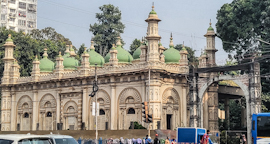
A mosque on the road to the Delhi Gate of Ahmedabad

THE CITY OF Ahmedabad was founded in 1411 AD when Ahmad Shah I of the Gujarat Sultanate moved his capital to the already existing settlement of Ashaval. He renamed the place as Ahmedabad. During the fifteenth and sixteenth centuries, many fine mosques were built in the city. During previous visits to Ahmedabad,  we have looked at many of these edifice.


Today, 29 November 2025, we came across a mosque we had not seen before. It, the Rani Rupamati (aka Rupavati) Masjid, is beside the main road (Mirzapur Rd) that leads from the Sidi Saiyed mosque in the city centre to the Delhi Gate.


The Rani Rupamati Masjid was constructed  in the fifteenth century,  possibly Sultan Mahmud Begada for Rani Rupamati,  whom he married. The mosque and the dargah next door to it are connected with Sunni Sufism.


Architecturally,  the mosque shares many features in common with other mosques built in Ahmedabad and the rest of Gujarat in the fifteenth and sixteenth centuries.  Built in the so-called Indo-Saracenic style, this mosque and others  built in the same era contain architectural and decorative features often found in Hindu and Jain temples. Although rich in decorative ornamentation, the mosques, unlike the temples,  are devoid of representations of people and animals. Floral and leafy motifs can be found at the Rupamati Masjid,  as well as at other mosques built in the same era. The highly decorated bases of two minarets can be seen  but the tall upper parts of the minarets were listed during an earthquake in the early nineteenth century.


 Beside the mosque and within its grounds, there is another structure, topped by two domes. This pillared hall contains the tombs of Rupamati and other worthies.


The mosque is a protected historical monument, but is still used by worshippers.  Although it is an attractive  building,  it does not seem to be on the main ‘tourist trail’.

Baked earth and building Islamic places of worship

THE COUNTRYSIDE AROUND Murshidabad is dotted with brick factories. Their tall, often smoking, chimneys are surrounded by vast expanses of new bricks, usually stacked neatly. The clay that can be found in the area is particularly good for brick making.  So, it is unsurprising that many local buildings make substantial use of brickwork.


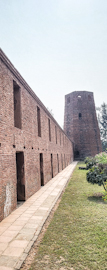
One of the towers of the Katra mosque

Near Murshidabad,  there are two famous mosques constructed not with stone or concrete, but with bricks. One of these, the Katra mosque, was constructed entirely with bricks between 1723 and 1724. This huge edifice was built not only as a mosque but also as a caravanserai. It is one of the largest caravanserais in the Indian Subcontinent.  The rooms of the caravanserai are arranged in a square that surrounds the mosque rather like cloisters in a monastery. These small rooms also served as workplaces and bedrooms for students studying the Koran and other Islamic texts. Thus, the Katra was a complex consisting of a mosque, a caravanserai, and a madrasa. At each of its four corners,  there were tall brick towers. Only two of these remain.   The tomb of Nawab Murshid Quli Khan(1660-1727) is located under the staircase leading to the main entrance of the building. Protected by the Archaeological Survey of India, the remains of the Katra complex are well conserved. This is not the case for another brick mosque nearby: the Fauti Masjid.


The Fauti was constructed in 1740 by Nawab Safaraz Khan (c1700 – 1740). However,  it was never completed. It is a large mosque, 137 feet long and 38 feet wide. If you manage to chamber within it, which I did with great difficulty despite helping hands, the remains of its five huge incomplete domes can be seen.


The Fauti is a protected building, but in a bad condition. It is possibly perilously unstable. However, because of the vegetation around it and within it, it is a picturesque ruin of the sort that eighteenth and nineteenth century European Romantic artists enjoyed portraying.


In addition to these mosques, which were built using baked clay (I.e., bricks), we have also seen some Hindu temples near Murshidabad that include terracotta in their construction.  But more about these at a later date.

A mosque in south Kolkata and one of the heroes of India

THE TOLLYGUNGE CLUB in South Kolkata stands on land, which was once the home of members of the family of Tipu Sultan (1751-1799). He fought first the Marathas, and then the British valiantly until his death at Srirangapatnam. Had Tipu not been defeated,  the British might have had great difficulty maintai g a foot in India.


Four years before Tipu’s death, his youngest son Ghulam Muhammad Sultan Sahib (1795-1872) was born in Srirangapatnam. In 1806, he and the rest of his family were deported to Calcutta by the British, and were settled in Tollygunge, south of the city. Where they lived is now occupied by the Tollygunge Club (founded 1895).


About 900 yards north of the Tollygunge Club’s clubhouse and across a very busy road, there is a mosque (on the corner of Deshparan Sasmal Road and Prince Anwar Shah Road). It stands within its own peaceful compound.


One of the first details I noticed when visiting the mosque and its grounds was that all of its outdoor lighting stands use old cannons for their bases. Maybe this is not surprising because this mosque is one of two  in Kolkata named after Tipu Sultan. The Tollygunge Tipu mosque was constructed in 1860 by Tipu’s youngest son, Ghulam Muhammad Sultan Sahib. It is designed in the Indo-Islamic style. Its exterior is attractive,  but its interior has very few visual attractions.


In the garden of the mosque, there is a raised rectangular platform. Upon this, there are five or six unmarked graves, each one looking dilapidated. One of these marks the burial place of Tipu’s youngest son. The walls of the platform have a few plaques engraved with words in a script resembling Urdu or Arabic. I  was told that these words are of religious significance,  rather than the names of the deceased.


At the east end of the compound, there are a few steps leading to a deep depression that was once a pond or small lake. An elderly caretaker told us that never in his long life had he ever seen water in it.


A review of the mosque on the TripAdvisor website described the place as not being somewhere in Kolkata that “must be seen”. This is correct, but as we often stay at the Tollygunge Club and have visited Srirangapatnam several times, I was keen to view the place with such an interesting link to Tipu Sultan.

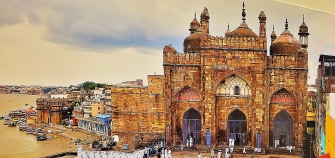
Built as a Jain temple, then repurposed as a mosque

AT THE TOP OF a short but hazardous flight of stairs, one reaches the compound of an extremely interesting mosque in Ajmer (Rajasthan, India). It is the Adhai Din Ka Jhonpra mosque, whose name means ‘Two and a half day hut’. To what the two and a half day refers is not certain.

The building was originally constructed as a Jain temple in 660 AD. In about 1190, the temple was destroyed by the Afghan leader Muhammad of Ghor. He built the mosque on the site of the former temple using carved stonework plundered from Hindu and Jain temples. The resulting edifice, although shaped like a mosque, contains many architectural features and decorative motifs that you would expect to find in 12th century (and earlier) Hindu and Jain temples.

The mosque and its ccompound is very popular with visitors. I noticed that I was the only European amongst several hundred visitors. The site is a much desired place to be photographed. There are many photographers carrying Nikon SLR cameras, all touting for business. And there is no shortage of people wanting to pose for photos. The photographers seemed to have plenty of customers despite the fact that most people carry mobile phones.

Although the nearby dargah (a Sufi shrine) attracts most tourists, the Adhai Din Ka Jhonpra is well worth visiting.