
SRI AUROBINDO (1872-1950) lived in Baroda between 1893 and 1906. During this period, he was an official in the Gaekwad’s government, a professor of English, and the Vice Principal of Baroda College, now the Maharaja Sayajirao University of Baroda.
Today, Aurobindo is best known as a spiritual leader, who spent much of his life in Pondicherry. However, before this he was a keen supporter of ridding India of its domination by the British. During his term as Vice Principal, he began taking an active interest in the growing independence movement.
In 1906, he shifted to Calcutta to become the first principal of National College (now Jadavpur University), which was founded to provide national education to Indian youth. He resigned in 1907 because of his increased involvement in anti-British activities.
In May 1908, Aurobindo was imprisoned for a year because he was suspected of having been involved in the fatal Alipore Bomb case. He was acquitted. During his imprisonment, his interests began to move from revolution to religion. He began practising yoga, and thinking about spiritual matters.
After his release, the British security services kept him under observation despite the fact that his active involvement in nationalist activities was waning. By 1910, he had fled to Pondicherry, which was then a French colony and out of reach of the British authorities. From then on, his activities as a spiritual leader, for which he is best known, took off.
The house where he lived in Baroda between 1900 and 1906 stands surrounded by well tended gardens. It is now known as an Aurobindo ashram. People who believe in him visit the place to meditate and enjoy its peaceful atmosphere.
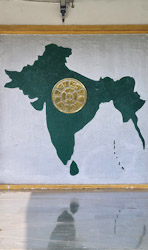
At the end of one of the gardens, there is a stage. Behind the stage, there is a large map on a wall. It shows the outlines of British India before it became divided into Bangladesh, Burma, India, Pakistan, and Sri Lanka. I do not know when this map was drawn, but it is interesting that it does not depict modern India alone.
As we wandered around the place, I wondered how many of its visitors seeking spiritual solace consider Aurobindo’s earlier less peaceful approach to life.


 yamey
yamey 