Eyes facing the ocean from Madeira

STARING OUT TO sea at Calheta on the Portuguese island of Madeira is a bronze bust of a man wearing 18th century clothing and a bow tie. The sculpture depicts Sebastián Francisco de Miranda y Rodríguez de Espinoza (1750-1816). Born in Caracas in what is now Venezuela, Miranda became a military leader and a revolutionary fighting for his country’s liberation from Spanish rule. Regarded by many as the forerunner of Simon Bolivar (1783-1830), the great liberator of several Spanish South American colonies and born in Caracas, Miranda ended his life in a Spanish prison in Cadiz.

The plaque below the bust in Calheta records (translated from the Portuguese on a website: https://statues.vanderkrogt.net/object.php?record=ptma108):

“The Sons of the municipality of Calheta in the lands of Venezuela at the bicentenary of the Independence in honour of its precursor ‘Generalisimo, Sebastian Francisco de Miranda’ ‘The most universal Venezuelan’”

I interpret this as meaning that the bust was erected by descendants of people from Calheta, who had emigrated to Venezuela.

The bust was created by the Venezuelan sculptor Julio César Briceño Andrade, who was born in Caracas in 1950. It was unveiled in Calheta by Lucas Rincón Romero, the Venezuelan Ambassador to Portugal, on the 5th  July 2011.

Miranda was the son of a man, who had migrated to Venezuela from the Spanish Canary Islands. His mother was born in Venezuela. Although, he crossed the Atlantic several times, I do not know whether Miranda ever set foot on the island of Madeira.

Like those from Calheta, who migrated to Venezuela, many others have migrated from Madeira to various parts of the world over the years. I have been told that many of the Portuguese speakers in South Africa had their roots in Madeira. Having seen the bust in Calheta, clearly Venezuela was another destination.

Now, with difficulties that Venezuela has been facing, some its citizens with Madeiran heritage are returning to the island as can be seen in an article published on-line (www.euractiv.com/section/global-europe/news/madeira-an-island-of-refuge-for-venezuelans-of-portuguese-origin/):

“No one knows the exact figure but the authorities in Madeira consider that about 6,000 Venezuelans of Portuguese descent have taken refuge on their island, where they found themselves in an extremely precarious situation. “They arrive with nothing, many are sick, these are people lacking a great deal,” said the President of the Portuguese archipelago, Miguel Albuquerque. These people are second or third generation Portuguese, descendants of those who left Madeira decades ago in search of a better life in Venezuela. They are now making the opposite journey.”

Reading this made me think about South Africa, to which many Europeans, including my parents’ families, travelled in search of a better life. After the ending of apartheid, many of their descendants have left the country because they had become concerned about their futures in a land where Europeans no longer hold the upper hand.
Rum and cane in Madeira

CALHETA IS A COASTAL town in Madeira about 1.5 hours drive west of the capital, Funchal. We went there for an outing to see something of Madeira away from its capital. While there we saw an interesting factory-cum-museum.

The island of Madeira was once a major producer of sugar cane. Some of the work was performed by black slaves, but unlike other places such as Brazil, the slaves in Madeira tended to be ‘employed ‘ as domestics and builders. Today, sugar cane is till grown in Madeira,  but the workers are local Madeirans.

Cane pressing machinery in Calheta

In Calheta,there is an enterprise called Sociedad dos Enghennos da Calheta. This is a factory where sugar cane is crushed between rollers to extract the sugar cane juice.  The juice is fermented in the factory to produce rum. It is also processed to make molasses. The place also makes traditional Madeiran cake called Bolo de Mel and soecial biscuits. All of these products can be sampled and bought at the factory. Visitors are free to wander around the factory and its attached museum, which contains a fine collection of vintage industrial machinery.

As with other museums we have seen in Madeira, the exhibits are well displayed. Although the main attraction of Calheta is its sandy beach – the only one in Madeira: it is created using sand imported from North Africa, the rum and cane factory/museum is well worth a visit.

A lady from Lichtenstein

FUNCHAL IN MADEIRA is famed for its glorious gardens, which can be visited by members of the public. Actually, the whole city is filled with so many flowering plants and trees that it is almost like a huge garden. Nevertheless, we decided to see one of the gardens  for which the city is known. We chose the Palheiro Gardens, which are located about 500 metres above sea level.

To reach the gardens, we took local bus number 37 from the Pingo, a square near the  Mercatos Lavradores. While waiting for the bus to depart, we began chatting with another passenger, a lady who spoke English with a Germanic accent, who last visited the Palheiro 18 years ago. It turned out that she is from Lichtenstein. As far as I can recall, she is the first person from that tiny country next to Switzerland with whom I have ever spoken.

The bus trip up to the Palheiro is spectacular. The road winds ever upwards along the edges of deep ravines. As the road ascends, there are many dramatic views of Funchal and its bay.

The gardens are well-tended and are laid out in a seemingly informal way, in the English garden style. The gardens flourish on slopes overlooking the city far below and a golf course nearby. I do not know enough about trees and flowers, but suffice it to say that the place provides a colourful feast for the eyes.

The Palheiro gardens are laid out in the former estate of the wealthy Count of Carvalhal. The place was purchased in 1885 by the Blandys, a family of British entrepreneurs, bankers, makers of Madeira wine, and merchants who have been important in the development of Madeira’s economy. Part of the gardens retain features laid out by the Count in the 18th century, but much of the rest of the grounds have been developed since then.

Being at about 500 metres,  the garden is noticeably cooler than in the centre of Funchal.  In fact, during our visit, we were close to the clouds and occasionally felt the moisture contained within them. I am pleased that we visited the Palheiro, but feel that given the profusion of lovely plants all around Funchal, I wonder whether visiting gardens like this one is a ‘must do’ activity unless you have a special interest in gardens and gardening.

The journey between Funchal and Palheiro and my first meeting with a person from Lichtenstein enhanced my trip to the gardens.

Where fishermen once lived

FUNCHAL IN MADEIRA is a place well suited for unhurried exploration. At first, I was worried that 11 days might be too long for a stay here, but this is not the case: it is far too short. There is plenty to see and do without queuing for the famous cable car or for the toboggan ride down a steep road. There are interesting museums to see, but a great deal of pleasure can be derived from wandering leisurely around the older parts of the place.

Cable car passing above Zona Velha in Funchal

One area, which despite being rather ‘touristy’, is the Zona Velha. East of the old patrician  areas around the cathedral and the university, the Zona Velha used to be the poorer part of the city, where fishermen and their  families lived in rather narrow crowded streets near the seashore and the venerable Forte São Tiago.  This fortress was one of a chain of four or five forts that used to protect Funchal from seaborne attackers.

The streets of the Zona Velha have become trendy and there has been a conscious attempt to make the area bohemian. Many of the doors have been painted with often entertaining designs and pictures. There are plenty of small bars and restaurants,  but we were advised by some ladies who work in a museum that these tend to be of poor quality and are best avoided.

High above the Zona there is a terrace overlooking a sea bathing area. Near this, there is an old church, the Igreja de Santiago Menor, which was closed when we visited the district. The café next to the terrace provided excellent coffee at a surprisingly reasonable price given the wonderful sea view from its tables: we paid 3 Euros for two coffees and a pastry.

As touristic areas go, the Zona Velha is certainly worth strolling through. It is probably best to go there earlier in the day before the roads are filled with tables  and chairs next to the eateries.

On a very steep street

WE CAN EITHER travel into the centre of Funchal by bus or walk. From our guesthouse,  the steep Caminho do Monte drops steeply down to the city centre. Most of the way, this almost a mile long  thoroughfare has a gradient of 40 to 45 degrees. Walking down this slope does wonders for one’s lower leg muscles, especially the calves. The first time we descended it, my calf muscles began to go into tremor.

A Sacred Heart

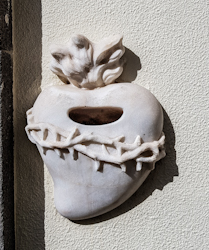
Our next attempt was altogether easier. On the way downhill, we passes a religious institution: a seminary called Colégio Missionário Sagrado Coração. Being Sunday, the gates were open for people who wanted to attend the Sunday mass. The institution is named in honour of the Sacred Heart. On either side of the door leading into the simply decorated chapel, there are car ings of hearts encircled by thorns.

There is a sculpture of a lion in the place’s large courtyard. Two busts of important religious figures stand near the chapel. One of them stsnds close to a terrace from which a wonderful view of part of Funchal can be enjoyed.

Although walking down the incredibly steep slope is slow, it is a wonderful way to observe deatails of life on the hills high above Funchal, and to meet locals standing on terraces over the road or in the entrances to their homes.

A museum in Madeira

HOUSED IN AN OLD palace, the Quinta das Cruzes museum (‘Quinta’ for short) contains a collection of exhibits of various kinds and its beautiful garden has a small collection of archaeological architectural fragments. In a way, the Quinta is Funchal’s version of London’s V & A, but much smaller.

Goa long ago

The much remodelled building housing the museum was initially built for João Gonçalves Zarco (c 1390 – 1471), who was the ‘discoverer’ and first Captain (i.e., governor) of Madeira. I am not sure how much of what Zarco would have seen in his time can be seen today. Nevertheless, it is an attractive edifice.

Several exhibits particularly interested me in the museum. One was a retable, a triptych, carved intricately in ivory. To our surprise, we discovered that this was an English production, created in the 19th century.

There were several fine paintings of Madeirans and their island painted by English artists including Eliza Eleanor Murray, Charles Scott-Murray, and Thomas Butterworth. The paintings by Murray and Scott-Murray were late 18th century. These pictures hung in rooms alongside English furniture including pieces by Chippendale and Sheraton.

Another exhibit that attracted me was a fine embroidery on which wild animals are depicted. This was produced in Portuguese Macau for a Christian religious order: the Carmelites.

Another former Portuguese colony, Goa on the west coast of India, is represented in the museum by three attractive paintings showing people and scenery in Goa in the 18th or 19th century.

These exhibits from what is now China and India remind us of Portugal’s pioneering and extensive colonisation of the world beyond Europe. The artefacts from the UK and by British artists recollect the importance of Madeira in the history of British trade and tourism.

I have outlined a few of the exhibits that are on view in the museum, but there is plenty more to enjoy including a grest collection of fine silverware (including models of serving women with black faces) and a very elegant modern refreshment area. It overlooks a fine panorama of part of Funchal.

Along with the Museum of Sacred Art, the Quinta is one of the cultural highlights of Funchal.

Roof ornaments in Funchal, Madeira

MANY ROOFS IN FUNCHAL are covered with terracotta tiles. Quite a few of these roofs have small sculptures on their corners. Many of them depict heads, birds, and scrolls ( leaves?) I have no idea why these things are added to the roofs.

Someone suggested that these ornaments are supposed to deter mice, squirrels, and birds. Maybe, they are for that purpose. In India ornaments depicting ogre’s faces (‘rakshasa’) are atteched to roofs to ward off the Evil Eye. Possibly, this is a finction of the ornaments I have seen in Funchal. Another possible function of these roof ornaments (finials) might be to distinguish one house from another. However, I am not sure about this here in Funchal because there is little variety in the firms used.

I would love to know more about them: their purpose and history.

Not my cup of tea

BEFORE REACHING MADEIRA, many people insisted that we should visit Reid’s Hotel in Funchal and to take afternoon tea there.

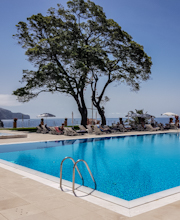
Pool at Reid’s Hotel in Madeira

Located in the western part of Funchal,  Reid’s was founded by William Reid, a Scotsman who arrived in Madeira in 1836. The hotel was his idea but he died before it was completed (in 1891). The massive seafront establishment was designed by George Somers Clarke and John Thomas Micklethwaite. It is not great architecture.

Since its opening, the hotel has hosted many famous guests including Winston Churchill,  Albert Schweitzer, George Bernard Shaw, and Rainer Maria Rilke. Apart from its celebrated guests, the establishment is famed for its afternoon teas. We decided against partaking of this treat because it contains far too many sugary confections. We had morning coffee and a pot of tea by the swimming pools on a terrace overlooking the ocean. By Funchal standards, it was costly (10 euros) but not outrageously so.

Undoubtedly, Reid’s is luxurious with good service. Its position overlooking a rocky cove is superb even though it is located in a part of Funchal, which resembles unexciting slightly upmarket seaside resorts on Italy’s Adriatic coast. However, the well-appointed hotel seemed somewhat sterile. If sun and sea is your top priority, then Reid’s is the place to go if you can afford it. However, it lacks the charm of other places in Funchal.

Well, we did visit Reid’s as people had suggested before we left London but I must say that it is not my ‘cup of tea’.

Buried in Madeira

IN CENTRAL SARAJEVO, there used to be a pair of footprints carved on the corner of a pavement where two roads met. I do not know whether these impressions, which I saw in the 1980s, still exist. They marked the spot where a young sharpshooter, Gavrilo Princip, took aim and assassinated Archduke Franz Ferdinand of Austria-Hungary in 1914. Had his aim not been so accurate, the last Emperor of Austria might not have been buried in a church high above the city of Funchal in Madeira.

Emperor Karl of Austria-Hungary

Had Princip’s aim not been so good,  his victim, Franz Ferdinand, would have been successor to the imperial throne. With the Archduke eliminated, his nephew, Karl (1887-1922), succeeded Emperor Franz Joseph when he died in 1916.

Following the end of WW1 in 1918, Austria’s last Emperor, Karl, fled to Switzerland. After a couple of attempts to regain his throne,  the British exiled him and his wife to Madeira in 1921.

In 1922, Karl died of pneumonia.  He was interred in a chapel on the north side of the nave in the Igreja Nossa Senhora in the Monte district high above Funchal.

Plenty of tourist gawp at Karl’s simple tomb in the lovely church, which overlooks the city and the Atlantic Ocean far below.  I wonder whether Madeira would have been the final home of the Archduke had he not been so unlucky in Sarajevo.

Curiously, Karl was beatified in 2004. Equally strange was the British choice of a Portuguese island for Karl’s exile. After all, Napoleon Bonaparte was eventually exiled to a British possession: St Helena.