
Flames flickering
On a cold dark autumnal night
Tiny signs of hope

Flames flickering
On a cold dark autumnal night
Tiny signs of hope
SCULPTURE CAN BE APPRECIATED by enjoying the light reflected off it or passing through it, by touch, and sometimes by sounds it makes. Today, at London’s Tate Modern gallery, I saw an exhibition of sculpture that can be seen, but cannot be touched or even heard. The exhibits were beams of light projected onto screens through a room filled with the sort of smoke used in theatres to create haziness. All these exhibits were created by the British artist Anthony McCall, who was born in 1946.

The projected light creates often changing patterns on broad screens. What makes the exhibits really exciting is that the slowly moving smoky haze in the room allows the viewer to see the paths taken by the projected light through space. These three-dimensional envelopes of light produce interesting sculptural forms, but unlike most sculptures, the viewer can move through them unimpeded. And while moving through these space-filling light formations, the viewer modifies their shapes and what is projected onto the screens. The results are both intriguing and beautiful, apart from being quite unusual. Words cannot adequately describe what we saw at this show. You need to experience it for yourself to enjoy this intangible but intensely visual sculptural show, which is continuing until 27 April 2025.

Of light and dark
Fair Diwali and strange Halloween
Two festivals
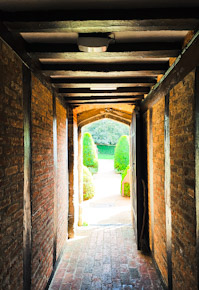
Ewelme, Oxfordshire
The light at the end of the tunnel can be blindingly bright.

YESTERDAY EVENING, WE took a stroll in Kensington Gardens when the temperature was beginning to drop. The sun was low in the sky. This caused some parts of trees to be shadowed by neighbouring trees so that lovely patterns of light appeared on them. One any particular tree, part of its foliage was brightly coloured because the rays of the sun could reach it, and other parts appeared dark green because the sun could not reach them. All this is obvious when you see it described in words, but wonderful when you see it in life.
PS: It is light effects such as these that make it difficult for artists to paint trees

Tied up by the bank
Reflect-ed on the water
She waits for trippers
FOR UNKNOWN REASONS, we were initially reluctant to bother with viewing the exhibition (at London’s Tate Britain until the 18th of September 2022) of paintings and drawings by Walter Sickert (1862-1942). However, I am glad that we did because we got to know and appreciate an artist, of whom I had heard but knew little about. That little which I did know was that for a brief while Sickert had one of the Mall Studios in Hampstead, where years later the sculptor Barbara Hepworth worked and resided with one husband, and then another. Later, Sickert moved from Hampstead to Camden Town.

Sickert was born in Munich (Germany). He and his family moved to Britain when he was 8 years old. His father, Oswald Sickert (1828-1885), an artist, introduced him to the works of important British and French artists, but Walter’s inclinations led him to study acting. However, in 1882 he entered London’s Slade School of Art (at UCL) and he became a student and assistant of the artist James Abbott McNeil Whistler (1834-1903). Soon, he began spending a lot of time in France, where he met Edgar Degas (1834-1917), whose work was to have a great influence on his style.
The exhibition at Tate Britain successfully demonstrates that Sickert was a highly competent artist. His topographical paintings (notably of Dieppe and Venice) are superb, as are the many of his portraits, some of which verge on being impressionistic, on display. His depictions of scenes within theatre show his great ability to portray light and shade. A series of paintings of nude women, some of whom are shown being in the company of often disinterested-looking men in far from elegant clothing, throw light on the shady world of the poor in places such as Camden Town and its environs.
Although some of Sickert’s paintings show features that later would become associated with artists such as the impressionists, Lucien Freud, and Francis Bacon, he is not one of the first artists that springs to mind when thinking about the great artists of the late 19th and early 20th century. Why is this the case? Despite hinting at what was to become common in the works of the Abstractionists, he never broke through the barrier into Modernism as did painters such as Braque, Picasso, Miro, Kandinsky, Matisse, and Mondrian. In no way does this detract from the brilliance seen in Sickert’s work. In a way, he was born too late to be considered as distinguished as those I have mentioned. Considered alongside 19th century artists, he shines. But, although he received many commissions, he was painting during an era when the more adventurous and innovative artists were in their heyday. That said, I can strongly recommend the exhibition at the Tate, which demonstrated to me that Sickert, a master of light and shade, was an artist who deserves much more attention than he gets today.
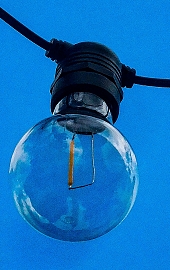
By day it reflects
The myriad clouds above
Later there is light
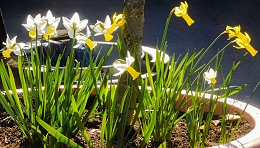
Sunlight through petals
Daffodils growing in spring
Bring joy to us all
THE RIVER ADUR rises in Sussex and flows through the county, reaching the sea (the English Channel) west of Brighton and Hove at Shoreham-by-Sea. Facing the rivers opening to the sea and close to the Brighton Road (A259), there stands the slender, tall Shoreham Lighthouse. The stone lintel over the small, narrow door at the base of the lighthouse bears the date “A.D. 1846”.

The lighthouse was built in 1842 and was at first supplied with oil lamps (https://brightonmuseums.org.uk/discover/2011/08/26/shoreham-lighthouse/). The structure was first used in 1846, the date on the lintel. In the 1880s, the lighting system was modernised, and the new lamps were powered by gas. It was only inn 1952 that the gas-powered system was replaced by electric lights (http://shoreham.adur.org.uk/lighthouse.htm). Major repair work was carried out in 1985-86, and the lighthouse is still in service, its beams can be seen from up to 15 miles away.
The tower, about 39 feet high, is made from blocks of limestone. The lamp housing topped with a weathervane mounted on a perforated, spherical base. It was rotating very keenly when I saw it on the second day of Storm Eunice (20th of February 2022). The weathervane is above the lamp housing that has and polygonal roof. At each corner of this, there a metal sculpture depicting the head of a fish with its mouth open.
The lighthouse stands facing a largely industrial stretch of the coast and a row of unexceptional looking two-storey residential buildings. This part of the coast is a complete contrast to the grand (and quite as grand) buildings lining the seafront at Hove and Brighton.
The lighthouse stands a few yards away from the new lifeboat station, built in 2010. It was so wet and windy when I stepped out of the car to take some photographs that I did not linger long. However, I noticed many hardy individuals setting out boldly to stride along the shingle beach despite the horrible weather.
 yamey
yamey 