
Fading lettering and an Edwardian building on London’s Harrow Road

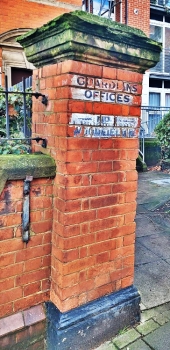
A LARGE BRICK edifice with white stone trimmings stands on the corner of Woodfield Road and the larger Harrow Road. Built in 1902, it now houses Westminster Register Office, but this has not always been the case. A clue to its former purpose can be seen on a brick pillar on one side of a now disused entrance to the building on Woodfield Road. In fading painted lettering, one can see the words “Guardians Offices”.
A somewhat difficult to read metal plaque on the staircase leading up to the building’s main entrance on Harrow Road gives a history of this elegant house. It was opened in 1902 as the then new offices of the Paddington Guardians, who supervised the running of the local workhouse. The Paddington Workhouse was built on a bank of the Grand Union Canal in 1846, and extended in 1868. According to an informative website (www.workhouses.org.uk/Paddington/):

One of the labour tasks for able-bodied inmates at Paddington was stone breaking.

In 1914, all the inmates of the workhouse were taken to the Marylebone Workhouse, and the Paddington establishment was turned into a military hospital that specialised in the care of men without limbs. In 1930, the place became Paddington General Hospital, and after 1986 it was demolished.

Returning to the building on Harrow Road, its new purpose came into being in 1965 after the original town hall on Paddington Green had been demolished to make place for the then new Westway. The council offices were moved into the former Guardians’ office building. In 1999, the building was demolished leaving intact only the grand façade we can see today. The 1902 façade is attached to newer buildings that contain the Register Offices in addition to residential flats managed by Paddington Churches Housing Association.

Despite its many reincarnations, the gatepost with its fading painted lettering is a reminder of the building’s original role.

Signs of times long past

OBSERVANT VISITORS TO KETTLES Yard art centre in Cambridge will notice a couple of incised stone signs embedded into the centre’s wall facing Castle Street. One of them reads:
“Godmanchester Turnpike Road Ends Here”.
Below this, there is another stone sign that reads:
“To the Horse-shoe Corner, Godmanchester, 14 Miles 4 Furlongs”
Just in case you did not know, or have forgotten (as I had), there are 8 furlongs in 1 mile (1.6 Km), and a turnpike is a toll-road. Godmanchester is northwest of Cambridge.

The turnpike was in existence by 1744. According to a website (www.geograph.org.uk/photo/568133), the tolls were:
“… collected by the Godmanchester to Cambridge Turnpike Trust. Horseshoe Corner in Godmanchester is almost probably the location of the then Horseshoe Inn at the southern end of Post Street. It was also where markets were held as early as 1533.”
The turnpike might well have run along a part of the course of a road built by the Romans – Via Devana. Robert Fox, writing in his 1831 history of Godmanchester, noted:
“The celebrated William Stukely had no doubts upon this point; for, in describing the course of the Via Devana through Cambridge, in his Itinerariium Curiosum, republished 1757,4to, at page 203 we find ‘Out of the ruins of this city—Granta now Cambridge—William the Norman Duke built a castle; a very straight Roman road comes to it from Durosiponte, Godmanchester. It passes as straight through the present Cambridge by Christ College and Emanuel College… so to Camulodunum, Colchester.’ “
Stukely was almost certainly describing Castle Hill and its southern continuation Magdalene Street, which leads almost straight towards Christ and Emannuel Colleges.

The stones were originally set higher than they are at present. They were then at the level of the eyes of coachmen seated high up on the front of their vehicles. The stones were discovered when Kettles Yard was undergoing restoration in 2016, and have been set at a level lower than would have been the case in the past.

Though not of as great visual impact as some of the exhibits in Kettles Yard, the two reminders of an old toll road are of considerable historic interest.