Photographs of Chandigarh in an old Indian magazine

DURING MY TEENAGE years, I had the idea that later I might train to become an architect. I enjoyed drawing, and read books about twentieth century architects such as Frank Lloyd Wright, Mies van der Rohe, Walter Gropius, and Le Corbusier. When the Bauhaus exhibition was held at the Royal Academy in London (September to October 1968), I visited it three times. My enthusiasm for becoming an architect ended after lunch one day when walking from the Highgate School dining hall back to the classrooms. Suddenly, I thought that instead of designing great buildings such as those created by the architects, whom I had read about, I might end up designing extensions and garages for people’s houses. This fleeting thought made me give up the idea of becoming an architect. However, since then, I have continued to enjoy looking at, and reading about, architecture.

One of the 20th century architects who intrigues me much is Le Corbusier. I have seen many of his creations in France and a few in the Indian city of Ahmedabad. But I have never been to Chandigarh in the Punjab. It was to be the new capital of the Indian Punjab. The old capital, Lahore, found itself in Pakistan after 1947.  This was a new city that Le Corbusier helped to design in the 1950s – both the layout and many of its buildings. Last year, I acquired a copy of a magazine called “Times of India Annual”. I have the 1955 edition. Although much of Chandigarh was already built by 1955, it was far from completed. The magazine contains an illustrated article by the British Modernist architect Edwin Maxwell Fry (1899-1987).

The article is illustrated with photographs that show both the novel designs employed for residences as well as some of the larger buildings including the Punjab Engineering College, the High Court, and a school. Several of Le Corbusier’s major projects such as the Palace of Assembly and his Open Hand Monument are not illustrated because they had not been completed by 1955. The Secretariat Building designed by Le Corbusier was complete when the article was published, but has not been included amongst its illustrations. The pictures tend to concentrate on the designs for dwellings that were economical without seeming mechanical or inhuman.

Having a great interest in Le Corbusier and Chandigarh, I was excited to find an article written by Fry, one of the city’s planners, at a time when the place was still in its infancy. For three years, he and his wife Jane Drew (1911-1996) worked with Le Corbusier on the planning of Chandigarh. Knowing that, I thought it would be interesting to see what Fry wrote in the magazine. Sadly, Fry’s article’s content is rather anodyne and self-congratulatory. Nevertheless, I am pleased that I have the magazine because apart from Fry’s article, it contains a wealth of other material – both written and illustrative.

From India’s Punjab to London’s Primrose Hill

WHEN THE PUNJAB WAS divided (by the British) between Pakistan and India in 1947, its former capital, Lahore, became a Pakistani city and the Indian part of the region was left without a capital. Jawaharlal Nehru, the first Prime Minister of India, decided that instead of assigning an existing city to become the capital of India’s Punjab a new city should be created. It was to symbolise the birth of modern India. A team of architects led by the Swiss born Le Corbusier began designing the new city, Chandigarh, in the early 1950s. In late 1953, it became the capital of India’s Punjab, which was later further divided into Punjab and Haryana states.

Amongst those who were on the team designing Chandigarh was Le Corbusier’s cousin, the architect Pierre Jeanneret (1896-1967). He designed much of the furniture installed in the buildings created in Chandigarh. According to one source (www.worldofinteriors.com/story/pierre-jeanneret-and-le-corbusier-chandigarh-furniture):

“Pierre Jeanneret, was strongly influenced by local materials and craftsmanship, with a Modernist twist. Due to the vast scale of what needed to be created for an uninhabited city – from Palace of Assembly chairs to university cafeteria tables and and linen baskets – Jeanneret experimented with what was on hand. Iron Sikh Sarbloh bowls became lampshades; mango tree trunks became tables. Readily available materials such as bamboo, teak, rope and wicker were woven into the designs.”

Recently, I saw a couple of examples of this furniture on display at a special exhibition at the Victoria and Albert Museum. Today, the 29th of October 2024, we visited an exhibition, “Syncretic Voices:Art & Design in the South Asian Diaspora”, in a private house near London’s Primrose Hill. What made it special for me is that there were many examples of Jeanneret’s Chandigarh furniture on display. The exhibition ends on the 1st of November 2024.

The house near Primrose Hill is owned by Rajan Bijlani, whose parents came from India to the UK in 1975. Rajan has been collecting Jeanneret’s Indian furniture for some time, and he showed it to us. Of particular interest was a table with a zinc table-top, which was once used in the Punjab University cafeteria in Chandigarh. Many of the other pieces on display were chairs and stools. There was also a shelving unit designed to hold files. Most of the furniture came from various government buildings in Chandigarh. Some of the pieces still have their original inventory numbers painted on them.

The furniture is in several rooms of the house. The walls of these rooms are decorated with attractive  modern artworks by several artists of Indian origin including Vipeksha Gupta, Rana Begum, Soumya Netrabile, Tanya Ling, Harminder Judge, and Lubna Chowdhary. Rajan told us that they were all for sale and he was holding them as consignments from various galleries. He is also selling some of his Jeanneret furniture. Rajan showed us around and was a perfect guide. It was a great pleasure and privilege to have been able to see his beautifully designed home and the fascinating furniture and other artworks displayed within it. If you wish to see this exhibition before it closes, visit: https://www.rajanbijlani.com/about

Modernism in Ghana and India in a museum in London’s South Kensington

UNTIL THE 22nd OF SEPTEMBER 2024, the Victoria and Albert Museum in London’s South Kensington is hosting an exhibition called “Tropical Modernism: Architecture and Independence”. It focuses on two countries: Ghana and India. It was the exhibits relating to India that interested me most, although those connected with Ghana were also intriguing.

The Royal Institute of British Architects describes Modernism as follows:

“Rejecting ornament and embracing minimalism, Modernism became the single most important new style or philosophy of architecture and design of the 20th century. It was associated with an analytical approach to the function of buildings, a strictly rational use of (often new) materials, structural innovation and the elimination of ornament.” (www.architecture.com/explore-architecture/modernism).

Modernism began both in the USA and Europe in the 1920s and 1930s. Its better-known pioneering exponents include Le Corbusier, Mies van der Rohe, Walter Gropius, Maxwell Fry, Louis Kahn, and Eero Saarinen. The Modernist architects, like the abstract painters of the early 20th century, broke with traditional approaches to form and style.

On the 15th of August 1947, India became independent. The country was no longer ruled by foreigners. Jawaharlal Nehru (1889-1964) became India’s first Prime Minister, a position he retained until his death. His vision for India was for it to shake off the shackles of the past (both colonial and traditional) to become a modern state. This extended to architecture in his new India. He invited Modernist architects including Le Corbusier and his cousin Perre Jeanneret to design a new city in the Punjab (following the loss of Lahore to Pakistan): Chandigarh. This is illustrated well in the V&A exhibition. Le Corbusier wanted to create his ideal of a city, which included forbidding street markets and cows to wandering in its streets. His pupil and collaborator, Balkrishna Vithaldas Doshi, who died in 2023, had a more human approach to architecture. Having seen some of his buildings, notably in Ahmedabad and Bangalore, I would say that Doshi developed an architectural opus, which might be loosely described as ‘user-friendly Corbusier’.  Incidentally, Doshi was also taught by Louis Kahn, who worked in India, notably in Ahmedabad.

A label in the exhibition noted that in 1959, at a conference about national identity in Indian architecture, Nehru urged Indian architects not to be “imprisoned by tradition”, but to experiment as had been done at Chandigarh (built between 1951 and 1956). Examples of this experimentation can be seen in the exhibition.

Naturally, since Nehru’s death, there have been many changes in India. I notice new changes every time we make our annual trips to the country. Nehru’s vision of a secular India has been replaced by a different vision in the minds of the leaders of the present Indian Government. Modernism’s internationalist aspects, which attracted Nehru and some of his successors, appear to have lost their appeal currently in India.

Immediately after gaining independence, both Ghana and India favoured Modernism in architecture. The exhibition at the V&A shows that even before independence, architects (almost all European) in Ghana had been building in the Modernist style, but specially adapted to cope with intense heat and high humidity. Ghana’s first leader, Kwame Nkrumah, encouraged the continuation of this architectural style. The exhibition includes a fascinating video about this. In India, Modernism seems to have been introduced post-independence. Both leaders wanted to project visions of a emerging modern countries, freed from the constraints of colonialism. Yet both promoted an architectural style developed largely by architects who came from countries that had had colonies in Asia and Africa.

Before ending this piece, I must not forget to mention two exhibits, which caricatured the great British colonial architect, Edwin Lutyens, who was certainly not a Modernist. One of them is a model of Lutyens’s head which has been combined with a model of one of his imperial buildings in New Delhi. The other, which is painted in the style of a Mughal miniature, shows Lutyens offering a model of the (British) Viceroy’s House (in New Delhi) to the Viceroy.

The exhibition was fascinating. Despite its rather obscure title, a good number of viewers were there during the Monday mid-afternoon when we visited it.

Designed by a disciple of Le Corbusier but it stands disused

THE BUSTLING KHWAJA Market in the heart of old Ahmedabad (Gujarat, India) stretches from the Bhadra Fort to the three-arched Teen Darwaja – a magnificent medieval gateway. Between the two, on one side of the marketplace, there is a 20th century edifice that is hard to miss. Built in the Brutalist style, this massive concrete building is the Premabhai Hall.

Premabhai Hall in Ahmedabad

It was completed in 1972. Its architect was Le Corbusier’s disciple and collaborator, the late BV Doshi (1927 – 2023). His building – an auditorium -replaced an earlier meeting hall, which had been built during the British occupation of India.

Looking like a giant piece of moder sculpture Doshi’s building hardly clashes with the mediaeval buildings on either side of it. Sadly, because of concerns about fire hazards, the Hall ceased being used in the 1990s. Luckily, it is still standing, but when looked at closely, it is showing signs of deterioration.

I hope that one day, the Premabhai Hall will be restored to its former glory.

Two architects and a painter in Ahmedabad

ON TUESDAY THE 24th of January 2023, we arrived in the city of Ahmedabad in the Indian State of Gujarat. That evening, we visited a friend who had been the curator of a building in Ahmedabad, which had been designed by the architect Le Corbusier. Our friend was pleased to see us but was upset because a close friend had died that morning at the age of 95. That friend had been a disciple collaborator of Le Corbusier.

Our friend’s friend was Balkrishna Vithaldas Doshi, who was born in Pune in 1927. He worked with Le Corbusier in Paris between 1951 and 1954. He returned to Ahmedabad to supervise Le Corbusier’s architectural projects in that city. In 1955, Doshi established his own studio in Ahmedabad, and was working there until the day before he died.

Clearly influenced by Le Corbusier and Louis Kahn, with whom he designed the campus of the Indian Institute of Management (Ahmedabad), his (some might say Brutalist) architecture embodies the ideals of Le Corbusier in a much more user-friendly form than that which his mentor produced.

Amdavad ni Gufa

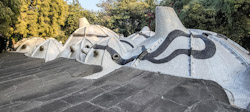
Next door to CEPT University in Ahmedabad much of which was designed by Doshi, there stands Doshi’s most unusual edifice, the Amdavad ni Gufa (the Ahmedabad Cave), which was completed by 1990. Its is difficult to describe this structure, but I will try. Covered in a mosaic of black and white ceramic tiling, it resembles an enormous caterpillar partially submerged in the ground. It is a giant caterpillar punctuated by bulbosities of various sizes, some of which have hemispherical windows at the end of short stalks that project from the dome-like bulbosities.

Steps descend to the two entrances of the Gufa. Originally designed as an art gallery, its irregular shape and wavy floor deemed it unsuitable for its intended purpose. Within the Gufa, the ceiling is supported by irregularly shaped columns that resemble stalactites with have joined with stalagmites beneath them. The strange space, which was too odd to be used as a gallery, is now decorated with sculptures and murals painted by the celebrated Indian artist MF Husain (1915-2011).

The Gufa is one of the ‘must-see’ sights of Ahmedabad. With the recent demise of Doshi and the earlier death of Husain, the Gufa makes a fitting memorial to these two great creators.

A Modulor in Bangalore

THE BOWRING INSTITUTE is a private members’ social club in central Bangalore (Bengaluru). It was established in 1868, and has been standing on its present site since 1888. The club has recently undergone a tasteful restoration and improvement. The old 19th century buildings can be seen in their full glory, looking as if they have only just been constructed.

One external wall of a club building has been adorned with a huge panel decorated with two Modulors. The Modulor is a symbol created by the great pioneer of 20th century architecture, Le Corbusier. It looks like a man with one arm raised and was designed by Le Corbusier to be “ a visual bridge between two scales: the metric and the imperial…” It was also connected with his philosophy that the proportions of structures should be related to those of the human body.

Le Corbusier had several connections with India. For example, he was intimately involved in the design of the city of Chandigarh and created a few wonderful buildings in Ahmedabad.

That said, I have yet to discover why the Modulor was placed twice on a panel at the Bowring Institute so long after its creator’s death. I would like to think that it is a fitting reminder of the considerable influence that Le Corbusier has had on 20th century Indian architects, including Balkrishna Doshi, whose studio and offices are in Ahmedabad.

Gracie Fields and modernism in Hampstead

ACTRESS AND ENTERTAINER GRACIE Fields (1898-1979) commissioned a house to be built in Hampstead in 1934. This was five years before she moved to the Italian island of Capri. I cannot establish how long she retained ownership of this home. The house, with its roof covered by interlocking curved green tiles (pantiles) and centrally located gable that resembles those found in houses built by the early Dutch settlers in the Cape of Good Hope, is by no means a masterpiece of architectural design. It stands on the curved section of a private road, Frognal Way, which links Frognal to Church Row. The short Frognal Way, apart from being the location of the house that Gracie built, contains two masterpieces of twentieth century British architecture.

Number 4 Frognal Way, London NW3

Standing on raised ground above the north side of Frognal Way is number 9, Sun House. This was designed by the modernist architect Maxwell Fry (1899-1987) and built 1934-35.  Fry and his wife, the architect Jane Drew (1911-1996), worked with Le Corbusier on his 1950’s project to build Chandigarh, the new capital of the Indian state of the Punjab.  Maxwell was originally trained in the classical style, but soon began working with noted exponents of modernism including Walter Gropius, Le Corbusier, and Pierre Jeanneret. His early compositions, which were in the neo-classical style, include Margate Station (1924-26), which is a far cry stylistically from the Sun House in Hampstead. It would be difficult to believe that the same person had designed both.

The architectural historian Nikolaus Pevsner (1902-1983), himself a resident of Hampstead (at North End) and much admired by Maxwell Fry, wrote of the Sun House:

“… an object lesson in façade composition. White rendered walls, three-storeyed window bands of different heights, large first-floor balcony on thin steel supports and then a broad projection at the r. end on the first floor, and a narrow one on the l. on second floor level. The effect is surprising and shows what a design of quality can make of relatively elementary material …” (from “The Buildings of England. London 4: North”)

Regarding the other buildings in Frognal Way, Pevsner and his co-author Bridget Cherry summarise them beautifully:

“Otherwise Frognal Way has an assortment of interwar villas from Neo-Georgian to Hollywood Spanish-Colonial and South African Dutch (with pantiles) …”

The latter mentioned is the house that Gracie Fields had built. Opposite the Sun House, there is a house with two wings and a centrally located entrance, number 4, which defies stylistic categorisation. It has three windows above the front door and above these there is a curious roundel with a bas-relief depicting a man wearing a skull cap and a winged cloak. On either side of him there is a single flower. The roundel is dated 1934, the same year as the Sun House and Gracie Field’s home were built. The house with the roundel is mentioned in a blog (https://trainwalkslondon.wordpress.com/2014/02/06/walk-1-st-pancras-walk-to-west-hampstead-thameslink/), whose author, like me, cannot shed any light on the history of this building.

There is another treat for lovers of modernism in Frognal Way. It stands where this short unpaved road meets the main road, Frognal. The façade of number 66 Frognal reminds me of paintings by the Dutch artist Piet Mondrian (1872-1944). The building was constructed in 1937, the year before the artist arrived in London. It was designed by Amyas Connell (1901-1980), Basil Ward (1902-1976), and Colin Lucas (1906-1984). Their architectural practice was short-lived (1933-1939), but highly creative and productive. They

“… were among the foremost exponents of the International Style in Britain. Their architecture largely comprised cubic sculptural forms made from reinforced concrete and an emphasised horizontality.” (www.themodernhouse.com/directory-of-architects-and-designers/connell-ward-lucas/)

To quote Pevsner again, the house they designed on the corner of Frognal Way was:

“… the extreme idiom of the day, now something of a classic. The design was perhaps a little too concerned to ‘épater les bourgeois’ [i.e., ‘to shock the bourgeois’]. The design has been diluted by alterations …”

Some of these alterations were approved by the original architects, others not. Despite the alterations, the building remains a stunning and pleasing architectural statement, and is a house in which I would be happy to reside. Despite this, the architectural critic Ian Nairn (1930-1983), who both admired and criticised Pevsner’s approach to architectural writing, wrote that in his opinion it was the best house built in Britain before WW2 (www.wowhaus.co.uk/2019/02/12/1930s-connell-ward-lucas-designed-66-frognal-modernist-house-in-london-nw3/).

During the last few months, we have been making regular visits to Hampstead, each time wandering slowly along its often steep streets and alleyways.  Amongst the many historic buildings there is a good number of adventurous new buildings, many of them superb examples of late 20th and early 21st century architectural talent. It is pleasing that the pioneering work of the pre-War architects, such as can be seen in Frognal Way and other parts of Hampstead (e.g. Willow Road and Lawn Road), is continuing even today. That these visually adventurous new buildings are being constructed is a credit to the open-mindedness of local planning authorities.