From the Ganges to the shore and then back into the river

THE CERAMIC ARTIST, our friend Falguni Bhatt, works in Calcutta. While visiting her studio, she suggested that we visit Kumartuli in north Calcutta. Close to the Hooghly River – part of the Ganges – this district of the city is a warren of narrow lanes lined with the workshops of craftsmen who make Hindu idols out of the grey clay collected from the shores of the Ganges. We went there and were amazed by the huge amount of creative activity that confronted us.

Mounds of damp dark grey clay are carried on the heads of porters to the workshops. Others carry bundles of straw to the artisans. The straw is used to make armatures – these are shaped roughly like the finished idols. A completed armature, which can sometimes include supporting metal rods, looks sufficiently like the idol being created.

Clay is applied to the straw armatures. Gradually, the straw is hidden by the clay. The surface of the clay is either smoothed to resemble fine skin and/or inscribed to create bodily details – for example finger nails and the creases on the palms of hands or facial details or clothing and footwear. Creatures and objects associated with the depicted deity – for example, veenas and snakes – are created in the same way, starting with straw armatures.

The completed idols, which are frequently very detailed and of complex shapes, are left to dry and harden. The clay idols are not fired in a kiln.

Detailing on a clay idol

Later, the idols are painted according to tradition, and then decorated with elaborate costumes and jewellery. The jewellery is made from hand cut cardboard often with sequins and mirrors applied. A small section of Kumartuli is dedicated to workshops creating these intricate, attractive ornaments.

Each of the clay idols is an exquisite work of art. Each of them displays evidence of the highly skilled workmanship that created them. They rival the superb ancient Hindu stone carvings that can be found carefully displayed and conserved in museums. Yet, each of these clay masterpieces is destined to have but a very short life.

The idols are created in Kumartuli for use in important Hindu festivals such as Durga Puja, Kali Puja, and Saraswati Puja. We saw idols being prepared for the last mentioned. Most of the idols being created include the stringed musical instrument played by Saraswati – the veena. Her puja is to be held next in February 2024.

During these ceremonies, the carefully crafted idols – fully painted and decorated with elaborate hand made ornaments – are dropped into the Ganges. When I expressed my surprise at hearing about this, Falguni said something like:
“Life is transient.”

Rabindranath Tagore, blood, and coffee in Calcutta

THERE IS A BRANCH of the India Coffee House chain in College Street, Calcutta. Housed on the first and second floors of Albert Hall (built 1876 in memory of Victoria’s Prince Consort), it is located in the midst of a vast bazaar specialising in bookselling – mainly textbooks and technical manuals. Soon after it was opened, the coffee house within Albert Hall became a centre of anti-British agitation.

The first floor serving area – many chairs and tables – is overlooked by two huge portraits. One photograph depicts Rabindranath Tagore as a young man and next to this, there is another of the poet and writer Kazi Nazrul Islam. Other smaller painted portraits line the walls of the café. Waiters wearing pugrees busily wandered around taking orders and delivering food and drinks – mostly coffee.

This ninth of January (2024) was a special day when an annual blood donation camp was held in memory of the Bengali footballer Sailendra Nath Manna (1924-2012). It was, as we discovered today, being carried out on the second floor gallery overlooking the serving area of the College Street India Coffee House.

Loudspeakers within the coffee house and in the streets surrounding it were exhorting people to come and donate some blood. A steady stream of volunteers climbed the staircase to the second floor. One of the officials, who was having coffee at a table near us, suggested we took a look upstairs.

The gallery was full of people. Chairs lined the walls. Donors were sitting in these with catheters in their veins. Several medics were wandering about with stethoscopes around their necks. Those who had donated blood were given packages contains bottled water and snacks. There were a few folding beds ready for anyone who fainted or collapsed during or after they had given blood, but these were unoccupied. Despite the seriousness of the purpose of the occasion, the blood donation camp seemed more like a joyous fair or party than a clinical situation.

We had come to College Street to enjoy the historic ambience of the old coffee house. Little had we expected to come acros a blood donation festival within it.

A bowler with only one leg in a park in Calcutta

WHEN I TRAVEL, the things that fascinate me most are not listed in any travel guidebooks. It is chance glimpses of everyday life that interest and delight me most.

This morning (9th of January 2024), we took a morning walk on Calcutta’s Maidan – a vast green space running along the western edge of the heart of the city. After entering the area from Park Street, we walked past a tall statue of Jawaharlal Nehru and came across a large pond, where a few people were bathing.

We walked along the path near to the pool, and met a flock of goats being herded along it towards us. Nearby in a large field, groups of school children were doing drill, marching on the spot, shouting “left, right, left, …”. A boy nearby was beating time on a drum. Beyond the children, there was another flock of goats. Looking away from them, we could see tall buildings through the dusty, hazy sunlight.

We followed various paths in a northerly direction, and came across a fenced in compound where we saw military cadets being taught outdoors. One of their teachers stood at a portable lectern upon which he had his lecture notes. Next, we saw a cricket match. We watched for a few moments, but nothing exciting happened.

Heading further north, we passed a huge open space fringed with various kinds of trees, including palms. Near the northern edge of the field, we came across a cricket practicing net. What we saw there was quite unexpected.

The one-legged bowler in action

There was nothing unusual about the batsman in the net. Padded up, he faced the bowlers, and whacked the balls bowled at him. There were two bowlers, who took turns to pitch the ball at the batsman.

One of the bowlers was an invalid. One of his legs had been amputated at knee level, or maybe just above. He supported himself on his one intact leg and a stout pole that he used as a crutch. Each time he bowled, the ball flew fast and was aimed accurately. Despite his considerable impediment, he was a formidable bowler. We watched spellbound as he bowled over and over again. If one had been unable to see his legs and his support, one would never have guessed that he had a serious physical impairment. It was life enhancing seeing this man making the most of life.

After watching the one-legged bowler, we hailed a taxi to carry us up to College Street, where we experienced another event that you would not find in any guidebook, but more about this in a future essay.

A Parsi fire temple and a Russian in a street in Calcutta

ANYONE WHO KNOWS Calcutta well might wonder what made us stroll along Ezra Street. We had just left St Andrews Kirk (completed in 1818), where we heard the start of a Sunday service in Nepali, when I realised we were not far from Ezra Street. The Street is named after a trader David Joseph Ezra (died 1882) of Baghdadi Jewish heritage. But that is not why we visited the street.

My wife’s sister-in-law was brought up in number 48 Ezra Street in a house that my wife remembered as having been a glorious, picturesque old building. We wanted to see what, if anything, was left of the residence.

The ruined agiari

On our way along the street, we spotted a board that read “Rustomjee Cowasjee Church”. We entered the building and saw nothing that looked remotely like a Parsi fire temple (agiari). Instead, we found ourselves in a series of dimly lit chandelier and fancy lamp showrooms. We asked about the “Parsi Church”, and were shown the way to it. By the way, it seems that if a place of worship is neither a ‘mandir’ nor a ‘masjid’, then it is described by locals in Calcutta as a ‘church’ – be it a church, a synagogue, or an agiari.

The agiari behind the lamp shops is no longer in use. It is falling to pieces and unsafe to enter. It stands behind a verandah whose roof is supported by sturdy pillars with Doric capitals. It must have been magnificent in its heyday. We saw two plaques – one in English, and the other in Gujarati. Although it is in a poor condition, Kolkata Heritage has listed it as a ‘Grade 1’ monument. It was built in about 1839.

Number 48 Ezra Street has been demolished and replaced by an unattractive new building. Outside its main entrance, there is a memorial plaque in English. It records that the Russian adventurer, linguist, musician, writer, and translator, Gerasim Stepanovich Lebedev (1749-1817), opened a theatre on the site of number 37 Ezra Street, which faces number 48. His theatre was the first in Calcutta to employ Bengali actors and actresses. The first performance was in November 1795.

According to Wikipedia:
“Lebedev lived in Calcutta (now Kolkata), then the capital of British India, for about ten years. During his stay, he started to learn Hindi, Sanskrit and Bengali from a local schoolteacher named Golokhnath Das. In exchange, Lebedev had to teach Das violin and European music. With the support of a Russian doctor, then practicing in Calcutta, he was soon established as a musician. Tickets for his musical programmes were priced at Rs. 12. Lebedev was the first person to use Indian tunes on Western musical instruments”
The British colonial authorities became unhappy with Lebedev being in India, and expelled him in 1797. Eventually, he returned to Russia, where he was employed by the Russian Foreign Ministry. But before reaching his native land, he stopped off in London, where he published his “Grammar of the Pure and Mixed East Indian Languages”.

Although we saw nothing of the house in which my wife’s sister-in-law lived during her childhood, our stroll along Ezra Street allowed us to discover the well hidden remains of a Parsi agiari as well as introducing us to the Russian indolgist, GS Lebedev.

Road reversal in central Calcutta

BETWEEN 8 AM AND 1 PM, traffic flows one way – from south east to northwest – along Calcutta’s Park Street. After 1 pm, traffic on this important thoroughfare flows one way but from northwest to southeast.

Park Street is one of several main roads in Calcutta on which the traffic flows in one direction until 1 pm,and then in the opposite direction from this time until 8am. It has long puzzled us as to what happens during the period when the direction reverses on these one way streets. Today, we discovered the answer.

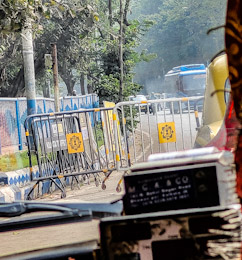
The barrier was removed at 1257 pm

We were in a taxi at about 1250 pm, travelling east towards the start of Park Street. Some distance away from this point, there was a barrier preventing us and other vehicles from continuing towards Park Street. Our taxi and many other vehicles came to a halt at this barrier. Meanwhile, traffic coming towards us gradually diminished in volume to almost nothing.

At about 3 minutes to 1 pm, a traffic police officer slid away the barriers, and we began proceeding towards Park Street. Ours was one of the first cars to be travelling down Park Street from northwest to southeast.

Although I have visited many cities, it is only in Calcutta that I have seen this system of road reversal.

Feeding the spirit of the deceased by the River Ganges in Calcutta

WHILE WALKING ALONG the well-tended riverside path that runs alongside the Ganges (Ganga) in Calcutta, we reached the Gwalior Monument – a tall tower overlooking the river. Around this edifice, which was built by the British in 1847, we saw something we had never seen before.

A craftsman was shaping the stiff dark grey mud from the holy Ganges into rectangular slabs with numerous small regular depressions. The finished product looked a bit like an oversized old fashioned Casio calculator. There were quite a few of these to be seen on the flat ground surrounding the monument.

Small groups of men, often with shaven heads, congregated around these mud slabs. The men were chanting prayers and placing grains of rice, sweets,and other food substances into the depressions in the slabs. We asked a bystander what was going on, and he explained it to us in perfect English.

The groups of men were performing ‘shraddha’ on the eleventh day following the death of a family member. Our informant was also attending a shraddha being held because of the recent death of a friend or relative. The son of the deceased was performing the shraddha puja. I have read that it is very important for Hindu couples to have a son because only a son can do shraddha for his parents

On the eleventh day following death, the spirit (atma) of the dead person is still in contact with his or her loved ones. The food being placed on the mud slabs will not, of course, be physically touched by the spirit, but it is believed that it will sustain him or her on the next stage of its eternal journey. A similar shraddha is performed on the first death anniversary and, sometimes, at other times.

Our informant told us that he was not entirely clear about the deep significance of shraddha, but he was happy to believe in its necessity. It was, he felt, an important part of the passage of life.

The eleventh day and one year ceremonies are observed by many Hindus, but until today, neither my wife nor I had ever come across these mud thalis for feeding the spirit of the deceased.

A year after my father-in-law died, there was a special ceremony in which I played an active role, but it was completely different from what we saw next to the Gwalior Monument.

Perfect aim in a pharmacy shop in Calcutta

I HAVE BEEN TO many shoe shops in India. Some of these have the store room above the showroom. The ceiling of such showrooms has a hatch through which pairs of shoes can be thrown to the salesmen waiting below. The salesman asks for a particular shoe in a specific size, and someone in the store room drops the pair through the hatch. The shoes are caught by the salesman. Until yesterday, the 4th of January 2024, I had never seen such a system in shops other than those selling footwear.

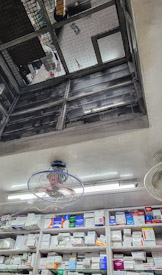
The hatch in the ceiling of the pharmacy

Yesterday, we entered a chemist shop (a pharmacy) close to Calcutta’s New Market (SS Hogg Market). The walls were lined with shelves from floor to ceiling. These shelves were filled with boxes of medicines on what seemed like considerable disarray, although I feel sure that there must have been some organisation of the products. There were 5 or 6 men serving customers from behind the shop’s counters.

Like the shoe shops described above, the chemist shop had a hatch in the ceiling. The shop’s stock room was on the floor above the sale room. At frequent intervals, the salesmen yelled names of medicines, ointments, and so on. Somebody in the room above hurled the desired product through the small ceiling hatch. The product was aimed accurately at the salesman who asked for it. Different products kept dropping from the ceiling and being caught by the salesman who had shouted up for it. Whoever it was that was dropping the medications must have recognised the voice of the person who requested it. In addition, the person dropping the products must have had an extremely good aim. He (or she) would make a good cricket player. And the salesmen below never dropped a catch.

Having seen this amazing pharmacy, I have now poked my head into a few others, but none operated this remarkable aerial delivery system. For me, seeing things like that pharmacy near New Market is what makes India seem so wonderful.

Hertford and the East India Company

HAILEYBURY SCHOOL WAS founded by the East India Company (‘EIC’) in Hertfordshire in 1806. It was an institution where young British men heading out to India to become British colonial administrators were given training. It was not the first of such establishments. In 1800, Fort William College (in Fort William, Kolkata) was founded by the Governor General Richard Colley Wellesley (1760-1842) to teach Indian languages, laws, and so on, to young recruits to the EIC. This school continued until it was closed in the 1830s. For various reasons, the EIC decided to open a training school in England – The East India College.

The East India College was first housed in Hertford Castle, where it remained whilst bigger premises, designed by the architect of University College London, William Wilkins (1778-1839), were being built nearby in Haileybury. When it was completed, the college moved from the castle to the new building, where a school has been located ever since then. Teachers at the East India College included well-known people such as Thomas Malthus and the Sanskrit scholar Monier Monier Williams.

It is ironic that one of the former students of the EIC college at Haileybury was Allan Octavian Hume (1829-1912). After studying at London’s University College Hospital, he was nominated to the Indian Civil Service. He went out to India in 1849 having passed through the course at the EIC college at Haileybury. After returning to England in 1894, having worked in the Indian Civil Service, he recognised that there was a sense of hopelessness and unrest amongst the Indian population and that the people were held in contempt by their British rulers. To try to remedy the plight of the Indians and to provide a ’safety valve’ for relieving unrest that he perceived in Inda, he founded what soon became the Indian National Congress. Little was he to know that eventually this organisation would play an important role in getting Britain to leave India.

Taking a rather circuitous route from Cambridge to London, we stopped for lunch in Hertford. I wanted to see the castle because I had just read about it and its brief connection with the EIC in an interesting book, “The Colonial Subjugation of India”, by Amar Farooqi. After enjoying a portion of splendid fish and chips, we entered the small park in which the castle is located.

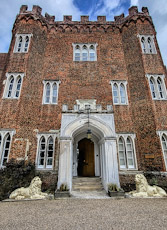
What can be seen today is a well preserved brick building with crenellations and windows in gothic style frames. When viewed face on, the edifice can be seen to consist of a tall central portion flanked by two lower wings. The tall central part, which was constructed in the 15th century was the gatehouse to the castle, which was fell into disuse and was demolished long ago (in the 17th century). The two wings were added during the reign of George III. Today, the so-called castle, erstwhile gatehouse, houses Hertfordshire council offices. We entered the lobby and noticed the gothic revival interior décor within the castle. We will revisit the castle on one of its open days and see some more of the building.

Hertford Castle played a short role in the history of British India and the EIC. The school at Haileybury continued its imperialistic function until 1857/8, when the EIC was wound up after the Indian Mutiny (First Indian War of Independence) of 1857-58. The present school, Haileybury College, a private school with boarding facilities, opened its doors to pupils in 1862 and occupies the old college’s premises.

A Marian mix-up and Mother Teresa

IN THE MID 1970s, I attended a series of evening lectures given by the art historian Ernst Gombrich. They were held in the Mary Ward Centre in London’s Bloomsbury.

Sign post at Loreto House School

In January 2023, we visited Sister Marilla, who works for Loreto House School and College in Middleton Row in the heart of Kolkata. My wife attended the school for several years in the 1960s. The two educational establishments are part of a larger organisation, the Loreto branch of the Institute of the Blessed Virgin Mary (‘IBVM’). When Sister Marilla told us that the IBVM was founded by Mary Ward (1585-1645), I immediately thought of the Mary Ward Centre in London, and was a bit surprised because I had always assumed that the Centre was named after a 19th century woman.

My assumption was correct. The Centre is named after the novelist Mary Augusta Ward (1851 – 1920), not the Mary Ward, founder of the IBVM.

The earlier Mary Ward (b 1585) was born in Yorkshire – Roman Catholic during the time that Roman Catholicism was outlawed in England. She felt the need to take up holy orders and instead of becoming yet another Catholic martyr, she wanted to do something worthwhile and practical. She went to Flanders where she joined the Poor Clares in St Omer.

To cut a long story short, she became, to oversimplify a lot, a female version of a Jesuit, but not a member of the Jesuit Order. After leaving St Omer, she founded the Poor Clare House for English women at Gravelines. There, and later elsewhere, she taught women about the Roman Catholic faith. In about 1609, she returned to England, where she gathered women to teach girls about the banned faith. Mary Ward suffered many hardships, including imprisonment in Germany, before succumbing to ill health in England

Leaping ahead in time, this group founded by Mary Ward, which had to surmount much criticism from the Jesuits and members of the Roman Catholic hierarchy, was the seed that germinated to become the officially recognised IBVM in 1877.

Followers of the group she had founded in 1609, established the Bar Convent in York in 1686. It was from here in 1821 that the IBVM Loreto branch was founded in Dublin by Teresa Frances Ball.

On the 12th of October 1928, 18 year old Albanian Agnes Gonxha from Skopje (now in North Macedonia) joined the IBVM at their Loreto Abbey at Rathfarnham in Ireland. She left Ireland on the 1st of December 1928, and landed at Kolkata on the 6th of January 1929. From there she travelled to Darjeeling, where on the 24th of May 1931, as a novice, she made her First Profession in Darjeeling’s Cathedral of the Immaculate Conception. In this church she made her Final Profession on the 24th of May 1937.

Next, Agnes was sent to the Loreto Convent at Entally in Kolkata. At first, she taught catechism and geography at Loreto St Mary’s Bengali School, which was on the campus of the convent. Eventually, she became the school’s headmistress.

On the 10th of September 1946, whilst travelling to a retreat in Darjeeling, she decided that her true calling was to work with the poor in the slums of Kolkata. By that time, she was known not as Agnes Gonxha but as the now much more familiar Mother Teresa. The order she founded, The Missionaries of Charity, maintained a warm relationship between it and the IBVM. Internationally famous, she died in 1997.

Had it not been for our visit to Sister Marilla and the informative booklets she gave us, it might have been a long time before I discovered the two Mary Wards and the connection that one of them had with both my wife’s school and Mother Teresa.