
Gulam Mohammed Sheikh in Ernakulam (Kerala) and the Kochi Muziris Biennale  2025/26

SOME PEOPLE SAY “save the best till last”. This is what we did accidentally while spending several days exploring the 2025/26 Kochi Muziris art biennale. Much of what we saw at this biennale was far inferior to what we had seen when visiting the four previous biennales. Most of this biennale’s offerings were rich in messaging but insubstantial artistically. The exception to this sad situation is an exhibition held at the Durbar Hall, which is across the sea from Fort Kochi in the city of Ernakulam.


The exhibition at Ernakulam is a large collection of (mostly) paintings by Gulam Mohammed Sheikh,  who was born in 1937 in what is now Gujarat.  His artistic training took place first at the MS University in Vadodara,  then at London’s Royal College of Art.
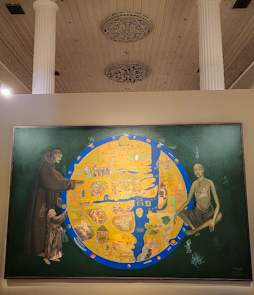
 

A Mappa Mundi by Sheikh

The exhibition includes works from the various stages of his career from the 1960s until today. Sheikh’s work provides  imaginative,  creative, original, beautifully executed, refreshing views and interpretations of the world and its inhabitants.


Amongst the many superb creations on display, there is a series of Mappa Mundi paintings, in which, to quote Wikipedia, Sheikh:

“… defines new horizons and ponders over to locate himself in. Sheikh construes these personal universes enthused from the miniature shrines where he urges the audience to exercise the freedom to build up their Mappa Mundi.

These wonderful artworks that were inspired by mediaeval maps of the world provide the viewer with exciting expressions of Sheikh’s interpretations of the world, past and present,  real and imagined. In one room at Durbar Hall, there is a wonderful film that, in a way, brings Sheikh’s Mappa Mundi to life.


Each of Sheikh’s artworks tells a story. However that story is open to each viewer’s own interpretation. The artist’s works are not only vehicles for a story or stories, but they are also aesthetically sophisticated: art at its best.


It was a great pleasure to see Sheikh’s art. Unlike much of the other exhibits in the Biennale,  his work does not rely on gimmickry, sound effects, lighting effects, film clips, ‘objets  trouvés’, and explanatory notes. Sheikh’s works are the products of a technically competent painter who is able to express his imaginative ideas in ways that are both aesthetically pleasing and highly original.


Seeing the exhibition of Sheikh’s works has revived my enthusiasm for art, which had begun to flag while visiting a seemingly never ending series of mediocre artefacts being displayed at the various sites of the 2025/26 Kochi Muziris Biennale.

It was barely worth visiting the main venue of the 2025/26 Kochi Muziris Biennale

THERE HAVE BEEN six Kochi Muziris art biennales to date. And we have attended five of them. This year, as is usual, the biennale runs from December to the end of March. Today, we visited the Aspinwall site, the main venue of the 2025/26 biennale and of the previous ones.

For a start, the area dedicated to the Biennale has been halved: an ugly concrete wall separates the area used to display art from a large derelict space that used to be part of the Biennale precinct. This means that not only
has the open space surrounded by galleries been reduced but also some of the lovely buildings that used to house artworks now stand empty and are looking dejected.

I like this work

As for the artwork on display at the main venue, the less said the better. Of the several hundred exhibits, only two appealed to me. Most of the other ‘artworks’ seemed to be assemblages of diverse objects. Many of these were less artistically arranged than what can be found in many shop window displays.

Naturally, given the way people often think these days, each exhibit was accompanied by an essay that tried to explain the ‘relevance’ of the creation and its relationship to problems that concern ‘woke’-minded people today. I felt that in most cases, the artists’ and curators’ ‘messages’ (written on information panels) were more important than the works’ artistic/aesthetic qualities.

In brief, I was disappointed by the main venue of the Biennale. In previous years, this part of the show contained at least a few outstanding works that appealed aesthetically and did not require reading a contrived explanation to appreciate them.

To end on a positive note, I liked the temporary structure that covers the seating area next to a refreshment stall. The shelter was designed by an artist from Pakistan.

[Over the next few days, we will visit some of the other Biennale sites and the many collateral exhibitions, and I hope that I will be able to be more positive about them than what I saw at the Aspinwall venue.]

The first exhibition we visited at the Kochi Muziris biennale in Kerala

OUR FIRST EXHIBITION IN FORT KOCHI (KERALA) 2026

WE HAVE COME to Fort Kochi (Fort Cochin) in the south of India to view art in the town’s Kochi Muziris Biennale. This art show is housed in a wide variety of places in Fort Kochi and its environs. There is a main exhibition area and numerous peripheral venues. The first show we visited in housed in Burgher Street, almost opposite the popular Kashi Art café. At this location, Gallerie Splash from New Delhi was hosting images created by Naina Dalal, who was born at Vadodara, Gujarat, in 1935.

Ms Dalal studied art first at MS University in Vadodara, then at London’s Regent Street Polytechnic, and later at Pratt Graphic Center in New York City. She was one of the first Indian women artists to explore the nude artistically.

The exhibition in Fort Kochi, “An Empathetic Eye”, includes watercolours, oil paintings, and various types of print including collographs. According to Wikipedia:
Collagraphy (sometimes spelled collography) is a printmaking process in which materials are glued or sealed to a rigid substrate (such as paperboard or wood) to create a plate. Once inked, the plate becomes a tool for imprinting the design onto paper or another medium. The resulting print is termed a collagraph.

The works on display in the exhibition were attractive and visually intriguing. Dalal provides fine examples of Indian Modernism that demonstrate her independence from the previously powerful influence of Western European artistic styles on Indian modern art.

Seeing this exhibition made a great start to our exploration of what is on offer during the Biennale that runs until the end of March 2026.

Art and documentaries at the Kochi Muziris Art Biennale 2022

ASPINWALL HOUSE IN Fort Kochi is the epicentre and largest exhibition space of the Kochi Muziris Art Biennale. We have attended this event four times to date – 2014, 2016, 2018, and 2022. Outside the main entrance to Aspinwall House, there is a list of those companies, organisations, and individuals, who have donated money to the Biennale. The current (2022/23) list has the following heading “Principle supporters”. Is this wording an undetected typographical error, or is it intentional, or is it a Freudian slip? I ask this question because the sentiments expressed in many of the exhibits question the consequences of the activities of some of the donors.

Far too many of the exhibits in Aspinwall House are more like well-made documentaries than what has until recently been regarded as art. The documentary exhibits are mostly well put together with superb still photography and cinematography, and quite a few of them are highly informative – akin to, for example, National Geographic productions.

The majority of the documentary-like exhibits have elements of political protest, often leftward leaning. Now, I have no objection to political protest in art, but I wonder whether some of these exhibits have strayed too far from what used to be considered art, and have become more documentary than artistic. In the past, to mention but a few, artists such as Picasso, George Grosz, Otto Dix, Joan Miró, Subhi Tagore, Diego Riviera, and currently William Kentridge, have made artworks with political content. These artists and some of their contemporaries produced artworks which are not purely political or polemic, but can also be enjoyed as purely visual experiences; knowing the message is not important to the impact the works make on the viewer, but can add to that. Much of what is on display at Aspinwall House during the current Biennale simply thrusts political messages at the viewer. There is little else to appreciate but often depressing messages and images.

As for the abundance of photography it is mostly superb. Since the invention of photography, it has been used highly creatively by some photographers. Examples of these include Julia Margaret Cameron, Charles Dodgson, László Moholy-Nagy, Ansel Adams, and Alfred Stieglitz. Artists like these were competent photographers who exploited the camera to create original images that would have been difficult if not impossible to produce with other artistic materials. In contrast, many of the beautiful photographic works in the current Biennale seem to be aiming at documentary or archival accuracy rather than creative images – works of ‘pure’ art.


Having blasted at what I did not like about the Biennale, I must point out that there are many artworks that satisfied me purely visually. Some of them are in Aspinwall House, but many of them are elsewhere, notably in the Durbar Hall in Ernakulam. The works that impacted me positively because of their purely aesthetic 7characteristics might also be conveying political sentiments, but the nature of these did not impede my immediate, visceral rather than cerebral enjoyment of them.

Returning to the predominantly documentary exhibits, those that made most impact on me were housed in the TKM warehouse complex in Mattancherry. Some of the works there are not only political or polemical, but also highly creative and artistic (in the old sense of the word).

As for the odd use of “principle” on the list of donors mentioned above, I found this not only careless but ironic. Many of the artworks in the current Biennale question the principles of some of the donors, who funded the show.

Having read this, you can call me ‘old-fashioned’ or ‘politically incorrect ‘ if that makes you feel better. I might well be both, but I was brought up by my artistic parents to appreciate the works of both old masters and contemporary artists equally, be they works by Piero della Francesca or JMW Turner or Brancusi or Barbara Hepworth or Rachel Whitehead or Anish Kapoor.

Visit the Kochi Muziris Art Biennale if you can before it ends in early March 2023, and judge it for yourself. Almost all of the exhibits are housed in heritage buildings, which are alone worth seeing. I look forward to the next show in 2024/25.