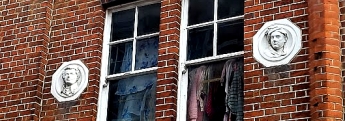
Heads on a wall
They are looking downward to the street
Lifeless indeed

Heads on a wall
They are looking downward to the street
Lifeless indeed
EVER SINCE THE early 1960s, I have travelled along Cambridge Avenue, which runs between Edgware Road and Kilburn Park Underground Station. I have always been in a car or bus. So, whenever I have passed what I am about to describe, I have never stopped to look at it carefully. Yesterday (14 April 2025), we stopped outside it to change buses.
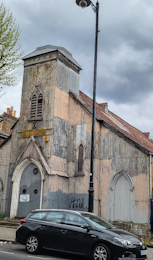
What I am referring to is an edifice made from sheets of corrugated iron, which looks like a Victorian gothic church. It looks slightly shapbby. Notices attached to it inform passers-by that it is a meeting place of the Sea Cadet Corps and it is now the ‘TS Bicester’, ‘TS’ standing for ‘Training Ship’. Known as the Tin Tabernacle, its history has been related on several websites including http://tintabernaclekilburn.org/history/ and https://englishbuildings.blogspot.com/2013/04/cambridge-avenue-london.html .
The church was erected as a temporary structure in 1863, when Kilburn was on the edge of the countryside. According to the Tabernacle’s own website, a local developer called James Bailey:
“… granted a lease to Rev. Woodhouse and the Trustees of Cambridge Road Chapel to build an iron church for Church of England worship at a cost of £1000. The agreement was to build a stone church or a row of 3 terraced houses by Michaelmas 1868. The church paid a yearly rent of £32.”
That deadline has long passed, and the tin church is still standing. The galvanised corrugated iron covers a timber and iron frame, and iron columns support the roof.
1863, the Tin Tabernacle was constructed and was initially called St James Church. It was probably intended to be a stop-gap church to be used while the nearby St Augustine’s Church was being built (it was completed in 1870). In 1948, the tin church, which was then known as ‘Cambridge Hall’, was assigned to the Willesden Sea Cadets for use as a social centre and training centre. In 1956, the HMS Bicester was scrapped. Between 1956 and the 1960s, the church was fitted out to reproduce the scrapped HMS Bicester, and the place was renamed TS Bicester. Sometime between 1960 and 1980, the church lost its spire. In 1998, the building was listed as Grade II, which gives it some protection against being demolished.
The Sea Cadets ceased using the church in 2011. Its naval interior has been preserved, and now the church is used occasionally for community and other events. Although I have seen its exterior, I would love to see inside this unusual edifice.

At Arbil City restaurant, Kilburn, London
Tasty lamb shank
Resting on a bed of rice
Is a joy to consume
AFTER A SUNNY DAY spent at Whitby in North Yorkshire, we stopped for a drink at sundown in a small pub for a pre-prandial alcoholic beverage. Behind and slightly above the pub, we could see a well-maintained 12th century parish church with later modifications and a square tower. Below the pub, a narrow stream, lined with bushes and trees, ran alongside the main road. Apart from the infrequent passing car, the place was silent except for some pleasant birdsong. From where we sat on the terrace of the hostelry, we could see a small, sloping village square with a simple war memorial, some parked cars, and a small post box. At first, I did not realise where we had stopped. Then, I noticed that the village is called Kilburn.

There is another Kilburn about 215 miles south of the lovely village where we stopped for an evening drink. The latter is in North Yorkshire and the place with the same name many miles south of it is in north London. Apart from sharing the same name, London’s Kilburn is anything but rustic and peaceful, as many Londoners will know. London’s Kilburn is not really picturesque in conventional people’s eyes; it might appeal to lovers of urban sprawl. It is a crowded metropolitan area with much commercial activity and a racial profile infinitely more diverse than that of the village in North Yorkshire.
I am not sure which of the two Kilburns is the oldest. North Yorkshire’s village was mentioned in the Domesday Book of 1086 and named ‘Chileburne’. London’s Kilburn was a settlement on an ancient Celtic route, a track between the places now known as St Albans and Canterbury. A priory was constructed on a stream that flowed through where London’s Kilburn now stands. The stream was known variously as ‘Cuneburna’, ‘Kelebourne’, and ‘Cyebourne’.
Whatever the origins of these two Kilburns, I know which of them is the place where I would prefer to linger in front of a glass of bitter.
 yamey
yamey 