Derek Jarman’s cottage near the nuclear power stations at Dungeness

A PRIVATELY OWNED road, Dungeness Road, heads from Battery Road, which is south of Lydd on Sea, to the Dungeness nuclear power stations. One of these two enormous units began producing electricity in 1965, and the other between 1983 and 1985. By 2018, both had been closed, and are not likely to be used again. Along the road leading to the power stations, there are houses, each one well-spaced from its neighbours. The terrain along which the road runs is flat, sandy, gravelly, windswept, and treeless. Scrubby little plants grow here and there, and the seacoast is nearby. The disused power stations dominate the southern horizon.

In 1987, the film director Derek Jarman (1942-1994) purchased Prospect Cottage, a wood cladding Victorian fisherman’s hut. It stands on Dungeness Road 1489 yards northeast of the power stations. From its garden, the power stations look like a huge liner on the horizon. Jarman, who was keen on garden design, created an unusual garden using bits of debris of all sorts as sculptural features. These objects are surrounded by gravel in which plants hardy enough to survive in the exposed terrain were planted. The garden he created is unusual but intriguing. It has a strange extraterrestrial feel about it, but is visually satisfying.

Jarman lived in the small cottage until his death. The walls of the cottage are painted with black tar and the window frames are yellow. One wall of the building has words from a poem by John Donne written on it in large wooden letters. After his death, Jarman’s friend Keith Collins inherited it and lived there until his death. It was put up for sale in 2018. In 2020, enough money had been raised to save it for the nation. Currently, it is being looked after by an organisation called Creative Folkestone.

When we visited Prospect Cottage and its garden on a sunny afternoon in August (2024) there were a few other visitors admiring the garden. Entry to the cottage is generally not permitted. We were told that occasionally it can be used by artists as part of residencies arranged by Creative Folkestone. As for the garden, it seemed that no one objected to visitors looking around. We did ask permission from someone using the cottage, and she told us to go ahead. Although the road leads to Dungeness lighthouse, which is open to the public and attracts many visitors, few of those on their way to it stop at Prospect Cottage. Having seen this curious place, I can recommend it as a destination if you happen to be in east Kent.

Charles Dickens used to write by the sea at Broadstairs

THE VICTORIAN AUTHOR Charles Dickens (1812-1870) visited Broadstairs, a seaside town in east Kent frequently. During a recent visit to the town in August 2024, we saw three buildings which are associated with the famous author.

The Royal Albion Hotel hosted Dickens several times. Nearby, there is what is now the Dickens House Museum. This was the home of Miss Mary Pearson Strong, who was the inspiration for Betsey Trotwood in “David Copperfield”.

On a hill overlooking both the popular Viking Bay Beach and other parts of Broadstairs, there is a large building with castellations. This was built in 1801 as Fort Howe. It was, and still is, a private residence. It was here (and at the Albion Hotel) that Dickens used to write while staying in Broadstairs. The author leased the house from the 1840s until 1852. Some people claim that the house was the inspiration of the title of Dickens’ novel “Bleak House”, but this is by no means certain.

At thus point, I must admit that I have not read any Dickens apart from highly abridged versions of “A Christmas Carol” and “Oliver Twist”. Having now visited Broadstairs, I feel there is a good chance that I might tackle a full novel, maybe “Bleak House” or “David Copperfield”. Which would you recommend?

Was I an inventor of rewilding?

BETWEEN 1983 AND 1994, I owned a house in Gillingham, Kent. Number 148 Napier Road was a detached dwelling with a narrow garden that stretched 180 feet behind it. Most of this long stretch was covered with grass.  After I first moved into the house, I purchased an electric lawn mower, and regularly trimmed the lawn. All went well at first. However, after a few months and several mowing sessions, I found that when I was cutting the lawn my eyes streamed, and I sneezed uncontrollably. I tried wearing a facemask when mowing, but this did not relieve the symptoms. Eventually, I decided not to bother mowing the lawn.

The grass grew. So did the anger of my immediate neighbours, both of whom were elderly and believed in tidy gardens. One of them said that because my lawn was so unkempt, insects were travelling from it into her garden and destroying her plants. She was so upset by this thought that she did something extremely unwise. One summer evening, I returned home after nightfall, and because the weather was pleasant, I decided to spend a few minutes in my back garden. It was dark. I sniffed, and believed that I could smell burning. I saw no flames, and retired to bed. On the next day, I met my other neighbour – a very practical old gentleman who had built his own house. He told me that during the previous day, he had had to enter my rear garden to extinguish a fire which had been started by the lady, who believed that my garden was infecting hers with pests.

Meanwhile, the grass grew longer. It reached a point where it was so tall that if someone sat down, they became hidden by it. As autumn approached, the tall grass just fell over, and seemed to disappear gradually. It returned without fail every spring, and despite not being mowed, it grew healthily. However, the neighbours were unimpressed by my lawn, the untidiest in Napier Road. I decided that I would have to do something to give the impression that my wild garden was by design, rather than simply the result of neglect. So, what I did was to use the mower to create a sinuous, narrow mowed path that ran along the length of the lawn – I created what might be described as a landscaped lawn. I am not sure that this impressed my neighbours, but I felt that I had ‘done my bit’.

In addition to the lawn, I planted shrubs, which I allowed to grow ‘willy nilly’. My seemingly wild garden was a haven for butterflies. As I walked along the garden, following my sinuous path, clouds of butterflies used to shoot out of the shrubs and other plants.  Unwittingly, I had ‘wilded’ or ‘rewilded’ my garden, which in the 1980s and early 1990s was not something that was done. Had I invented what is now known as ‘wilding’, also known as ‘rewilding’?  Probably not, but it only began to be adopted as a strategy for reducing loss of biodiversity following work done in the mid-1980s (see https://en.wikipedia.org/wiki/Rewilding). I must confess that my pioneering rewilding in Gillingham did not result from a desire to save the natural world, nor from laziness, but to save myself from symptoms of allergy.

In the late 1990s, we put the house up for sale. The garden had become such a veritable jungle that our estate agent described it as being “… in a natural state.” Interestingly, the people who bought the house from me liked it because they were looking forward to taming the garden – there is no accounting for taste!

Once a real mediaeval castle, but now a garden feature

IN ABOUT 1380, Roger Ashburnam (died 1392) commenced building a castle surrounded by a moat about 6.7 miles southeast of what is now Royal Tunbridge Wells in Kent. During the centuries after the commencement of its construction, this edifice, Scotney Castle, was modified in various ways in different architectural styles.

In 1778, the cricketer and landowner Edward Hussey (1749-1816), who killed himself with a blunderbuss, purchased the estate in which the castle stands. In 1830s, Hussey’s grandson, also called Edward Hussey III, built a new and larger house on a hill overlooking the old castle. It was designed by the architect Anthony Salvin (1799-1881), who was an expert on mediaeval buildings. At the same time, the gardens surrounding the new house were landscaped. As part of the landscaping process, carefully selected parts of the old castle were demolished to create a picturesque ruin – an attractive garden feature.

In the 18th and 19th centuries, it was not uncommon for garden designers to build follies to add interest to gardens. Often, the follies look like classical or mediaeval structures – either constructed to look intact or ruined. At first sight, the old Scotney Castle looks like a grand and elaborate garden folly, but it cannot be so-described – it was not built as a folly. Although its degree of ruination was enhanced in the 19th century, it had been a real castle for several centuries, and had been built to be used as a fortification as well as a residence. Thus, what had once served to counter a possible invasion by the French ended up being an elaborate garden ornament. Maintained by the National Trust, Scotney Castle is well worth a visit. The ruined castle and its surrounding gardens make a magnificent sight. Salvin’s newer edifice, which is open to the public, does not deserve much of a visitor’s attention.

Salvation in Sandwich

THE HIGH STREET runs through Sandwich (Kent) from south to north. At its northern end, it runs beneath an archway next to a former toll bridge across the River Stour. After 1977, the toll was abolished. Under the archway, which is part of the mediaeval barbican (built c 1470) that used to be a gateway through the town wall, there are several notices of interest.

One of the notices records the fact that tolls were collected from users of the bridge from 1759 to 1977, and the last toll was collected from the Mayor Councillor on the 30th of September 1977. Near this memorial, there is a table of tolls dated June 1905. Interesting as these two signs are, it is the third one that was a complete surprise to me. It read:

“This plaque is to commemorate Richborough Transit Camp 1939-1940 where 5000 men found refuge from Nazi persecution on the Continent. During the Second World War most of them volunteered to fight for the Allied cause.

Erected in gratitude to the citizens of Sandwich and East Kent who, as in the past, welcomed the refugees.”

I noted that this brief notice made no mention of the identities of the refugees. However, another plaque, attached to the nearby Bell Hotel, clarified the situation. The hostelry was:

“… A meeting place for Jewish refugees from the Kitchener Camp, Richborough, Sandwich 1939-40”

The Kitchener Camp was a former army barracks located north of the Stour, not far from the toll bridge, on the west side of Ramsgate Road. There is now no trace of it because it was demolished after the end of WW2. During 1939, 4000 mainly German and Austrian Jewish men were accepted for accommodation in the camp on condition that they would not be granted UK citizenship or work, and must emigrate to the USA. The camp received no government funding. It was paid for by Jewish organisations including The Central British Fund for German Jewry (founded 1933).  At the start of WW2, 887 of these men volunteered to join the Pioneer Corps, which carried out light engineering projects at the battle fronts. After the Dunkirk episode in May 1940, the British public became suspicious of German speaking refugees because they were worried about the possibility that some of them might be involved in spying and sabotage. So, those, who were not enrolled in the war effort, were shipped out to internment camps in Australia and Canada, and then Kitchener was closed.  

During its brief existence, the Kitchener Camp, which began accepting refugees on the 20th of January 1939, became a hive of cultural activity as can be discovered by looking at the highly informative website – https://kitchenercamp.co.uk/   There were concerts and a cinema provided by the Odeon Cinemas, run by it’s the  Jewish founder Oscar Deutsch. I had never heard of the Kitchener Camp (aka ‘Richborough Tansit Camp’) until I spent a few days in Sandwich recently. Regarding the plaque commemorating it beneath the arch of the barbican, it mentions 5000 men, but reliable sources always refer to 4000 Jewish men. This puzzles me, as it was placed by the Jewish Community of Great Britain ( according to https://www.warmemorialsonline.org.uk/memorial/263444/).

It was much earlier than Greenwich Mean Time

DESIGNED BY BENJAMIN Wyatt (1775-1852) and George Louch, then later modified by John Rennie (1761-1821), The Clock House (built 1817) overlooks the harbour in Ramsgate, Kent. As its name suggests, this building is surmounted by a square tower with clocks on each of its four sides. Today, the time on the clocks is Greenwich Mean Time (‘GMT’) or, when appropriate, British Summer Time (GMT+1). But this has not always been the case.

The Clock House was home to chronometers that were used to synchronise shipborne chronometers employed for determining longitude. The edifice stood on what was known as the Ramsgate Meridian Line, which was established in 1819. This was before 1851 when Sir George Airy (1801-1892) defined the position of the prime meridian that runs through the observatory at Greenwich. It was not until 1884 that the prime meridian at Greenwich was recognised internationally, much to the disgust of the French, who hoped it would run through Paris.

The now disused Ramsgate Meridian Line is east of the Greenwich prime meridian. So, when the clocks on the Clock House were set to Ramsgate Mean time, they were 5 minutes and 41 seconds ahead of GMT. A notice beneath the clock tower informs the viewer that the clocks are now set to show the same time as it is in Greenwich. And if there are any ancient mariners still using Ramsgate Mean Time, they are informed by another notice that:

“Ramsgate Mean Time is 5 min 41 sec faster than this clock.”

Whichever time you choose to use, it is well worth spending some hours, if not longer, in Ramsgate, which is full of interesting things to see as well as the Clock House.

An artist and a gallery in a British seaside resort

THE GREAT BRITISH artist Joseph Mallord William Turner (1775 – 1851) was accurately described by the writer John Ruskin as “… the father of Modern art …” in 1843. Turner first visited Margate when he was aged 11. After about 1820, he often stayed in the town because he thought the skies over the area were the most beautiful he had seen in Europe. Between 1827 and 1847, he stayed in the town in a guesthouse owned by Mr and Mrs Booth. When Mr Booth died in 1833, Turner became a close companion of the widowed Sophia Booth, who died in 1878. He also adopted the name ‘Booth’.

The house owned by Sophia Booth, where Turner resided, is no more. Where the guesthouse once stood is now occupied by the Turner Contemporary Gallery (‘TCG’). The gallery was designed by David Chipperfield (born 1953), and opened in April 2011. Just as Turner’s paintings were considered avant-garde and even provocative when they first appeared, the TCG is a highly adventurous contrast to the rest of the old town that neighbours it. Some buildings look better inside than outside. The TCG is a good example of this. The gallery spaces are spacious and well-lit both by natural and artificial light. They were a perfect place to view the highly colourful creations of the Brazilian born artist Beatriz Milhazes (born 1960), which are on show at the TCG until the 10th of September 2023.

I believe that the presence of the TCG has elevated Margate’s status from being a simple, unexceptional seaside resort to a place that attracts a much wider range of visitors than it did in the past. As happened in London’s Islington in the 1960s, a rather mundane place has become somewhere that people now feel they ‘must visit’. Although the usual British seaside attractions can still be found in Margate, the town is now also catering for the ‘up market’ clientele. And that cannot be a bad thing because when I lived in Kent (1982-1992), apart from Whitstable (and maybe Broadstairs), most of the seaside places in north and east Kent were in decline and rather melancholy.

The opening of the TCG has done for Margate what the art Triennale has done for another previously dreary Kent town – Folkestone. Even if Turner might have been shocked to see what now stands where he spent many happy hours with Sophia Booth, I feel sure that he would have been happy to know that it has revitalised a town which he loved.

Remembering victims of war in Sandwich, Kent

Some of the WW1 names and the Falklands victim below

IN THE HEART of Sandwich in Kent, near to the deconsecrated Church of St Peter, there is a war memorial that was erected to commemorate those from the town who died in the ‘War to End All Wars’ – the First World War (1914 – 1918). Roughly 100 names are recorded on the lists of people who died during WW1. However, they are not the only people listed on this monument because ‘The War to End All Wars’ did not live up to its name.’

The memorial lists about 15 people who were killed in WW2 (1939-1945). In addition, three of Sandwich’s population perished in the Korean War (1951), and more recently, one of the townsfolk was killed in the Falklands Conflict (1982).

I sincerely hope that no more names need to be added to this war memorial as a result of the conflict in Ukraine, or any future wars.

Safe and sound under the ground

DURING WW1, THERE were German Air raids over the town of Ramsgate in Kent. Many were killed by relatively few bombs.

In the late 1930s, the forward thinking Mayor of Ramsgate and his Chief Engineer designed a series of tunnels deep below the town to be used as air raid shelters. Over three miles of tunnels were dug into the chalk far below the town. The digging was carried out by miners from the (now closed) coal mines of East Kent.

Bunks in the tunnel shelter

Except for a short section about 25 feet below the ground, which was reinforced with thick concrete, the rest of the tunnel system, which was on average 75 feet below the surface, was self supporting. The tunnels could accommodate up to 60000 people, but because many of Ramsgate’s population were either evacuated or serving inthe armed forces, the town’s population was about 15000 during WW2.

The tunnels were fitted out with electric lighting; bunk beds; benches; first aid stations; and chemical toilets. People were allowed to spend the night there or when air raids were in progress. Given that Ramsgate was the last place that German bombers flew over when returning to mainland Europe, they tended to drop any remaining bombs on the town. In addition, the Germans had heavy long-range guns at Cap Gris Nez just across the English Channel from Ramsgate, and shells capable of destroying buildings fired from these could arrive in the town without prior warning.

In short, the tunnel system saved innumerable lives. Today, excellent guided tours allow visitors to explore it. Today, the 24th of July 2023, we joined one of these tours. Everything was beautifully and interestingly explained. Although not as well furnished and comfortable as the huge nuclear bunker built at Gjirokaster in Albania in the 1960s, what was constructed in quite a hurry at Ramsgate is remarkable.

Having just seen the not too brilliant film “Oppenheimer”, I could not help wondering how many people might have been saved had Hiroshima and Nagasaki been supplied with deep shelters like that at Ramsgate.

Loads of lavender in rural Kent

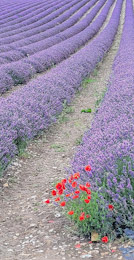
ON OUR WAY to visiting new friends in Kent, at their recommendation, we stopped en-routr at Castle Farm near Shoreham. We were delighted to discover that this agricultural enterprise specialises in cattle and growing lavender. It is the largest lavender farm in the UK.

I had no idea until we visited the farm that lavender was grown on such a large scale in England. I have visited lavender farms in Provence and seen many glorious photographs of lavender fields in that and other regions of France. However, it came as a complete surprise to discover similar fields in South East England. I am grateful to Asha and Matthew for introducing us to this place.