Stark naked and crouching on a pedestal in London’s Mayfair

MY PARENTS HAD a small collection of works of modern art in our home in London’s Hampstead Garden Suburb. These included an engraving by the Italian artist Emilio Greco (1913-1995). I have no idea where this image is now, but having grown up with it I was familiar with the artist’s name even if I knew nothing about him.

Today (14 July 2025) while walking near the Connaught Hotel in Mayfair, we passed a modern fountain, and close to it, a bronze sculpture of a naked woman, perched on a cylindrical stone pedestal. On the pedestal are carved the words: “A gift to the City of Westminster from the President of the Italian Republic. 20th November 1987. Sponsored by the Italian Bank in London.” The President at that time was Francesco Cossiga (1928-2010).  There was no mention of the creator of this artwork on the pedestal. However, at the base of the sculpture I could make out: “Emilio Greco 1977”. It had been made by the artist, whose engraving used to hang on the wall of our living room.

A website (https://pssauk.org/public-sculpture-of-britain/biography/greco-emilio/) provides some information about the artist, and his sculpture in Mayfair, which is a bronze casting of his sculpture “Crouching Figure No. 4”, created in 1973.  

The sculpture is a great addition to the area, and is sometimes referred to as ‘Mayfair Lady’!

A landmark in London’s Soho since 1949

DURING THE LATE 1950s and much of the 1960s, my mother created artworks in the sculpture workshops of St Martins School of Art, which was then located on Charing Cross Road near to Foyles bookshop. My mother was a keen follower of the recipes of Elizabeth David (1913-1992), who introduced Mediterranean food to British kitchens. Near to St Martins in Old Compton Street, there were many food shops that supplied the ingredients that were required to follow Ms David’s recipes accurately. There used to be a French greengrocer between Charing Cross Road and Greek Street. This was one of the only places where ‘exotic’ salads such as mâché (lamb’s lettuce) could be purchased. Further west along Old Compton Street, there was a Belgian butcher, Benoit Bulcke, which cut meat in the French style, which my mother preferred. She claimed that English butchers were not ‘up to scratch’. Both these shops have long since disappeared. Another Soho establishment, which we used to visit regularly, was Trattoria da Otello in Dean Street. We went there so often that we were treated like old friends. Now, sadly, that wonderful restaurant is no more.

Three Old Compton Street shops frequented by my mother are still in business. They are the Algerian Coffee Stores, whose appearance has barely changed since the early 1960s when I first remember entering it; and a supplier of Italian foods: I Camisa & Son. Lina Stores, which my mother also used to visit still exists, but its branch on Brewer Street (and other newer branches) seems to have become more like restaurants than Italian delicatessens.

During school holidays, I used to accompany my mother on trips from Golders Green, where we resided, to the West End. On most of these excursions, food shopping in Soho was on our itinerary. So, as a youngster I got to know these various food shops quite well. As an innocent child, I associated Soho with food shopping rather than its other more colourful activities.

Every visit to Soho involved a stop at Bar Italia on Frith Street. There, I would be treated with a cappuccino while my mother drank an espresso. From when I first knew it in the early 1960s (or possibly the late 1950s), the overall appearance of Bar Italia has barely changed. As a friend remarked on a recent visit, the cracked Formica counter opposite the bar is typical of how cafés would have been fitted out back in the 1950s.

Bar Italia is almost three years older than me. It was founded in late 1949 by Lou and Caterina Polledri. Lou was born in the Italian city of Piacenza. According to the Bar’s website, some of the above-mentioned Formica was put in place in 1949, when the establishment was for its time ‘state-of-the-art’. The floor is that which was laid down by members of the Polledri family in 1949.

When it opened, Soho had a large Italian community, which much appreciated the Bar Italia as a home-away-from-home. At the far end of the small establishment, there is a television that broadcasts Italian TV, mostly sporting events. Each time I visit the place, the screen sems to have been replaced by a larger one. However, I cannot recall whether there was a television in place when I visited as a child. What I do remember is that next door to Bar Italia, there used to be a Greek restaurant called Jimmy’s, which, for some reason, my mother never took us there.

Once a local for the Italian community, Bar Italia has become somewhat of a Soho landmark and tourist attraction. In addition to coffee and alcoholic drinks that would be available in any local bar in Italy, Bar Italia now also serves hot meals. It also sells Portuguese ‘natas’, which are not typical fare in bars in Italy.  Apart from this change, the prices of its excellent coffee have shot up to levels higher than most London cafés charge. Whereas one can expect to pay from on average £2.80 to “£3.20” for an espresso, Bar Italia is now charging over £4.20. I mention this, but do not begrudge them because by patronising Bar Italia we are helping to preserve a delightful historical London landmark.

NOW watch this lovely little video about the place:

Morandi or bore-andi

CALL ME A PHILISTINE if you wish but I was underwhelmed by the much-hyped temporary exhibition of the works of the Italian artist Giorgio Morandi (1890-1964), which is being shown until the 28th of May 2023 at the Estorick Collection of Modern Italian Art in London’s Canonbury district. Morandi, who was born in Bologna (Italy), where he lived most of his life and died, was primarily a still-life and landscape artist. Without doubt, his works are both carefully and extremely well executed. However, his numerous still life works depicting bottles, jars, and other containers, did little to excite my interest in them. His landscape images appealed to me more, but not much more. For me, almost the best work in the show is a self-portrait, showing Morandi seated.

Compared with the other works in the Estorick’s permanent collection (e.g., Balla, De Chirico, Modigliani, Boccioni, Music, Greco, Manzu, and Russolo), all of which are highly creative and visually exciting, poor old Morandi’s work pales into insignificance. Having expressed my opinion about the temporary exhibition, I must admit that many of the other viewers I saw today seemed to find Morandi’s works of great interest. Many of them stood staring intensely at individual works for minutes rather than a few seconds. Few of the works in the exhibition grabbed my attention for more than a few instants.

Well, maybe I missed something that other people see in Morandi’s art, but if someone were to give me a genuine Morandi, I would sell it as quickly as possible, and might spend the money on a work by a more interesting Italian artist.

Macchiavelli and spicy masala meat dishes

RAAVI KEBAB BEGAN serving Pakistani and Punjabi food in the mid-1970s. It is located on Drummond Street, close to London’s Euston Station. This unpretentious eatery with barely any internal decoration except some mirrors with Koranic verses engraved on them in Urdu script, is next door to the Diwana Bhel Poori House. It was at the latter that we used to enjoy Indian vegetarian dishes when we were undergraduate students at nearby University College London during the first years of the 1970s. In those days, Raavi, named after the river that flows through the now Pakistani city of Lahore, did not yet exist. It was only in the early 1990s that a friend visiting from Bombay suggested that we ate with him at Raavi’s. When the grilled kebabs arrived at our table, it was love at first bite. We have been returning to Raavi’s ever since.

Raavi’s with Diwana in the backround

Yesterday (1st of September 2022), we made yet another visit to Raavi’s. As we sat down, I noticed a thick wad of photocopies held together with a bulldog clip. They were resting on top of a neatly folded shawl. Out of curiosity, I looked at the top sheet, which was a page copied from a book with annotations added in red ink. I looked more carefully and noticed that the printed text was in Italian. The page was headed “<De ingratitudine> Joanni Folci Niccolaus Maclavellus”. It is a chapter (‘The ingratitude of Joanni Folci’) from a book by Niccolò Machiavelli (aka Maclavellus), who lived from 1469 to 1527. The rest of the text on the photocopied page appeared to be a learned commentary on Macchiavelli’s chapter.

I do not know why, but I felt that Raavi’s was the last place I would expect to find scholarly papers lying about so casually. I associate the place, as do most of its many customers, with grilled meat and spicy masalas. I asked the waiter about the papers. He shrugged his shoulders and said that someone must have left them behind after eating, and that he had no idea whether anyone would return to retrieve them.

Burgers on the Strand

THE BYRON RESTAURANT chain, which specialises in serving burgers, has a branch next to the Adelphi Theatre on London’s Strand. I have not eaten there but I did peer through its street door. What I saw is quite amazing. The ground floor dining room’s walls have giant mirrors separated by marble pilasters. The ceiling beams look like marble , although it is unlikely that they are made of that material. The grand dining room has a decadent fin-de-siècle appearance, providing your eyes are averted from the banquettes upholstered with red leather, or perhaps plastic, which are quite appropriate for a burger joint.

The large façade of the restaurant has pink granite pillars on both sides. On one of these, there is a commemorative plaque that reads:

“Site of the Adelphi Theatre Restaurant owned by the Swiss-Italian Gatti family, restaurateurs, music hall, theatre and electricity supply entrepreneurs. Sir John Gatti served as Lord Mayor of Westminster, 1911-12.”

The Adelphi Theatre is still in business, but its neighbour, the Adelphi Theatre Restaurant, is now the Byron outlet.  Carlo Agostino Gatti (1841-1897) and his brother Stefano Gatti (1844-1906), father of Sir John, ran the Adelphi Theatre, the Adelphi Theatre Restaurant and the Vaudeville Theatre all in the Strand (www.londonremembers.com/subjects/gatti-family). Carlo and Stefano came from Ticino Canton in Switzerland. Another Gatti, Gaspare Antonio Pietro Gatti, known as ‘Luigi’, came to London from Montalto Pavese in Italy, where he was born in 1875. He is supposed to have managed the restaurant at The Ritz Hotel, as well its concessions on two ships, one of which was the ill-fated Titanic. Whether Luigi was related to the brothers is uncertain.

What is also uncertain in my mind is whether the dining room that now serves as home to Byron and its burgers is the original that existed when the Gatti family owned the restaurant or whether it is from a later era. The upper storeys of the building were recently converted into luxury flats, whose interiors can be viewed on websites such as https://www.businessinsider.com/pictures-london-gatti-house-millionaire-flats-on-the-strand-with-pizza-lift-2015-10?r=US&IR=T .

So, next time you are wandering along the Strand, take a peek into Byron’s and, maybe, if you are feeling peckish …

Learning the lingo: Italian

aerial photography of city


Until I was 16 years old, I accompanied my parents on annual holidays in Florence (Italy). We always stayed at the Pensione Burchianti, which was run by two ageing sisters. Almost every evening, we ate dinner in a nearby restaurant (the Buca Mario). This excerpt from my book CHARLIE CHAPLIN WAVED TO ME describes how I began to acquire some limited skill in speaking Italia. Here is the excerpt:

” … After dinner we would walk back to the Burchianti. It might have been during one of these evening strolls that my father came up with a new version of the saying ‘a penny for your thoughts’, namely: ‘a penne for your sauce’. The traffic in the streets would have quietened down by the time that we had eaten, and all of the traffic signals, or ‘robots’ as my South African parents called them, had flashing amber lights instead of the usual sequence of three coloured lamps. The pedestrian signals, which alternated between the red ‘Alt’ and the green ‘Avanti’ during the day, simply flashed both messages at the same time at night.

When we arrived back at the Burchianti, the residents, who had been eating supper, were usually still lingering at their tables. Many of them almost lived in the Burchianti. There was an elderly commendatore, who took all his meals there but slept elsewhere. There were also a number of business people who spent the week working in Florence, but resided some distance away in the weekend. They lived in the pensione during the week. One of these was a lady pharmacist from Parma who spoke Italian with a curious accent, rolling her ‘r’s in an exaggerated way.

On entering the dining room, we would be greeted like old friends, which I suppose we were. We would be invited to sit at the sisters’ table, and then I had to perform. One of the sisters would ask me in Italian what I had eaten for dinner, and I had to reply in Italian. Everyone listened to my reply which usually went something like this:
Primo piatto o mangiato spaghetti con pomodoro. Dopo o mangiato bistecca con patate fritte. E dopo, profiterole.”

It was not difficult to relate what I had eaten because every dinner I ordered the same thing or substituted lombatina di vitello (veal chop) for the bistecca. This nightly recitation gave me the confidence to try to speak in Italian, even if badly. When I did not know a word, I tried using a Latin word but pronounced it in a way that I believed made it sound Italian. Often, this worked! ...”


If you want to know whether Charlie Chaplin really did wave to me, grab a copy of my book from:

https://www.bookdepository.com/Charlie-Chaplin-Waved-Me-Adam-YAMEY/9781291845051

OR

http://www.lulu.com/shop/adam-yamey/charlie-chaplin-waved-to-me/paperback/product-21611544.html

OR Amazon or Kindle store


Photo by Josh Hild on Pexels.com

Pigeon English

Creatures real and imaginary_500


Pidgin English is a simplified, often colourful, form of the English language used by some people for whom English is not their mother tongue. The various forms of  Pidgin English, and there are many, are typically mixed with the speaker’s native language. Well, for many years, I did not know that. I must admit that this was a symptom of my ignorance. Also, when people referred to ‘Pidgin’ English, I used to think that they were talking about ‘pigeon’ English, which in my ignorance I believed to be English as spoken by someone who knows as little of English as, for example, pigeons. True, people who speak Pidgin probably know less English than fully fluent English speakers, but they know a great deal more about English than pigeons.

I used to visit Italy often during my youth and early adult years. During this period, I picked up a smattering of Italian. I knew enough to have simple conversations with Italians. Although my Italian was mostly ungrammatical, people could make some sense of what I was trying to communicate.

Once, I was travelling through Italy on a train, having a chat with an Italian passenger. He praised my Italian, probably out of politeness and because I was making an effort to speak in his language. Modestly, I told him that I was speaking ‘pigeon’ Italian, when what I really meant, without knowing it, that I wanted to say I was speaking ‘pidgin’ Italian.

I said:

Parlo italiano come un piccione” (Meaning: ‘I speak Italian like a pigeon’).

The person I was talking to looked at me as if I was mad. And, he was right to do so, because of my ignorance of the difference between ‘pidgin’ and ‘pigeon’.

Love at first bite

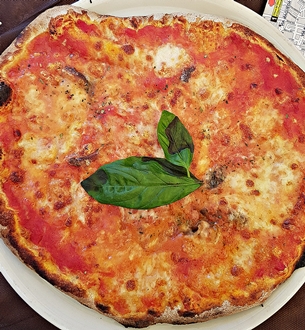
pizza


Until I was  16 years old, I always went on holidays with my parents. Every year, we visited Florence and Venice in Italy. When I was 16, I decided that I would try touring on my own.  After spending some time with my folks in Florence, I set off alone on a tour of my own planning: Volterra, Grossetto, Orvieto,  and Cortona, hoping to visit some Etruscan remains on the way.

All went well except for one thing. In those days, I was extremely shy and unable to strike up a conversation with strangers. As the days passed, I travelled through Italy becoming increasingly lonely. I spoke to no one, and, unusually for Italy, nobody spoke to me. I would get very hungry, but often felt unable to step into any eatery. I would wander around feeling a bit hypoglycaemic yet unwilling to risk entering a restaurant or bar.

When I reached Orvieto, I stayed in a hotel that was close to a church whose bells struck throughout the night. One lunch time when I was wandering pathetically from one eating place to the next, I passed a place selling pieces of pizza. I was overcome by the delicious smell of freshly baked pizza. I bought a piece and loved it. This was the first time that I had ever eaten pizza. Being unadventurous in my food choices, such as I was as a teenager, but no more, I had always avoided pizza. However, when I tasted it in Orvieto, it was love at first bite.

I still enjoy eating pizza occasionally, but now I am not shy about entering the first place selling food as soon as I feel hungry.

Spaghetti House

My parents loved coffee. In particular, they enjoyed drinking well-prepared Italian espresso coffee. Every Saturday morning when I was a child in the late 1950s and early 1960s, we used to drive to the car park by Jack Straws Castle, a pub near Whitestone Pond in Hampstead. Now, the pub no longer exists; it has been adapted to become a block of flats. The car park behind it, where we used to leave our car, still exists.

We used to walk down Heath Street, passing the open-air art exhibition if it was summer-time. Our first stop was a café housed within a building with a triangular floor plan, which still stands on the corner of Heath Street and Elm Row. The Pimpernel café/restaurant, which was run by Italians, no longer exists, but this is where my parents used to take their espresso coffee on Saturday mornings.

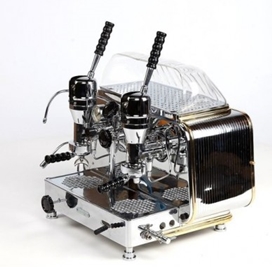
In those far-off days, espresso machines were not equipped with pre-set electronic controls as they are today. The person making the coffee had to pull down a leaver, which forced the hot water through the powdered coffee and into the cup waiting below it. The speed at which the leaver is pulled determines the rate at which the hot water flows through the coffee and the length of time that the water remains in contact with the coffee grains. These factors help affect the taste and quality of the final cup of espresso and are dependent on who operates the lever. Thus, using the manual espresso machines requires skill and experience. In my parents’ view those who worked at the Pimpernel had these skills. Whenever we visited this café, the kindly staff would give my sister and me a small matchbox sized piece of Italian nougat (‘torrone’). I remember that the piece of torrone was coated on two sides with thin edible rice paper. That there was paper which was edible really impressed my young mind.

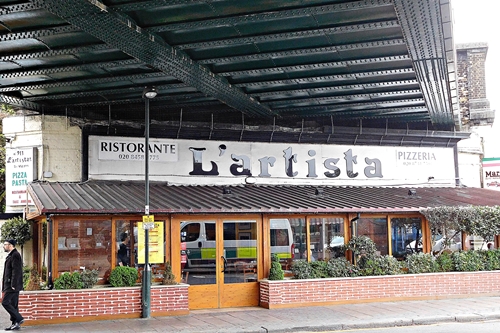
There was another place, whose coffee gained my parents’ approval during the 1950s. This was the Bamboo Bar on Finchley Road in Golders Green. It was located under the Northern Line bridge which straddles Finchley Road close to Golders Green station and opposite a now disused covered walkway which was once an entrance to the station.

SPAG 2

Although the walkway and the Bamboo Bar have been closed for many decades, there is still an eatery in the same place, the popular Artista Italian restaurant. The latter is much larger than its predecessor.
SPAG 1

The walls of the Bamboo Bar were lined with bamboo. It was run by two Italian men, Lorenzo Fraquelli and Simone Lavarini. My parents, who both loved Italy and her people, enjoyed chatting with these fellows. In 1955, they opened the first branch of what was to become the now widespread, extensive chain of Spaghetti Houses.

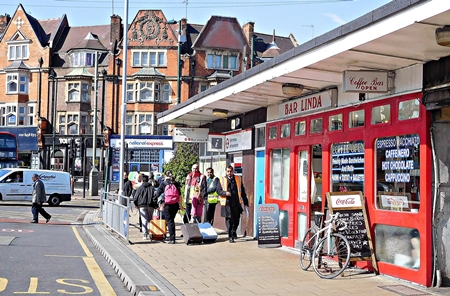
As mentioned, the Bamboo Bar closed years ago. Sometime in the 1960s, another café, Bar Linda, opened next to the bus station at Golders Green. This souvenir of my childhood still survives and is thriving.
SPAG 3

One branch of the Spaghetti House chain made headline news in 1975. It was the branch, now closed, in Knightsbridge. This was the branch where managers of the various outlets of the chain would meet occasionally to deposit their takings before they were deposited in a nearby bank’s night-safe. On the days of the meetings, this restaurant was closed to the public. On Sunday 28th September, three armed men burst into the restaurant and demanded the takings that had been collected from the branch managers, who were meeting there. They bundled the managers in the basement. Luckily, one of the managers escaped and alerted the police, who arrived promptly.  The bandits held the managers hostage for three days before giving themselves up to the police. This event became known as the ‘Spaghetti House siege’. I am pleased to report that nothing remotely exciting as that has ever occurred during my years of visiting this restaurant chain.

SPAG 4

The first branch, which still exists, stands on the corner of Goodge Street and Whitefield Street (see picture above). When I was a young boy, my mother often treated me to a meal at this restaurant. We became quite familiar with the staff.

Many years later in 1970-71 during my first year as a BSc student at University College London (‘UCL’), I used to treat myself to lunch at the Goodge Street Spaghetti House. It was more expensive than the numerous canteens that were available on the UCL campus, but the food was far better. The ground floor of this multi-storey restaurant, like the Bamboo Bar, had walls covered with bamboo. This has long since been replaced by newer wall coverings.  Some of the waiters who were working at the Goodge Street Spaghetti House were getting on in age by the time I began my undergraduate studies. At least one of them used to greet me as she remembered me as a child. Not only had she worked at the Spaghetti House since its opening, but she told me that she had also been a waitress at the Bamboo Bar.

We still eat the occasional meals at various branches of the Spaghetti House chain. The food is usually of a good standard. A few years ago, I met a chap with whom I had been to school before 1960. I had not seen him since about 1971, and then only extremely briefly. We agreed to meet up at a Spaghetti House restaurant. He told me that he preferred meeting people on ‘neutral territory’ in places like restaurants, rather than in homes. Although he had aged quite a bit since we were both 8 years old, he was recognizable. Almost as soon as he met me, he said to me:

“Oh, I thought I was meeting someone else, not you.”