ONE OF ISTANBUL’S many attractions is that it is intimately associated with water: the Golden Horn, the Bosphorus, the Black Sea, and the Sea of Marmara. Incorporated within the city’s excellent public transport system, there are many boat services on all these bodies of water. During our recent visit to the city in April 2024, we took a boat from Kabataş on the European shore of the Bosphorus to Büyükada – one of the Princes Islands out in the Sea of Marmara. This pleasant journey took about 1 hour and 40 minutes. As we sailed across the smooth sea, flocks of seagulls followed us, and were fed by other passengers, who threw them bread and other titbits.
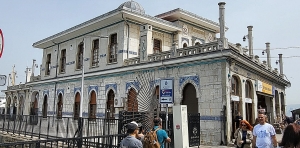
One of the piers at Büyükada has a beautiful old quay building in which passengers can wait for their boat and do a little shopping. Equipped with ticket windows, which are no longer in use because modern ticket machines have replaced them, the building is decorated with lovely tiling and stained-glass windows. As with many old buildings we saw in Istanbul, this one was supplied with a panel describing (in both Turkish and English) its history.
The pier was built in 1899. It was rebuilt with the addition of the present two-storey terminal building, which was completed in 1915 to the designs of its architect, Mihran Azaryan (1876-1952) from Izmit. He was an Ottoman Armenian. It is worthy of note that by the time that his building was built, the Ottoman rulers had been involved in the death of many Armenians.
The upper floor had a café between 1918 and 1923. And between 1950 and 1951, it had been the island’s first ever cinema. Between 2000 and 2001, the edifice was beautifully restored, and although the ticket windows no longer serve any purpose, its octagonal waiting room-cum-ticket hall is a rare survival.
Having seen this superb example of a ferry terminal, I kept my eyes open during the many other boat trips we made along, and across, the Bosphorus. Many of the landing stages have ornate terminal buildings – often with tiling and stained-glass windows, and sometimes with their names still in the old Turkish script. However, the terminal at Büyükada is the most impressive of all those we saw.
MUCH HAS CHANGED IN Istanbul since we last visited it in October 2008. Many places we saw then have either been restored or are closed for restoration. One place that was not open to visitors in 2008 is the Tekfur Sarayi, a palace built next to the ancient city walls of Istanbul. We came across it in April 2024 after having made an abortive visit to the nearby Kariye Mosque (once a Byzantine church), which was closed for restoration.
The Tekfur Sarayi, which used to be known as ‘Palace of the Porphyrogenitus’, is one of three Byzantine palaces still surviving in Istanbul. This edifice was constructed either in the late 13th century or early in the 14th. According to Wikipedia, the palace was:
“… named after Constantine Palaiologos, a son of the Emperor Michael VIII Palaiologos. “Porphyrogenitus”, meaning literally “born to the purple”, indicated a child born to a reigning emperor. The emperor would show off the newborn heir from the balcony and have them proclaimed “Caesar Orbi”, or “ruler of the world””.
The palace was badly damaged during the Ottoman conquest of Constantinople in 1453, and was later used to house part of the Sultans’ menagerie. By the end of the 17th century, the animals were moved, and the building housed a brothel. In 1719, the building was repurposed to house a factory for making decorative tiles, and this is how it remained before going out of business during the first half of the 19th century. Next, it became a poorhouse for some of the Jewish people in Istanbul. Following this, it became a bottle factory for a few years before being abandoned. What makes the building of special interest is that it is a rare surviving example of secular Byzantine architecture.
In 2010, the building was extensively restored and 5 years later a new roof and glazed windows were added. After that, new wooden floors and ceilings and staircases were added. In addition, a stylish lift was installed close to the palace. This allows visitors to reach the high second floor with ease. From a terrace on the second floor, there is a superb panoramic view of the city. In 2021, the place became a museum, whose exhibits include displays of the kind of tiling that used to be made in the palace and informative explorations of the stages in the traditional methods of manufacturing tiling. On the ground floor, there are a couple of archaeological remains of the kilns in which the tiles were fired. Apart from the exhibits, the elegantly contemporary design of the museum and what can be seen of the palace itself add much to the enjoyment of a visit to the Tekfur Sarayi.
The ground floor opens out into a courtyard where more archaeological finds can be viewed. A short staircase from the yard leads to a small garden from which one gets a good view of both the palace and the city walls stretching away from it. Although we were hoping to see the Kariye Mosque, but were unable to do so, visiting the Tekfur Sarayi more than adequately compensated us.
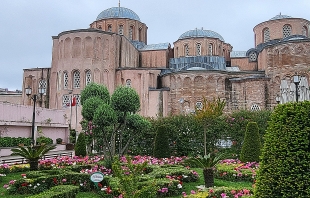
THE MOLLA ZEYREK mosque stands high on one of Istanbul’s seven hills. From its garden, which has a pleasant café, you can enjoy a wide panorama that includes views of the Bosphorus, the Golden Horn and bridges crossing it, the Galata Tower, the great Suleymaniya Mosque, and many other historic buildings around it. Turn your back on the view, and look across the well-kept flower garden, then you will see what looks like a large Byzantine church with three apses and several domes. However, as you stroll around this building, you will soon notice that it has its own minaret. This mosque was a church before 1453 when the Ottomans captured Constantinople/Istanbul.
As is the case with many other places of historic interest in Istanbul, there is an informative notice outside the mosque, written in three languages (Turkish, Arabic, and English). It outlines the history of the mosque. The building, designed by the architect Nikeforos, was built in the 12th century by Eirene (died 1134), the wife of Emperor Ioannis II Komnenos (ruled 1118-1143). Her father was King Laszlo I of Hungary. The edifice which is, in fact three churches joined in one building were the churches of the large Pantokrator Monastery. This institution included a 50-bed hospital, a library, an old-age home, a sanctuary for lepers, a medical school, a pharmacy, and a holy spring. The triple church was exceptional because:
“Except for the Church of the Holy Apostles, no other Byzantine building received as many imperial burials. John II (1118-43) and Eirene (Piroska of Hungary), their son Manuel I (1143–1180), and his wife Bertha of Sulzbach, were buried there, as were the Palaiologan emperors Manuel II and John VIII in the 15th century. In front of Manuel’s black marble sarcophagus was the Stone of Unction (a marble slab on which Christ’s body laid after his crucifixion), which Manuel brought from Ephesus around 1170. The large funerary chapel of the Archangel Michael is described by the typikon as a heroon – the shrine of a hero later used for the imperial mausoleum of Constantine and his imperial successors at the Church of the Holy Apostles.” (www.thebyzantinelegacy.com/pantokrator-monastery)
These monuments can no longer be found in the building.
Soon after Mehmet the Conqueror captured Istanbul, the monastery was converted into a madrassa. It became the first educational establishment created by the Ottomans in Istanbul. The monastery’s monk cells became cells for the madrassa and the triple church, suitably modified with a minaret, a mimbar, a mihrab, and other Islamic features, became a mosque with two classrooms for religious instruction. One of the new establishment’s professors was Molla Mehmed Efendi, nicknamed ‘Zeyrek’ – now, part of the mosque’s name. This learned man not only offered education to those who were already Muslim, but also to those who converted to Islam. In addition, he was instrumental in persuading many local people to convert to his religion.
Apart from the former church complex, now mosque, the other monastery/madrassa buildings have disappeared. This century, what had become an unusable, badly dilapidated structure was restored, and is now back in use as a mosque. The mosque occupies the southernmost of the three chapels. The other two chapels, although attractively painted, were empty spaces. One of these once served as the Byzantine Imperial mortuary chapel.
The Molla Zeyrek Mosque was formerly a Byzantine church. When the Ottomans took Istanbul, rather than destroying the places of worship of their Christian enemies, they recycled or repurposed them – they modified the churches and converted them to become mosques. Probably, the best-known example of this is Istanbul’s enormous Ayasofya-i Kebir Cami-i Şerifi (i.e., the ‘Hagia Sophia Grand Mosque’), constructed in the 6th century. Apart from Ayasofya, which we walked past almost every day during our recent 16-day visit to Istanbul, The Molla Zeyrek mosque was one of the most impressive and largest former Byzantine churches that we saw in the city. However, my favourite of these recycled churches was near where we were staying: the Kucuk Ayasofya Mosque, in whose charming walled garden we enjoyed numerous glasses of tea, met many friendly Turks, and watched the antics of the garden’s large feline population.
I have visited many cities in America, Asian and Europe. Many of them are fascinating, but now I can safely say that amongst these wonderful places, Istanbul has become my favourite because here the past, present, and future blend together with an exciting vibrance.
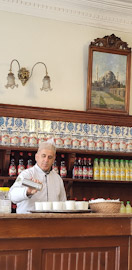
BOZA IS A TURKISH drink, popular both in Turkey and in the Balkans. It is made from fermented grains – such as millet and wheat. It originated in Central Asia. We tried some today. It was light yellow, had the consistency of custard, and tasted both sweet and slightly sour. It was also slightly fizzy (because of the fermentation). It was mixed with cinnamon powder and another customer told us that it is usually drunk with dried chickpea seeds.
We came across the boza shop – an old-fashioned place with tiling – in the Vefa district of Fatih in the European part of Istanbul. The shop is called “Vefa Bogacisi” and it was founded by Haci Sadik Bey.
Haci Sadik Bey came from Prizren in Ottoman Albania (now in Kosova) in 1870. He noticed that the boza then sold in Istanbul (by numerous sellers) was fairly runny, dark in colour, and sour. He developed a new version of it, which was lighter in colour, and as already described in my first paragraph.
At first, like other vendors of boza, he sold it on street corners. Eventually, his customers encouraged him to open a shop in the then upmarket district of Vefa. This he did in 1876. It was in this shop, which we encountered quite by chance, that we sampled boza. The business is still run by the same family – the fourth generation since Haci Sadik Bey opened his shop. Opposite this shop, there is another, which sells the chickpeas (‘leblebicisi’).
Finally, although Haci Sadik Bey (died1933) and his brother Ibrahim (died 1944) came to Istanbul (during the Turco-Russian War), I have not yet discovered whether or not they had Albanian heritage.
Within the shop, locked in a glass case, there is a glass drinking vessel from which the father of Modern Turkey Mustafa Kemal Atatürk (1881-1938) drank boza on Monday the 4th of January 1937. It was good to know that we tried boza in the same place as that great man.
WE MADE ANOTHER visit to Beykoz (on the Asian shore of the Bosphorus), hoping to eat paça soup at the place where we had enjoyed it a few days earlier.
The closed restaurant
We were surprised to find it closed, and shocked to discover that the man who ran it had just passed away. A notice to that effect was stuck on the windows of the small restaurant. As my late father often said when faced with disappointment: “these things happen” and “such is life”
Saddened, but hungry, we found another place which served the delicious meat soup. Its tiny dining area overlooked the waterfront. The food was good.
THE FIRST TIME I visited Turkey was in about 1960. My father was participating in a conference organised by the Eczacibaşi Foundation. It was held in the then luxurious Çinar Hotel on the European shore of the Marmara Sea at a place called Yesilköy, which is about 9 miles west of old Istanbul. This April (2024), we visited Yesilköy both for old times sake and because we had read that the place has several interesting sights to be seen. Incidentally, it was in Yesilköy that I had my first piece of chewing gum.
After disembarking from the Marmaray train, which connects settlements on the coast of the Sea of Marmara, we enjoyed the best cheese börek we have eaten since arriving in Turkey. Then, despite constant rain, we walked along Istasyon Caddesi, admiring the many houses with decorative timber cladding that line the avenue.
We made a small detour to look at a Syriac Christian Church, which looked recently built. We could not enter because a service was in progress. Thence, we walked to the rainswept seafront, where we looked around a museum dedicated to the life of Ataturk. It was housed in a mansion once owned by Greeks. The ground floor is dedicated to the first decade of the Turkish Republic, which was founded in October 1923. The first floor has a display of ethnographic exhibits from Turkey. The second floor is a collection of photographs, items, and books relating to the life of Ataturk.
Greek Orthodox church in Yesilköy
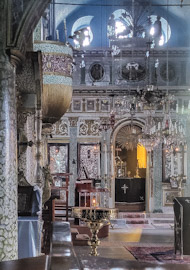
Next, we came across a Greek Orthodox church. We could enter its covered porch in which candles were flickering. Through the windows of the porch we could see enough of the church’s interior to realise it is quite beautiful. Unfortunately, the church was locked.
Nearby, we found the huge Latin Catholic Church, which was open. Its interior was nothing special, apart from one religious painting which contained words in the Ottoman Turkish script. The size of the church suggests that there might once have been a large Roman Catholic community in Yesilköy.
Yet another church is a few yards away from the Latin church. It is an Armenian church, enclosed in a compound surrounded by high walls. The entrance was open, and after looking at the church, we joined the congregation (at least 40 people), who invited us to have tea and cakes. A couple of gentlemen began speaking with us in English. They told us that the Çinar Hotel was no longer in business, but it was still standing. They also told us that they are in the textile business. They are waiting for Indian visas because they are planning to visit Bangalore and Tiripur soon because they are looking to buy textile machinery there.
Several people told us that the Çinar Hotel is about a mile from the centre of Yesilköy. As it was cold and raining we decided against looking for it. Despite not revisiting the place I first stayed in Turkey more than 60 years ago, we saw Yesilköy and some of its fascinating sights. It is close to the railway tracks and not on most tourists’ beaten tracks.
I AM ALWAYS WARY about visiting the ‘must-see’ places partly because I hate queuing and do not particularly enjoy crowds. Also, one of the few flaws in my personality is that I love visiting places that are off the beaten track taken by most visitors to a town or city. That said, I visited one of Istanbul’s most popular tourist attractions today – The Grand Bazaar – on my way to places less often seen by tourists.
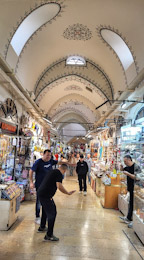
The Grand Bazaar (Kapali Çarşi = ‘covered bazaar’) covers a huge area, and is like a city within a city. It has 62 covered streets and about 4000 shops. It’s construction commenced in about 1455/56 – a very few years after the Ottoman conquest of Constantinople/Istanbul. Much of its construction occurred during the second half of the 15th century, and it was largely completed by the beginning of the 17th century.
Many things impressed me about the Bazaar. It is very clean. The numerous shops are mainly tidy. Until we entered the place, I had not realised that it is built on a hillside. Many of its gently curving streets (or wide corridors) are far from level – they slope gently. The beautiful curved ceilings, supported by numerous arches, are wonderfully decorated with painted Ottoman motifs and patterns – tasteful not garish. Despite the presence of many people – tourists and locals – the bazaar did not feel crowded. Because of the great width of the streets, the bazaar did not have the bustling feeling that many large bazaars in India have.
All in all, despite my initial reservations about entering such a ‘mustn’t miss’ attraction, I greatly enjoyed visiting the Grand Bazaar, and am very pleased I did.
KARAKÖY IS A DISTRICT of Istanbul close to the Golden Horn (Haliç). When walking along Tersane Cadesi, a busy avenue lined with shops selling technical goods for mechanical operations (from nails to power tools), we passed an old building topped with domes. Its walls are alternating layers of stones and brick work.
A plaque on the wall of this place reads “ISBU FATIH BEDESTENI AYASOFYA VAKFI KEBIRI OLARAK INSA EDEL MIŞTIR”, which means ‘This Fatih Bazaar was built as a part of the Hagia Sophia Foundation’. So, the building was constructed as a bazaar, and is still used as such. Like the rest of the street, only machine tools and spare parts are sold in the edifice.
Made in India
The above-mentioned foundation was founded soon after the Ottoman conquest of Istanbul. Its function, along with other foundations, was to restore and restructure Istanbul, which had deteriorated badly during the last years of Byzantine rule. I have not yet been able to find out when the bazaar was constructed.
On one of the external walls of the building, a selection of rubber car tyres was on display. An elderly man, who was running the stall, greeted us, and began trying to guess where we were from. My wife told him that she is Indian. Hearing that, the old fellow rushed back to his collection of tyres, and we started to walk away. A few seconds later, he rushed towards us. He was holding a tyre in his hand, and pointing to it, and he kept saying “India”. We stopped, and then he rotated the tyre until he found the words “Made in India” embossed on it, and showed then to us.
THE ARCHITECT MIMAR SINAN (c1489-1588) was the greatest of Turkish architects. There are many wonderful buildings of all sizes and for a wide variety of purposes designed by him all over Istanbul.
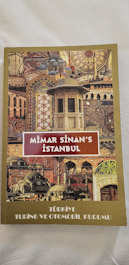
When visiting a tourist information office on the Asian side of Istanbul, I noticed several copies of a book called “Mimar Sinan’s Istanbul”. Beautifully illustrated with a detailed text, I quickly decided that I would love to own a copy. I asked if I could buy a copy. The official said that he could not sell me one because they were for reference only. I asked where they were sold, and was told that I could buy one at the publisher’s bookshop. The book is published by Turing. The discovery of the book occurred on a Friday.
On the following Sunday, we found the Turing shop. It was shut. We went again on Monday, and found a notice stating that it was always closed on Mondays. Tuesday was a public holiday. So, we did not bother going to the shop. On each of our abortive visits, I could see the book on a shelf in the shop, but could not quite see its title.
On Wednesday, the shop was open. We entered it, and discovered that they only stocked the Turkish edition. As it is beautifully illustrated and remarkably cheap given its fine quality, we purchased a copy.
Later that day, my wife Lopa had an ingenious idea. We were not sure whether it would work, but it was worth a try, especially as the tourist office was close to where we wanted to go the next day.
On the following day, we took the ferry to the Asian side, carrying with us the brand new copy of the Turkish edition of the book about Sinan, and returned to the tourist office. Lopa asked the official, who remembered us, whether we could exchange our Turkish book for one of the office’s books in English. Without hesitating, the official said: “Why not. We don’t have a copy in Turkish.”
He handed us a copy of the book in English, and we gave him our Turkish copy. I was very pleased and full of admiration for Lopa’s resourcefulness – especially as it was her birthday.
THE KUCUK AYASOFIYA mosque in the European side of Istanbul was once a Byzantine church (construction commenced in 527 AD). It was converted to a mosque after the Ottomans took over Istanbul. In front of the mosque, there is a square garden with a pavilion in its centre. The garden is enclosed on three sides by cloister-like arcades, which contain small shops, a religious institution, craftsmen’s workshops, and a small café.
From the first day we arrived in Istanbul – a Monday, we visited the peaceful garden every evening to relax and enjoy glasses of Turkish tea. The tea was made by a man in his sixties, called Yavuz.
We kept returning to the garden every evening not only because of the tea, but to greet Yavuz. He was the sort of person you have to like. Despite not being able to speak Turkish, we felt the warmth of his personality. After a couple of days, he began greeting us as if we had known him forever. When he walked past our table, he would pat our shoulders in a friendly manner. He was a person, whom you could not help liking. He was warm and genuine.
On the Sunday following our arrival, Yavuz was not at the café. Someone else made our tea. We imagined that it was Yavuz’s day off. On the next day, he was not there. Someone else, whom we had met earlier at the café and spoke good English, was at the café that Monday. We asked him where Yavuz was. He told us quietly: “He is no more. He died of a heart attack at the café late on Saturday night.”
We must have seen him only a few hours before he died. Although we had known him for less than a week, we were heartbroken. We felt as if we had lost a close friend or a much-loved relative.
Sadly, I never took a photograph of dear Yavuz. As we expected to see him during the rest of our trip, I had planned to ask him for his permission to take his picture later on. Even without a photograph, Yavuz will occupy an honoured place in our memories.





 yamey
yamey 