
An exhibition in London at a gallery called Parafin

ONE OF THE MANY advantages of living close to central London is that it does not take long for us to reach the numerous commercial art galleries in Mayfair and Marylebone. Many of these hold exhibitions of modern and contemporary art, which is often fascinating to see. My mother was a sculptor, many of whose works were abstract rather than figurative. Being brought up in close proximity to someone so interested in the contemporary art world (of the 1960s and 1970s) might well have been a source of my lifelong interest in seeing works of contemporary artists (as well as modern artists who no longer live). My enthusiasm for viewing art has been enhanced by two people close to me. My wife has always had an interest in art in general and ‘modern art’ in particular. Our daughter, who works in the world of art and its propagation, has added to our enjoyment of experiencing artistic creations by recommending galleries with exhibitions that often prove to be most fascinating.

Recently, our daughter suggested that we see an exhibition, “As Above So Below”, by an artist with whom she is working. Creations of British born Tania Kovats (born 1966) are being displayed at an exhibition in a small Gallery, Parafin, in Woodstock Street (close to Bond Street Underground station) until the 24th of February 2024. Although she is known for her work in a wide range of artistic activities, she best known for her drawings and sculptures. The present exhibition includes many drawings and a few sculptural creations. The gallery’s ‘flyer’ (or handout) explained that:

“… Kovats’ enduring themes are the experience and understanding of landscape, geological processes, patterns of growth and the intersection of landscape, nature and culture and how art can speak to our critical climate crisis.”

This summarises what the artist is trying to convey with her artworks. Everything on display at the exhibition was pleasing visually and meticulously executed, but just by looking at the works I was unable to grasp anything about them but their beauty. Fortunately, the gallery’s flyer helps to explain the artist’s intentions.

Many of the works on display relate to the sea and evoke it beautifully. One exhibit, also connected with the sea, was a series of images of numbered, but un-named, graves of 20 migrants who lost their lives crossing the sea from Africa to the Italian island of Lampedusa. Near this artwork, there was another work – a line of used school shoes. This is Tania’s memorial to her son’s childhood, and (to quote the flyer):

“… explores how growth houses loss, and is built into the child’s progress towards individualisation.”

The passage of time is depicted in another work in the exhibition, “Luna”, in which a series of pictures depicting the phases of the moon as they change during a lunar month.

I am very pleased that our daughter recommended this exhibition by an artist, who we had not encountered before. Although I greatly enjoyed the exhibition, now that I write about it and reflect on what I saw and read, I feel that I would like to see the show once again because at a second viewing I will gain much more from it than during my first visit.
From Egypt to Dorset

CLEOPATRA’S NEEDLE IS a familiar landmark in London. It was originally erected at Heliopolis in Ancient Egypt in about 1450 BC and brought to London in about 1877. Less well-known is another hieroglyph covered obelisk in the gardens of Kingston Lacy near Wimborne in Dorset.

The pink granite obelisk at Kingston Lacy arrived in the grounds of this rich family’s dwelling in about 1827. Like Cleopatra’s Needle, this monument is inscribed with hieroglyphics. Because there is a mixture of Greek words and hieroglyphics, the obelisk, discovered on an island in the River Nile, became important in the early attempts to decipher the Ancient Egyptian writing.

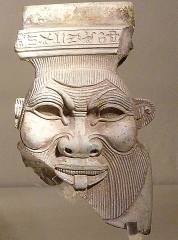
In Banke’s collection of Egyptian artefacts at Kingston Lacy

Kingston Lacy has been owned by successive generations of the Bankes family since the 1660s, when John Bankes (1589-1644) took possession of the estate and built the present grand house. One of his descendants, William John Bankes (1786-1855), who met Lord Byron when they were both studying at Cambridge University, first travelled in Spain and collected a vast number of Spanish paintings, many of which are hanging within Kingston Lacy House. Later, during the early part of the 19th century, William travelled extensively in the Middle East and along The Nile. During his travels, he collected many valuable Ancient Egyptian artefacts, some of which are beautifully displayed in a former billiards room within Kingston Lacy House.

The obelisk was found by Bankes at Philae in Upper Egypt in 1815. According to Wikipedia (https://en.wikipedia.org/wiki/Philae_obelisk), the inscriptions on the object:

“… record a petition by the Egyptian priests at Philae and the favourable response by Ptolemy VIII Euergetes and queens Cleopatra II and Cleopatra III, who reigned together from 144-132 BC and again from 126-116 BC. The priests sought financial aid to help them deal with the large numbers of pilgrims visiting their sanctuary and the king and queens granted the sanctuary a tax exemption.”

Both the Greek and the Egyptian inscriptions deal with the same topic but are not direct translations of each other.

THOSE MORONS

DR BR AMBEDKAR (1891-1956), lawyer and fighter for the rights of dalits (‘untouchables’), was the chief ‘architect’ of the Constitution of India ( adopted for use in late 1949). Highly educated, he had degrees from the Columbia University (USA) and the London School of Economics (LSE). While at the LSE, Ambedkar lived in a house near Primrose Hill, which has been preserved as a museum dedicated to his memory.

While walking along the splendid seaside promenade in Pondicherry, we visited a monument to Ambedkar, the Ambedkar Manimandapam. Opened in March 2008, this memorial complex contains a large statue of Ambedkar, some highly enlarged photos taken during his lifetime, and a small library.

The captions to the pictures are currently in the local language, Tamil, only. One huge painting depicting Ambedkar handing over a copy of the Constitution dated 1952 to various worthies including Jawaharlal Nehru and Maulana Azad had no caption identifying the persons in it. We asked a young lady, a Bengali, if she could name any of the men. She pointed at Motilal Nehru, Sardar Patel, and Rajagopalachari in addition to those we could identify ourselves. Pointing at Rajagopalachari, she said: “He must be some kind of ‘southie’.” He was a Tamil.

And then, pointing at the portraits, she added: “If it had not been for that bunch of morons, India would have become independent much sooner. They should have left it to Netaji.” She was referring to her fellow Bengali, the late Subhas Chandra Bose, whose Indian National Army gave the British an important jolt towards allowing India to leave the British Empire.

Facts and opinions

NEWS


The title of this brief blog article was inspired by the name of a Russian magazine  Аргументы и факты (‘Arguments and Facts’).

When I was a PhD student back in the 1970s, I did my experimental research in a laboratory.  For a while, the maintenance of this lab was supervised by a technician, ‘H’ by name. H was left-wing in his political views and made no attempt to keep his views to himself.

One day while I was working, H and I started talking about the newspapers we read. In my case, it was simple. I hardly ever read them. H said to me:

“I read two papers every day.”

“Which?” I asked.

“Oh,” he replied, ” I read the Times for the facts and the Morning Star for the opinion.”

For those who do not know, the Times used to be Britain’s most authoritative newspaper and the Morning Star is published by British Communists.

So, for H, the Times provided the facts which he coud use in arguments inspired by the Morning Star.