Riding from Udaipur to Ahmedabad: a road trip

TODAY WE TRAVELLED by road from Udaipur in Rajasthan to Ahmedabad in the neighbouring state, Gujarat. The 158 mile journey took us about 4.5 hours with a brief stop for tea.

South of Udaipur in Rajasthan

The hilly scenery between Udaipur and the frontier between Rajasthan and Gujarat was pleasant. It was mostly rural with few industrial buildings.

On entering Gujarat, everything changed. The terrain became flat and the countryside was liberally dotted with industrial structures, both small and large. In addition, there were plenty of fields for growing crops. Many of these fields were equipped with elaborate irrigation systems. Compared with the delightful, almost ar arcadian landscape in south5 Rajasthan, the landscape in the part of Gujarat north of Ahmedabad is far from attractive.

Until we reached the outskirts of Ahmedabad, the traffic on the dual-carriageway highway was light. Most of the vehicles we met were trucks. We saw only a few private cars.

After passing Ahmedabad airport, we entered the old city via the recently constructed Sabarmati Riverside road. This passes beneath a bridge being constructed for the new Ahmedabad to Bombay superfast railway, which should e running in about 2 years time.

Although the journey was not the most fascinating we have made on Indian roads,we were driven enough superbly by Rajesh, a driver engaged for us my the helpful Mr Yashwant of PP Tour and Travels in central Udaipur.
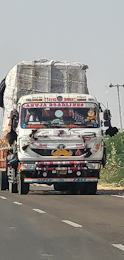
Tassels attached to trucks on the highway

 THE ROAD FROM Jodhpur to Jaisalmer is called a highway and tolls are levied along the way. In fact, most of the way it is a two-lane road without a central divider. The country through which we travelled from Jodhpur to Jaisalmer is for the most part as flat as a pancake The sandy landscape contains many trees and succulent plant bushes.  As one gets further and further away from Jodhpur,  villages and settlements become few and far between. Apart from agriculture,  there is no other industry.  However, as you get closer to Jaisalmer,  the countryside becomes filled with wind turbines and electricity pylons.


Although we did not encounter much traffic, we did meet a variety of animals using the roads: cattle, goats, sheep, horses, peacocks, and camels. Drivers are careful to avoid hitting them, often crossing over to the wrong side of the road to bypass them.


We stopped for a light lunch (vegetarian) at an isolated, small, unpretentious wayside eatery (a ‘dhaba’). The menu was in Hindi script only, and the waiter asked my wife to write down (in Hindi) the items we wanted. In addition to us, there was a family from Assam eating in the dhaba. The stuffed parathas we ate were well made and the buttermilk was refreshing.


Most of the trucks we saw on our way had tassels attached. Often, they are black, as we have seen all over India during past travels. However  some of the trucks we saw in Rajasthan sported coloured tassels, hanging from the rear. Those readers unfamiliar with India might be curious about the purpose of these usually unattractive tassels. In my book “CORACLES AND CROCODILES: 101 TALES OF INDIA”, I have written about these tassels, which flutter in the wind as the truck speeds along the highway.


Even if the scenery is not spectacular,  I  enjoy travelling by road in India. All along the way, there are scenes of rural life to be seen. For example, today we passed through a village in which piles of red chillies were out drying alongside the roadway. And often the country folk can be seen going about their daily routines dressed in traditional garb, whose design is centuries old. These fleeting glimpses of rural life enhance my enjoyment of India.

[The book mentioned above is available from Amazon: https://www.amazon.com/CORACLES-CROCODILES-101-TALES-INDIA/dp/B0DJZ6DMYB ]

Driving on roads on India

WHEN I FIRST visited India – that was in January 1994 – I carried my British and International driving licences with me. Boldly, I drove in the heavy traffic and densely crowded streets of the busy City Market area of Bangalore and also all the way to Ootacamund (‘Ooty’) – over 270 Km, and that was before the highway was constructed. You can share in these experiences by reading my book about travels in India, “The Hitler Lock & Other Tales of India”. This book/kindle is available from Amazon (https://www.amazon.co.uk/HITLER-LOCK-OTHER-TALES-INDIA/dp/B0CFM5JNX5/ ), and IF you live in India, from: https://store.pothi.com/book/adam-yamey-hitler-lock-and-other-tales-india/ .

Keeping on the safe side

IT IS ALWAYS WISE to ward off the Evil Eye. The Turks use characteristic amulets known as ‘nazar’. They are usually flat and almost circular with a design that resembles a stylised eye. This is now to seen on the homes of many people with no connection with Turkey. The Arabs and some Jewish people use an amulet, the ‘hamsa’, depicting a hand with five outstretched digits, to protect against the malevolent effects of the Evil Eye.

During road trips in India, I have often seen lorries (trucks) and other vehicles with thick, black, plaited tassels attached on the left and right sides of the driver’s cab. These things fly out sideways as the vehicles speed along.

One of our driver’s, the highly educated and informative Raheem, explained that these tassels are nazars. The drivers attach them to their vehicles to ward off the Evil Eye – an especially wise precaution on many roads in India.

During a recent (December 2022) visit to Panjim in Goa, my wife bought a couple of scarves from a female street vendor. The seller was so happy that my wife had bought from her that she immediately attached a bracelet on my ‘other half’s’ right wrist. The bracelet has a Turkish style Eye nazar and is made of black beads, which might well be designed also to protect against the Evil Eye.

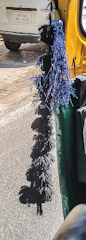
Even more recently, I noticed that an autorickshaw, which we had hired in Bangalore, was adorned with two hefty black tassels just like those seen on lorries. I was struck by these because on the whole autorickshaws in the city do not have them.

I have one minor concern about vehicles whose drivers have attached things to ward off the Evil Eye. That is, I wonder whether the knowledge that their vehicles are equipped with such protection might drive more recklessly than those who do not put any faith in objects that might possibly have a protective value.