The Imaginary Institution of India at London’s Barbican Centre

THE OBJECTS IN an exhibition are usually chosen to fit in with a particular theme. An exhibition might be based on the work of an individual artist or a group of artists; on a style of art (e.g., Impressionism or Expressionism or portraiture); on a specific genre (e.g., etchings or sculpture or paintings or photographs); a period of history. It is the latter theme – a period of history – which has been adopted to create a superb exhibition, “The Imaginary Institution of India” at London’s Barbican gallery. This show is on until the 5th of January 2025.  

The theme connecting the artworks on display at this exhibition is India during the period from 1975 to 1998. You might well wonder why these years have been singled out. Some landmarks during these years include Prime Minister Indira Gandhi’s proclamation of a state of emergency in 1975; problems in West Bengal (in 1979); the founding of the BJP party; inter-communal problems; the attack on the Golden Temple in Amritsar (1984); the toxic leakage at the Union Carbide plant in Bhopal; Hindu-Muslim tensions in Ayodhya; the destruction of the Babri Masjid (in Ayodhya); terrorist attacks in Bombay; and India’s successful underground nuclear tests. These events and many others occurred during the period covered by the exhibition.

The works on display at the exhibition are, according to the Barbican’s useful handout (a booklet), expressions of the various artists’ reaction to the events and social upheavals occurring in India during the years 1975 to 1998. The booklet describes what the exhibition’s organisers believe were the artists’ (political) messages being expressed in their creations. Interesting as these observations are, the works on display can be enjoyed without having any knowledge of what might have or might not have been going through the artists’ minds while they were producing their artworks. The exhibition provides a wonderful display of the excellence of Indian art produced during the period covered by the show.

I had not heard of most of the artists apart from MF Hussain, Bhupen Khakar, Sudhir Patwardhan, and Arpita Singh. The works that I liked most are by Patwardhan, Singh, Gieve Patel, and some lovely bronzes by Meera Mukherjee. I was also impressed by a set of collages by CK Rajan. That said, almost every work on display is worth seeing. The only disappointment for me was a video-based installation by Nalini Malani.

The Barbican has displayed these works in this exhibition both brilliantly and dramatically. I hope that the seemingly specialised nature of the theme of the exhibition (and its rather odd name) will not deter people from experiencing this superb collection of artworks.

Paintings by artists in India who escaped from western European artistic traditions – at the Brunei Gallery

WHENEVER I VISITED my in-laws in India, I used to admire the painting by the Bengali artist Jamini Roy (1887-1972), which used to hang in their flat. His style of painting was both modern (20th century) and at the same time almost folkloric. When our friend Bob Annibale posted on Facebook about an exhibition at the Brunei Gallery (in London’s Bloomsbury) that included Roy’s works, we could not resist visiting it, and we were glad we viewed it.

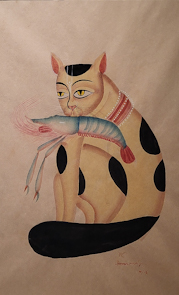
The exhibition, which continues until the 22nd of June 2024, not only contains a good selection of Roy’s works, but also others by Bengali artists working mainly between the late 19th century and the 1950s. Apart from works by Roy’s contemporaries including various members of the Tagore family, Hemendranath Mazumdar, Nandalal Bose, and Qamrul Hassan, there were also paintings by lesser-known or unknown artists who painted in the traditional late 19th century Bengali (Kalighat) style, rather than in experimental styles of the 20th century.

The emergence of modern Indian painting was a consequence of the establishment of The Government College of Art in Calcutta (in 1854). As the website of the Brunei Gallery explained, it was:

“… established by a benevolent government for the purpose of revealing to the Indians the superiority of European art.”

In the late 19th century, Indian artists working in the college began questioning the validity of Indians painting in the alien Western European fashion that was being taught them. The gallery’s website continued:

“Academic art, introduced by the British Raj, was challenged by the nationalist art movement, the Bengal School of painting, led by Abanindranath Tagore (1871-1951) and his disciples who dominated the art scene in the first decades of the twentieth century.”

It is works by these artists, who used their creations as part of their expressions of desire to see India free of British rule, that form the greater part of the show at the Brunei.

Several things particularly interested me whilst viewing the excellently curated and displayed exhibition. One was three paintings by Jamini Roy that illustrate Christian themes (e.g., the Crucifixion, the Last Supper, and the Flight to Egypt). I had not before seen any of Roy’s paintings depicting Christian stories.  Another exciting discovery for me were a selection of paintings by Sunayani Devi (1875-1962), who was the sister of the artists Abanindranath Tagore and Gaganendranath Tagore, some of whose pictures are also hung in the show. These 3 siblings had a famous uncle, Rabindranath Tagore, some of whose paintings were also on show. At the exhibition, there were portraits of Rabindranath Tagore by each of his above-mentioned relatives, and one by Jamini Roy.

Yet another artist on show, whom I had never encountered, is Qamrul Hassan (1921-1988), who was born later than the other artists. Born in Calcutta before independence and the Bangladesh War (1971), he died in what is now Bangladesh. He studied at The Government College of Art in Calcutta in the late 1930s, and afterwards became involved with left wing political activities as well as his art. Later, he was active in the struggle for East Pakistan (now Bangladesh) to become independent of what was then West Pakistan. Beneath one of his creations at the Brunei, there is a quotation by Qamrul about his style of painting:

“… where Jamini Roy ends , I begin …”

And this is so easy to see in the excellent exhibition at the Brunei Gallery

I have told you what stood out for me, but although I have highlighted a few things, the rest of the exhibits are wonderful, and not to be ‘sniffed at’. After seeing the show, I thought that never before had I seen such a fine and large collection of paintings by the liberated artists either here in the UK or in India. The curators of this show deserve hearty congratulations.

Cross cultural fertilisation between India and Europe at Milton Keynes

THE ARTIST REMBRANDT (1606-1669) produced a set of 23 drawings based on Mughal miniature paintings that were created in India in the early 1600s. In her article (see: https://mapacademy.io/what-rembrandt-learned-from-mughal-miniatures/), Shrey Maurya wrote:

“Perhaps the original Mughal miniatures arrived from the Dutch trading post in India. It’s also possible that he encountered the paintings in the collections of wealthy traders and various Dutch East India Company officials, who were his friends and often his clients.”

Shrey added:

“These drawings are remarkable for they allow us to understand the incredible global network established by trade ships which allowed an exchange of cultures to take place on a global scale.”

Recently, we visited an excellent exhibition at the MK Gallery in Milton Keynes: “Beyond the Page. South Asian Miniatures and Britain 1600 to now.” Amongst the many beautiful and intriguing exhibits, there were a few that illustrated the influence of Mughal painting on Western European artists. Although none of the above-mentioned Rembrandt drawings were on display, what I saw interested me greatly. I have been long aware of the influence of western artistic trends on the works of artists from the Subcontinent, but not the other way around.

An artist, Willem Schellinks (1623-1678), one of Rembrandt’s contemporaries is represented in the MK Gallery’s exhibition. He, like Rembrandt, is believed to have studied an album of Mughal paintings, which was thought to have been in the possession of the English art collector Alethea Howard (1585-1654), Countess of Arundel, who lived in Amsterdam from 1641 until her death. Incidentally, her portrait was painted by Peter Paul Rubens (1577-1640). In addition to sketches, Schellinks is known to have painted at least six paintings that contain Indian imagery (see the detail above). One of these and a sketch are on display at the MK Gallery.

In the same room as the Schellincks works, there is a painting by William Rothenstein (1872-1945). Drawing inspiration from traditional Mughal miniature paintings in the India Office Collection (in London), he created his “Sir Thomas Roe’s embassy to the court of Jahangir”, which was completed in 1924.

Before seeing the exhibition at Milton Keynes, I knew that Rothenstein had an interest in Indian culture. For example, he helped Rabindranath Tagore (1861-1941) to find accommodation in Hampstead’s Vale of Health in 1911-1912, but the well-produced exhibition catalogue provided me with information that was new to me. For example, Rothenstein had visited India and was a collector of Rajput paintings and drawings. In addition, in 1910 he was a co-founder of the India Society of London, whose aim was to bring Indian Art, in its many forms, to the attention of audiences in Britain and the world. So, it is maybe unsurprising that he chose to paint his picture of Sir Thomas Roe (c1581-1644) meeting with Emperor Jahangir (1569-1627) in a style that was influenced by the painters who would have around at the time of that historic rendezvous, sometime between 1616 and 1619.

Close to Rothenstein’s painting, there is an image by Abanindranath Tagore (1871-1951), who was a nephew of Rabindranath Tagore. This chromolithograph, “The Last Moments of Shah Jahan”, was created in 1903 in the style of traditional Mughal miniature painting. It is interesting to note that Abanindranath had never encountered Mughal paintings until he was in his twenties. He was introduced to them by another of the founders of the India Society, the art historian Ernest Binfield Havell (1861-1934). Havell had served the Madras School of Art as Superintendent for a decade from 1884, and in 1896 became Superintendent of the the Government School of Art in Calcutta. According to Wikipedia:

“Havell worked with Abanindranath Tagore to redefine Indian art education. He established the Indian Society of Oriental Art, which sought to adapt British art education in India so as to reject the previous emphasis placed on European traditions in favour of revivals of native Indian styles of art, in particular the Mughal miniature tradition.”

The works by Schellincks, Rothenstein, and Abinindranath Tagore, all on display at the MK Gallery, vividly demonstrate the cross-cultural fertilization that began when Europeans first set foot on Indian soil with intentions that were far from being cultural.  I have written about only a few of the wonderful exhibits in the show, but all of the others on display are not only beautiful but are filled with a wide variety of deep meanings. Of the many exhibitions I have seen this year, the one showing at the MK Gallery until the 28th of January 2024 is by far the best.