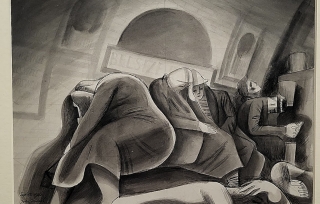
ALTHOUGH LONDON’S IMPERIAL War Museum contains a rich collection of objects related to warfare, it also has a fine art gallery in which there are many paintings inspired by, and recording, wars from WW1 onwards. The artworks, mostly paintings, are to be found in the rooms in the Blavatnik Art, Film and Photography Galleries on the museum’s third floor.
The paintings and other artworks are mostly by artists, who are now well-known, such as, to mention only a few: Joan Miro, Paul Nash, Eileen Agar, Laura Knight, Percy Wyndham-Lewis, John Piper, Eric Ravilious, John Singer Sargent, David Bomberg, and Steve McQueen. Others are by less well-known artists, and many of them have created images inspired by outbreaks of warfare that have occurred since the end of WW2. One of these, made by Steve McQueen, is a collection of postage stamps with faces of military personnel who died during the relatively recent Iraq conflict. These postage stamps, all of which bear a soldier’s portrait and the head of Queen Elizabeth II, are kept in a special wooden cabinet with sliding panels that can be pulled out to see the stamps. Like all the other artworks, this is both dramatic and moving. And seeing them during a period of warfare in the Middle East made them seem even more poignant.
There are several paintings by artists who joined British Colonial Artists Scheme, which encouraged ‘native-born’ artists to depict aspects of activities connected with warfare in the colonies. One of these artists was an African called Katongole. Another artist of interest is an Iraqi refugee called Walid Siti, who was born in Iraqi Kurdistan in 1984, and his etching was inspired by warfare.
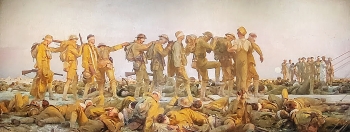
Of all the wonderful paintings on display, two particularly attracted my attention. One showing Indian soldiers, who were recovering from injuries during WW1, lying in beds under a large, amazingly decorative dome in Brighton Pavilion, This was painted by Douglas Fox-Pitt in 1919. The other, which is the biggest picture in the galleries, is by John Singer Sargent. Called “Gassed”, it shows a long line of blindfolded soldiers, injured by poisonous gas, being led by an officer wearing a white overcoat. As they walk along, they are passing the corpses of their fellow soldiers.
The artworks in the Blavatnik Galleries at the Imperial War Museum easily rival what can be seen in the permanent collection of Tate Modern, and are a ‘must-see’ for anyone who has an interest in twentieth century artists, especially those who worked in Britain.