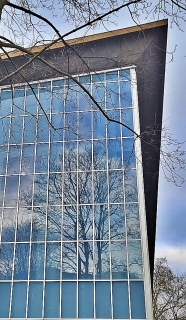
Once the Commonwealth Institute, now the Design Museum

Here is a short extract from my book “BEYOND MARYLEBONE AND MAYFAIR: EXPLORING WEST LONDON”. The extract concerns an unusual building next to Holland Park:

Set back from the main road, and partly hidden by two hideous cuboid buildings, stands an unusual glass-clad building with an amazing, distorted tent-shaped roof (made of copper). This used to be the Commonwealth Institute. Built in 1962 (architects: Robert Matthew Johnson-Marshall & Partners), I remember, as a schoolboy, visiting the rather gloomy collection of exhibits that it contained shortly after it opened. The Institute closed in late 2002, and the fascinating building stood empty until 2012, when it was restored and re-modelled internally. In 2016, it became the home of the Design Museum. Like the architecturally spectacular Guggenheim Museum in Manhattan, the building competes with the exhibits for the viewer’s attention, and then wins over them easily. The displays in the Design Museum are a poor advert for the skills of British designers, whereas the building’s restored interior is a triumph. This is a place to enjoy the building rather than the exhibits. One notable exception to this comment is the sculpture by Eduardo Paolozzi (1924-2005), which stands outside the front of the museum.


The museum borders Holland Park, which is well-worth exploring. By the park’s High Street entrance, there is a plaque giving the history of the ‘Trafalgar Way’. This was the route taken between Falmouth and London by Lieutenant John Richards Lapenotière (1770-1834), when he carried news of Nelson’s victory at Trafalgar in 1805. It is at this point that I will let you rest on a bench in the park, or to enjoy the delights of its lovely Kyoto and Fukushima Japanese Gardens.
“‘

My book is available from Amazon sites by clicking below:

A building with a strangely shaped roof in London’s Kensington

Here is a brief excerpt from my illustrated book “BEYOND MARYLEBONE AND MAYFAIR: EXPLORING WEST LONDON”. It concerns a curiously shaped building constructed in the early 1960s in Kensington:

Returning to High Street Kensington, the eastern wall of the Melbury Court block of flats bears a plaque commemorating the cartoonist Anthony Low (1891-1963), who lived in flat number 33. Set back from the main road, and partly hidden by two hideous cuboid buildings, stands an unusual glass-clad building with an amazing, distorted tent-shaped roof made of copper. This used to be the Commonwealth Institute. Built in 1962 (architects: Robert Matthew Johnson-Marshall & Partners), I remember, as a schoolboy, visiting the rather gloomy collection of ethnographic exhibits that it contained shortly after it opened.

The Institute closed in late 2002, and the fascinating building stood empty until 2012, when it was restored and re-modelled internally. In 2016, it became the home of the Design Museum. Like the architecturally spectacular Guggenheim Museum in Manhattan, the building competes with the exhibits for the viewer’s attention but wins over them easily. The displays in the Design Museum are a poor advert for the great skills of British designers, whereas the building’s restored interior is a triumph. This is a place to enjoy the building rather than the exhibits. One notable exception to this comment is the sculpture by Eduardo Paolozzi (1924-2005), which stands outside the front of the museum.

You can discover much more about Kensington and many places west of it by reading my book, which is available (as a paperback and a Kindle) from Amazon:

Keeping watch in the Kyoto Garden

LONDON’S HOLLAND PARK contains a lovely area – the Kyoto Garden. It is a well-maintained Japanese-style garden. I visit it frequently. Each time, I see something different there.

The garden is planted around a small pond in which there are several rocks, which look like miniature islands. Today, I saw a heron perched on the summit of one of these rocks. It stood still, moving its head slowly every now and then. It showed little interest in the many fish that swim in the pond. My wife noticed that there was a nest containing eggs just below the bird’s feet. The creature stood like a sentinel, guarding its future offspring.

I could see four eggs in the nest – there might have been more. In general, so I learned from Wikipedia, the various species of heron are monogamous and lay between three and five eggs. I have no idea what species I saw in the Kyoto Garden, but it is the first time I have seen a heron’s nest with eggs anywhere in Holland Park.

The way to the summer ballroom

HOLLAND HOUSE IN Holland Park was badly damaged by aerial bombing during WW2. What is left of the building shows that it must have been a splendid Jacobean palace. It stands on the estate of Sir Walter Cope (c1533-1614), for whom it was originally constructed. In his time, the estate extended south from what is now Holland Park Avenue almost to what is now Fulham Road.

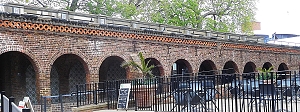
Although much of Holland House was destroyed in the War, many of its out-houses still stand today. Amongst these are the icehouse with its conical roof; a disused dairy; a stable block which now houses a Parks police station; and an orangery, which is attached to what was once the summer ballroom.

A covered arcade, open to the outside on one side, runs from where the southwest corner of the house used to stand, passing near the icehouse, to the southeast corner of the orangery. In poor weather, this long covered passageway was used by house guests moving between Holland House and its summer ballroom. From the western end of the passageway, they would have had to walk through the orangery to reach the ballroom. In fine weather, those attending balls would have walked along the walkway above the covered passage. In places, this runs past walls covered with colourful tiled panels, made in Florence (Italy), which were placed there in the 1850s. The wall of one stretch of the covered walkway, the section nearest to the orangery, are painted with scenes depicting an imaginary garden party held sometime in the 1870s. They were created between 1994 and 1995 by the artist Mao Wen Biao (born 1950).

Currently, the former summer ballroom is being restored. For many years, it was home to The Belvedere restaurant, a pricey establishment. When the restoration of the ballroom is complete and its former glory restored as much as possible, it will be used to house a new Italian restaurant, which is planned to be more affordable than its predecessor.

Over several decades, we have made innumerable visits to lovely Holland Park, but had not realised that the arcade described above was anything but decorative. Today, we met Jenny Kettlewell, who is the Chairman of the Friends of Holland Park. It was she who revealed its purpose. Currently (2nd to 10th of April 2022), there is an annual art exhibition in the orangery. The works on display are by local artists.

Then and now: Holland House in London before and after the 2nd World War

HOLLAND HOUSE in Holland Park (west London) was built in the early 17th century (about 1604) in the Jacobean style. It was designed by the architect John Thorpe (dates uncertain: c1555-c1655), who is thought to be the creator of Audley End House in Essex. In 1939, King George VI and his wife Queen Elizabeth (the Queen Mother) attended a debutante ball at Holland House. Little did they know that this was to be the last great ball to be held at the house. After the German Luftwaffe began devastating London, Holland House was hit by twenty-two incendiary bombs during a ten-hour raid on the night of the 27th of September 1940. Much of the old house was destroyed apart from the east wing. Fortunately, the library and its valuable contents remained undamaged. A video (www.britishpathe.com/video/holland-house-damaged) made by Pathé News shows the house shortly after it was bombed.

The house remained as a ruin until 1952 when its then owner, Giles Fox-Strangways, 6th Earl of Ilchester (1874-1959), a Member of the Royal Commission on the Historical Monuments of England from 1939–1959, sold the remains of the house and its extensive grounds (now Holland Park) to the London County Council. Eventually in 1986, what was left of the building was transferred to the Royal Borough of Kensington and Chelsea. In normal, non covid19, summers, the now well-preserved remains of the house become the home of a temporary theatre where opera is performed. For many years, but no longer, the relatively intact part of the house was used as a youth hostel by the YHA.

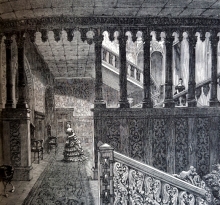
Recently, I have acquired a facsimile edition of “History and Antiquities of Kensington” by Thomas Faulkner, which was published originally in 1820. I have also my own copy of an original edition of Volume 5 of “Old and New London” by Edward Walford, published in 1878. Both books were published when Holland House was still intact, and both contain engravings showing how the house looked both outside and inside.  Faulkner’s book contains a lengthy detailed listing of all the artworks and books that the house contained. These items included several paintings by artists as famous as Teniers, Canaletto, Joshua Reynolds, and Hogarth, to name but a few. Luckily, most of the art treasures in the house were removed for safety before the outbreak of WW2.  The illustrations, some of which I have reproduced, demonstrate how great a tragedy it was that Holland House no longer remains intact.

The illustrations to this article can be viewed at: https://londonadam.travellerspoint.com/60/  

The slave owner who helped abolish slavery

BLOG HOLL LATE 246

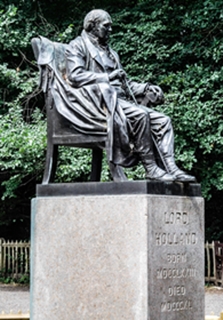
SEATED IN A CHAIR ON A STONE PLINTH, surrounded by a small pond and often with a pigeon on his head or shoulder, Henry Vassall-Fox, 3rd Baron Holland (‘Lord Holland’; 1773-1840) gazes benevolently towards the ruins of his home, which was destroyed by German bombs during WW2. The fine cast metal statue was sculpted by George Frederic Watts (1817-1914) with technical assistance from Joseph Edgar Boehm (1834-1890). I have walked past this statue innumerable times and never given it much of a thought apart from being amused when I have seen pigeons resting on the crown of Holland’s head. A friend of ours pointed out that the sculptor has included, unusually, a depiction of Holland’s wedding ring, a memorial to his marriage which was to prove very interesting with regard to his political activities. Today, the 20th of June, I walked past it yet again, but with the recent interest in statues and their subjects’ relationships with the slave trade, I wondered whether Lord Holland had any connection with it. What I have discovered is somewhat surprising.


Lord Holland was the nephew of the Whig statesman Charles James Fox (1749-1806). According to the British History Online website:
“On the death of his uncle … Lord Holland was introduced into the Cabinet as Lord Privy Seal; but the strength of the Whig portion of the Government had then departed, and the only measure worthy of notice in which his lordship co-operated after his accession to office was the Bill for the Abolition of the Slave Trade.”
This suggests that Holland was an abolitionist.


However, things are never so simple. When visiting Florence (Italy) in 1793, he fell in love with Elizabeth Vassall, wife of Sir Godfrey Webster, 4th Baronet. She and Webster divorced and then Elizabeth married Lord Holland. The “Oxford Dictionary of National Biography” (‘DNB’) records that in 1800
“… Holland assumed the additional name of Vassall to safeguard his children’s right to his wife’s West Indian fortune.”
When her first husband died in 1800, Lord Holland became the owner of the Vassall plantations in Jamaica. By accident, the abolitionist became an owner of slaves.


According to a website published by the Portobello Carnival Film Festival 2008:
“By all accounts, the Hollands were humane and improving proprietors who supported anti-slavery measures against their own financial interests. It can even be argued that he was more use to the abolitionist movement as a slave owner than he would have been as a mere politician. Nevertheless, in perhaps the defining local paradox, the finest hour of Holland House as the international salon of liberal politics was financed by the profits of slave labour.”
The site continues by pointing out that after his uncle died, Lord Holland:
“… was on the committee that framed his uncle’s bill for the abolition of the slave trade. Meanwhile Lady Holland founded the area’s multi-cultural tradition by employing Afro-Caribbean, Spanish and Italian servants – in order to enhance the foreign image of her political salon.”


VE Chancellor wrote in his article “Slave‐owner and anti‐slaver: Henry Richard Vassall Fox, 3rd Lord Holland, 1800–1840” that Holland regarded a slave:
“…not as mere chattel, but as an individual with feelings and abilities no less than those of other men …”.
However:
“… he justified the continuing history of slavery in the British Empire in Whiggish terms of the right to property and the need to obtain the consent of those who owned slaves before Abolition could be achieved…”
So, it seems that Holland, an avowed Abolitionist and ‘accidental’ owner of slaves, was placed in a difficult position. Chancellor records that the great Abolitionist William Wilberforce (1759-1833) regarded Holland as:
“… a ‘most zealous partisan’ of slave trade abolition …”,
And the DNB relates:
“Holland himself was an equally keen supporter of the abolition of slavery in 1833, despite its adverse effect on his West Indian income.”
Holland gave his full support for the Slave Trade Abolition Bill when it passed through the House of Lords. The passing of the Bill was accompanied by sizable tax relief to sugar producers in the West Indies. Lord Holland benefitted from these, as the University College London ‘Legacies of Slave Ownership’ website notes:
“Lord Holland, awarded part of the compensation for under three awards for the enslaved people on his estates in Jamaica…”
Chancellor wrote that Holland, who had benefitted financially from the tax relief concessions:
“… learnt the lesson that those called on to make sacrifices in a good cause do so the more willingly when potential loss is compensated.”


So, now returning to the statue covered with bird droppings in Holland Park, what are we to think? No doubt, Lord Holland became an owner of slaves, but by an accident caused by one of Cupid’s arrows. Had he married someone else, he might not have become the inheritor of Caribbean plantations with slaves. If William Wilberforce was happy to regard him as a bona-fide Abolitionist, that is for me a favourable contemporary character reference for Lord Holland. Some, including me, looking at his statue with hindsight, might ask why he, an avowed Abolitionist, did not emancipate his slaves as soon as they came into his possession. I am willing to believe that the answer to this is far from simple.

[For reference to Chancellor, see: https://www.tandfonline.com/d…/abs/10.1080/01440398008574816]