MOST PEOPLE ASSOCIATE Varanasi (Benares) with Hindu temples and practices. However, the city is important to other religions, notably Islam.
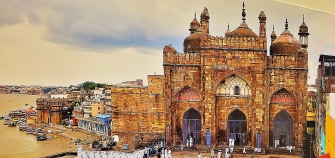
The largest mosque in Varanasi
Recently, we viewed an exhibition called “Mughal Banaras” at SOAS Gallery in London. It was a collection of excellent photographs taken by architect and photographer Jateen Lad who collaborated with historian Malavika Kasturi.
In a Hindu math (monastery) which existed during the time when the city was under Mughal rule, there is a collection of Mughal firmans (official documents) on display, including one written by Dara Shikoh, who was murdered by his brother Aurangzeb).
We were fortunate to have met Jateen at the exhibition, and he showed us around. His superb commentary brought the pictures to life, and discussed the historical importance of, and the current circumstances of the Muslims in the city.
EALING ROAD RUNS south from near Wembley Central station to Alperton station. At the north end of the road is the vegetarian Gujju Dhaba Express, which offers a range of Gujarati and other Indian dishes including Indo-Chinese food. Nearby, there are other restaurants (mostly South Indian and Sri Lankan) and several jewellery shops with signs and notices both in English and Tamil. A little south of these there is the Wembley Central Masjid, which is housed in an old church. Next door to this mosque is a Hindu Shiva temple. And a little further south, there is a branch of ICICI, an Indian bank. Further along the road there is a modern building covered with colourful paintings from top to bottom. This is Brent Indian Association, which looks from its website to be primarily concerned with Gujarati and Gujaratis. The lampposts along the northern part of the road are decorated with large notices discouraging the use of paan, and spitting this substance onto the road.
After walking along a section of the road without shops, one reaches a long stretch of shops and eateries. Almost all of them cater to the Gujarati population. Almost without exception, the shop assistants and the managers speak Gujarati. During the few months before I first went to India, Lopa, who is now my wife, took me to this Gujarati area of London a few times, maybe to familiarise me with Indian things. Often, we used to eat at Sakonis, where South Indian vegetarian dishes were served, along with some items commonly eaten by Gujaratis who hailed from East Africa.
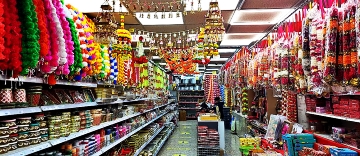
Inide Popat store
Yesterday, 7 March 2026, we revisited Ealing Road after not having been there for several years. Sakonis is still in business but looks fancier than it did more than 30 years ago. And to our great delight, Popat, a wonderful hardware and household goods shop, is still going strong. So strong that it has opened a new branch a few yards away. While wandering around Popat, I found a collection of framed images of Hindu deities. Rummaging through them, I hoped to find an image of Shrinathji, a form of Krishna that is favoured by my wife’s mother’s family. When we have visited various members of this family, all devoted to Shrinathji, we have always seen images of this deity hanging in several rooms of their homes.
I could not find an image amongst all the pictures on offer. So, we asked one of the friendly assistants in Popat. She searched through the stock, and found one. She was delighted that we should want to obtain an image of Shrinathji, as she is devoted to him. She told us that she had visited his shrine, a temple at Nathdwara, which is not far from Udaipur in Rajasthan. Full of enthusiasm, this lady related that she had spent more than two days at the shrine, and had attended many pujas and darshans each day. She said it was the most wonderful experience, and that we should also visit Nathdwara because Shrinathji would enrich our lives and change them for the best. After she had extolled the virtues of the deity and the benefits that would surely follow a visit to his shrine at Nathdwara, we purchased the image. As we did so, I thought that it is not every day one enters a shop and receives a lesson in theology.
Apart from Popat, there are shops selling clothes for everyday use and weddings, jewellery shops, vast fruit and vegetable stores, other shops selling ingredients for south Asian cooking, and shops selling freshly made snacks, which most Gujaratis love. This part of Ealing Road is an ‘outpost’ of Gujarat that is frequently beneath a dismal grey sky. Despite the bad weather, the crowd of shoppers, mostly speaking Gujarati, is good humoured, as are those who serve in the shops. Visiting Ealing Road provides a taste of India without needing to purchase an air ticket. Having said that and having visited Gujarat many times, I felt that the Gujarati section of Ealing Road was even livelier than many places in Gujarat itself.
IN 2018 WE visited Somnath (in Gujarat), where there is a highly revered Hindu temple. Many pilgrims enter the temple. However, before they do so, they must leave anything made of leather in their cars or accommodation. Hindus hold the cow as being sacred. So, nothing made of leather can enter this important temple.
Belt removed before entering the temple
This December (2025), we visited the Puneshwar Shiva Temple near Bhuj in Kutch, Gujarat. As with most holy places in India, one must remove one’s footwear before entering the sanctuary. When we reached the podium on which the ancient (10th or 11th century) temple stands, I spotted a leather belt that someone had respectfully removed before entering the inner chambers of the temple. This reminded me of our visit to Somnath.
THE PUNVARESHVAR TEMPLE is one of the oldest surviving Hindu temples in Kutch. It stands beside state highway 42 between Bhuj and Nakhatrana.
The temple is built in a style that incorporates elements of both Dravidian and Nagara styles. It was built sometime around the tenth or eleventh century. During the earthquake of 2001, part of its roof collapsed, leaving part of the temple without a roof. The temple is dedicated to Shiva.
The dripping cow head
Built on a stone podium, there is a walkway surrounding the temple. We began walking around it, and stopped to look at a carved cow’s head from which water was dripping. While I was taking a picture of this dripping sculpture, a man approached it, knelt down, let some water drip onto his fingers, and then touched his eyes with the water. He explained that we should not walk all the way around the temple, because only Ganesh, son of Shiva, is permitted to walk the whole way around. Ordinary mortals are supposed to walk up to the dripping cow, put the water in their eyes, and retrace their steps. Then, one can walk around the rest of the temple until one reaches the dripping cow. After applying water to the eyes, one retraces one’s steps.
While we were looking at the old temple, a group of ladies dressed in traditional folk costumes arrived at the temple. Each of them had what looked like a colourful pillow balanced on their heads. These were, in fact, bundles of clothes.
We learned that the ladies had walked through the night from Ratnal, which is 40 miles east of the Puneshwar Shiva Temple. According to Google maps, this walking journey takes between 13 and a half and 14 hours. We were at the temple at 10 am. The ladies would have set out on their walk early the evening before. Very kindly, they allowed me to take pictures of them.
The Punvareshvar Shiva Temple is on the way from Bhuj to the enormous temple complex called Mata no Madh. We visited this popular temple a few years ago. It was overcrowded and highly commercialised. Near the sanctum containing the highly revered deity, I spotted an ATM machine for pilgrims who had not brought enough cash to offer to the deity and the priests who perform the pujas – at very high speed. The simple, ancient Puneshwar Temple is a peaceful place, where unlike at Mata no Madh, there is a spiritual atmosphere bathing the environment.
A DARGAH IS a shrine enclosing the grave of a (usually) Sufi saint or ‘pir’ (a Sufi spiritual guide). During my travels in India, I have visited many dargahs. Today (27 November 2025), we came across a dargah close to the Imli Ghat and the city wall by the shore of Pichola Lake in Udaipur.
The tree growing within the dargah
The dargah was contained in a decoratively perforated stainless steel enclosure. Part of the shrine is the trunk of a tall, growing tree. A gentleman who has a shop nearby showed me that part of the trunk is hollowed out. This space is covered by a decorated cloth such as can often be found draped on Muslim gravestones. Fresh flowers were scattered at various places in the dargah.
What interested me is something I have noticed before in dargahs. That is the presence of smoking agarbatti (incense sticks), similar to those used at Hindu religious shrines and temples.
In the case of the dargah near the Imli Ghat, another feature that caught my attention was the tree growing within it. Maybe, it was not significant, but it reminded me of the multitude of Hindu shrines located around the trunks of trees.
In my book “CORACLES AND CROCODILES: 101 TALES OF INDIA”, I have written about practices shared by both Hindus and Muslims in India. Although the two religions differ considerably, it seems to me that some rituals (rather than beliefs) are commonly used by Indian adherents of both of them. Some other commonalities related to religious rituals are also described in my book.
IN DECEMBER 2024, we hired a taxi to take us from Jaisalmer to Bikaner: both are cities in Rajastahan (India). As it was a journey that was going to take over five hours, we decided we needed a break en-route.
When we asked our rather sullen driver to find a place for us to stop for a light lunch, he drove us off the main road into a small town (an overgrown village) called Ramdevra. The modest place where we ate satisfactory vegetarian food was not one frequented by foreign visitors. People hanging around the establishment were clearly curious about us, but in a friendly way. After lunch, our driver encouraged us to walk to the Sree Baba Ramdev Temple, for which the town is famous. It was much further away from the restaurant than the “few minutes” our driver had told us. Near the temple, there were many stalls where lumps of different coloured crystalline dhoop (aromatic products made with herbs and resins, which when heated or burned release fragrant smoke) and incense sticks were for sale. It was very clear that his choosing to stop in Ramdevra was to visit the temple, which turned out to be a crowded place in a huge shed filled with Hindu shrines.
It was mass-production Hinduism. Impatient crowds of people, including us, were hurried along narrow passageways demarcated by metal railings. The maze of railings made the place look like a cattle market filled with animal holding pens. The idea seemed to be to get the devotees to donate money at the several shrines in exchange for blessings that were performed by pandits as quickly as they could manage. Rather than feeling like a spiritual experience, it felt more like being a product on a fast-moving industrial conveyor belt. Our driver seemed pleased that he had visited the temple complex. We did not share his enthusiasm, and were pleased when we returned to the highway.
THE LETTERS ‘CITU’ stand for the Centre of Indian Trade Unions, which was founded in 1970. Its ‘logo’ includes the hammer and sickle, a symbol first used on some Chilean coins as early as 1894. However, it became widely recognised after 1917 when it was used as a symbol during the Russian Revolution, and long after it was over.
Today, I spotted a small street stand erected in Pondicherry by the CITU. It is located on the corner of Rue du Bazar St Laurent and Beach Road (Goubert Avenue), which runs along the seafront. It has three white hammer and sickles, each on a red background. One of these symbols faces in the opposite direction to the other two.
Now, here is what interested me. Two of the Communist symbols decorate the stone supports of a short table or bench. Running along the length of the bench and slightly above it, there is a row of religious images. Four of them depict Hindu deities, three of them are images of Christianity, and one, showing two mosques and the Holy Koran, is connected with Islam.
I suppose that this might reflect the fact that local members of the CITU are adherents of these three religions. But, I am only guessing.
THE WORD AARTI is from the Sanskrit language. It means ‘something that removes darkness’. In many pujas (Hindu ceremonies), an aarti is performed: it involves presenting a flame to appease the deity or deities.
One evening, we were walking along the bank of the Hooghly (a part of the holy Ganges river that flows through Kolkata) just after sunset. We came across rows of plastic chairs facing the river at Babughat (one of the stepped landings used by people bathing in the river). Between them and the water there was a row of altars. We asked someone the reason for the chairs. We were informed that they were set up so that people could watch the daily Ganga Aarti, which was due to happen at 530 pm. Our daughter, who had witnessed a Ganga Aarti at Varanasi, persuaded us to wait and watch the forthcoming aarti.
We sat down and joined the other spectators. While we waited, several hawkers walked along the rows of chairs, selling snacks of various kinds, both packaged and prepared to order (for example, jhal muri – puffed rice with flavourings). One hawker carried a tray on which a small lamp (a diya) was flickering. For a small cash offering, he blessed the ‘customer’ and placed some prasad (blessed food) into his or her right hand. Meanwhile, rotating spotlights and piped music added to the festive atmosphere. Gradually, all the seats were occupied, and many people were standing nearby on the sides of the ghat.
At 5.30 pm, priests dressed in shiny gold robes with wide sashes over their left shoulders began assembling, one in front of each of the altars. The latter were illuminated with hoops carrying brightly lit electric light bulbs. Then, the ceremony began.
A pandit, dressed in white, speaking into a handheld microphone chanted prayers in Sanskrit. As he was doing this, the gold clad priests performed several visually exciting activities. These included moving containers emitting clouds of smoke. They swung them and moved them in circles, each man in synchrony with the others. After this, they did much the same thing with candelabras each carrying many small flaming oil lamps (diyas). These were then replaced by larger flaming lamps, each of which had handles shaped like cobras ready to attack. After the balletic flame movements, the flaming lamps were carried down to the water’s edge. I could not see whether they were immersed in the river.
In addition to the movements with the flaming lamps, large conch shells were washed through with water, some of which was sprinkled on the crowd. The conches were also blown to produce a sound indistinguishable from the horns on the locomotives of the trains running every few minutes on the suburban railway track that was a few feet behind where the ceremony was being performed.
I am very pleased we waited to watch the Ganga Aarti. Apart from being more spectacular than many theatrical performances I have seen, it was very moving. It is yet another example of how much more vibrant and fervent religious ceremonies are in India than they are in most parts of Europe.
THE ALIPORE JAIL used to house political prisoners, whom the British regarded as a threat to their rule of India. The inmates included freedom fighters such as the future Sri Aurobindo, Jawaharlal Nehru, and Subhas Chandra Bose. The prison has been restored and is now a museum. In December 2024 and for the first few days of 2025, several exhibitions that are part of the Bengal Biennale have been held in some of the jail’s buildings. One of these, which I found extremely interesting and well curated, is called “Kali: Reverence and Rebellion”.
Kali is a Hindu goddess. I will not try to explain her exploits and great importance to Hindus, but will outline the subject matter of the exhibition by quoting from the website of the Biennale (www.bengalbiennale.com/):
“Divided into sections, the exhibition traces Kali’s pervasive influence across the subcontinent. It explores Kali and her cohorts of the divine feminine. Born from Durga’s angry, darkened brow as she battles the asuras Chanda and Munda, Kali decapitates the demons and assumes the form of Chamunda. Within these depictions, she is seen alongside Durga, the primordial force, as well as the ten Mahavidyas that emerge to subdue Shiva.”
Subhas Chandra Bose image
In addition to the wonderful array of images on display, which can be enjoyed without any knowledge of Kali, what fascinated me was the connection between Kali and the fight of Indians for independence. The website explained:
“During the nationalist period, Kali was invoked as a symbol of rebellion by Aurobindo Ghosh and Subhash Chandra Bose to urge their followers to fight against imperialist forces.”
In connection with this, two images fascinated me. One of them depicts Kali who has cut off her own head and she holds it in her left hand while blood shoots out of her cut neck and into the mouth of her self-decapitated head. Painted in about 1840, this image shows what Kali did after either she was unable to obtain Shiva’s blood, or she had been deprived of her conjugal rights. Known as Chinnamasta, this avatar of Kali is often shown with one foot on the chest of a god (Shiva) or standing above a copulating couple.
Elsewhere in the exhibition, there is an image of Subhas Chandra Bose created during the twentieth century. It shows the freedom fighter, Bose, standing decapitated and holding his own head in his left hand. He is standing above a group of decapitated heads. Blood pours down from his head and it falls onto a map of India on which the words “Jai Hind” (‘Victory to India’) can be seen. The image is a politicisation of the depiction of Chinnamasta.
Apart from a wonderful selection of Kali images created by Indian artists, there are a few made by early Europeans who visited India and wanted to record their experiences and to attempt to understand Hinduism. All in all, the exhibition was very well worth viewing. It was so popular with visitors to the jail that a security guard was present to regulate the number of viewers at any one time, to prevent overcrowding.
THE SOUTH PARK Street Cemetery in Kolkata was opened in 1767 and was used as a burial ground for Europeans (mainly British) until 1830. It contains a large collection of funerary sculpture (mostly mausoleums and obelisks), much of which is in the neoclassical style. This now peaceful oasis in central Kolkata with much greenery is the final resting place of many people who had roles in the British East India Company (including its armies) and their families. Although the place contains the remains of many interesting people I will concentrate on two of them, both of whom had military careers.
Tomb of Hindoo Stuart
Charles Stuart (c1758-1828) was born in Ireland (Dublin) and joined the East India Company when aged 19. He served in one of its armies, reaching the rank of Lieutenant Colonel. In India, he was attracted to, and fascinated by, Hindu culture and traditions. He adopted many Hindu ways of life including religious practices. For example, when off duty, he wore Indian clothes and bathed in the Ganges (the Hooghly) daily. In addition, he wrote many articles, published in the newspapers of Calcutta, which extolled the Indian ways of living, and encouraged Europeans to wear Indian garb rather than western clothing. He felt that ladies from Europe would feel more comfortable and look better wearing saris in India. His sympathy for the Indian modes of life and admiration of Indians earned him the nickname ‘Hindoo Stuart’, but did not impede his military career. His funerary monument in the South Park Street Cemetery is in the form of a small Hindu temple, quite different in form from all of the other monuments in the graveyard.
The other military person commemorated at South Park Street has a very modest, barely legible gravestone. It records the death of the short-lived Walter Landor Dickens (1841-1863). He was the fourth child and second son of the author of “Oliver Twist” and many other famous novels: Charles Dickens. Walter became an officer cadet in the East India Company armies, arriving in India in 1857, just before the so-called Indian Mutiny began. After the end of this revolutionary activity and the end of the Company’s rule in India and the start of the British government’s control of the country, he became a soldier in the British Army. Illness resulted in his death in a military hospital in Calcutta.
Walter was buried at the Bhowanipore Military Cemetery in Calcutta. In 1987, some students at Kolkata’s Jadavpur University raised funds and had Walter’s gravestone moved to the South Park Street Cemetery. This was done because it was not being cared for and to honour his father, the famous author.
Having recently become a fan of the novels of Charles Dickens, I was pleased to have been able to view Walter’s gravestone. The lettering on it is legible, but not too easy to read.
During our recent visit to the Cemetery, which we made in December 2024, we saw the two graves mentioned above and many others which we had not noticed on previous visits. For those interested in the early history of Kolkata during its British occupation, the South Park Street Cemetery should not be missed.



 yamey
yamey 