IN 2018 WE visited Somnath (in Gujarat), where there is a highly revered Hindu temple. Many pilgrims enter the temple. However, before they do so, they must leave anything made of leather in their cars or accommodation. Hindus hold the cow as being sacred. So, nothing made of leather can enter this important temple.
Belt removed before entering the temple
This December (2025), we visited the Puneshwar Shiva Temple near Bhuj in Kutch, Gujarat. As with most holy places in India, one must remove one’s footwear before entering the sanctuary. When we reached the podium on which the ancient (10th or 11th century) temple stands, I spotted a leather belt that someone had respectfully removed before entering the inner chambers of the temple. This reminded me of our visit to Somnath.
THE TEEN DARWAZA (a magnificent three arched gateway built in 1415) was an entrance to the Bhadra Fort in Ahmedabad. The Gateway faces the main part of the fort, but is separated from it by a large rectangular piazza lined with shops, eateries, an auditorium designed by BV Doshi, and market stalls.
The Bhadra Fort itself was constructed by the founder of Ahmedabad, Ahmed Shah, in 1411. Thus, it is one of the oldest surviving edifices in the city. Only a few parts of this imposing structure are accessible to members of the public.
One substantial part of the fort is occupied by a busy Hindu Temple, Nagardevi Shri Bhadrakali Temple. This has been in existence for many years. However, since our last visit to Ahmedabad two years ago, the temple has spread into the piazza, occupying an area that used to be filled with traders’ stalls. The expansion consists of an area covered by a colourfully decorated canopy.
In addition, many of the street vendors who used crowded and enliven the piazza between the fort and the Teen Darwaza have been cleared out. According to one shopkeeper, with whom we spoke, it was the Temple authorities who ordered their removal.
The Bhadra Fort was built by followers of Islam. It has now been used to accommodate a Hindu temple. Seeing this reminded me of the Charminar in Hyderabad. This place, which is of great significance in the Islamic world, like the Bhadra Fort, has been encroached by a Hindu temple. Although less solid in appearances than that in the Bhadra Fort, that attached to the Charminar is here to stay.
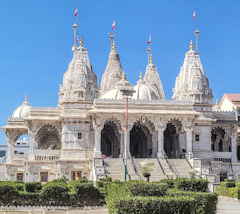
THE SWAMINARAYAN TEMPLE in Mandvi (Kutch, Gujarat) was constructed between 1991 and 1999 to replace a smaller Mandir on the site. Without going into the details of its very fine architectural and decorative features, this edifice was financed by local Kutchi followers of Swaminarayan. The Rajasthani Marble that forms the temple’s structure was hand carved by workmen, all of whom were followers of Swaminarayan. The stones that make up the building were carved in Rajasthan, transported to Mandvi where they were put together to make the edifice. This is similar to how the great temple in London’s Neasden was constructed.
Swaminarayan Mandir in Mandvi
The temple at Mandvi looks very similar to ancient Hindu temples I have seen elsewhere in India. As you look around it, you can see how the very old temples looked when they had just been built many centuries ago. Apart from the fact that Mandvi’s Swaminarayan Mandir looks recently built, a layman like myself, would find it difficult to age the building.
In 19th century England, many new churches were built in the gothic style. Like the newish temple at Mandvi, may of them faithfully reproduce the churches built in mediaeval times. The only thing that differentiates the 19th century Gothic Revival churches from their mediaeval predecessors is that they look too new to be as old as them.
In a book about Gothic Revival written by the art historian Kenneth Clark (1903-1983), he suggests that in England the use of gothic style in architecture never actually died out, and this suggested to me the Gothic Revival was really gothic survival. As far as I can gather, the same is the case for Hindu mandir architecture. If this is really the case, new temples such as Mandvi’s Swaminarayan Mandir is not the revival of the use of an ancient style of architecture, but an example of its survival. Put another way, the new temple at Mandvi is a reincarnation of its predecessor.
THERE WAS ALWAYS a tin of pink coloured Isogel granules in the bathroom of my childhood home. One of my parents took a teaspoon of this daily to ensure regularity of bowel movements. An important ingredient in Isogel is psyllium husk, which is extracted from the plants Plantago ovata and Plantago psyllium. Basically, the husk is a polysaccharide gelling agent which, believe it or not, can be used to ameliorate both constipation and diarrhoea. It might also have other health promoting properties, including possible mitigation of Type 2 diabetes, and reducing cholesterol levels in the blood.
Recently, for reasons that need not be detailed here, we have taken to using psyllium husk. We did not buy Isogel, as my parents did, but a product from India called ‘Sat-Isabgol’, which my wife’s parents used in that country. This product is packed in a picturesque box that includes the company’s trademark: an old-fashioned telephone (B.G. Telephone Brand Regd.). The box we bought recently proudly proclaims that the company is in its 80th year. According to the box, Sat-Isabgol is:
“… the upper coating of Plantago Ovata (Ispagul) which is highly purified by sieving and winnowing.”
Interesting as this is, what attracted me to the box was the fact that the Sat-Isabgol factory is in Sidhur, a place we visited in Gujarat (western India).
Sidhpur is far from being a major tourist attraction, but it is not far from the ruins of the magnificent Sun Temple at Modera, which does attract many sightseers. The main attraction in Sidhpur is a couple of streets lined with mansions decorated with ornate facades and other decorative features. These were built between the 1820s and the 1930s by a successful group of Muslim traders, members of the Dawoodi Bohra sect. The buildings incorporate many features of European neo-classical styles. Many of the houses bear their owners’ monograms in Latin lettering. The streets in this rural provincial town have a surprisingly un-Indian look about them and if it were not for cows and other animals roaming about them, it might be easy to imagine that one was not in India. While I was roaming around taking pictures, local people were extremely friendly to me. I got the impression that few Europeans visit Sidhpur. One exception was at the sad ruins of a Hindu temple, the Rudra Mahalaya, where the security guards were most unenthusiastic about seeing me with a camera. I was unable to photograph it. Constructed between 943 AD and 1140 AD, this temple is was in extremely poor condition when we saw it about two years ago. If it should ever be restored, it would make Sidhpur a fine excursion for tourists staying in Ahmedabad. I liked what I saw during our brief visit to Sidhpur, but was completely unaware that the town is home to the factory which has been producing something that has brought so much relief to people all over the world, since 1940.




 yamey
yamey 