When German bombs rained down on Hampstead and a pub that no longer exists

DURING MY CHILDHOOD in the 1960s, there was a concrete platform on Hampstead Heath Extension. It was close to Hampstead Way. Today, where it used to be visible, there is a mound of impenetrable bushes and weeds surrounded by a fence. The concrete structure was a base for anti-aircraft guns during WW2.  Although, many German aircraft were knocked out of the sky by guns such as these, many of them caused a great deal of damage all over London. Recently, while sorting through some books, I came across a slender volume called “Hampstead At War”. It was first published by Hampstead Borough Council in 1946, republished by the Camden Historical Society in 1979, and then again in 1995.  The book contains many photographs of the terrible destruction caused by bombs dropped by the Luftwaffe over Hampstead.

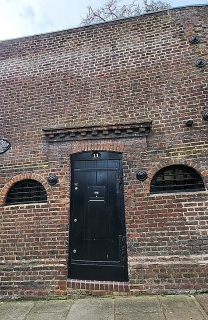
One of the photographs in the book struck a particular chord with me. It shows the badly damaged Hare and Hounds pub after it had been bombed in 1940. The pub, which was almost next door to the famous Old Bull & Bush pub, was established in about 1751. However, the building that was destroyed was built a long time after that.

Between 1965 and 1970, I used to travel From Golders Green station to Highgate School on the bus (route 210). Every school day, the bus would pass the Old Bull & Bush and its neighbour, the Hare and Hounds. When passing the latter in those days, I always wondered why the pub looked so recently built. When leafing through the “Hampstead at War” book today, more than 50 years after leaving the school, I found the answer. The book contains a photograph showing the extensively damaged pub.

The Hare and Hounds was rebuilt during the years I studied at Highgate. Although I can only faintly recall its appearance and can find only one photograph of it after its rebuilding, its presence remains firmly fixed in my memory. Finding the book certainly jogged my memory, and seeing the photographs of war damaged Hampstead makes a great impression. One wonders why the Germans chose to waste their ammunition on an area that has always been mainly residential.

PS: The Hare and Hounds closed forever in 2000.

A library that is far from mundane in north London

VISITORS TO LONDON (and residents of the city) should not miss visiting Kenwood House, which is in north London between Hampstead and Highgate. Not only does it contain a magnificent collection of Old Master paintings that can be compared favourably with what can be seen in Britain’s finest public art galleries, but it also has a beautiful library.

In my book about Hampstead, “Beneath a Wide Sky: Hampstead and its Environs”, I wrote:

“The first house to stand on the site of the present one was built in brick by John Bill (1576-1630), printer to King James I. He bought the Kenwood Estate (which was known as ‘Caen Wood’) in 1616. After several changes in ownership, the Estate was bought in about 1747 by a former Prime Minister and King George III’s close associate, John Stuart, third Earl of Bute (1713-1792). In 1754, Bute sold the property to the lawyer and law-reformer William Murray (1705-1793), who became the First Earl of Mansfield, and was Lord Chief Justice of the King’s Bench from 1756 to 1788. In 1778, he was a supporter of the Roman Catholic Relief Bill that led to the violent protests described above. During the First Earl’s stay in the House, he employed the architect Robert Adam (1728-1792) to make improvements.”

The library was one of the improvements that Robert Adam created at Kenwood. The library or Great Room was constructed between 1764 and 1774. It was intended both as a reception room and a library, which might explain why so little of this large room’s wall space is occupied by bookshelves. Most of the wall space is occupied by mirrors and windows. Lord Mansfield would have been used to host guests, hold dinners, and for music performances.

The library’s architecture is based on that of Roman public bath houses.  John Summerson (1904-1992), the architectural historian, wrote of its design in his “The Iveagh Bequest, Kenwood : a short account of its history and architecture” (published 1988):

“This is one of the finest Adam rooms in existence … The shape of the room, with its curved ceiling leading into two apsidal ends, on the chords of which are pairs of columns, is one which Adam used for several of his most stately interiors. Apart from the plan, a great innovation for England was the flat arched ceiling which Adam frankly describes as ‘extremely beautiful …”

Although the library is the finest of Adam’s creations at Kenwood, there are others that deserve to be admired. These include the orangery, the entrance hall with its magnificent stucco ceiling, and the library’s anteroom. In this piece I have concentrated on the interior of Kenwood House, but a visit to this wonderful place should be accompanied by a stroll in the place’s superb, landscaped gardens.

My first visit to a famous pub near Hampstead (in north London)

I HAVE BEEN PAST the Old Bull and Bush pub near Hampstead inummerable times during the past 70 years, but until today (1 June 2025), I had never entered it. Here is a little about the pub from my book “Beneath a Wide Sky: Hampstead and its Environs”:

Made famous in an old music hall song Down at the Old Bull and Bush (by Andrew B Sterling and Henry von Tilzer), the Old Bull and Bush began life as a farmhouse that was built around 1645. The pub began in the early 18th century. The artist William Hogarth (1697-1754) visited it regularly. The artists Gainsborough and Reynolds frequented the pub with the actor/director Garrick. The present pub was built in the 1920s and is uninteresting architecturally. When I was a child, there was another pub next door to the Old Bull and Bush. This was the ‘Hare and Hounds’. I used to pass it and the two pubs on my way to school in Highgate (between 1965 and 1970). It was already present in the early 19th century. In 1940, during WW2 it was twice destroyed by aerial bombardment. And, according to Christopher Wade, it: “… existed for a time in five linked caravans…” before being rebuilt in 1968. The pub ceased operating in 2000 and has since been demolished. A modern brick apartment block now stands where people used to enjoy a casual pint.”

Well, today, we ate lunch at the pub. The dining room was comfortable, the service was good, but the food was unexceptional. Would I visit that establishment again? Maybe, but I still prefer other pubs in Hampstead.

PS My book is available from Amazon, e.g.:

https://www.amazon.co.uk/BENEATH-WIDE-SKY…/dp/B09R2WRK92

Yet another visit to a church in Hampstead (north London)

THE PARISH CHURCH OF St John stands at the western end of Hampstead’s elegant Church Row. We have visited it often, and each time we notice things we had not observed on previous visits. During our most recent one (in May 2025), we spotted two things that we had not been aware of previously. One is a small detail, and the other is glaringly obvious now that we have thought about it.

The small detail relates to the font that stands close to the main entrance to the church. It incorporates the bowl of the font that was originally constructed in 1745. The stem that supported it is elsewhere in the church. The font is covered by a wooden lid inlaid with religious images. On top of this cover there is a statue of st John the Baptist standing within a cast-iron frame. What we had not noticed before is that there is a lifting mechanism for raising the lid. This consists of a chain, which is attached to the top of the frame, and then runs over some pulleys, At the other end of the chain there is a heavy looking weight, presumably added to make it easier to raise the heavy cover.

The glaringly obvious thing about this church, which it has taken us years to notice, is that the chancel (containing the high altar) is at the west end of the church. This is unusual because in most churches, the chancel is at the east end. When we were in Pondicherry (in Southern India) in January 2025, we visited two of its churches. Both of them have, as does St John, their chancels at their west ends.

I was brought up near Hampstead, and from my childhood onwards, I have visited this charming hilltop place innumerable times, each time discovering something I had not noticed before. In January 2022, I published a book about Hampstead  (which is available from Amazon sites such as https://www.amazon.co.uk/BENEATH-WIDE-SKY-HAMPSTEAD-ENVIRONS/dp/B09R2WRK92).

A versatile artist who was born in London

THE CAMDEN ART Centre in London’s Hampstead area rarely puts on exhibitions that can be classed as dull. The current show, which runs until 22 June 2025, is certainly anything but dull. It is a solo exhibition of works by Richard Wright, who was born in London in 1960. After his family moved to Scotland, he attended Edinburgh College of Art from 1978 to 1982 and then was at Glasgow School of Art between 1993 and 1995. He lives in Glasgow and Norfolk. In 2009, he won the prestigious Turner Prize.

From what can be seen in the variety of art works on display in the Art Centre, it is difficult to pigeonhole his art in any particular category. The works that can be viewed in the exhibition include huge wall-paintings, stained glass windows, light-diffusing structures, framed paintings, decorated sculpture, books that have had had paintings added to them, and more. A note in the exhibition handout outlines some of the influences on Wright’s art:

The exhibition also brings together more than 40 works on paper made over the last 30 years, drawing on languages of signwriting, 1970s subculture, album covers and poster-art, as well as Baroque painting, Renaissance frescoes, Islamic mosaics and early modern artists and movements including Kandinsky, Klee, De Stijl, Mondrian, and Russian Constructivism. Some of these works are made directly into the pages of books, another kind of site, surface or architecture for him to intervene in and occupy.”

Seeing this collection of refreshingly original artworks in the brightly lit galleries of the Camden Art Centre was a delightful experience.

An artist from India in London’s St Johns Wood

THE BEN URI gallery in was established in 1915 in London’s East End. Named in honour of Bezalel Ben Uri, the craftsman who designed and built the Ark of the Covenant, it moved to Boundary Road in St Johns Wood in 2002. Originally, it was a place where Jewish immigrant artists and craftsmen could display their work. More recently, it has widened its remit to feature artists of all religions, who have migrated to Britain from other countries.

Until the 29th of November 2024, the gallery is holding an exhibition of works by an artist born in Goa (part of India since 1961): Lancelot Ribeiro (1933-2010). He came to England to study accountancy in 1950. He disliked the subject. At first, he lived with his half-brother, the artist FN Souza. Later, he resided in Hampstead. In 1951, he began studying art at St Martins School of Art, where my mother created sculpture between 1950 and the mid-1960s. The exhibition at the Ben Uri focusses on Ribeiro’s work in the field of portraiture, and displays his innovative and imaginative approach to this form of art. The exhibition is small but well displayed. I felt it was a more satisfactory showing of Ribeiro’s art than the exhibition that was held recently at Hampstead’s Burgh House.

Workers in London’s Hampstead and the historian Thomas Carlyle

I AM NOT A GREAT fan of the style of painting found in pictures by the Pre-Raphaelite artists. Although not a member of that artistic circle, Ford Madox Brown (1821-1893) created paintings in the Pre-Raphaelite style.

The Manchester Art Gallery contains a large collection of Pre-Raphaelite style paintings. Amongst these, one caught my attention. Entitled “Work”, it was painted between 1852 and 1865 by Ford Madox Brown. What interested me is that it depicts a scene in north London’s district of Hampstead.

Detail from “Work”

“Work” depicts two labourers (‘navvies) digging a hole in the street as part of the preparations for laying sewers. In the background, there are houses that strongly resemble buildings that can be seen in Hampstead today. The painting was inspired by a book which Brown had read: “Past and Present” by the historian Thomas Carlyle (1795-1881) and published in 1843. The author discussed the nobility of labour in this book. Ford Madox Brown included a portrait of Carlyle on the right side of his painting. The canvas “Work” illustrates the contrast of the hard working labourers with the relatively wealthy, inactive bystanders.

An early study for Brown’s “Work” is his painting of Heath Street in Hampstead, which he created between 1852 and 1856 (https://artuk.org/discover/artworks/heath-street-hampstead-study-for-work-205501). The part of Hampstead depicted in “Work” is The Mount, which branches off Heath Street at an extremely acute angle. Brown had made a detailed study of the area in 1852.

Ford Madox Brown lived in many different places, including Manchester. However, I am not sure whether Hampstead was one of them until the end of his life. He did have a studio in Hampstead.He died in Primrose Hill (in his home at 1 St Edmunds Terrace), which is very close to Hampstead.

Lovers of Pre-Raphaelite artworks should not miss a visit to the Manchester Art Gallery. It should also appeal to those interested in modern architecture because the space between two parts of the institution has been roofed over and contains a interesting new staircase and a glass-floored bridge.

Depictions of Hampstead in painting always interest me because I was brought up in that neighbourhood and have researched it in detail whist preparing my book “BENEATH A WIDE SKY: HAMPSTEAD AND ITS ENVIRONS”. My title refers to the artist John Constable and his fascination with the cloudscapes that he could see from Hampstead, where he lived for many years .

He lived and painted in and around London’s Hampstead district

TWO HALF-BROTHERS from India were both artists, and spent time creating artworks in and around Hampstead. Lancelot Ribeiro (1933 – 2010) was one of them, and the other was his older and more famous brother Francis Newton Souza (1924-2002). Today (23rd of June 2024), we dashed up to Hampstead’s Burgh House to see an exhibition of works by Souza created when he lived in Hampstead and Belsize Park. This small, but superb exhibition closes today.

Born in Portuguese Goa, Souza studied art at the prestigious JJ School of Art in Bombay. A participant in the Quit India Movement, he was expelled from that school in 1945 when he pulled down a Union Jack flag at a school celebration. Souza migrated to the UK in 1949. By 1955, he was already making a success in London’s contemporary art world.

In London, Souza first lived in Paddington, then North Kensington, and by the mid-1950s, he had moved to Hampstead. By 1961, he had made enough money to buy a large house – number 9 Belsize Park. He remained there until he moved to the USA in 1968.

The exhibition handout (produced by London’s Grosvenor Gallery) described Souza as an Expressionist artist who:

“… conveyed the fear and anguish of the generation.”

One of the great fears was that of nuclear weapons. Souza became an anti-nuclear activist, taking part, for example, in the Aldermaston Marches. Three of the paintings at the exhibition, “The Mad Prophet of New York”, “The Apocalypse”, and “Oedipus Rex”, reflected Souza’s reaction to nuclear weaponry, and were painted during his time in the Hampstead area.

At least two of the paintings we viewed reflected Souza’s life in northwest London. One of them depicts a church in Chalk Farm (near Belsize Park), and the other, a parody of Picasso’s 1907 “Demoiselles d’Avignon”, has the title “Young Ladies of Belsize Park”.

The paintings were hung in the well-lit Peggy Jay Gallery in Burgh House, and were accompanied by informative panels. It is a shame that this excellent exhibition was only open for a few days (19th to 23rd of June 2024). I am glad that we made the effort to see it.

An almost hidden treasure on London’s Hampstead Heath

ANYONE TRAVELLING BY ROAD along North End Way between Hampstead’s Whitestone Pond and Golders Green will pass Inverforth House (on the west side of the road). Now used as a luxury apartment house, the place has an interesting history and an even more interesting garden, some of which is open to the public.

Here is what I wrote about this property in my book “Beneath a Wide Sky: Hampstead and its Environs” (available from Amazon):

“Inverforth Close, a small private road open to pedestrians, leads off North End Way. At the end of it, there is a delightful garden with a wooden pergola, The Hill Garden, which is open to the public. It was once part of the gardens of Inverforth House. The present house was built in 1895 in a ‘neo-Georgian’ style to the designs of the architectural practice of Grayson and Ould. Between 1896 and 1904, Ronald Fisher (1890-1962) lived there as a child. He was one of the ‘fathers’ of modern biological statistics.

Between 1904 and 1925, the house was owned by William Lever, Viscount Leverhulme (1851-1925). He was one of the first men to produce soap on an industrial scale (in 1884) and was an enlightened industrialist. He built Port Sunlight near to Birkenhead to house his workers in pleasant surroundings. The house’s library was designed by built by William and Segar Owen of Warrington, who also designed buildings at Port Sunlight. In 1955, Inverforth House became a convalescent home of the (now closed) Manor House Hospital, and that is how I remember it from my childhood. The hospital was not part of the NHS. It was privately run by trade unions. The edifice ceased being a hospital in 1999. Now, the house contains privately owned, luxury flats; it has become a ‘gated community’.

The gardens of Inverforth House were laid out from 1906 onwards by Thomas Hayton Mawson (1861-1933), garden designer, landscape architect, and town planner. According to one source (www.historic-uk.com), Lord Leverhulme wanted the pergola:

‘…to be the setting for extravagant Edwardian Garden parties, while at the same time being a place where his family and friends could spend long summer evenings enjoying the spectacular gardens.’

In 1960, the London County Council (‘LCC’) bought the Pergola and associated garden areas, which had by then become very dilapidated. In 1963, part of the gardens was opened to the public, and called the ‘Hill Garden’…”

Today, the 12th of June 2024, we re-visited the pergola. We had not been there for at least 10 years. Most of the long pergola (about 300 yards in length) was open to the public – more than in the past, it seemed to us. Although some of the timber trellising, which is supported by stone pillars, was looking rather weatherbeaten, walking along the raised paths was a delight because of the flowering bushes blooming all along it. From the pathway, one gets good views over Hampstead Heath and into the well-manicured private grounds of Inverforth House.

Many locals and people who used to be locals in Hampstead and Golders Green know about the Pergola and the Hill Garden next to it. However, when you reach it, you are sure to get the pleasurable feeling that you have discovered a secret garden, and unless you suffer from hay fever (and have not taken antihistamines), a wonderful experience awaits you.

Son of missionaries at the Camden Art Centre in Hampstead

MATTHEW KRISHANU WAS born in Bradford (UK) in 1980. His parents were Christian missionaries. His father was British, and his mother Indian. Their work took them to Bangladesh, where Matthew and his brother spent some of their childhood years. Matthew’s formal education in art took place at Exeter University, and then at London’s Central St Martin. Today, the 1st of June 2024, we viewed a superb exhibition of his paintings at the Camden Art Centre in Hampstead’s Arkwright Road. The exhibition continues until the 23rd of June 2024.

Many of the paintings on display include depictions of two young boys – the artist and his brother – often in a tropical setting that brings to mind places on the Indian Subcontinent. The paintings vary in size, but all of them are both pleasing to the eye and full of interest. His paintings of trees and other plants are impressionistic. Like many of the other pictures, they were inspired by the artist’s childhood in Bangladesh and later visits to India.

One room with several paintings contains works that must have been inspired by the artist’s memories of being brought up in a missionary family. The paintings in this gallery are depictions of the colonial legacy of Christianity in the Indian Subcontinent. Another indication of the artist’s upbringing in a Christian religious family setting is the appearance of small images of the Last Supper in several of the paintings, including those which are not specifically portrayals of religious environments.

Although, there is no doubt much that can be read into his paintings, Krishanu’s works are both approachable and engaging. I liked them immediately – as soon as I saw them. It is worth a visit to Arkwright Road to see this well laid-out exhibition.